
The best power tool brand is the one whose battery platform, performance, price, and service support match the work you actually do.
There is no single best power tool brand for every buyer.
Milwaukee, DeWalt, and Makita are strong professional ecosystems; Ryobi is compelling for many homeowners; Festool is specialized for premium woodworking. Before choosing, compare the tools you will buy next, battery costs, local service, and how often the tools will work—not just the drill kit price.
Best power tool brands by buyer type
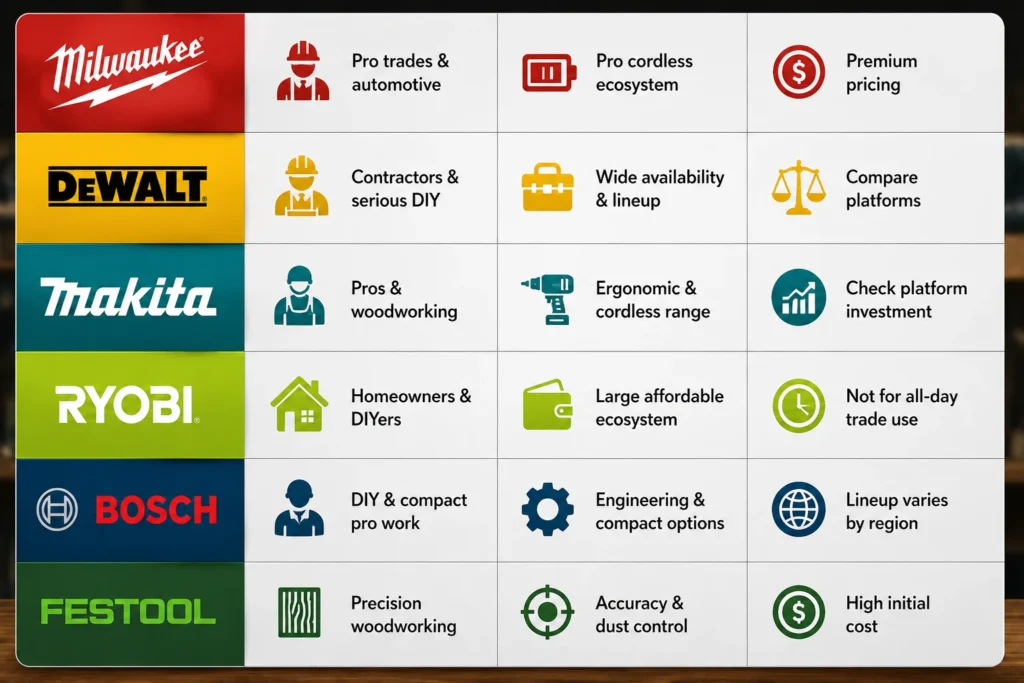
| Brand | Best suited for | Main strength | Watch-outs |
|---|---|---|---|
| Milwaukee | Professional trades and automotive | Broad pro cordless ecosystem | Premium pricing can exceed DIY needs |
| DeWalt | Contractors and serious DIYers | Wide availability and familiar lineup | Platform choices need careful comparison |
| Makita | Pros and woodworking users | Ergonomics and established cordless range | Compare current platform investment first |
| Ryobi | Homeowners and DIYers | Large affordable ecosystem | Not built around all-day trade use |
| Bosch | DIY and compact professional work | Engineering depth and compact options | Lineup breadth varies by region |
| Festool | Precision woodworking | Integrated accuracy and dust control | High initial cost |
A consistent way to compare brands
Brand ranges, pricing, battery compatibility, and warranties change frequently. This guide compares broad platform strengths rather than declaring that one model always beats another. Confirm current specifications, compatibility, and local warranty details on the manufacturer’s site before buying.
- Performance: power under typical loads.
- Durability: suitability for repeated work.
- Ecosystem: tools, batteries, outdoor equipment.
- Ergonomics: weight, balance, trigger control.
- Service: warranty terms and repair access.
- Value: useful capability for the money.
Power tool brands explained by real-world fit
These are use-case recommendations, not an unconditional ranking. A homeowner drilling shelves a few times a year needs a different platform from a contractor depending on cordless tools all day.
1. Milwaukee — strong for professional trades and automotive
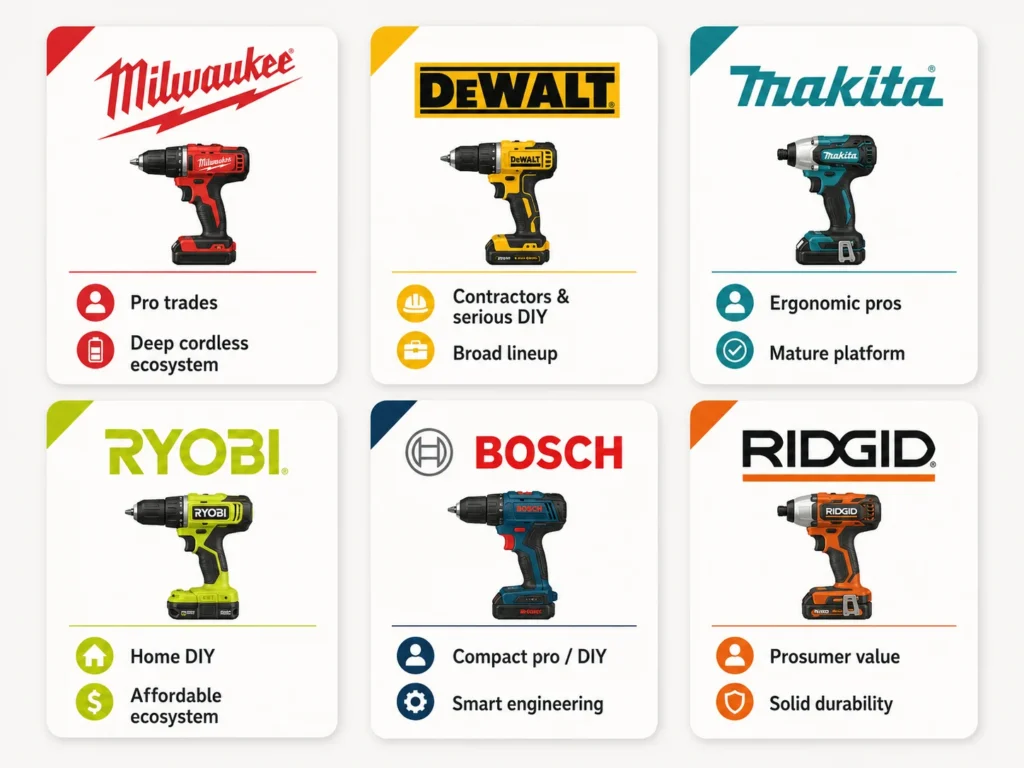
Milwaukee is often a practical choice for trade users who value a deep cordless ecosystem, compact tools, lighting, plumbing-oriented options, and automotive-focused tools. It can be more capability than an occasional DIYer needs, so compare kit and replacement battery costs before committing.
2. DeWalt — broad contractor and serious-DIY appeal
DeWalt combines widespread retailer availability with a broad range of cordless construction and woodworking tools. It is a sensible platform to investigate if you want easy access to bare tools, combo kits, and jobsite accessories. Check which battery family supports the exact tools you plan to add.
3. Makita — established platform with ergonomic appeal
Makita remains a strong consideration for users who care about balance, everyday handling, and a mature cordless lineup. It is particularly familiar in woodworking and professional applications. Evaluate the available batteries and tool families in your region rather than relying on older platform advice.
4. Ryobi — best-value starting point for many homeowners
Ryobi’s appeal is ecosystem breadth at a more accessible entry cost. For a homeowner who needs a drill, driver, saw, inflator, light, and occasional outdoor tool, this can be a smarter spend than buying contractor-grade tools that rarely see hard use. Budget does not mean unsuitable.
5. Bosch — thoughtful engineering and compact options
Bosch is worth comparing for compact cordless tools, drilling systems, and users who value engineering-led features. Its best fit varies by country and product category, so inspect the local lineup and service options instead of assuming the same selection is sold everywhere.
6. Ridgid — value-focused prosumer option
Ridgid is commonly considered by buyers seeking more robust-feeling tools than entry-level DIY platforms without stepping fully into premium trade pricing. Its appeal depends heavily on local retail availability and warranty conditions, which should be verified before purchase.
The best brand changes with the job
Best for homeowners
Ryobi is often the first platform to compare when price, variety, and occasional projects matter most. DeWalt or Bosch may make sense if you expect your DIY workload to grow.
Best for contractors
Milwaukee, DeWalt, and Makita are sensible starting points for daily work because ecosystem depth, runtime options, and replacement availability are often more valuable than the lowest kit price.
Best for automotive DIY
Prioritize compact impact tools, ratchets, inflators, lighting, and battery availability. Milwaukee is commonly compared here, but the best choice is still the platform whose tools fit your jobs and budget.
Best budget ecosystem
Look beyond the starter kit. A budget platform is only good value if its bare tools and replacement batteries remain affordable when your collection grows.
You are usually buying a battery ecosystem, not just a drill
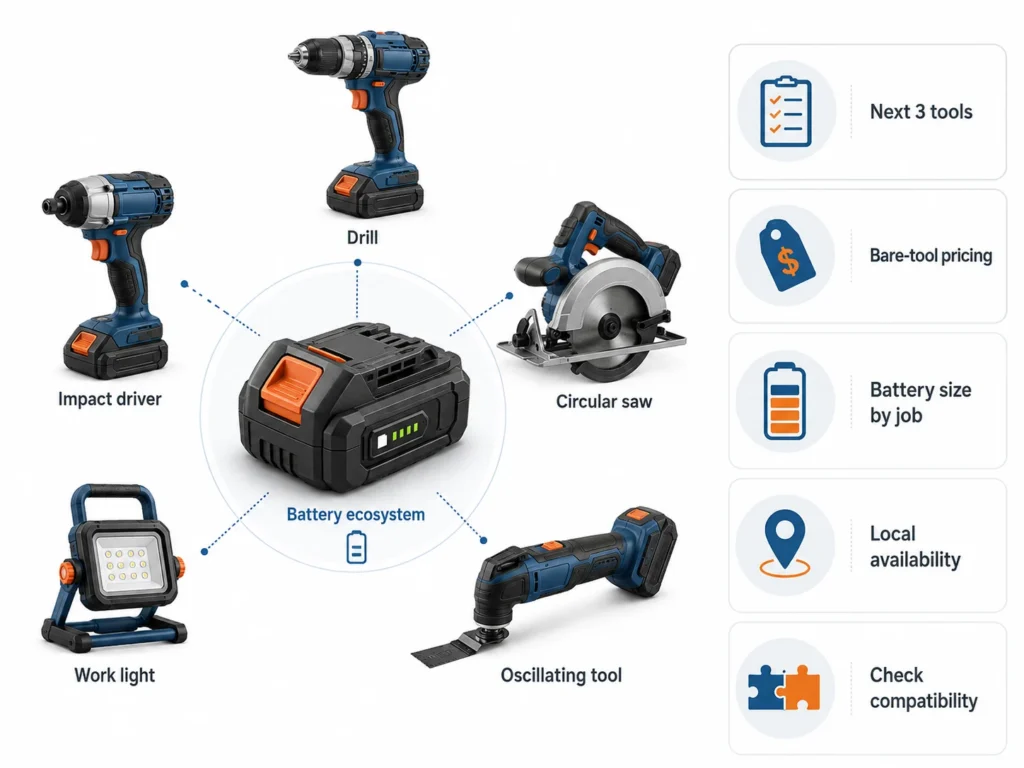
A cordless battery platform becomes more valuable with every compatible bare tool you add. Amp-hours (Ah) describe battery capacity: higher Ah generally provides more stored energy, but it also adds weight and does not guarantee identical runtime across different jobs. Buy batteries around the tools and workload you actually expect.
- Start with your next three tools, not just the drill you need today.
- Check bare-tool pricing before buying a large starter kit.
- Compare battery sizes by job: compact packs reduce weight; larger packs help demanding tools.
- Look at local availability for batteries, warranty support, and replacements.
- Verify compatibility with the exact voltage platform and generation you plan to buy.
Woodworking, precision, and motor choices
Best power tool brand for woodworking
For general carpentry, DeWalt, Makita, Milwaukee, and Bosch each offer useful saws and sanders. For cabinetmaking and precision-oriented work, Festool deserves comparison because its tools, guide systems, and dust-management approach are designed to work together. Decide whether that integrated workflow justifies the higher entry cost.
Brushless vs brushed: the practical version
A brushless motor removes traditional carbon brushes and can improve efficiency, runtime, and long-term durability. It is often worthwhile for a tool you will use heavily. For occasional jobs, a lower-cost brushed tool may still be completely adequate if the platform and tool quality otherwise meet your needs.
How to choose your first power tool platform
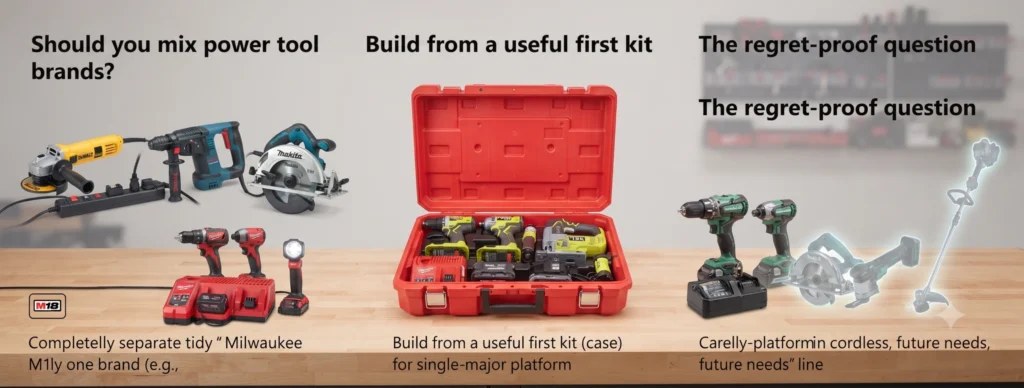
Should you mix power tool brands?
Yes—especially for corded or specialist tools. But keeping your core cordless tools on one platform simplifies charging, battery storage, and future bare-tool purchases. Mix brands deliberately, not by accident.
Build from a useful first kit
For most new owners, a drill/driver, impact driver, two batteries, charger, work light, and the next job-specific tool is a better starting plan than buying a giant kit full of rarely used tools.
The regret-proof question
Ask: “Can this platform support the next three tools I will realistically need?” If the answer is yes, the battery price is reasonable, and service is accessible, you are likely choosing well—even if another brand wins a headline comparison.
Best power tool brand FAQ
Is Milwaukee better than DeWalt?
Neither brand wins every category. Milwaukee is especially compelling for professionals who want a deep ecosystem that includes compact trade and automotive-oriented tools. DeWalt is widely available and strong for contractors and serious DIYers. Compare the exact tools, batteries, promotions, and service support relevant to your work.
Is Ryobi good enough for a homeowner?
For many homeowners, yes. A tool used for shelves, furniture assembly, repairs, occasional cutting, and outdoor chores does not necessarily need contractor-grade pricing. Choose a platform based on expected workload, safety, battery availability, and the additional tools you plan to buy.
What does Ah mean on a power tool battery?
Ah means amp-hours, a rating related to battery capacity. In general, a higher Ah battery stores more energy and may run longer, but actual runtime depends on the tool, material, speed, temperature, and how hard the tool is working. Higher-capacity packs are usually heavier.
Are premium power tools worth the money?
They can be worth it when better runtime, durability, ergonomics, service, or precision saves time repeatedly. For occasional home projects, a value-focused platform may deliver a better return. The useful benchmark is workload—not brand prestige.