
A practical guide to Bosch’s strongest tool categories, its 18V platform, and the trade-offs worth knowing before you buy.
The Bosch power tools company is best known for durable professional cordless tools, class-leading rotary hammers, accurate measuring equipment, and a broad 18V cordless ecosystem.
Bosch is a broad engineering company, but its power-tool reputation is built on practical jobsite equipment rather than one single headline product. For a homeowner, that can mean a compact drill with well-considered controls. For a trade user, it often means dependable drilling, cutting, grinding, or measuring gear backed by a deep accessory and service network.
What is Bosch known for in power tools?
Bosch is particularly established in concrete drilling, woodworking, metalwork, and measuring. Its Professional range is widely recognized by the blue housing used in many markets, while consumer-oriented tools may use green housing. That visual distinction is useful, but always read the actual model specification: availability, naming, and range separation vary by country.
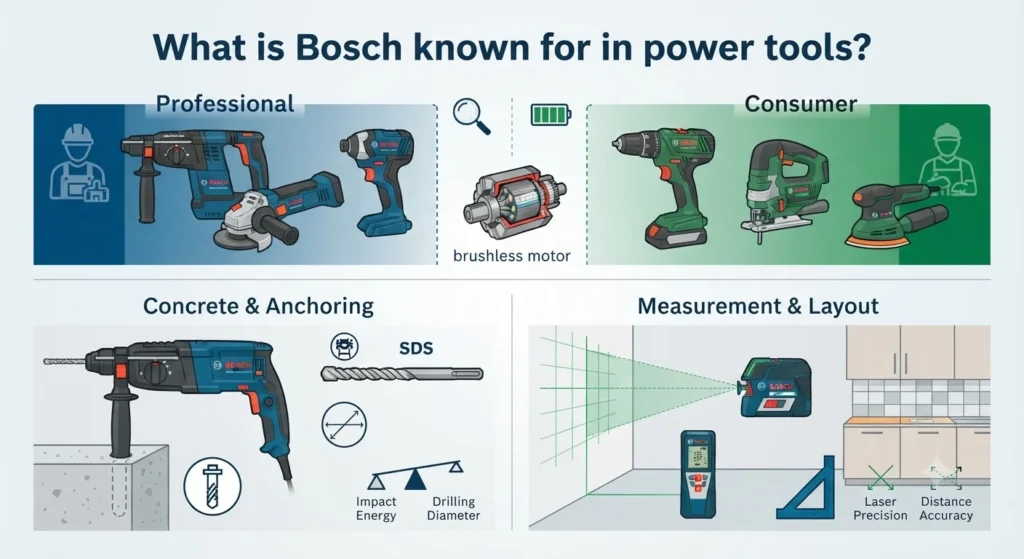
In hands-on use, the useful measures are rarely just voltage or marketing labels. Check torque for fastening, no-load speed for drilling and cutting, impact energy for rotary hammers, disc size for grinders, and the battery capacity included in a kit. Brushless motors can improve efficiency and reduce maintenance, but they do not automatically make every tool the best choice for every occasional job.
Concrete and anchoring work
Bosch rotary hammers are a major reason tradespeople consider the brand. Match the SDS system, impact energy, and drilling diameter to the anchors or holes you actually make.
Measurement and layout
Laser levels, distance measurers, and layout tools are a Bosch strength for cabinetry, installation, tiling, and interior finishing where accuracy prevents rework.
The Bosch categories worth looking at first
These are not universal “best tool” picks. They are the categories where Bosch has a clear, practical reputation and where comparing exact models can pay off.
Drill / driver
Cordless drills and impact drivers
A sensible starting point for DIY and installation work. Compare chuck size, torque settings, tool length, and whether the kit includes batteries that suit your runtime needs.
Woodworking
Circular saws, track saws, and sanders
For sheet goods, framing, and finish work, prioritize cut depth, blade diameter, dust extraction, guide compatibility, and the availability of appropriate blades.
Accuracy
Laser levels and measuring tools
An excellent Bosch category for layout-heavy tasks. Look at line visibility, self-leveling range, stated accuracy, mounting options, and whether outdoor work requires a receiver.
Metalwork
Angle grinders and heavy-duty tools
Bosch grinders are common in fabrication and repair. Select guard, wheel size, grip style, restart protection, and speed-control features according to the material and accessory.
Is the Bosch 18V battery system worth investing in?
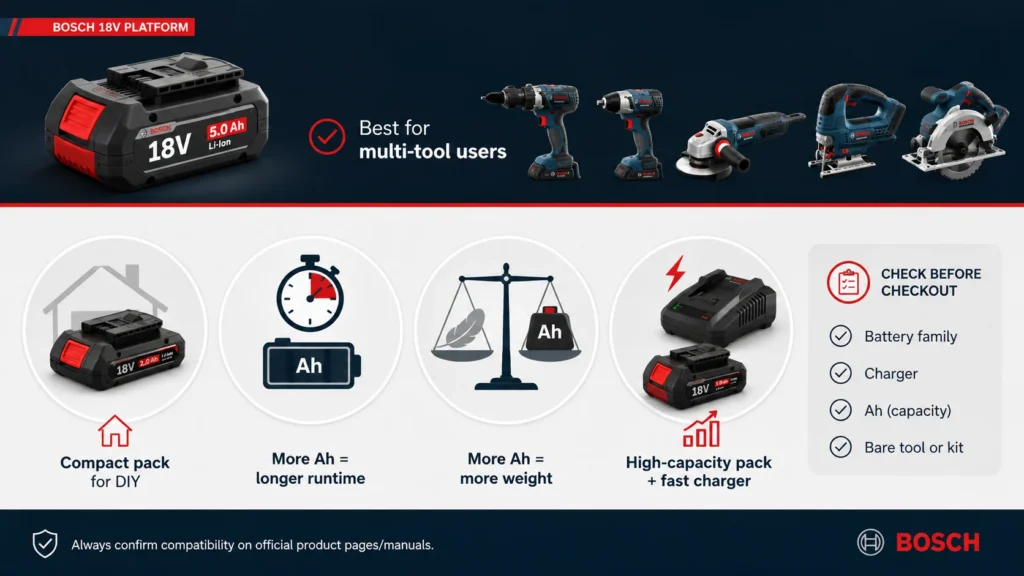
The 18V platform can offer good long-term value when you expect to add several compatible cordless tools. Buying bare tools after your first battery-and-charger kit usually reduces the cost of expanding a setup. Battery amp-hour (Ah) ratings matter: a larger Ah pack generally offers longer runtime, but adds weight and can make overhead work more tiring.
For occasional DIY, a compact battery may be more pleasant than the biggest available pack. For repeated drilling, grinding, or cutting, higher-capacity batteries and fast chargers can be more practical. Check the exact platform and regional documentation before purchase—do not assume every Bosch battery, charger, or product color is cross-compatible.
Compatibility check before checkout
Confirm the battery family, charger type, included battery capacity, and whether a listing is a bare tool. Manufacturer manuals and official product pages are the safest source for compatibility claims.
Bosch versus the alternatives: a practical lens
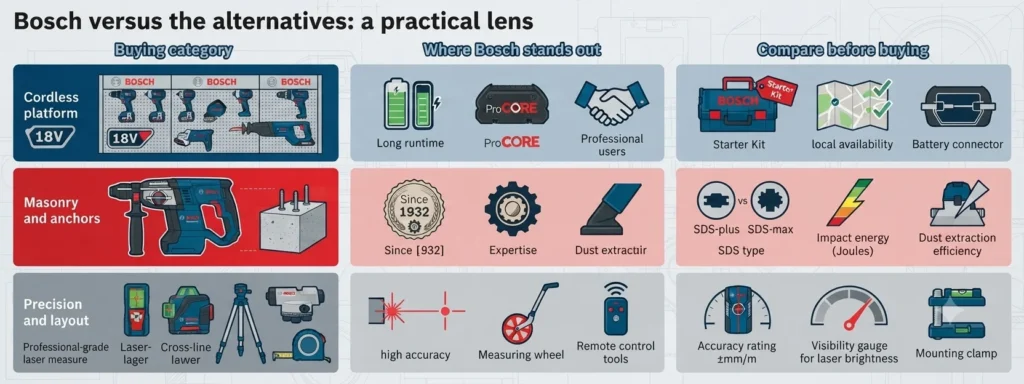
| Buying category | Where Bosch stands out | Often a good fit for | Compare before buying |
|---|---|---|---|
| Cordless platform | Broad 18V range and professional-grade options | Users building a multi-tool setup | Battery family, kit value, local availability |
| Masonry and anchors | Long-standing rotary hammer expertise | Installers and renovation work | SDS type, impact energy, dust control |
| Precision and layout | Strong range of measurement tools | Finish work, cabinetry, interiors | Accuracy rating, visibility, mounting |
The buyer verdict: who should choose Bosch?
Bosch is a credible choice for a DIY buyer who wants to grow into a better tool system and for professionals who value capable cordless tools, rotary hammers, and accurate measurement equipment. It is not automatically the best value in every category. Compare the specific model, local warranty terms, repair access, included batteries, and the price of the tool you need—not just the brand’s overall reputation.
Reasons to consider Bosch
A broad product catalogue, respected professional lines, strong drilling and measuring heritage, and an 18V ecosystem that can make expansion efficient.
Reasons to pause and compare
Model names can be confusing, country ranges differ, and a lower-priced competitor kit may include more battery capacity for a light-duty user.
Four checks before you choose a Bosch tool
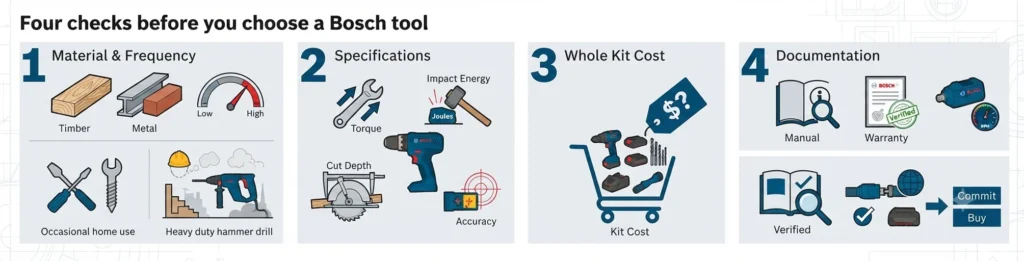
- Define the material and frequency of use: timber, metal, masonry, occasional repairs, or daily trade work.
- Compare the important specification for that tool type—torque, impact energy, cut depth, speed, or stated measurement accuracy.
- Price the whole working kit: tool, battery or cord, charger, blade/bit/disc, and any dust-control accessory.
- Read the manual and warranty terms for your country, then inspect the official compatibility guidance before committing to a platform.
Frequently asked questions
Are Bosch power tools suitable for beginners?
Yes. Bosch consumer-line tools are designed with accessible controls and reasonable price points for DIY. Start with a basic drill-driver kit to build confidence, then expand into specialized tools as your projects grow.
Can I used Bosch batteries interchangably across all models?
Not always. Bosch batteries vary by voltage (12V, 18V, 36V), connector type, and regional variants. Check the official compatibility chart for your exact models before assuming a battery will fit a new tool.
Is it worth buying Bosch if I only use tools occasionnally?
For occasional use, consider kit value and total cost—battery, charger, and tool. A lower-priced competitor kit may suit light work better. Bosch excels when you plan to add multiple tools over time.
How long do Bosch power tools batteries last?
Lithium-ion batteries typically retain 70–80% of capacity after 2–3 years of regular use. Runtime depends on amp-hour rating, tool load, and usage patterns. Refer to the manual for specific expectations for your model.