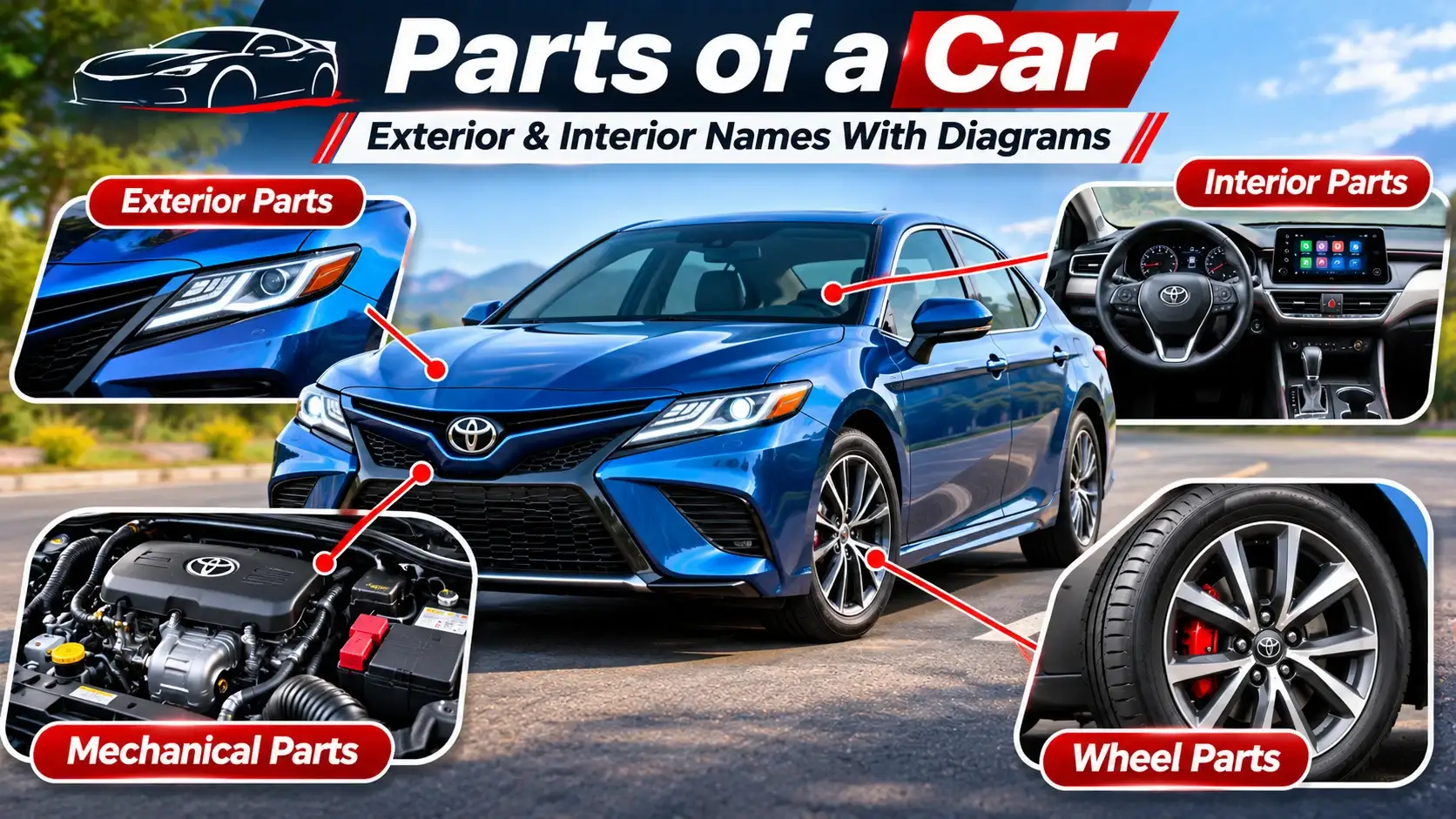
Every car has hundreds of visible components, but knowing the parts of a car can feel confusing when you are just starting to learn about vehicles. What is the difference between a bumper and a fender? What are the controls inside a car called? And which parts actually make up a wheel?
Whether you are a new driver, a car owner preparing for maintenance, or a student learning automotive basics, recognizing the correct car part names makes it easier to understand your vehicle and communicate with mechanics.
This illustrated guide explains the main exterior parts, car body parts, interior components, wheel parts, and basic mechanical systems. Each section includes clear names, locations, functions, and a corresponding diagram reference.
What Are the Main Parts of a Car?
The major parts of a car can be divided into five groups: exterior body parts, interior components, wheels and tires, mechanical systems, and safety equipment.
Common examples include the hood, bumper, fenders, doors, windshield, dashboard, steering wheel, seats, tires, engine, transmission, and brakes. Their exact designs and locations vary depending on the vehicle.
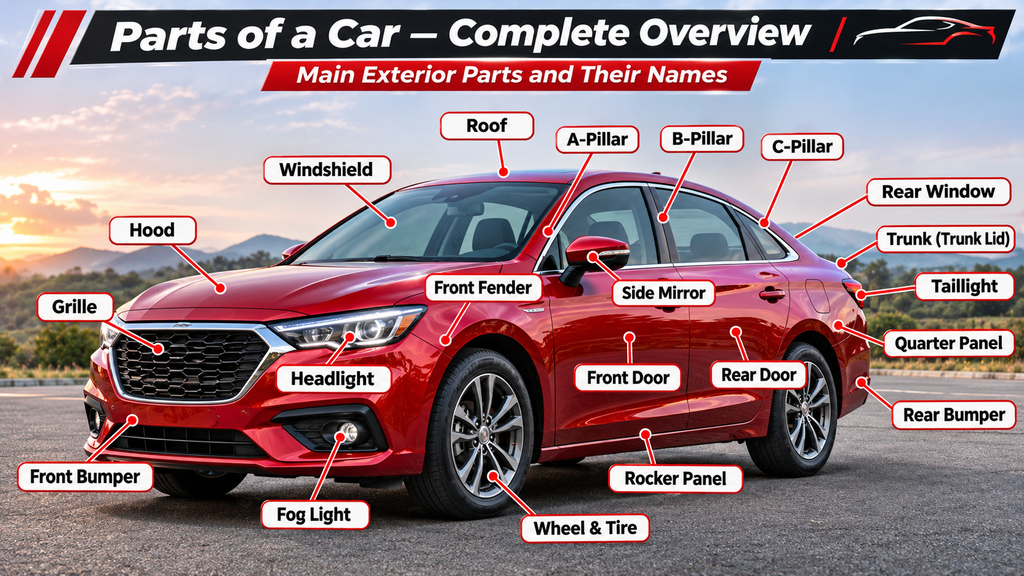
Labeled Diagram of a Car: Complete Overview
A labeled car diagram is one of the easiest ways to understand vehicle anatomy. Instead of memorizing unfamiliar words, you can connect each name to a visible component.
Most passenger cars share the same basic categories, although the appearance of individual parts changes between sedans, SUVs, pickup trucks, hatchbacks, and electric vehicles.
Five Main Groups of Car Parts
01 · Exterior
Hood, bumpers, body panels, doors, mirrors, windows, and lights.
02 · Interior
Dashboard, steering wheel, seats, pedals, console, and cabin controls.
03 · Wheels and Tires
Tire, wheel, rim, valve stem, lug nuts, hub, and wheel hardware.
04 · Mechanical Systems
Engine or motor, transmission, suspension, steering, and brakes.
05 · Safety Systems
Seat belts, airbags, head restraints, lights, and electronic safety control
Some components fit into more than one group. For example, headlights are exterior parts but also important safety equipment.
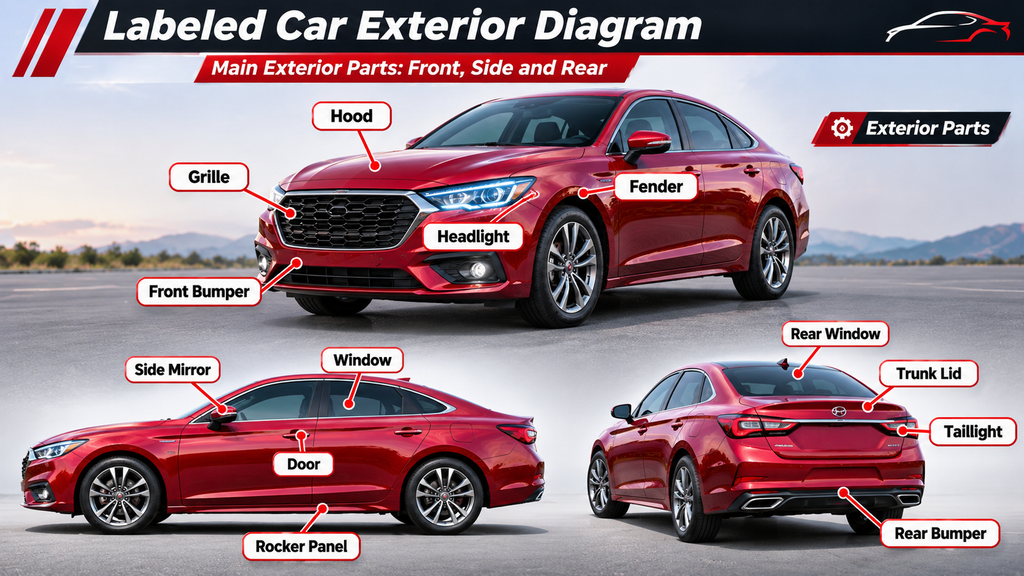
Exterior Parts of a Car and Their Names
The exterior includes the visible components on the outside of the vehicle. These car body parts create the vehicle’s shape, help protect occupants and internal components, and support important features such as lighting and visibility.
The main exterior areas are the front, sides, roof, and rear of the car.
Front Parts of a Car
The front of a car contains body panels, lights, air openings, and structures that help protect internal components.
| Part Name | Location | Main Function |
|---|---|---|
| Hood | Top front body panel | Covers the engine compartment or front storage area. |
| Front Bumper Cover | Lower front exterior | Provides the visible bumper surface and covers underlying structures. |
| Grille | Front center opening | Allows airflow where required and contributes to the front appearance. |
| Headlights | Front lighting assemblies | Illuminate the road and improve vehicle visibility. |
| Front Fender | Around each front wheel opening | Forms the exterior panel around the wheel area. |
| Windshield | Front cabin glass | Provides forward visibility and helps protect the cabin. |
| Windshield Wipers | Base of the windshield | Clear rain and debris from the glass. |
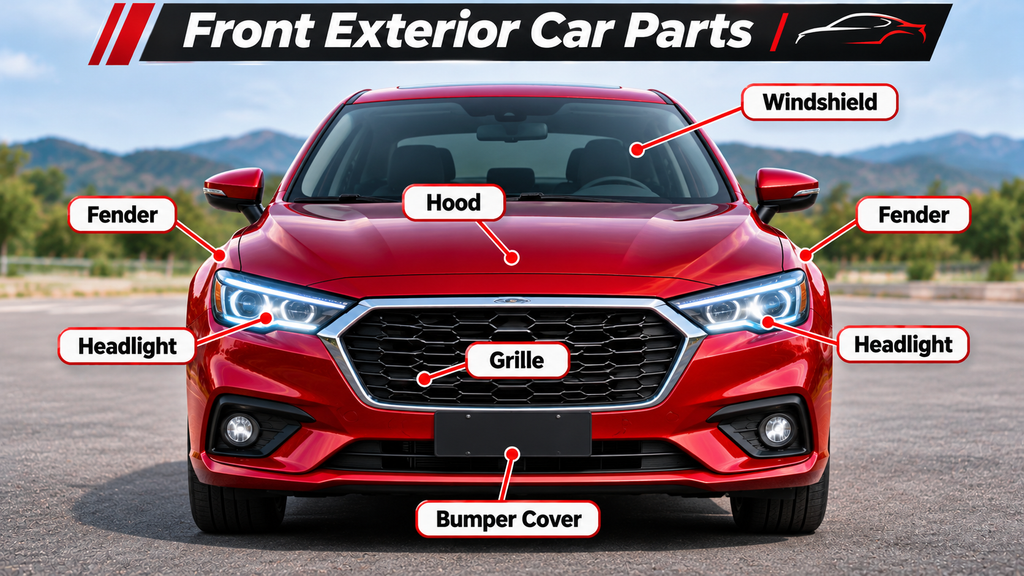
Beginner tip: People often refer to the entire front bumper assembly simply as the “bumper.” The painted or textured exterior component is typically the bumper cover; behind it are separate structural and energy-management components.
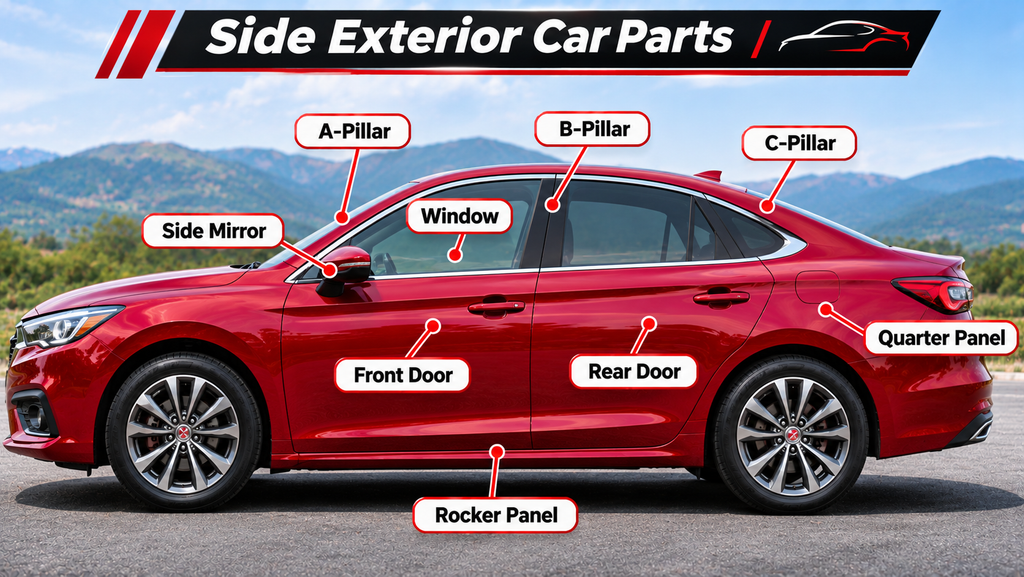
Side Parts of a Car
The side of a vehicle includes the doors, windows, side mirrors, and structural body pillars. These components contribute to access, visibility, weather protection, and occupant protection.
| Part | What It Is |
|---|---|
| Front Door | Provides access to the driver’s or front passenger’s seat. |
| Rear Door | Provides access to rear seating on four-door vehicles. |
| Side Mirror | Helps the driver monitor areas beside and behind the vehicle. |
| Side Window | Provides outward visibility and may open for ventilation. |
| Door Handle | Allows occupants to open the door. |
| Rocker Panel | Lower body area beneath the side doors. |
| A-Pillar | Front roof support beside the windshield. |
| B-Pillar | Middle roof support, typically between the front and rear side door openings. |
| C-Pillar | Rearward roof support; its exact location depends on body style. |
| Quarter Panel | Rear side body panel, usually surrounding the rear wheel opening. |
| Fuel Filler Door | Exterior access cover for the fuel filler on gasoline or diesel vehicles. |
The A-, B-, and C-pillars are particularly important to understand because they help describe the cabin structure. Some longer vehicles also have a D-pillar near the rear of the roof.
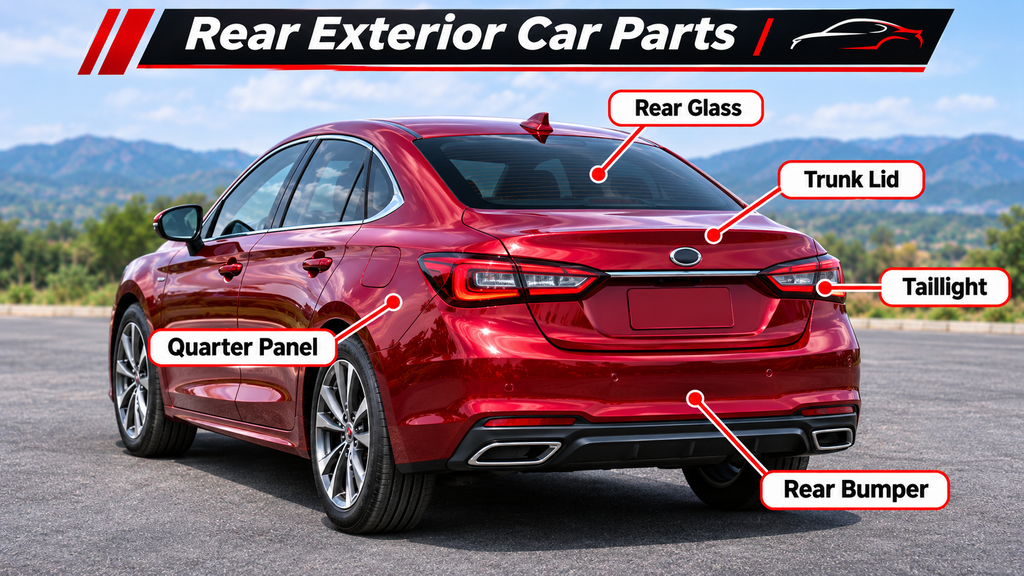
Rear Parts of a Car
The rear section contains the cargo-area opening, rear lighting, bumper components, and surrounding body panels.
| Part | Function |
|---|---|
| Trunk Lid | Opens the separate cargo compartment on many sedans. |
| Liftgate or Hatch | Opens the rear cargo area on many SUVs and hatchbacks. |
| Taillights | Provide rear lighting and visibility; assemblies may contain multiple functions. |
| Brake Lights | Indicate when the driver applies the brakes. |
| Rear Bumper Cover | Exterior covering for the rear bumper assembly. |
| Rear Window | Provides visibility behind the passenger compartment. |
| License Plate Area | Mounting position for the rear license plate. |
Not every car has a traditional trunk. A hatchback or SUV typically uses a liftgate, while a pickup truck has a cargo bed and tailgate.
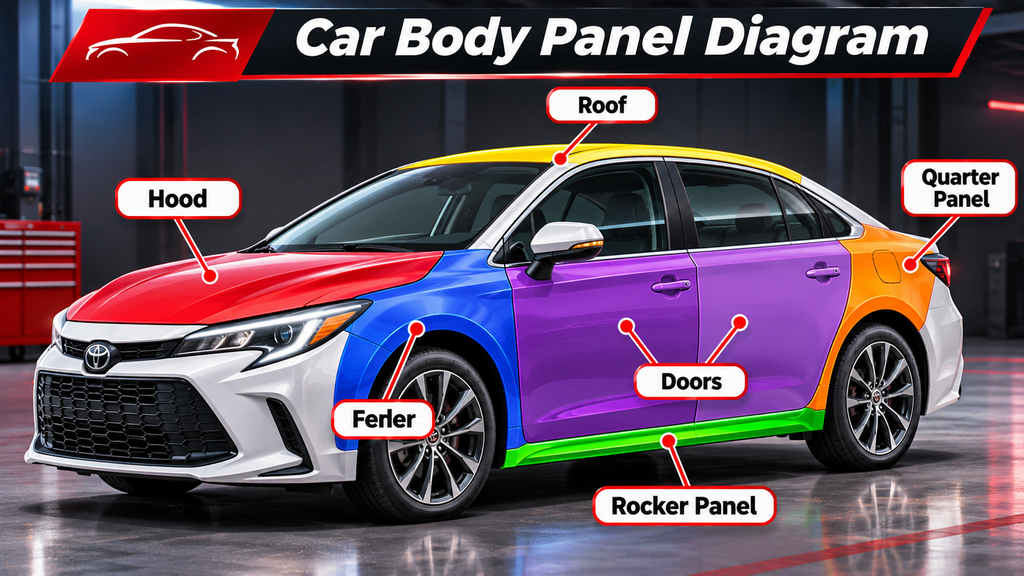
Car Body Panels and Structural Parts
The car body includes the exterior panels and underlying structural elements that form the vehicle’s main shape and passenger compartment.
Modern passenger vehicles commonly use unibody construction, where the body structure and major load-bearing elements form an integrated assembly. Some trucks and SUVs use separate body-on-frame construction.
Exterior Panels vs. Structural Components
Exterior Body Panels
Examples include the hood, removable front fenders on many vehicles, door skins, and trunk lid. These parts contribute to appearance, weather protection, and exterior coverage.
Structural Body Parts
Examples include certain pillars, rocker structures, floor structures, and reinforced sections. They contribute to vehicle strength and occupant protection.
Some body panels also contribute to structural performance, so the distinction is not always simply cosmetic versus structural. Repair methods must follow the vehicle manufacturer’s procedures.
Interior Parts of a Car and Their Names
The inside of a car contains the controls, displays, seating, safety equipment, storage areas, and comfort features used by the driver and passengers.
Learning the names of the interior parts of a car is especially helpful for new drivers. It makes owner’s manuals easier to understand and helps you describe controls or problems accurately.
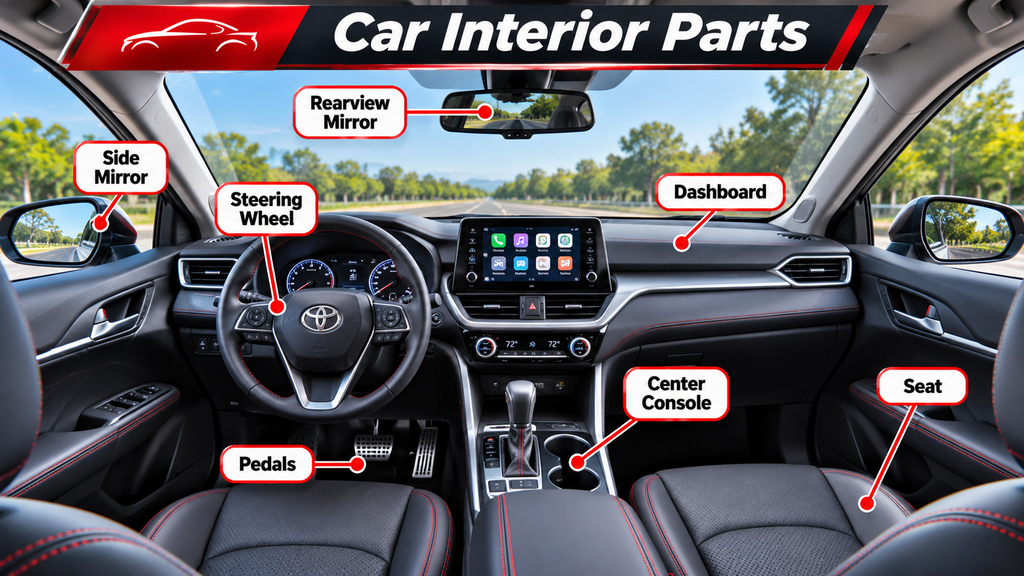
Car Interior Parts Names and Functions
| Interior Part | Main Purpose |
|---|---|
| Dashboard | Front interior panel containing or surrounding controls and displays. |
| Steering Wheel | Allows the driver to control vehicle direction. |
| Instrument Cluster | Displays speed, warning lights, and vehicle information. |
| Infotainment Screen | Provides access to media, navigation, and other vehicle features. |
| Center Console | Area between the front seats, often containing storage and controls. |
| Gear Selector | Selects transmission positions or gears, depending on the vehicle. |
| Accelerator Pedal | Controls the driver’s request for propulsion. |
| Brake Pedal | Commands the braking system to slow or stop the vehicle. |
| Clutch Pedal | Used in many manual-transmission vehicles to disengage the clutch. |
| Air Vents | Direct airflow into the cabin. |
| Climate Controls | Control cabin heating, cooling, fan speed, and airflow. |
| Rearview Mirror | Helps the driver see behind the vehicle. |
| Glove Compartment | Storage compartment usually located in the passenger-side dashboard. |
| Sun Visor | Helps shield occupants’ eyes from sunlight. |
| Door Panel | Interior trim covering the inside of a door. |
The exact layout differs by model. For example, some modern electric vehicles use large central displays and fewer physical buttons, while manual-transmission cars include a clutch pedal.
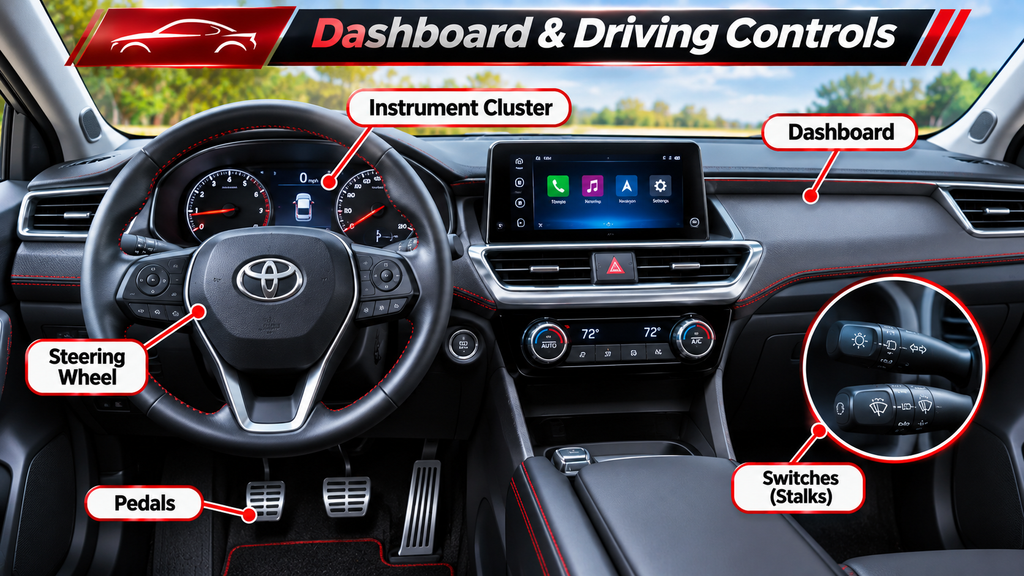
Dashboard and Driving Controls
The dashboard is the large panel across the front of the cabin. It can contain the instrument cluster, infotainment system, air vents, and controls for various vehicle functions.
The instrument cluster is the display area that shows important driving information. It may include a speedometer, fuel or battery level, warning indicators, and an engine-speed gauge on many combustion-engine vehicles.
Drivers also use stalks, buttons, or touch controls for turn signals, windshield wipers, lighting, and other functions.
Center Console and Comfort Features
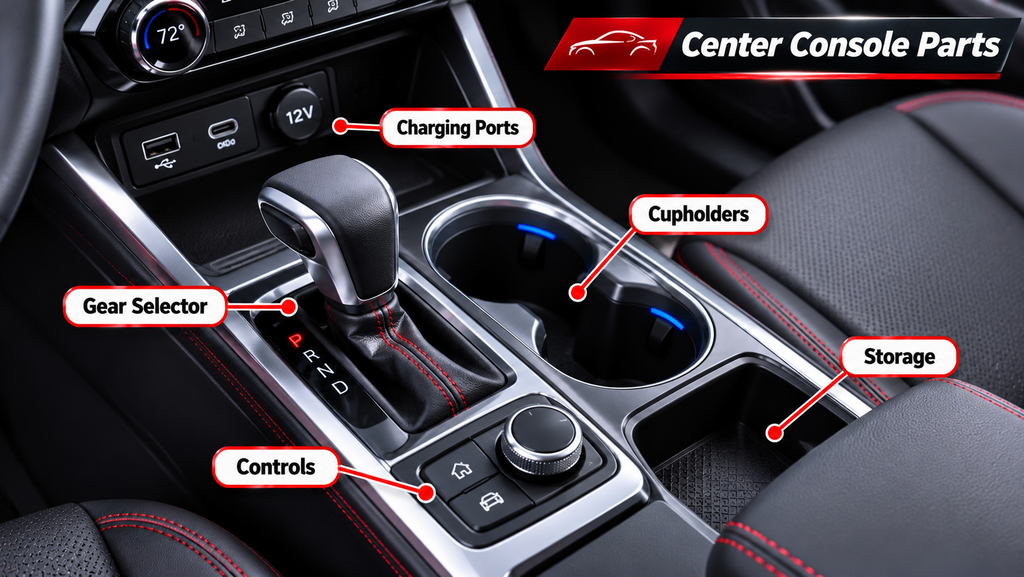
The center console is generally located between the front seats. Depending on the car, it may contain the gear selector, cupholders, parking brake control, storage compartments, and charging connections.
The center dashboard area may contain climate controls, media controls, a touchscreen, and hazard warning light switches.
These features help drivers and passengers interact with the vehicle, but not every model arranges them in the same location.
Seats and Interior Safety Parts
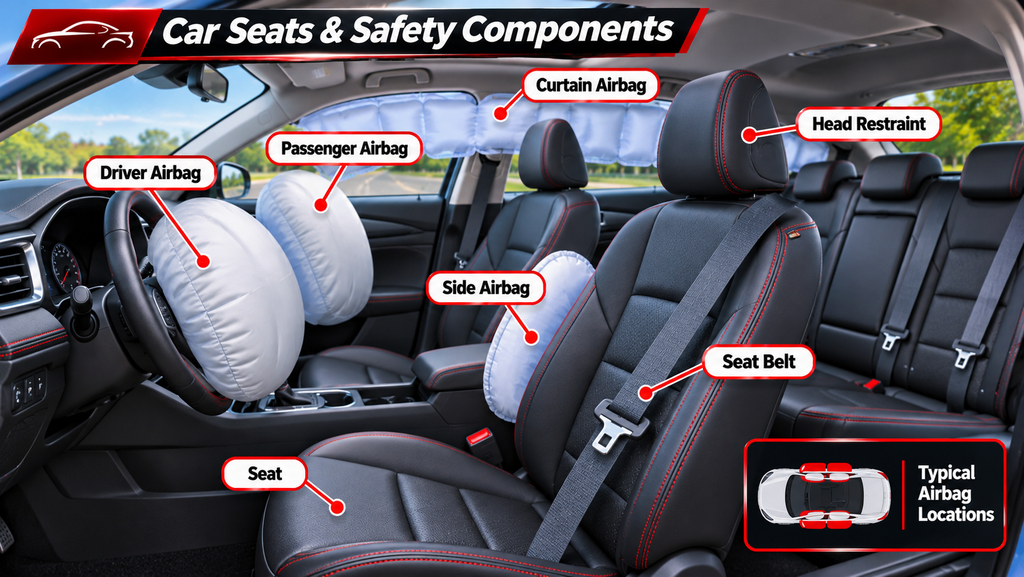
Some of the most important interior car parts are designed to help protect occupants during normal driving and collisions.
- Seats: Support occupants in the correct seating position.
- Seat Belts: Restrain occupants during sudden stops and collisions.
- Head Restraints: Help reduce certain neck injuries in a collision when positioned correctly.
- Airbags: Supplemental restraint devices that deploy under specified crash conditions.
- Child Safety Anchors: Allow compatible child restraints to be installed according to manufacturer instructions.
- Interior Grab Handles: Provide handholds for occupants in appropriate situations.
Airbags are concealed in locations such as the steering wheel, dashboard, seats, or roof-side structures, depending on the vehicle. Their locations should never be guessed when performing repairs or installing accessories.
Parts of a Car Wheel: Names and Functions
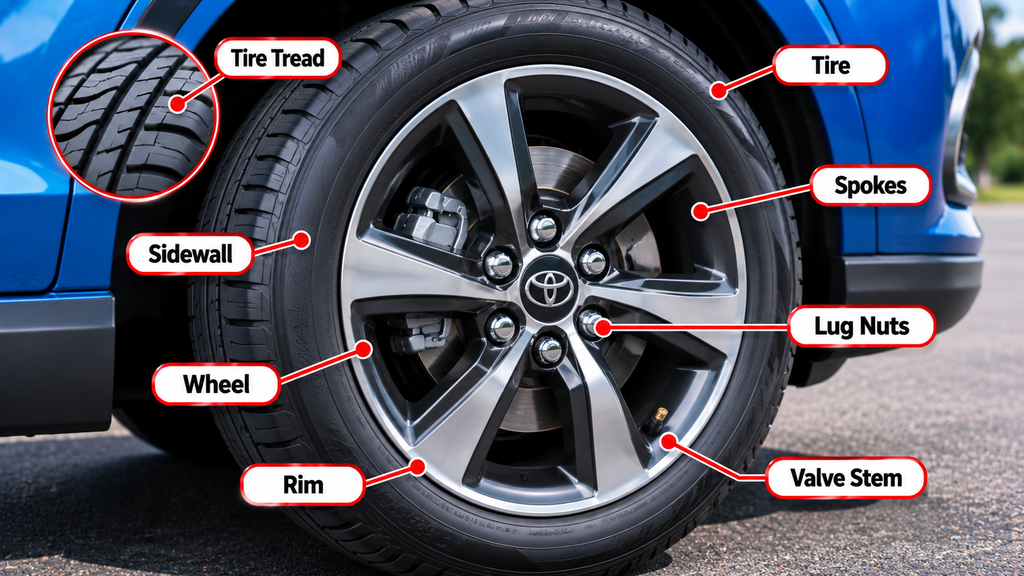
The parts of a car wheel are often confused because people commonly use the words wheel, rim, and tire as though they mean the same thing.
They are related but different components. The tire is the rubber assembly that contacts the road, while the wheel is the metal structure to which the tire mounts. The rim is the outer wheel section where the tire beads seat.
| Part | Function |
|---|---|
| Tire | Provides the road-contacting surface and contributes to grip and ride comfort. |
| Tread | Outer tire surface designed to contact the road. |
| Sidewall | Side section of the tire containing markings and structural materials. |
| Wheel | Metal component supporting the tire and attaching to the vehicle hub. |
| Rim | Outer wheel section that supports the tire beads. |
| Spokes | Structural sections connecting the wheel center to its outer portion on many wheels. |
| Lug Nuts or Bolts | Secure the wheel to the vehicle hub. |
| Valve Stem | Provides a connection for tire inflation and pressure checking. |
| Wheel Hub | Vehicle component that supports the wheel mounting connection and rotation. |
| Center Cap | Covers the center area of many wheel designs. |
Wheel vs. Tire: When replacing worn rubber, you normally replace the tire, not necessarily the wheel. If the metal wheel is bent or cracked, the wheel itself may need repair or replacement following manufacturer guidance.
Many modern vehicles also contain tire-pressure monitoring sensors. These sensors may be attached to the valve stem or mounted elsewhere inside the wheel assembly, depending on the system.
Basic Mechanical Parts of a Car
While the exterior and interior are the most visible parts of the vehicle, several mechanical systems work underneath the hood and body.
These systems provide propulsion, control movement, support the vehicle, and help it slow down safely.
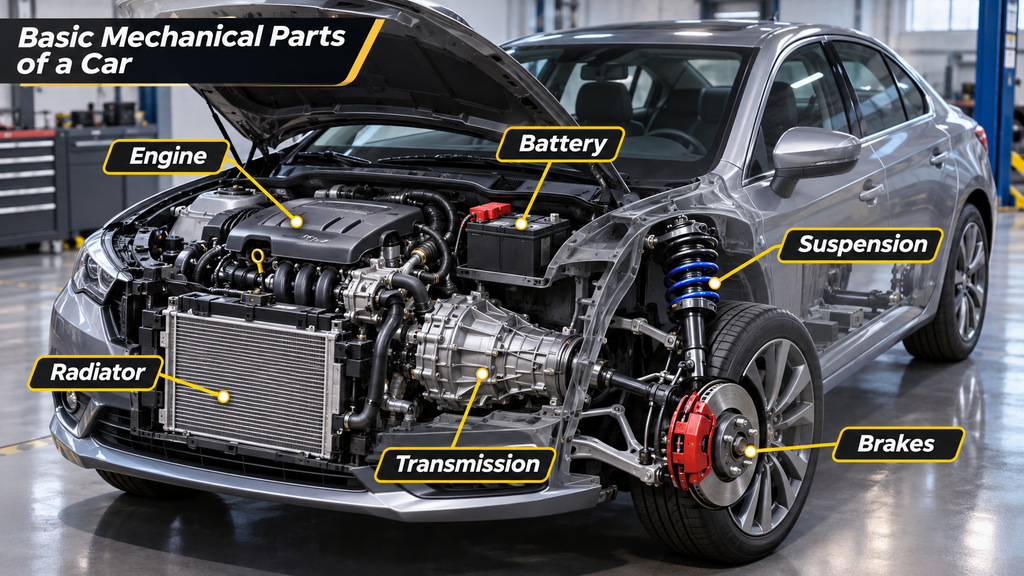
| Component | Purpose |
|---|---|
| Engine or Drive Motor | Provides power for vehicle propulsion. |
| Transmission | Transmits power through suitable gearing or drive arrangements. |
| 12-Volt Battery | Supplies low-voltage electrical power and supports vehicle systems. |
| Radiator | Releases heat from a liquid cooling system when fitted. |
| Alternator | Generates electricity in many combustion-engine vehicles. |
| Suspension | Supports vehicle weight and controls wheel movement over the road. |
| Brakes | Slow or stop vehicle motion. |
| Steering System | Turns the road wheels or otherwise controls vehicle direction, depending on design. |
Electric vehicles have different propulsion components from gasoline-powered cars. For example, an EV typically uses an electric drive motor and high-voltage battery pack rather than a conventional gasoline engine and fuel system.
Car Body Parts vs. Mechanical Parts
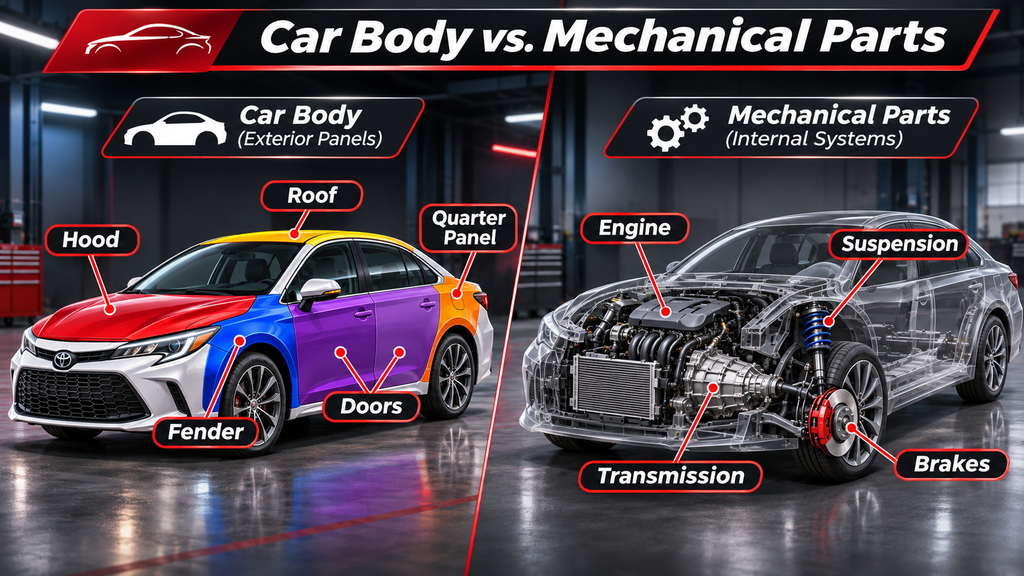
Car body components and mechanical components serve different roles, although both are essential to the complete vehicle.
Car Body Parts
Form the vehicle’s exterior and structure. Examples include doors, hood, roof, fenders, quarter panels, and structural pillars.
Mechanical Parts
Operate the vehicle’s moving and supporting systems. Examples include the engine or motor, transmission, suspension, steering, and brakes.
Commonly Confused Car Part Names
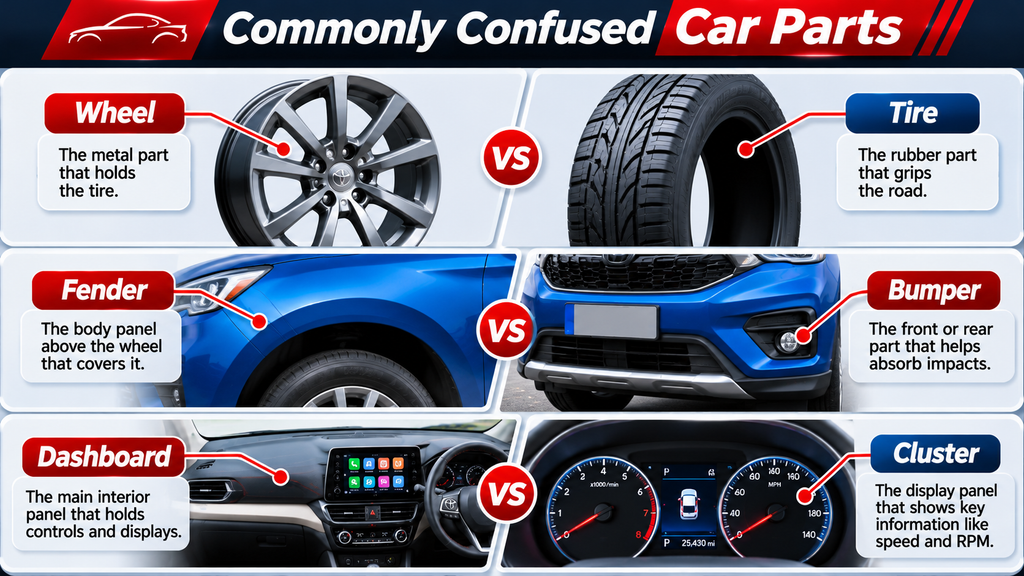
Some automotive terms sound similar but refer to different components. Understanding these distinctions helps prevent mistakes when buying replacement parts or describing vehicle damage.
| Common Confusion | Correct Difference |
|---|---|
| Wheel vs. Tire | The wheel is the metal structure; the tire is mounted around it. |
| Fender vs. Bumper | A front fender surrounds the front wheel opening; the bumper assembly spans the front or rear end. |
| Fender vs. Quarter Panel | A front fender is near the front wheel; a quarter panel is near the rear wheel area. |
| Dashboard vs. Instrument Cluster | The dashboard is the larger front interior panel; the cluster displays driving information. |
| Trunk Lid vs. Liftgate | A trunk lid opens a separate cargo compartment; a liftgate opens a larger rear body opening. |
| Bumper Cover vs. Reinforcement | The cover is the exterior surface; the reinforcement is a separate underlying component. |
How to Identify Car Parts Correctly
If you are unsure what a component is called, a simple identification process can prevent confusion
- Identify the location. Determine whether the part is on the front, side, rear, inside the cabin, or underneath the vehicle.
- Use the relevant diagram. Compare the component’s shape and position with the labeled illustration.
- Check the vehicle’s owner’s manual. Manufacturer diagrams can clarify names and locations.
- Confirm the make, model, and year. Similar-looking components may differ between vehicles.
- Verify the exact replacement part. Use the correct vehicle specifications and part-number information before purchasing.
When ordering a replacement component, it may also be necessary to identify the trim level, body style, engine type, and production variation. The vehicle identification number (VIN) can help a qualified parts supplier verify compatibility.
Safety Note: Identifying a part is not the same as diagnosing or repairing it. Airbags, high-voltage electrical systems, structural body parts, and brake components may require specialized tools, training, and manufacturer procedures.
Frequently Asked Questions About Parts of a Car
1. What are the main parts of a car?
The main parts of a car include the body, engine or electric motor, transmission, wheels, tires, brakes, suspension, steering system, dashboard, seats, and safety equipment. These components work together to provide transportation, control, comfort, and protection.
2. What are the exterior parts of a car called?
Common exterior car parts include the hood, grille, headlights, front bumper, fenders, doors, side mirrors, windshield, roof, rear quarter panels, trunk lid, taillights, and rear bumper.
3. What are the interior parts of a car?
The main interior parts of a car include the dashboard, steering wheel, instrument cluster, center console, gear selector, accelerator pedal, brake pedal, seats, seat belts, rearview mirror, air vents, and glove compartment.
4. What are the basic car body parts?
Basic car body parts include the hood, roof, doors, fenders, quarter panels, rocker panels, trunk lid, bumpers, and structural pillars. These parts form the vehicle’s exterior shape and contribute to protection and structural support.
5. What are the parts of a car wheel called?
The main wheel and tire components include the tire, tread, sidewall, wheel, rim, spokes, valve stem, lug nuts or bolts, and wheel center. The wheel attaches to the vehicle’s hub.
6. What is the difference between a wheel and a tire?
A wheel is the metal component attached to the vehicle’s hub, while a tire is the rubber assembly mounted around the wheel. The tire provides traction and helps absorb road irregularities.
7. What are the three pedals inside a car?
A typical manual-transmission car has three pedals: the clutch pedal on the left, brake pedal in the middle, and accelerator pedal on the right. Most automatic-transmission cars have only brake and accelerator pedals.
8. What is the difference between a bumper and a fender?
A bumper assembly is located at the front or rear of a vehicle and helps manage certain collision impacts. A front fender is a body panel surrounding the front wheel opening. These parts have different locations and functions.
9. What are the parts of a car dashboard?
Common dashboard components include the instrument cluster, speedometer display, warning lights, air vents, infotainment screen, climate controls, and various switches. Their positions vary by vehicle model.
10. What is the instrument cluster in a car?
The instrument cluster is the display area that provides important driving information, including vehicle speed, warning indicators, fuel or battery level, and other operating information. It may use analog gauges, digital displays, or both.
11. What are the A-pillar, B-pillar, and C-pillar of a car?
The A-pillar supports the roof beside the windshield, the B-pillar is generally between the front and rear side door openings, and the C-pillar is located toward the rear of the passenger compartment. Their arrangement varies by body style.
12. What are the main mechanical parts of a car?
Major mechanical components include the engine or drive motor, transmission, cooling system, suspension, steering system, brakes, and drivetrain. Their designs differ between gasoline, hybrid, and electric vehicles.
13. What is the difference between a car body and a chassis?
The car body includes exterior panels and passenger-compartment structures. The chassis refers to the vehicle’s supporting framework and associated running systems, although the exact distinction depends on vehicle construction. Many modern passenger cars use integrated unibody construction.
14. What safety components are inside a car?
Important interior safety components include seat belts, airbags, head restraints, and child-restraint anchorage systems. These features help protect occupants during certain collisions when used correctly.
15. How can I identify car parts using a labeled diagram?
Start by determining whether the part is on the front, side, rear, inside, or underneath the car. Compare its position and shape with a reliable labeled car diagram, then check your vehicle’s owner’s manual to confirm its exact name and location.