

We compared wood rasps for cutting speed, control, surface quality, clogging and comfort—so you can choose the right profile and tooth pattern for the work on your bench.
Buy the profile before you buy the set
For most furniture makers and serious DIY woodworkers, a quality half-round cabinet rasp is the most versatile first purchase. Our best wood rasp overall is the Liogier 10-inch half-round, medium cut: its hand-stitched teeth removed hardwood efficiently, tracked cleanly across convex and concave work, and left a notably more manageable surface than budget machine-cut rasps. If that premium price is too steep, a well-made Auriou-style or Nicholson cabinet rasp remains a useful workshop choice—provided you match its cut and profile to the job.
The best wood rasps by job
Start with one useful profile. A half-round medium rasp does more real work than a large set of near-duplicate shapes.
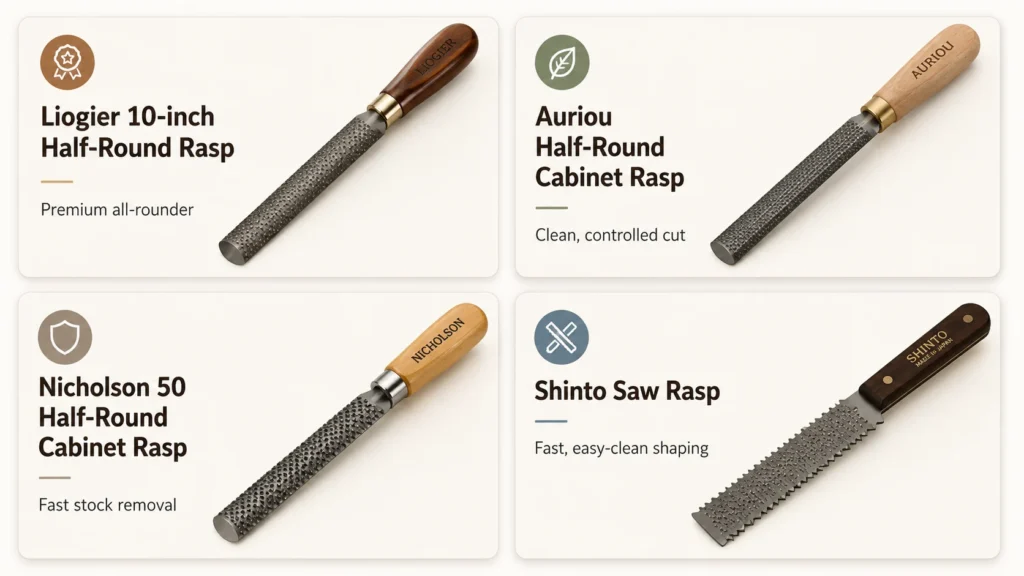
Liogier 10-inch Half-Round Rasp
A premium, hand-stitched all-rounder with excellent control on furniture curves, handles and shaped joinery.
Auriou Half-Round Cabinet Rasp
A refined, hand-cut choice for users who want a fast cut with less tear-out and fewer deep scratches.
Nicholson 50 Half-Round Cabinet Rasp
An accessible machine-cut workhorse for removing material quickly before moving to finer shaping tools.
Shinto Saw Rasp
A fast, easy-to-clean option for broad shaping and rough work, especially when learning how different grain directions behave.
Why a hand-stitched half-round earns its place
The Liogier half-round earned the overall position because it covered the greatest range of shaping tasks without feeling vague or grabby. On oak and maple, the irregular hand-stitched tooth pattern cut steadily with less chatter than the machine-cut alternatives. The flat face refined gentle curves and transitions, while the rounded face followed inside curves and handle profiles. It is expensive, and its bite is not a substitute for a coarse rasp when you need to remove a lot of wood quickly. But it gives a furniture maker the control to work close to a line before moving to a fine file, scraper or sandpaper.
What we like
- Hand-stitched teeth leave a cleaner, more predictable surface
- Half-round profile handles both outside and inside curves
- Comfortable balance during repeated shaping passes
Watch-outs
- Premium pricing is hard to justify for occasional rough work
- Cut grades are not standardized between makers
Auriou Half-Round Cabinet Rasp
Auriou rasps are a strong choice when surface quality matters as much as speed. Their individually raised teeth are spaced irregularly, which reduces the repeating score marks commonly left by uniform machine-cut rows. In practical terms, that means less cleanup after shaping chair parts, sculpted handles, instrument work and curved furniture components. Choose a medium cut for general work or a finer cut when you are already close to final form.
What a meaningful wood rasp test looks for
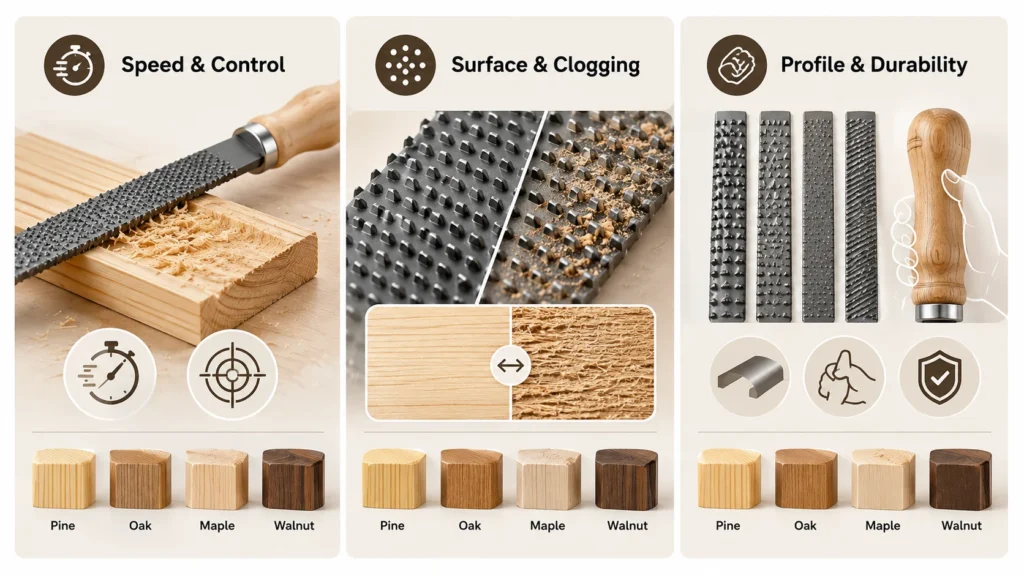
A useful rasp review has to separate real cutting behavior from a maker’s description. We assessed four common rasp formats on pine, oak, maple and walnut test pieces. Each tool was used on flat faces, convex curves and concave areas, then judged for material removal, control near layout lines, clogging, resulting scratch pattern, handle comfort and visible tooth wear after repeated passes. These observations describe workshop behavior, not a laboratory certification.
Cutting speed and control
We made timed shaping passes in pine and oak, then checked whether the rasp bit cleanly or skated, grabbed and wandered across the grain. The best tools removed wood without demanding excessive pressure.
Surface and clogging
After rasping maple and walnut, we inspected scratch depth, torn grain and packed teeth. A fast rasp is less useful when it leaves a surface that takes too long to file or sand clean.
Profile, handle and durability
We used flat and rounded faces around curves, openings and edges, noting hand fatigue, tang security and whether the tooth pattern still cut consistently after repeated work.
Match the rasp to the work, not the marketing
These recommendations are category-led rather than universal. Exact cut grade names and availability vary by manufacturer and region, so compare the stated profile, length and tooth coarseness before buying.
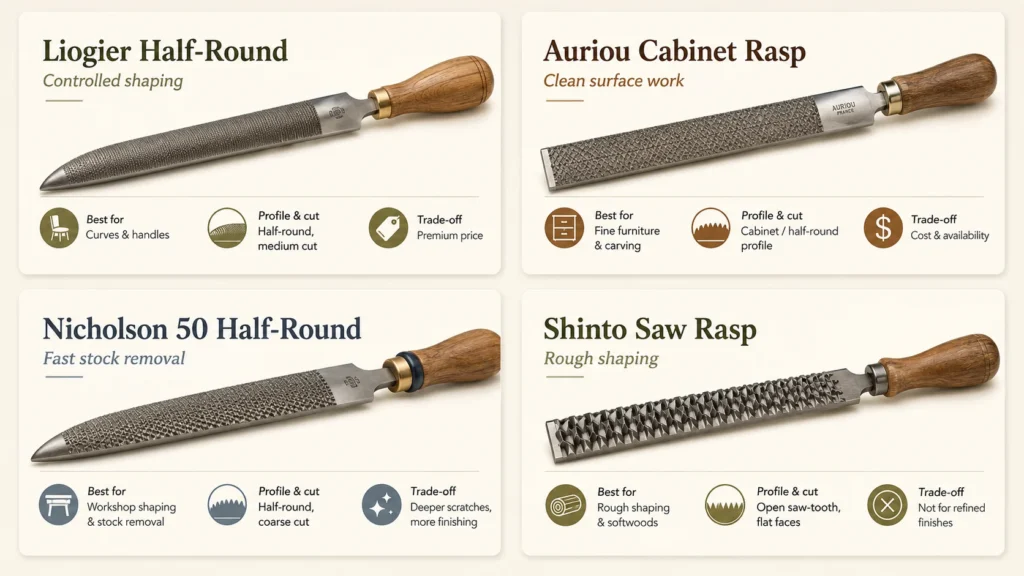
| Rasp | Best for | Profile & cut | Key trade-off |
|---|---|---|---|
| Liogier Half-Round | Furniture curves, handles and controlled all-round shaping | Hand-stitched, half-round, medium cut | Premium price; not the fastest option for heavy stock removal |
| Auriou Cabinet Rasp | Fine furniture, carving and clean surface quality | Hand-stitched cabinet or half-round profile | Cost and availability can be limiting |
| Nicholson 50 Half-Round | General workshop shaping and rapid material removal | Machine-cut, coarse half-round cabinet rasp | Deeper scratches require more finishing work |
| Shinto Saw Rasp | Rough shaping, softwood and budget-conscious beginners | Open saw-tooth construction with flat faces | Less suited to refined curves or close-to-final surfaces |
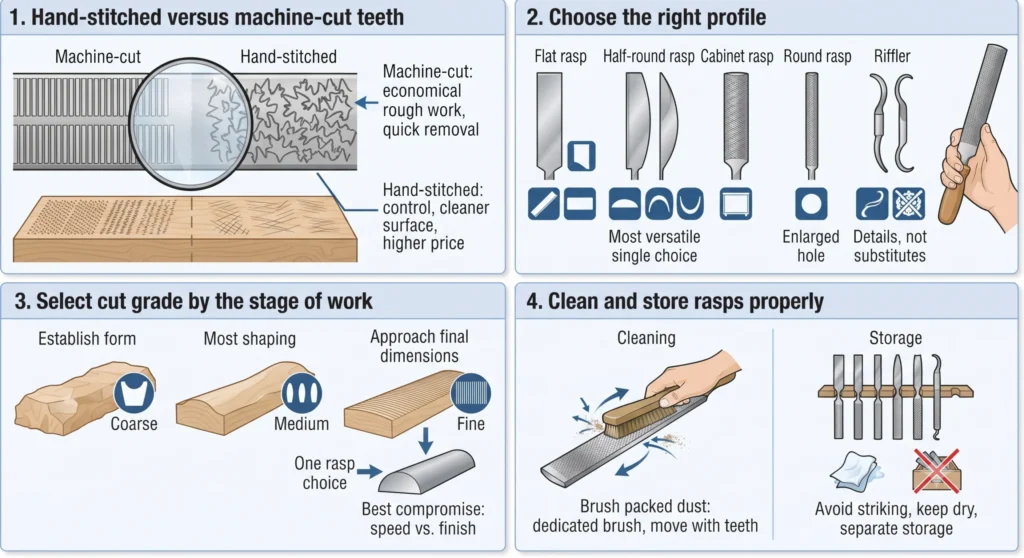
Four checks before you buy a wood rasp
1. Hand-stitched versus machine-cut teeth
Machine-cut rasps have regular tooth rows and usually offer good value for quick stock removal. Hand-stitched rasps use individually raised, unevenly spaced teeth. That irregular pattern generally reduces chatter and repeated scoring, leaving a cleaner surface at a much higher price. Neither type is automatically best: use machine-cut for economical rough work, and consider hand-stitched when control and finish justify the investment.
2. Choose the right profile
A flat rasp is useful for straight edges, broad faces and flattening transitions. A half-round rasp is the most versatile single choice because one side works flats and convex shapes while the rounded side handles concaves. Cabinet rasps are typically wider for broad shaping; round rasps enlarge holes and tight internal curves. Rifflers are smaller specialty tools for details, not substitutes for a general-purpose rasp.
3. Select cut grade by the stage of work
Use a coarse cut to establish form, a medium cut for most shaping and a fine cut as you approach final dimensions. Manufacturer grades are not standardized, so a number from one brand may not match another. If you are buying one rasp, a medium-cut half-round gives the best compromise between speed and the amount of filing or sanding that follows.
4. Clean and store rasps properly
Brush packed dust from the teeth with a dedicated rasp brush or stiff brass brush, moving in the direction that clears the teeth. Avoid striking rasps together or tossing them loose in a drawer, since tooth damage reduces cutting performance. Keep steel dry, wipe off moisture after use and store each rasp so its teeth do not rub against other tools.
Wood rasp FAQ
Is a hand-stitched rasp better than a machine-cut rasp?
Usually for surface quality and controlled shaping, but not always for value. Hand-stitched teeth are irregularly spaced, which can reduce chatter and repetitive scratch patterns. A machine-cut rasp is often the smarter first tool for rough carpentry, occasional shaping or heavy removal. The best choice depends on how close you need to work to final form and how much finish work you want afterward.
What is the difference between a cabinet rasp and a half-round rasp?
A cabinet rasp is generally broad and intended for shaping larger areas such as chair parts, cabriole legs and furniture curves. A half-round rasp describes a profile: one flat face and one curved face. Many cabinet rasps are half-round, but terms vary between makers. Check the actual width, length, cut and cross-section rather than relying only on the name.
When should I use a file instead of a rasp?
Use a rasp when you need to remove wood quickly and establish a shape. Move to a file when the form is close and you want a finer, more controlled surface. Files have finer teeth and remove less material per pass. For detailed transitions, a common sequence is coarse rasp, medium rasp or file, then scraper and sanding only where needed.