
We compared five respected wire-stripper formats on common solid and stranded conductors to find the cleanest, most comfortable choices for electricians, technicians, and serious DIYers.
Klein Tools 11063
A dependable manual multi-gauge choice for day-to-day electrical work and clean inspection-friendly strips.
Knipex 12 40 200
Fast, repeatable stripping when you have a bench full of similar conductors to prepare.
IRWIN VISE-GRIP 2078309
An approachable automatic-style tool for homeowners who want less hand effort without premium pricing.
Best wire strippers at a glance
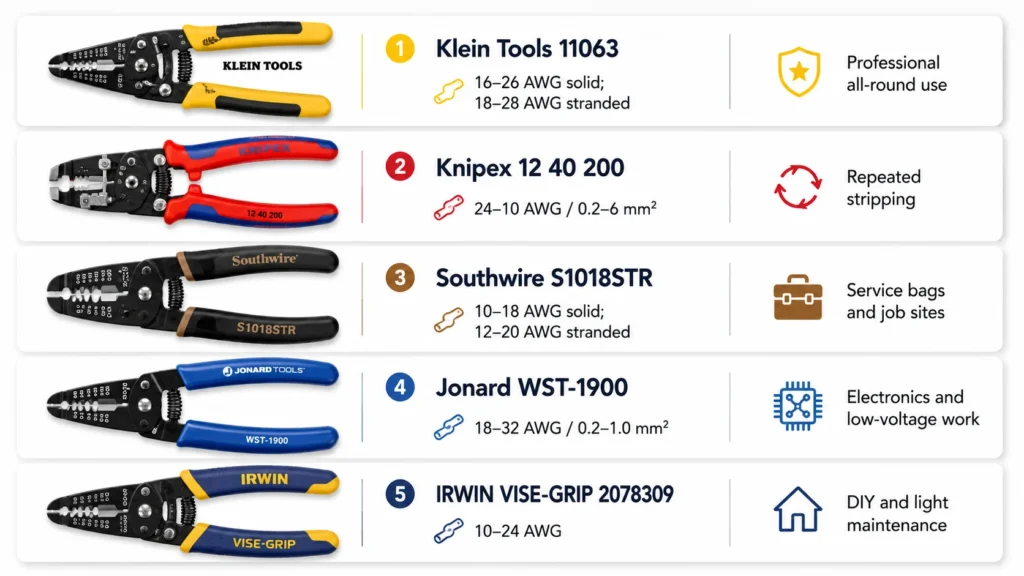
| Tool | Stated wire range | What stood out in testing | Best for |
|---|---|---|---|
| Klein Tools 11063 | 16–26 AWG solid; 18–28 AWG stranded | Very controlled cuts and legible gauge holes. | Professional all-round use |
| Knipex 12 40 200 | 24–10 AWG / 0.2–6 mm² | Fast, consistent gripping on common PVC insulation. | Repeated stripping |
| Southwire S1018STR | 10–18 AWG solid; 12–20 AWG stranded | Rugged combination head with useful cutter. | Service bags and job sites |
| Jonard WST-1900 | 18–32 AWG / 0.2–1.0 mm² | Precise control on small, delicate conductors. | Electronics and low-voltage work |
| IRWIN VISE-GRIP 2078309 | 10–24 AWG | Easy operation; less refined on unusual insulation. | DIY and light maintenance |
The five best wire strippers we recommend
For this review, we focused on how cleanly each tool removed insulation from common copper conductors, whether it nicked strands, how comfortably it repeated the task, and where its design started to show limits.
Klein Tools 11063 Wire Stripper and Cutter
Wire range: 16–26 AWG solid · 18–28 AWG stranded
This classic manual style gave the most feedback during testing: select the correct marked hole, close the jaws, and the insulation releases with a tidy cut line. On 18 and 22 AWG stranded copper, the cleanest results came from aligning the wire squarely in the slot rather than twisting the tool. Its simple steel head, crisp markings, and familiar handle shape make it a strong everyday choice.
Best for: Electricians and experienced DIYers who want maximum control and easy visual inspection.
Watch for: It is slower than self-adjusting tools, and the wrong gauge hole can score the conductor.
Knipex 12 40 200 Self-Adjusting Stripper
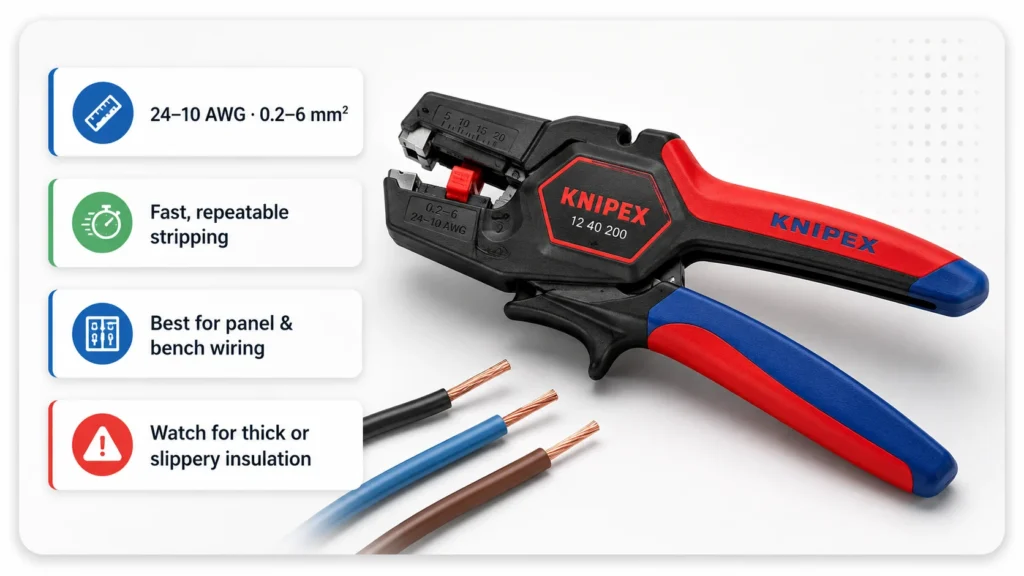
Wire range: 24–10 AWG · 0.2–6 mm²
The Knipex self-adjusting action is built for rhythm. On repeated runs of 14, 16, and 18 AWG PVC-insulated wire, its clamping and pulling motion reduced the hand repositioning needed between strips. The grip remained consistent when the insulation thickness stayed predictable, and the adjustable stop helped produce repeatable strip lengths. It felt more substantial than lower-cost automatics, with a positive mechanism and comfortable leverage.
Best for: Panel building, control wiring, and bench work involving lots of similar conductors.
Watch for: Thick, slippery, brittle, or unusually soft insulation can still need a manual stripper’s finesse.
Southwire S1018STR Multi-Tool Stripper
Wire range: 10–18 AWG solid · 12–20 AWG stranded
A combination stripper earns its place when one tool needs to cut, strip, loop, and crimp. The thicker head felt confidence-inspiring on larger building wire, and the cutting edge dealt cleanly with common copper conductors. In use, the trade-off was clear: the tool is bulkier in a crowded box than a dedicated slim stripper, but it reduces trips back to the pouch.
Best for: Maintenance technicians and electricians who value several job-site functions in one pair.
Watch for: The heavier head is less nimble for fine electronics or deep, tight-panel work.
Jonard WST-1900 Precision Wire Stripper
Wire range: 18–32 AWG · 0.2–1.0 mm²
Fine conductors reveal every weakness in a stripper. This precision format offers more deliberate blade-depth control for small solid and stranded leads, where removing one strand can meaningfully reduce conductor strength. During delicate bench-style work, the compact head made positioning easier and the adjustment rewarded a careful setup with clean insulation removal.
Best for: Electronics technicians, low-voltage installers, and anyone stripping very fine wire.
Watch for: It is specialized; larger building wire and high-volume work are better served by broader tools.
IRWIN VISE-GRIP 2078309 Self-Adjusting Stripper
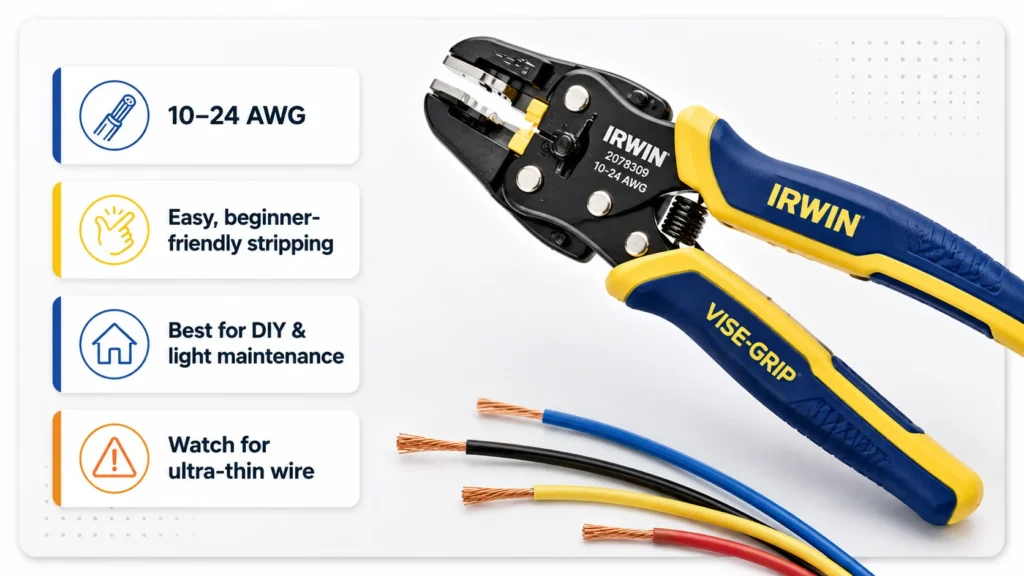
Wire range: 10–24 AWG
For occasional repairs, automotive accessories, and first toolkits, this self-adjusting design makes stripping feel approachable. The action removed common PVC insulation quickly on mid-range wire and avoided the learning curve of selecting individual holes. It also brings useful cutter and crimper functions for light work. At this price, it is a good value—provided you accept less refinement when insulation types vary.
Best for: DIY homeowners and light-duty maintenance users who want an easy first purchase.
Watch for: It can be less predictable on ultra-thin wire or insulation outside its sweet spot.
Our wire-stripper test method
We assessed each format on repeated stripping tasks using common PVC-insulated solid and stranded copper wire, including 10, 14, 18, 22, and 24 AWG where the tool’s stated range allowed. We inspected the conductor after each group of strips for visible scoring, broken strands, uneven insulation cuts, slipping, and inconsistent strip lengths. We also noted handle pressure, spring return, jaw alignment, cutter performance, marking clarity, and how the tool behaved after repeated cycles.
Specifications vary by model revision and region. Always verify the manufacturer’s current wire range before buying or using a tool on a critical installation.
How to choose the right wire stripper
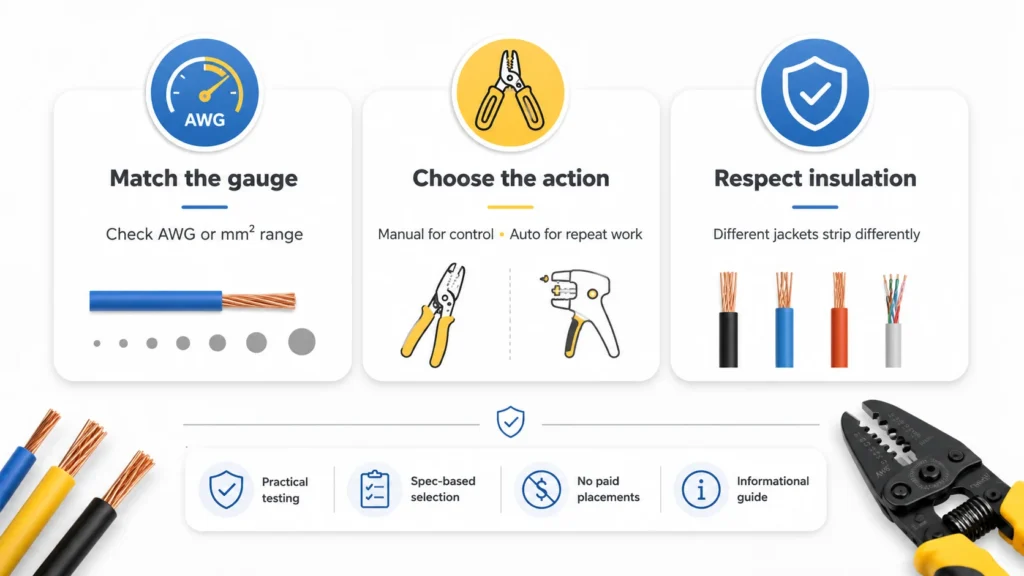
Match the gauge
Use the AWG or mm² range as a starting point, not a suggestion. A slot that is too small can nick copper; one that is too large may fail to cut the insulation cleanly.
Choose the action
Manual strippers offer direct feel and control. Self-adjusting tools save time and hand effort when many wires share a similar size and insulation type.
Respect insulation
PVC, silicone, thin-wall automotive wire, and data cable jackets react differently. Do not force a general-purpose tool onto coax, fiber, or energized wire.
Mister Worker Editorial Team
Mister Worker’s editorial team evaluates professional tools through practical job scenarios, published specifications, handling observations, and the factors that matter at the bench and on site: control, durability, ergonomics, and value.
Editorial disclosure: Product selection is based on stated specifications, category reputation, and our practical assessment criteria. This guide is informational and may contain affiliate links where available; this does not change our recommendations. We do not accept payment for favorable placements.
Wire stripper FAQs
Are automatic wire strippers better than manual models?
Not universally. Automatic strippers are faster for repeated work on familiar wire and insulation. Manual models are usually better when you need close control, work with unusual insulation, or want to feel exactly how the jaws are engaging the conductor.
Why does nicking a conductor matter?
Nicks reduce the effective cross-section of the copper. On stranded wire, cutting even a few strands can weaken the conductor and create a future failure point—especially where vibration, heat, or repeated flexing are involved.
What wire stripper should a beginner buy?
A well-marked manual multi-gauge stripper is the best learning tool because it teaches correct gauge matching and gives clear feedback. A simple self-adjusting model can be a good alternative for straightforward household or automotive wire, but inspect every strip until you trust the result.