Choose the best drywall anchors for shelves, mirrors, curtain rods, décor, and other wall-mounted projects—without relying on a headline weight rating alone.
The best wall anchors for drywall match the load and wall: plastic anchors for light décor, self-drilling anchors for many light-to-medium fixtures, and properly sized toggle or snap-toggle anchors for heavier hollow-wall projects. For valuable, moving, overhead, or safety-critical items, use framing whenever possible.
A screw driven only into drywall can pull out with surprisingly little force. A drywall anchor spreads that force through the gypsum board or behind it, creating a better connection for a compatible screw. That does not make every anchor suitable for every project: drywall thickness, damage, load direction, fixture design, and installation accuracy all matter.
What drywall anchors do—and when you need one
Drywall, sheetrock, and plasterboard are common names for gypsum wallboard. In an open wall bay, there is often nothing solid behind the board except air. Anchors work by expanding in the board, gripping it with threads, or opening behind it. The best sheetrock anchors create a broad bearing area without crushing an already weak wall surface.
Before drilling, try to locate a stud with a reliable stud finder and confirm the location carefully. A wood screw driven into sound framing is usually the preferred option for heavy shelves, television brackets, cabinets, grab bars, and anything that will be pulled, bumped, or loaded repeatedly.

Choose by the real project
1. Identify the wall
Check whether the board is sound, how thick it is, and whether a stud is available.
2. Count the full load
Include the fixture, its contents, and the extra force caused by opening, pulling, or vibration.
3. Follow the exact rating
Use the manufacturer’s drill size, wall-thickness range, screw size, and rated load direction.
Best drywall anchors by type
There is no single best drywall anchor. These common categories are useful when chosen within their published limits and installed in undamaged drywall. Treat product-package ratings as controlled-test information, not a universal promise for every wall or fixture.

Plastic expansion anchors
Best for very light décor, small picture frames, and low-demand accessories. They are inexpensive and simple, but can spin or pull out if the hole is oversized, the drywall is soft, or the load is too demanding. Use the supplied screw size.
Self-drilling drywall anchors
Convenient for many light-to-medium wall fixtures because they often install without pre-drilling. Drive them straight and stop when the flange sits flush. Overtightening can strip the threads or crush weak gypsum around the anchor.
Molly bolts
Metal sleeve anchors expand behind the wall as the screw is tightened or set. They can provide a secure, removable screw connection when the anchor is sized for the actual drywall thickness. Installation requires a correctly sized drilled hole.
Traditional toggle bolts
A spring-loaded metal wing opens behind the drywall and spreads the load over a wider area. Traditional toggles are often among the stronger hollow-wall choices, but they need a comparatively large hole and the wing can fall into the wall if the screw is removed.
Snap-toggle anchors: a practical heavy-duty option
Strap-style toggle anchors hold a metal channel behind the drywall while a bolt is installed from the front. They can be easier to position than a traditional toggle, and the channel generally remains behind the wall if the bolt is removed. Confirm clearance behind the wall and use the manufacturer’s listed hole size and screw or bolt.
How drywall anchor weight ratings really work
Published ratings may assume a specific drywall thickness, a new undamaged panel, a particular screw, correct installation, and a static load applied in a defined direction. A shelf loaded far from the wall, a curtain rod pulled sideways, or a door-mounted accessory can create leverage and repeated force that is much harder on anchors than a still picture frame.
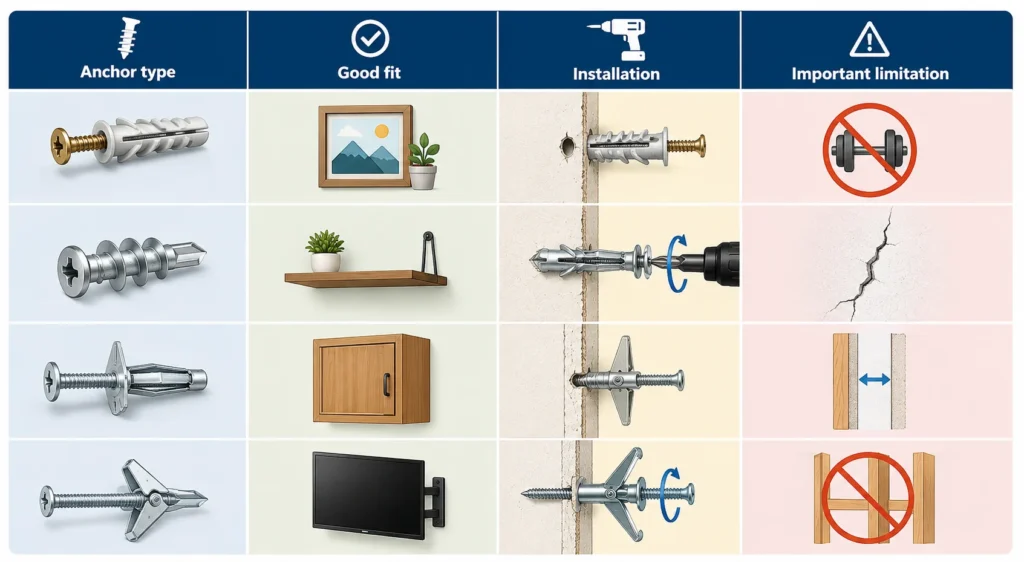
| Anchor type | Good fit | Installation | Important limitation |
|---|---|---|---|
| Plastic expansion | Light picture frames and small décor | Pre-drilled hole sized to the anchor | Not a reliable choice for demanding or dynamic loads |
| Self-drilling | Light-to-medium fixtures and accessories | Usually no pilot hole; check instructions | Can strip or crack weak drywall when overtightened |
| Molly bolt | Medium-duty fixtures needing a removable screw | Accurate drilled hole; thickness-specific sizing | Must expand correctly behind the actual wall thickness |
| Toggle or snap-toggle | Heavier hollow-wall installations within rating | Larger drilled hole and clear cavity behind wall | Not a substitute for framing on safety-critical projects |
How to install drywall anchors without damaging the wall
Exact steps vary by anchor. The following workflow prevents many common mistakes, especially oversized holes and overtightened fasteners. Always defer to the package or technical sheet for the specific product in your hand.
- Inspect the wall surface. Do not use a nearby patch, cracked area, water-damaged gypsum, old loose hole, or visibly crumbling section as an anchor location.
- Scan for studs and use appropriate caution around potential electrical wiring, plumbing, or other concealed services before drilling.
- Mark the fixture holes level and measure the drywall thickness if the anchor requires a thickness range. Many residential walls use 1/2-inch board, but do not assume.
- Use only the specified drill-bit size. A hole that is too large lets a plastic or metal anchor spin; a hole that is too small can tear paper facing or deform the anchor.
- Tighten the screw until the fixture is secure and flush, then stop. Do not keep turning to pull the fixture tighter after the anchor has reached its intended bearing position.
Why drywall anchors fail or keep spinning
Most failures trace back to a mismatched anchor, damaged drywall, an oversized hole, or a load that creates more force than the installer expected. Replace a failed anchor rather than trying to tighten it harder in the same damaged hole.

If an anchor spins
Stop turning. Remove the screw and inspect the hole. If it is enlarged or the gypsum is crushed, move the fixture to a sound location, use a manufacturer-approved larger fastener only when appropriate, or repair the wall before reinstalling. Do not pack the hole with improvised material and treat it as a rated repair.
If the drywall is damaged
A paper face torn away from drywall or a soft, crumbly area has substantially less holding ability. Patch and allow the repair to cure, relocate the mount to sound wallboard or framing, or reconsider the fixture. Anchor capacity cannot be restored by tightening a screw more aggressively.
Ceiling-mounted objects need a different standard
Do not assume a wall rating applies overhead. Ceiling loads act directly downward and can be dangerous if they fall. For fans, suspended chairs, punching bags, heavy lights, storage systems, or anything above people, fasten to suitable framing or use a purpose-designed mounting method approved for the load and ceiling construction. Seek qualified advice when in doubt.
Frequently asked questions
Can drywall anchors support a television?
A television mount should follow its manufacturer’s instructions. Many mounts require studs or other structural support because televisions are valuable, the bracket can create leverage, and users may adjust the screen. Do not assume a package rating for a drywall anchor makes it suitable for your television mount.
Are toggle bolts stronger than metal bolts?
Often, a correctly installed toggle or snap-toggle can spread load over a wider area behind hollow drywall than a small molly bolt. But the exact answer depends on the product size, drywall thickness, fixture, hole placement, and load direction. Compare the technical specifications for the specific anchors, not just the category name.
Can an installled drywall anchor be reused?
Some molly bolts and snap-toggle channels may remain in place while a screw or bolt is removed, but many plastic anchors and traditional toggle wings are not reusable in the same way. If you remove an anchor, inspect the wall and the fastener carefully. Replace damaged parts and patch holes that are no longer needed.