Unleaded 88 is usually E15: gasoline containing up to 15% ethanol with an 88 octane rating. The number tells you about octane—not whether the fuel is right for your vehicle.
The short answer
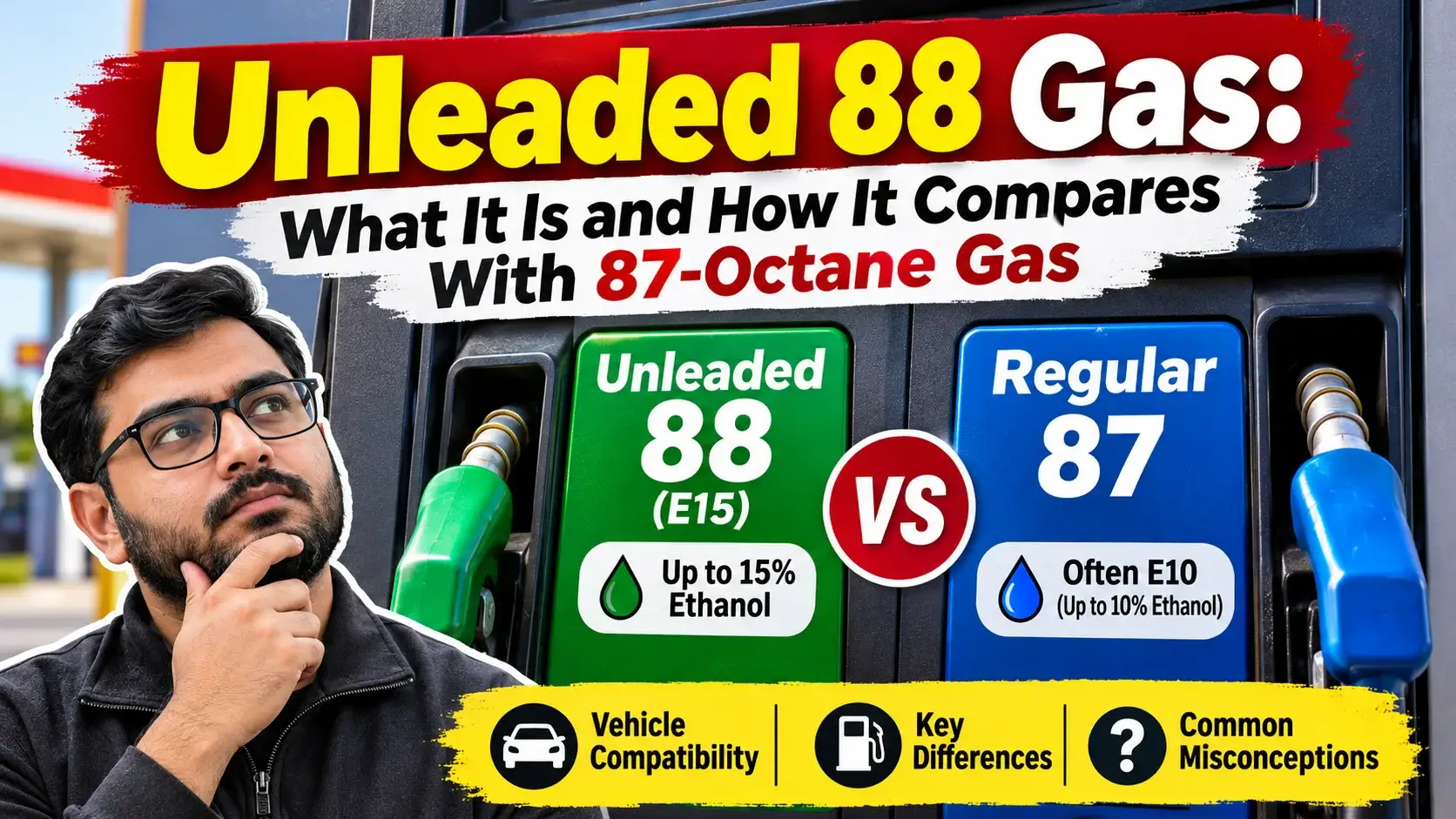
At many U.S. pumps, Unleaded 88 is the retail name for E15, a gasoline blend containing more than 10% and up to 15% ethanol. Its “88” refers to an octane rating. Check the actual pump label: a product name alone is not a substitute for its stated blend and your vehicle’s fuel requirements. Source: U.S. Department of Energy, Alternative Fuels Data Center (AFDC).
Before you choose
EPA permits E15 in certain vehicles, including model-year 2001 or newer passenger cars and light trucks, but not in every engine or piece of equipment. Permission is not a promise that E15 is the preferred fuel for your particular vehicle. Follow your owner’s manual and manufacturer guidance. Source: U.S. EPA, E15 fuel registration.
First, untangle the names
Unleaded 88A pump-market name commonly used for E15 with an 88 octane rating; read the pump label to confirm the blend.E15Gasoline containing more than 10% and up to 15% ethanol. The “15” describes ethanol content, not octane. DOE AFDCOctaneA measure of a fuel’s resistance to engine knock. A higher number does not, by itself, establish a benefit for every engine; use the grade your manufacturer specifies. Source: FuelEconomy.gov, Selecting the Right Octane Fuel“88 gas” or “88 octane gas”Informal ways people may refer to a fuel’s octane rating. They do not independently identify its ethanol content.“E88 gasoline”An ambiguous search phrase, not the standard name for Unleaded 88 or E15. Do not assume “E88” means E15; look for the pump’s actual ethanol and octane labels.
Unleaded 88 vs. 87: a quick comparison
| What to check | Unleaded 88 / E15 | Typical 87-octane regular |
|---|---|---|
| Octane rating | 88 | 87 |
| Ethanol content | More than 10% and up to 15% ethanol | Often E10 (up to 10% ethanol), but the exact blend varies; check the pump label |
| Vehicle question | Is E15 allowed by both applicable guidance and your vehicle manufacturer? | Does 87 octane meet your manufacturer’s minimum requirement, and is the labeled blend suitable? |
| What the label cannot promise | Neither number alone guarantees a particular price, fuel economy, performance, emissions result, or long-term durability outcome for your vehicle. | |
Comparison describes common U.S. pump labels, not every product sold under these names. Blend definitions: DOE AFDC. Octane guidance: FuelEconomy.gov.
Compatibility: check before refuelling
The EPA allows E15 for model-year 2001 and newer passenger vehicles, including cars, SUVs, and light trucks, as well as flexible-fuel vehicles. It prohibits E15 in model-year 2000 and older conventional vehicles and in motorcycles, boats, snowmobiles, lawn equipment, and certain other engines. This is a regulatory distinction; your manufacturer’s instructions still matter. Source: U.S. EPA.
- Read the owner’s manual. Find the recommended octane and any ethanol-blend limits.
- Check the fuel-door label. It may identify the acceptable fuel or point you to the manual.
- Read the pump labeling. Verify the displayed octane, ethanol content, and E15 warning rather than relying on a nickname.
- Resolve a mismatch before filling. Ask your vehicle manufacturer or a qualified service professional if guidance is missing or unclear.
Editorial guidance
If you cannot verify that a fuel meets your vehicle’s requirements, pause and choose a fuel you can verify. This is a cautious decision aid, not a diagnosis or a substitute for manufacturer instructions.
Common misconceptions
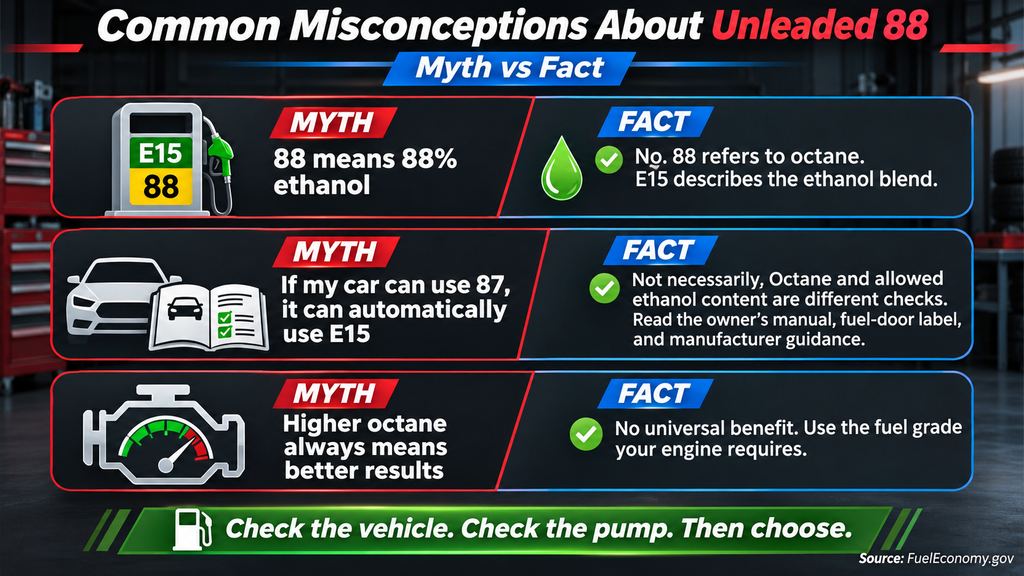
“88” means 88% ethanol.
No. In Unleaded 88, 88 refers to octane. E15 is the term that describes the ethanol blend.
If my car can use 87, it can automatically use E15.
Not necessarily. Minimum octane and permitted ethanol content are different checks. Consult the manual, fuel-door label, and manufacturer guidance.
Higher octane always means better results.
No universal performance or economy benefit follows from the number alone. The appropriate grade depends on the engine’s requirements. Source: FuelEconomy.gov.
A practical decision framework
- Identify the vehicle or equipment. Model year and engine type affect whether E15 is permitted.
- Find its fuel requirements. Note both the minimum octane and any ethanol restriction in the manual or manufacturer guidance.
- Match those requirements to the pump. Confirm the labeled blend and octane; do not infer either from “88 gas” alone.
- Consider local trade-offs only after compatibility. Compare posted price and your own priorities, without assuming a fixed savings or fuel-economy result.
- When uncertain, ask. Contact the vehicle manufacturer or a qualified service professional before choosing a fuel.
Quick questions at the pump
What is Unleaded 88?
It is commonly the retail name for 88-octane E15 gasoline. Confirm the product’s blend on its pump label.
What’s Unleaded 88 compared with 87?
The displayed octane differs by one point, and Unleaded 88 is commonly E15 while regular 87 may have a different ethanol blend. The right choice depends on the vehicle’s requirements, not the numbers alone.
What is 88 gas—and is “E88 gasoline” the same thing?
“88 gas” can be shorthand for 88-octane fuel. “E88 gasoline” is ambiguous and should not be treated as an established synonym for E15. Read the exact label instead.
Final action reminder
Check the vehicle. Check the pump. Then choose.
Use your owner’s manual and fuel-door label first, confirm the pump’s octane and ethanol labeling, and ask your manufacturer or a qualified service professional when anything conflicts.