
A practical guide to choosing, fitting and using an open-end wrench without rounding the hardware you are trying to save.
An open-end wrench grips a nut or bolt from the side, making it useful where a closed wrench cannot slip over the fastener. It is quick and versatile, but a box end is usually the better choice for high torque or seized hardware.
What is an open-end wrench?
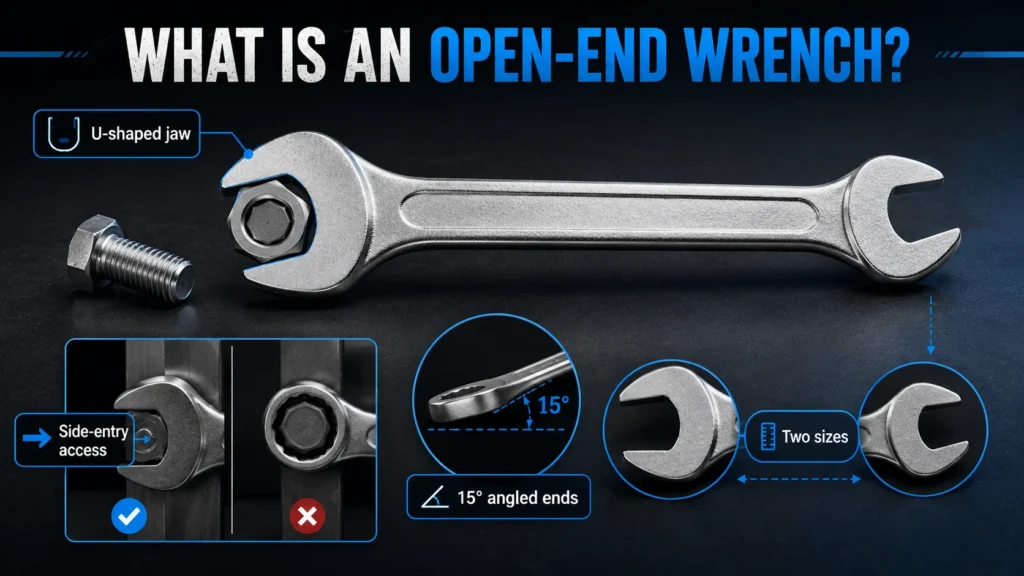
An open-end wrench has a U-shaped jaw that slides onto two opposite flats of a hex nut or bolt head. Unlike a box-end wrench, it does not need to pass over the end of a bolt. That side-entry design is its real advantage.
Most open end wrenches have differently sized jaws at each end, often angled about 15 degrees from the handle. Flip the wrench after each short pull and you can keep working in a tight arc. Combination wrenches pair this open jaw with a box end of the same size.
Where an open-ended wrench works best
Use an open end when access matters more than maximum grip. It is especially handy for hardware on brackets, linkage, household plumbing fittings, lawn equipment and automotive locations where a hose, line or nearby component prevents a closed wrench from fitting over the fastener.
Good candidate
A nut on an automotive bracket where a brake line or cable blocks access from the end. Start it with the open jaw, then switch to a box end if there is room.
Choose a better grip
A rusty suspension bolt, a rounded fitting or any fastener that needs a heavy break-loose pull. Use a six-point socket, box end or specialty tool first.
Open-end vs. box-end vs. combination wrench
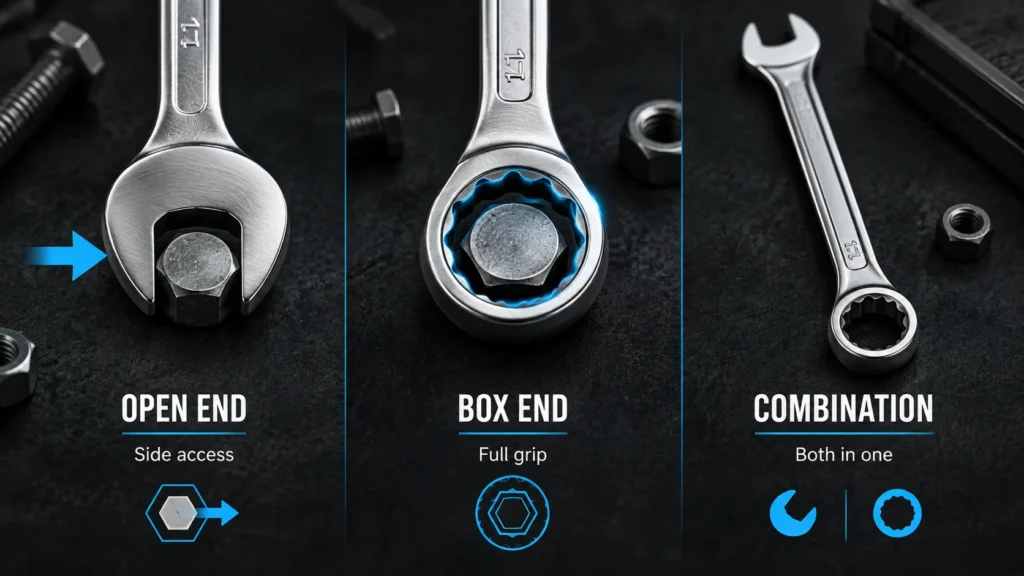
No wrench style wins every job. The best choice depends on access, condition of the fastener and how much force you need to apply.
| Wrench style | Main strength | Best use |
|---|---|---|
| Open end | Slides in from the side | Quick adjustment and line-adjacent access |
| Box end | Wraps the full fastener head | High-torque work and protecting corners |
| Combination | Both options in one tool | General repair kits and daily work |
For most beginners, a quality combination wrench set is the sensible starting point. The open end gets the wrench into awkward places; the box end finishes the job with more secure contact.
Common open-end wrench sizes
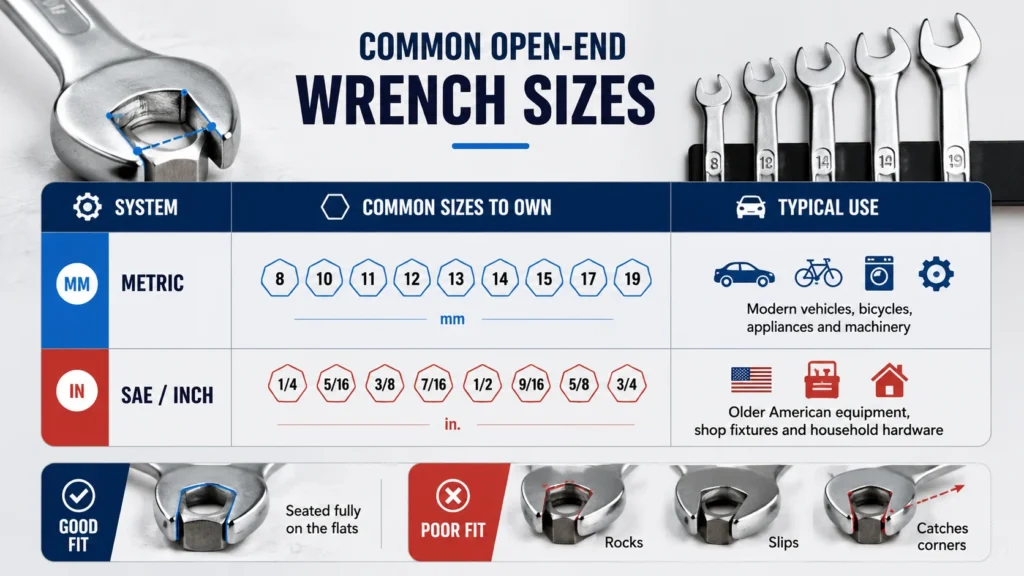
Wrench size refers to the distance across the fastener flats, not the diameter of the bolt thread. Metric and SAE tools are close in some sizes, but “close” is not a safe substitute when you want to avoid rounding a nut.
Useful starter ranges
| System | Common sizes to own | Typical use |
|---|---|---|
| Metric | 8, 10, 11, 12, 13, 14, 15, 17, 19 mm | Most modern vehicles, bicycles, appliances and machinery |
| SAE / inch | 1/4, 5/16, 3/8, 7/16, 1/2, 9/16, 5/8, 3/4 in. | Older American equipment, shop fixtures and household hardware |
Test the fit before pulling. The correct open-end wrench seats fully on the flats with very little side-to-side movement. If it rocks, slips on easily or only catches the outer corners, stop and find the exact size.
How to use an open end without damaging the fastener
Place the wrench jaw as deeply as possible over the nut or bolt head. Keep the handle roughly in line with the jaw opening, brace yourself so you will not fall if it slips, and apply smooth force rather than a sudden jerk.
Whenever possible, pull rather than push. Pulling gives you more control and reduces the chance that your knuckles will meet sharp engine parts, walls or machinery if the wrench comes free.
Are open-end ratchet wrench designs worth it?
The phrase “open end ratchet wrench” can describe a few different tools. Most commonly, shoppers mean a ratcheting combination wrench: one end is a conventional open jaw and the other is a ratcheting box end. That ratcheting ring lets you turn a fastener repeatedly without lifting the wrench off.
A wrench ratchet open-end design is useful for repeated turning in confined spaces, such as accessory brackets or long threaded fasteners. The open jaw still provides side access, while the ratcheting end is usually the faster choice once it can fully engage the fastener.
There are also specialty ratcheting open jaws and pass-through styles, but they are not replacements for a strong box end or socket. Check the mechanism’s direction switch, tooth engagement, head thickness and manufacturer torque guidance before relying on one for stubborn bolts.
What to look for when buying open end wrenches
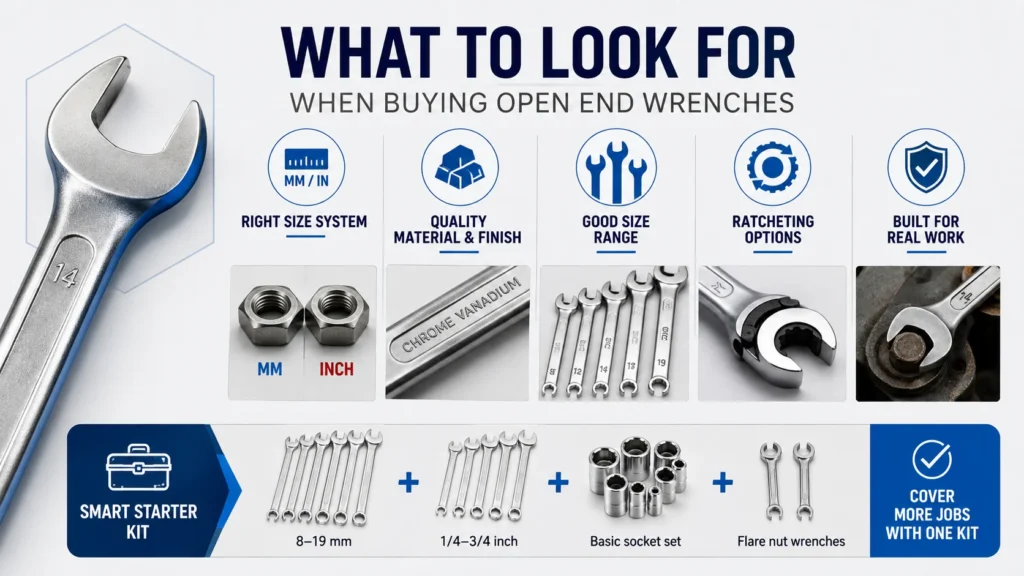
A basic set does not need to be expensive, but accuracy and finish matter. Sloppy jaw openings are more likely to damage hardware than a well-machined wrench of the correct size.
- Buy the measurement system your equipment actually uses—metric for most modern vehicles and equipment, SAE for many older or US-standard fasteners.
- Choose chrome-vanadium steel or another reputable alloy, with clearly stamped sizes that remain readable after use.
- Look for a practical spread of sizes before chasing specialty pieces. A complete combination set is usually more useful than several premium individual wrenches.
- Add ratcheting wrenches when repeated turning and limited swing room are common in your work—not as a substitute for sockets and breaker tools.
For a first tool kit, a combination wrench set covering 8–19 mm and 1/4–3/4 inch, plus a basic socket set, handles a wide range of home and vehicle jobs. Add flare-nut wrenches for brake or fuel lines and specialty tools only when a job truly calls for them.
Frequently asked questions
Can an open-end wrench be used on a tight or rusty nut?
Use caution. An open jaw can spread or slip when high force is needed, which may round the fastener. Try penetrating oil and a correctly sized six-point socket or box end instead of adding a pipe for leverage.
What is the difference between metric and SAE wrench sizes?
Metric sizes are measured in millimetres, while SAE sizes are measured in fractions of an inch. Some sizes are close but not interchangeable; use the system and exact measurement that matches the fastener.
Is a ratcheting wrench better than a standard open-end wrench?
It can be faster in a confined space, especially when the ratcheting box end fully engages the fastener. A standard combination wrench remains more versatile, and neither should replace a socket or breaker tool for stubborn hardware.