Learn how socket wrench extensions, drive adapters, impact-rated accessories, wrench extenders and speed handles fit together, so you can reach difficult fasteners without creating a weak or unsafe setup.
A socket wrench extension adds reach between a ratchet and a socket. A drive adapter changes the square-drive size. Neither automatically makes a setup stronger: the safe torque limit is set by the weakest component, and impact tools need extensions, sockets and adapters specifically rated for impact use.
What is a socket wrench extension?
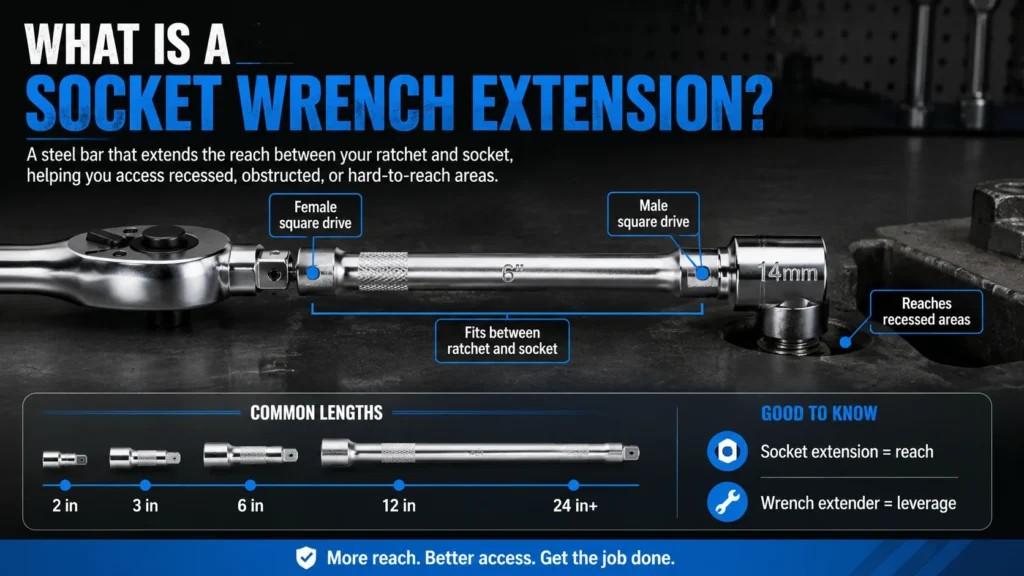
A socket wrench extension is a steel bar with a female square drive on one end and a male square drive on the other. It fits between your ratchet or breaker bar and the socket, moving the socket farther into a recessed, obstructed or hard-to-reach area. Common lengths range from short 2-inch and 3-inch pieces to 24-inch extensions and beyond.
Sellers sometimes use socket wrench extension and socket wrench extender interchangeably. In ordinary garage use, both usually mean the same reach-extending accessory. A wrench extender is different: it normally adds leverage to an open-end, box-end or combination wrench rather than extending a socket drive.
Socket drive sizes: 1/4-inch, 3/8-inch and 1/2-inch
Drive size refers to the square connection between the ratchet, extension, adapter and socket—not the hex size of the fastener. Match the extension drive to the ratchet and socket whenever possible. A correctly matched setup is shorter, more stable and usually easier to control.
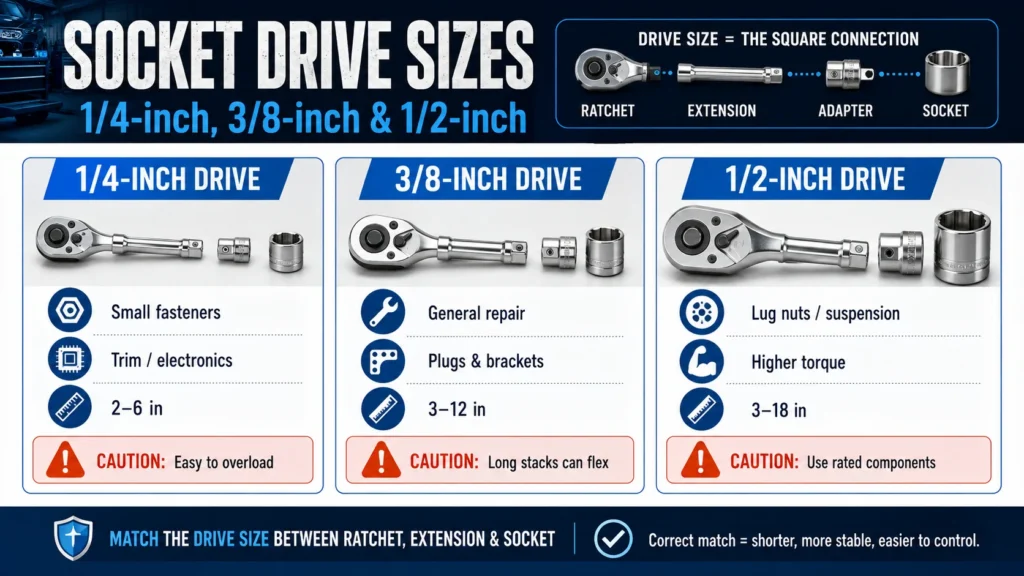
| Drive size | Typical work | Useful extension lengths | Watch out for |
|---|---|---|---|
| 1/4-inch drive | Small fasteners, trim, hose clamps, electronics and tight engine-bay work | 2 to 6 inches for compact access | Easy to overload on seized or large fasteners; avoid using it as a substitute for a stronger drive |
| 3/8-inch drive | General automotive repair, plugs, brackets, medium fasteners and routine service | 3 to 12 inches for most garage jobs | Long stacks can flex and make it difficult to keep a socket square on the fastener |
| 1/2-inch drive | Lug nuts, suspension, axle hardware and higher-torque service work | 3 to 18 inches when clearance requires it | Use rated components and support the socket carefully when working around high-torque fasteners |
An extension normally has the same drive size at both ends: for example, a 3/8-inch female square accepts a 3/8-inch ratchet anvil, while its 3/8-inch male square accepts a 3/8-inch socket. An adapter is the part that intentionally changes sizes, such as 3/8-inch female to 1/2-inch male.
Standard extensions, wobble extensions and universal joints
The right reach accessory depends on whether the fastener is straight ahead or slightly offset. Choose the least flexible option that reaches the fastener cleanly, because stiffness helps keep the socket fully seated and reduces the chance of rounding a bolt head.
Standard socket extensions
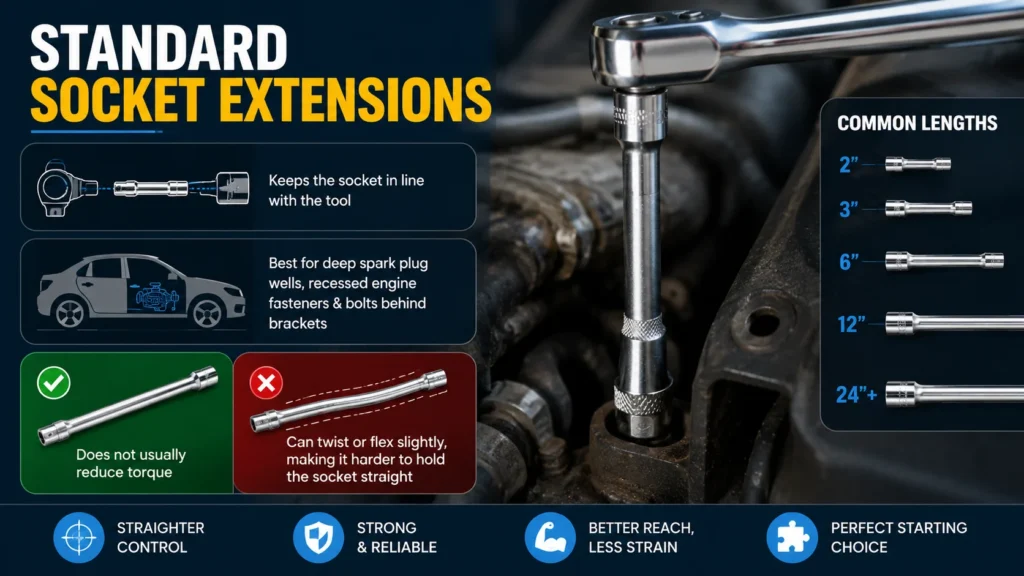
A standard extension keeps the socket in line with the tool. It is the best starting choice for deep spark plug wells, recessed engine fasteners and bolts behind brackets. Long extensions do not usually reduce the torque delivered in a simple hand-tool setup, but they can twist or flex slightly, making fastener feel less direct and making it harder to hold the socket straight.
Wobble extensions
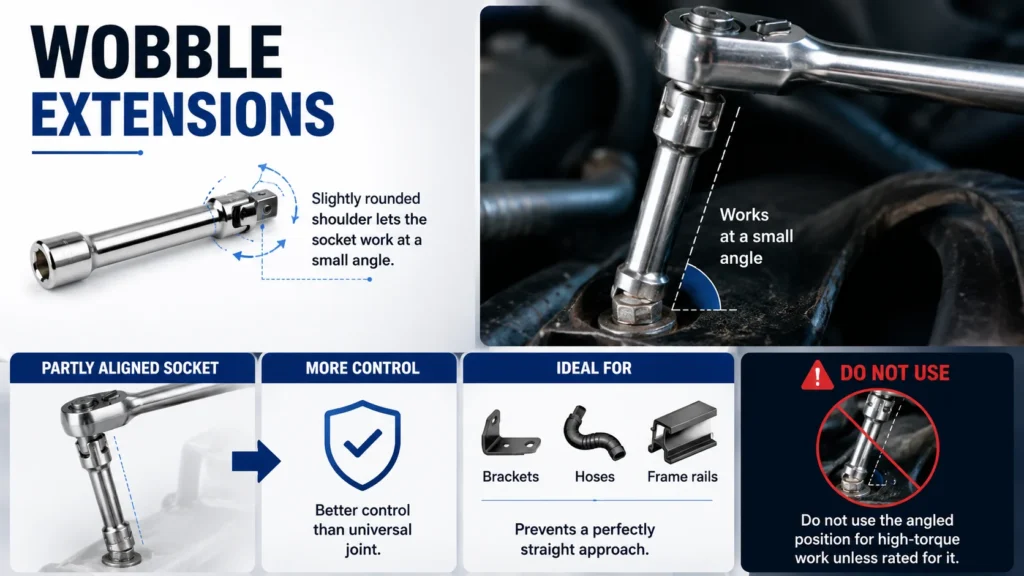
A wobble extension has a slightly rounded or reduced shoulder near the male square drive. With the socket partly engaged, it can work at a small angle while remaining more controlled than a universal joint. It is useful when a socket is almost aligned but a bracket, hose or frame rail prevents a perfectly straight approach. Do not use the angled position for high-torque work unless the manufacturer specifically rates it for that use.
Universal joints
A universal joint, often called a U-joint, gives a greater working angle than a wobble extension. It can reach fasteners around corners, but it also adds bulk, movement and side loading. Keep the joint angle as shallow as practical, steady the socket by hand when safe, and avoid breaking loose heavily seized fasteners through a sharply angled universal joint.
Drive adapters and adapter impact socket safety
A drive adapter connects two different square-drive sizes. Typical examples include 1/4-inch female to 3/8-inch male, 3/8-inch female to 1/2-inch male, and the reverse reducers. They are helpful when one socket is needed for an occasional job, but they should not become a way to force a small ratchet, small extension or light-duty socket into heavy work.
Read the ends before you buy
Female means the square hole that receives a tool’s male anvil. Male means the square stud that accepts a socket or extension. Read an adapter listing from input to output: “3/8 female to 1/2 male” fits a 3/8-inch ratchet and accepts a 1/2-inch socket.
Impact-rated means every part
For an impact wrench, use an impact-rated adapter, extension and socket together. Look for manufacturer impact ratings, suitable retention-hole or detent-pin features, and black-oxide or similar impact-tool finishes where applicable.
The weakest component controls the setup. A 1/2-inch impact wrench connected through a 3/8-inch adapter does not turn a 3/8-inch socket into a 1/2-inch-drive tool. For demanding suspension, axle or lug-nut work, move up to the proper drive size instead of stacking reducers, extensions and universal joints.
What are wrench extenders and speed handles for?
Extensions solve a reach problem in a socket setup. Wrench extenders and speed handles serve different purposes: one changes leverage on a conventional wrench, while the other helps turn a socket quickly after the fastener is already loose enough to move freely.
Wrench extender
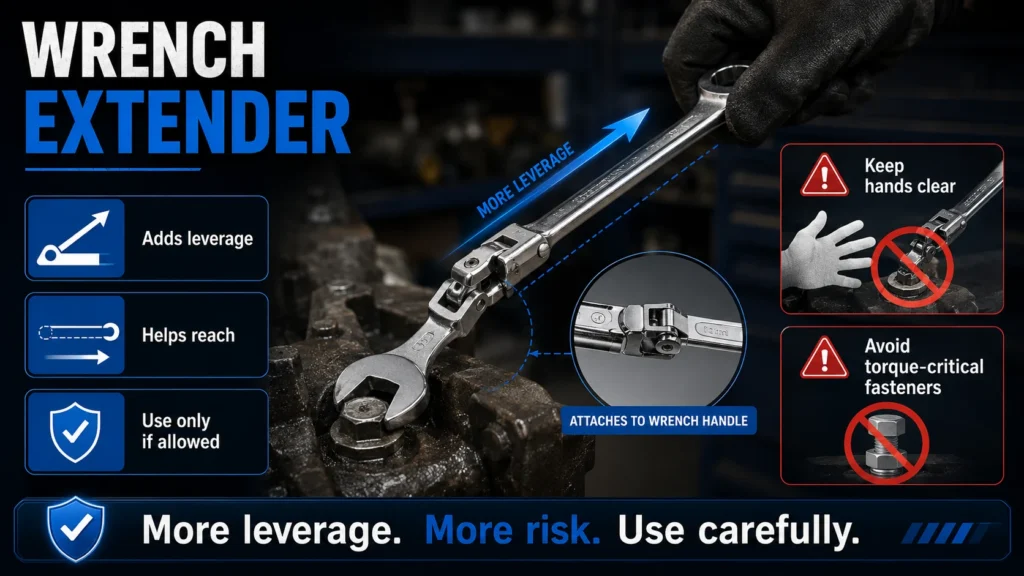
A wrench extender is a leverage accessory that grips or supports the handle of another wrench. It can help reach a fastener or increase leverage, but it also increases the chance of exceeding the wrench’s design limit, slipping off the handle or damaging a fastener. Use it only when the extender and wrench manufacturer allow it, keep your hands clear, and avoid it on torque-critical fasteners where a specified torque tool is required.
Speed handle
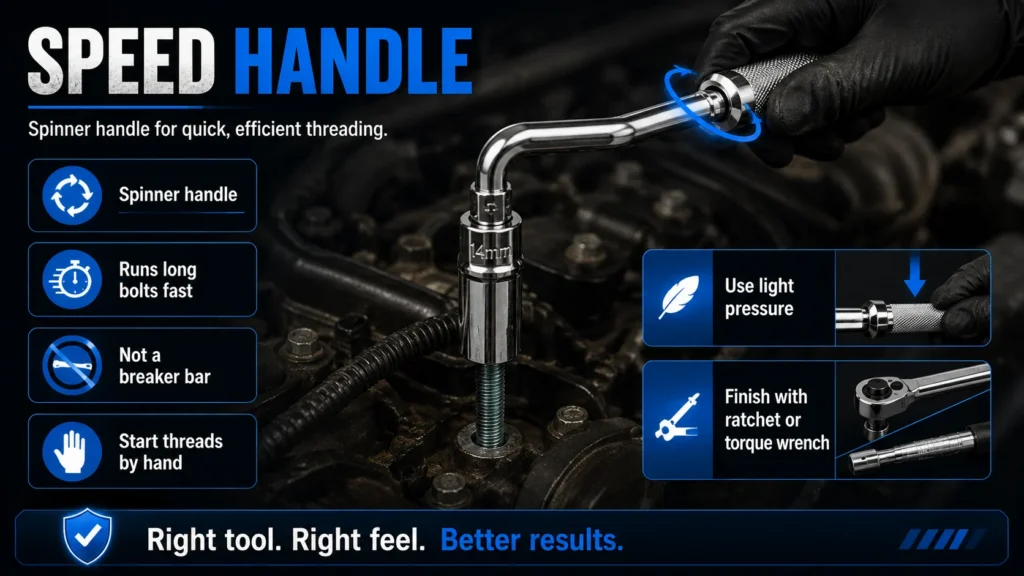
A speed handle, also called a spinner handle, has a rotating grip and crank-shaped shaft. It is designed to run long bolts, spark plugs or threaded fasteners in and out quickly by hand. It is not a breaker bar. Start threads by hand, use light pressure, and switch to a ratchet or torque wrench when final tightening matters.
How to build a controlled socket setup
Start with the socket size and drive size that fit the job, then add only the reach accessory you need. Use the shortest practical extension, keep the stack straight, and make sure each square drive clicks or seats fully. If the socket cannot sit squarely on the fastener, change your approach rather than leaning hard on a crooked tool chain.
Avoid adapter stacks on high-torque work
Each added adapter, wobble point or universal joint creates another place for flex, side loading or accidental disengagement. Use impact-rated components with impact tools, wear eye protection, and stop if an extension twists heavily, a socket rocks, or a connection will not stay fully seated.
For final torque, follow the vehicle or equipment procedure. If a torque specification is given, apply it with the correct torque wrench arrangement and manufacturer-approved accessories. A long inline extension generally does not change a torque wrench setting, but offset adapters, crowfoot-style tools and unusual geometry can change effective leverage and may require a calculation or the service manual’s method.
A sensible starter set for socket reach and compatibility
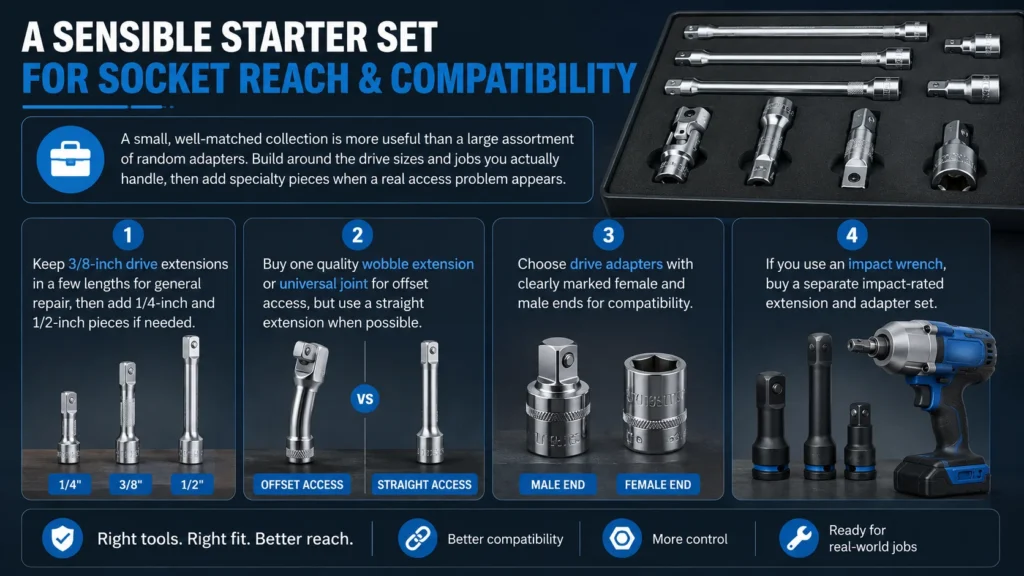
A small, well-matched collection is more useful than a large assortment of random adapters. Build around the drive sizes and jobs you actually handle, then add specialty pieces when a real access problem appears.
- Keep 3/8-inch drive extensions in a few lengths for general repair, then add 1/4-inch and 1/2-inch pieces if you regularly work on small hardware or high-torque vehicle fasteners.
- Buy one quality wobble extension or universal joint for offset access, but use a straight extension whenever the fastener is in line.
- Choose drive adapters with clearly marked female and male ends, and keep a compact reducer and step-up adapter only for occasional compatibility gaps.
- If you use an impact wrench, buy a separate impact-rated extension and adapter set instead of mixing chrome hand-tool accessories into impact work.
Frequently asked questions
Can I use a chrome socket extension with an impact wrench?
Only if the manufacturer specifically states that the extension is impact rated. Standard polished chrome extensions are generally intended for hand tools. Repeated impact loads can damage chrome accessories, so use an impact-rated extension, adapter and socket for impact-wrench work.
Do long socket extensions reduce torque?
A straight inline extension does not normally change the torque ratio the way an offset lever does. However, long extensions can twist, flex and make the fastener feel less direct, especially under high load. Keep them as short and straight as practical, and use the correct drive size for the job.
Is it safe to adapt 1/2-inch drive down to 3/8-inch drive?
It can be appropriate for light or occasional work when every component is correctly seated and rated for the use. But the smaller 3/8-inch adapter, extension and socket become the limiting parts. Do not use a reducer to apply 1/2-inch-drive impact or breaker-bar force to a small socket setup.