Understand ratcheting wrenches, socket ratchets, flex-head designs, and the sizes that make the biggest difference before you buy a set.
A ratcheting wrench is usually a combination wrench with a ratchet mechanism in its box end. A socket ratchet drives removable sockets through a square drive. Both speed up repeated turns, but they solve different access problems, and neither should automatically be used for maximum breakaway torque.
What is a ratcheting wrench, and how is it different from a socket ratchet?
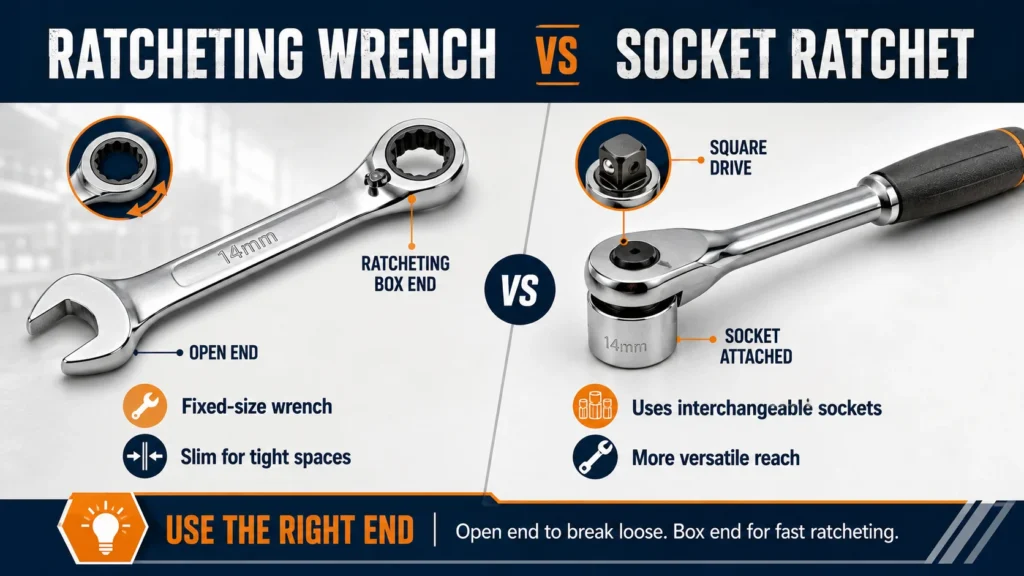
A ratcheting wrench looks much like a standard combination wrench: an open end on one side and a closed box end on the other. The difference is inside the box end. A gear-and-pawl mechanism lets the wrench turn a fastener in the working direction while the handle moves back without removing the wrench.
A ratchet socket wrench, by contrast, has a square drive for interchangeable sockets. It is more adaptable across fastener sizes and depths, especially with extensions, but a fixed-size ratcheting wrench is often slimmer and faster around brackets, lines, and crowded engine-bay hardware.
Use the right end for the job
Use the open end to initially loosen a tight fastener when access allows, then move to the ratcheting box end for speed. Keep the box end fully seated on the flats; partial engagement rounds hardware and can damage the mechanism.
The ratchet wrench types you will actually use
The best style depends on swing room, fastener condition, and whether you need a fixed size or the flexibility of sockets. A good ratcheting wrench set handles most routine jobs; specialist styles earn their place when access gets tight.
Fix-head ratcheting wrench
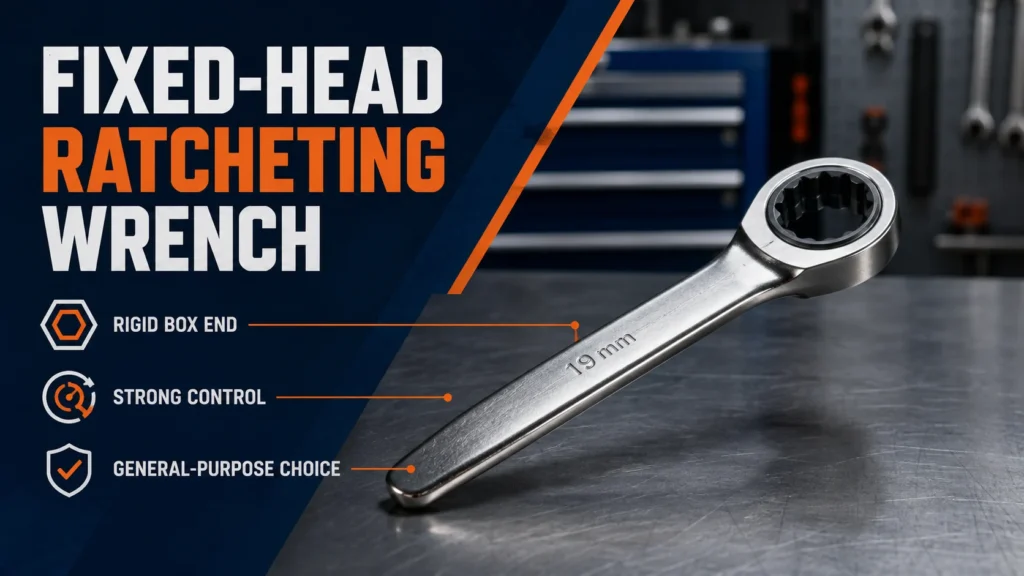
The dependable first choice. Its rigid box end is compact, strong, and easy to control for general repair, assembly, and maintenance work.
Flex-head ratchet wrench
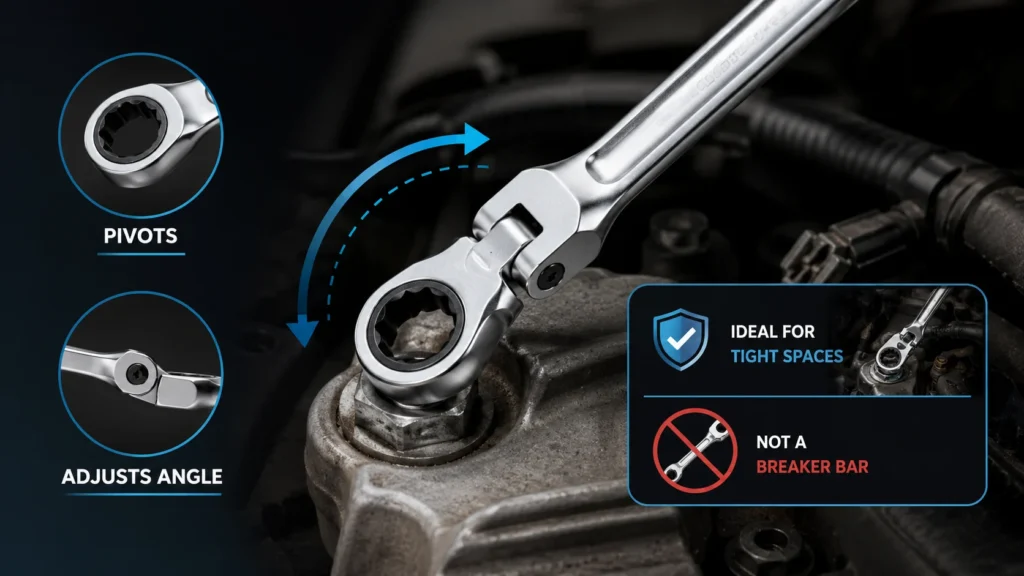
Its pivoting head reaches around obstructions and changes the handle angle. It is valuable in engine bays, but the joint adds bulk and should not be treated like a breaker bar.
Reversible and stubby designs
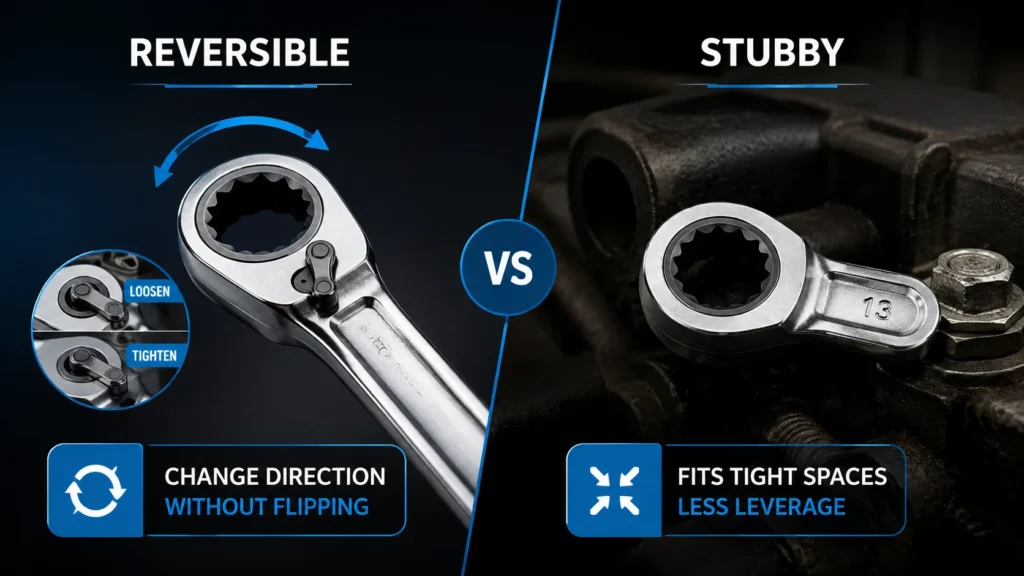
Reversible models use a lever to change direction without flipping the wrench. Stubby handles fit confined spaces, though their short length gives up leverage.
Socket and cordless ratchets
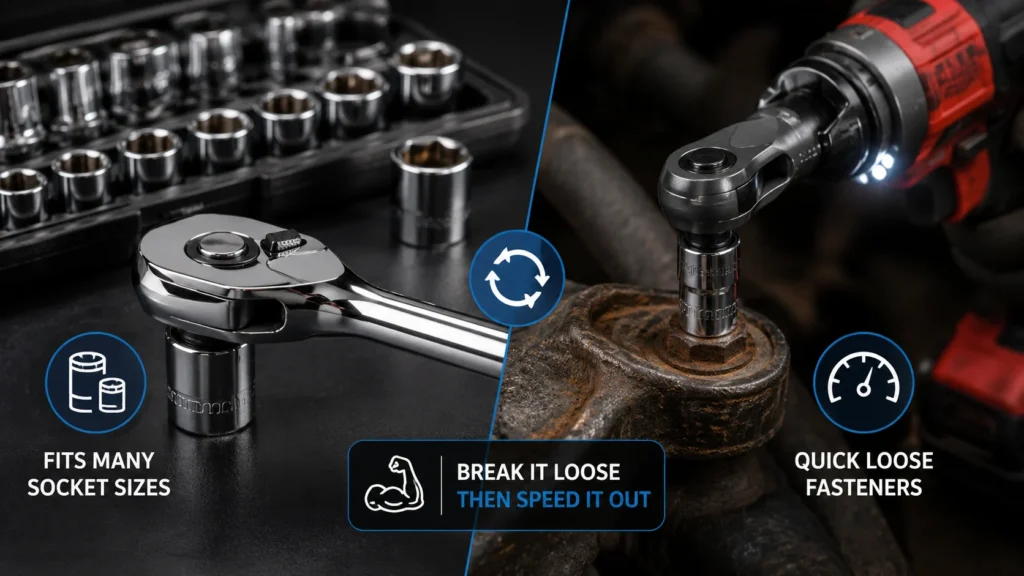
Socket ratchets accept many socket sizes; cordless ratchets quickly run loose fasteners on and off. Use either after breaking a stubborn fastener loose by hand with the correctly rated tool.
Ratchet wrench sizes worth owning first
For automotive and mechanical work, metric sizes are essential even if you also own SAE tools. A 10mm socket and ratchet wrench are especially useful because 10mm fasteners appear frequently on battery terminals, brackets, covers, and light-duty hardware.
| Size | Common use | Buying note |
|---|---|---|
| 8mm–10mm | Small brackets, clamps, battery and trim hardware | High-use metric range for automotive work |
| 11mm–13mm | General vehicle, appliance, and equipment fasteners | Core sizes in a first metric set |
| 14mm–17mm | Engine accessories, mounts, larger brackets | Choose a longer handle for leverage |
| 18mm–19mm | Suspension, machinery, and larger hardware | Verify torque requirements before ratcheting |
| SAE 3/8in.–3/4in. | Older domestic equipment and mixed workshops | Useful alongside—not instead of—metric tools |
Which ratchet wrench should you reach for?
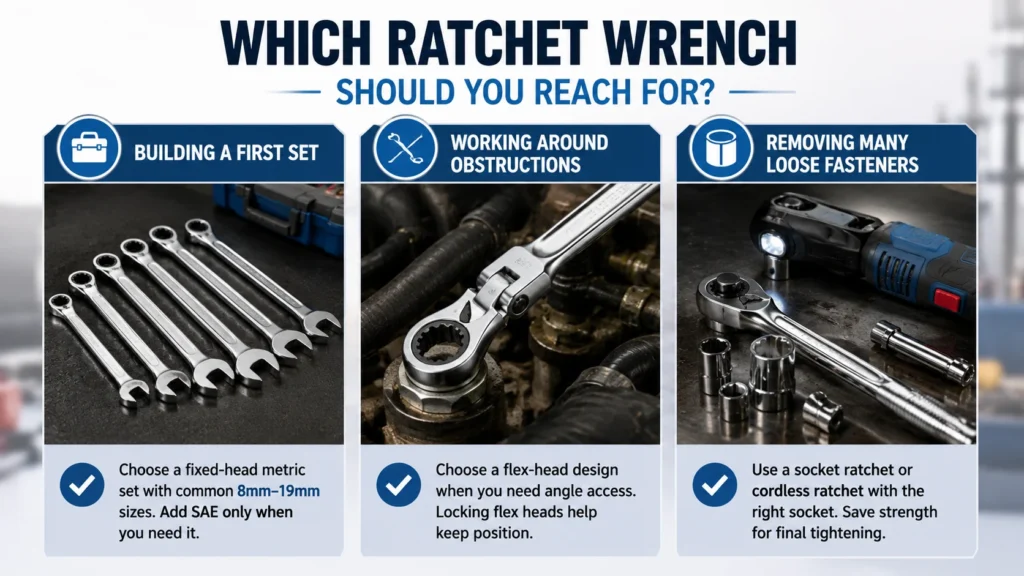
Building a first set
Choose a fixed-head metric ratcheting wrench set with the common 8mm through 19mm sizes. Add SAE only when your equipment needs it.
Working around obstructions
Choose a flex-head design when the handle needs to approach the fastener at an angle. Locking flex heads help keep the chosen position.
Removing many loose fasteners
Use a socket ratchet or cordless ratchet with the proper socket. Save hand-force tools for breakaway and final tightening when torque matters.
Tooth count, swing arc, and why a ratchet wrench is not always the torque tool
More ratchet teeth generally mean a smaller swing arc: a 72-tooth mechanism needs about 5 degrees of movement per click, while a 12-point box end can require more clearance depending on its design. This matters when a firewall, frame rail, or plumbing line limits handle travel.
Quality mechanisms feel positive rather than gritty, with minimal back-drag and a sturdy reversing switch where fitted. Brand comparisons—whether looking at a Craftsman ratchet wrench set, GearWrench 7-piece set, Icon ratchet wrench set, Harbor Freight option, or a specialty Astro Tools flex-head tool—should start with fit, access, warranty, and published ratings rather than a logo alone.
- Break a seized fastener loose with a standard wrench, breaker bar, or rated socket tool first.
- Follow manufacturer torque guidance, particularly with long flex-head and reversible ratcheting designs.
- Keep mechanisms clean and dry; wipe away grit and avoid soaking a ratcheting head in harsh solvent unless its maker approves it.
How to use ratchet wrenches without damaging fasteners or tools
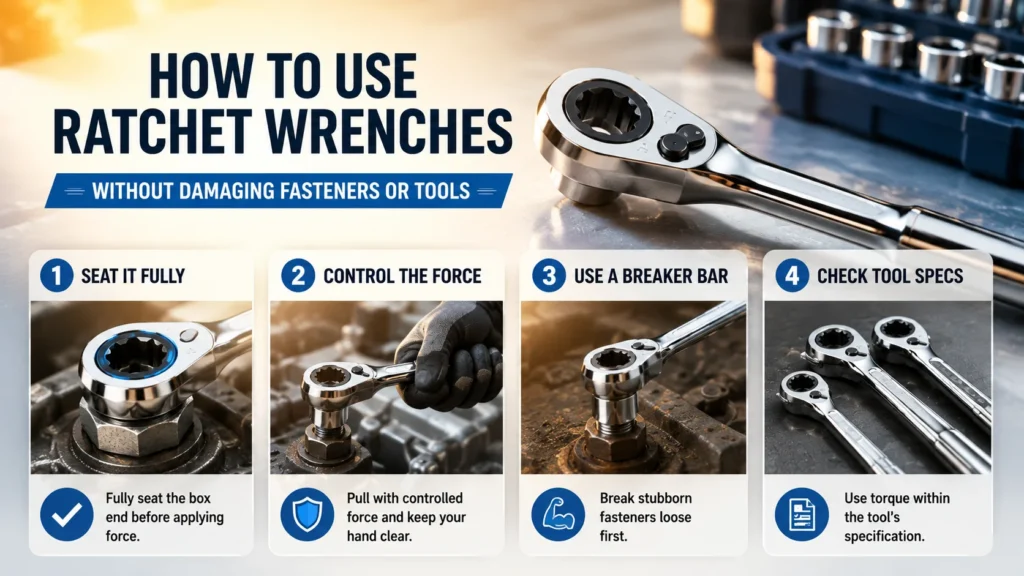
Ratcheting wrenches are speed tools, not a shortcut around sound fastener practice. Good fit, steady force, and the right tool for the torque protect both the fastener and your knuckles.
- Confirm the exact size and seat the box end all the way down before applying force. A loose fit can round corners quickly.
- Pull with controlled force where possible and keep your hand clear of sharp edges if the tool slips.
- Do not add a cheater bar to a ratcheting wrench unless the manufacturer specifically permits it; excess load can damage internal gears or a flex joint.
- Use a torque wrench for final tightening whenever a service specification matters. A ratcheting wrench cannot confirm torque by feel.
Ratchet wrench FAQs
Are flex-head ratchet wrenches worth buying?
They are worth it when fasteners sit behind hoses, brackets, or body panels that block a straight approach. For simple exposed work, a fixed-head wrench is thinner, usually less expensive, and often the tougher choice.
Can I use a ratcheting wrench to loosen tight bolts?
Only within the tool maker’s rating and when the fastener is in good condition. For high breakaway torque, start with a conventional box wrench, breaker bar, or socket setup, then switch to the ratcheting wrench once the fastener moves freely.
Is a cordless ratchet wrench a replacement for hand tools?
No. A cordless ratchet is excellent for spinning off long, already-loose fasteners and for repetitive assembly. You still need hand tools for initial breakaway, controlled final tightening, and jobs where access or torque requirements exceed the cordless tool’s rating.