

This guide explains what TIG welding is, how the tungsten arc, shielding gas, and filler rod work together, and what beginners should know before choosing equipment or striking an arc.
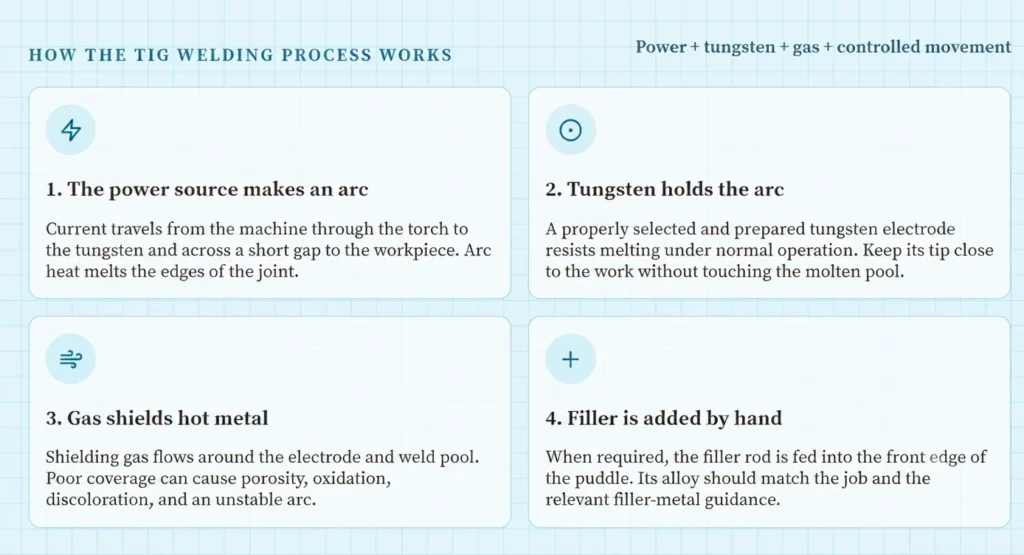
TIG welding—formally gas tungsten arc welding (GTAW)—uses a non-consumable tungsten electrode to create an arc that melts the joint. Inert shielding gas protects the hot metal, and the welder adds a separate filler rod only when the joint needs extra metal.
If you have seen a clean stainless exhaust weld, a neat aluminum repair, or a carefully finished motorcycle bracket, there is a good chance TIG welding was involved. It is valued for precise heat control and tidy results, but it asks the operator to manage the torch, arc length, travel, filler rod, and often a foot pedal at the same time.
What is TIG welding?
TIG stands for tungsten inert gas welding. The formal process name used in many standards and welding documents is gas tungsten arc welding, or GTAW. The name describes the essentials: a tungsten electrode carries current to create an electrical arc, while an inert shielding gas protects the electrode and molten weld pool from surrounding air.
Unlike MIG and stick welding, the electrode normally does not become part of the weld. The arc supplies heat to melt the base metal; a separate filler rod can be dipped into the leading edge of the weld pool when the joint design, gap, or approved welding procedure calls for added metal. Thin, tightly fitted joints may sometimes be fusion welded without filler.
Why tungsten and shielding gas matter
The tungsten electrode is central to TIG control. Its diameter, preparation, type, extension, and current capacity affect arc behavior. Do not assume one tungsten type or point shape works for every machine, current mode, alloy, or amperage. Follow the welding-machine, torch, and consumable manufacturer’s recommendations for the work you are doing.
Argon is commonly used for TIG work, but the correct shielding gas, cup size, and flow rate depend on the material, position, draft conditions, and procedure. Clean metal matters just as much: oil, moisture, paint, plating, mill scale, and shop debris can contaminate the weld or create hazardous fumes.
A basic beginner practice workflow
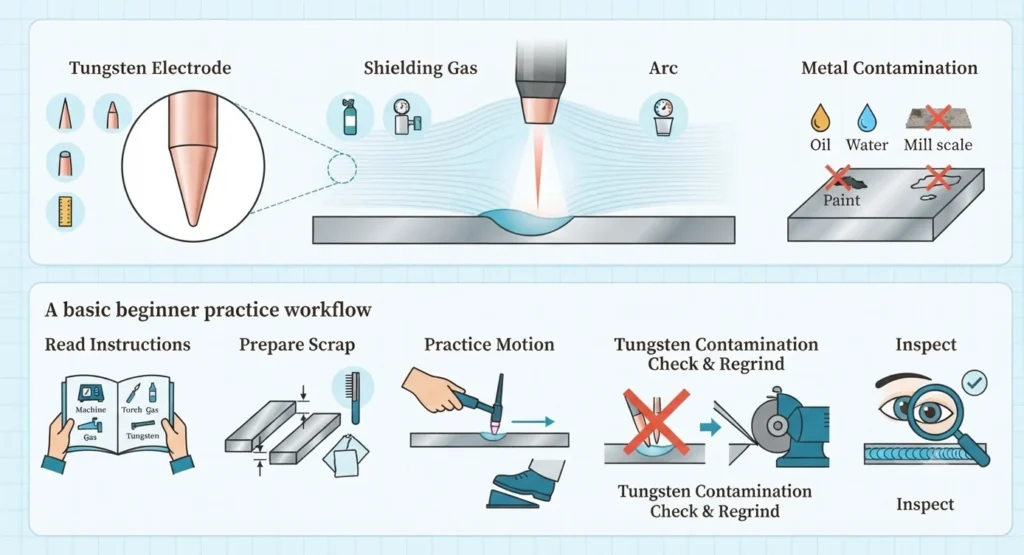
- Read the machine, torch, gas regulator, filler, and tungsten instructions before setting up. Confirm the work clamp has clean contact.
- Prepare low-risk scrap of the same material and thickness as the project. Remove surface contamination before welding.
- Practice holding a steady torch angle and a short, consistent arc length. Use controlled pedal pressure or amperage adjustment rather than rushing.
- If tungsten touches the weld pool, stop and regrind or replace the contaminated tip before continuing. Then inspect the weld before moving to a finished part.
AC versus DC TIG welding
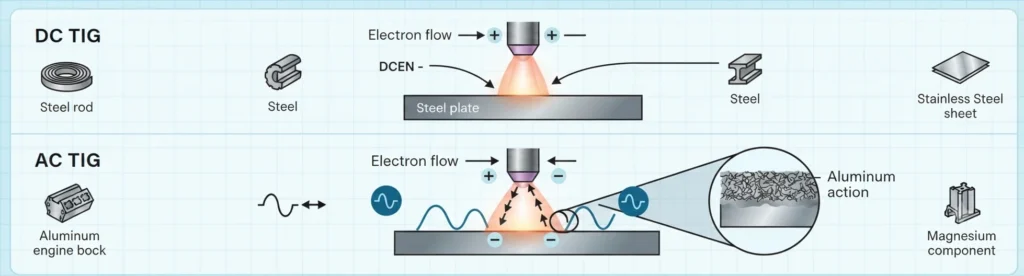
Current mode is an important setup choice, not a universal quality setting. Direct current and alternating current behave differently at the electrode and workpiece. Machine controls, alloy, thickness, joint design, tungsten choice, and the applicable procedure all influence the final settings.
| Current mode | Common use | Practical note |
|---|---|---|
| DC TIG | Often used for carbon steel, stainless steel, and many other metals. | Usually offers a focused arc and is a common starting point for steel practice. Confirm polarity and setup in the equipment guidance. |
| AC TIG | Commonly selected for aluminum and magnesium work. | Alternating current can help address aluminum oxide, but machine balance and frequency controls are not set-and-forget. Refer to a qualified procedure. |
What metals can TIG weld?
TIG is used across many fabrication and repair tasks because it gives the welder direct control over heat input and filler addition. Suitability still depends on the exact alloy, condition, thickness, joint, and procedure—not just the metal category.
Stainless steel
A popular TIG application for exhaust systems, food-grade fabrication, tube, and visible finish work. Cleanliness and heat control help limit discoloration and distortion.
Aluminum
TIG can produce precise aluminum welds and repairs, but oxide removal, AC capability, preparation, and heat management are especially important.
Mild and carbon steel
Useful for brackets, furniture, automotive fabrication, and precision repairs where a slower, more controlled process is worthwhile.
Thin sheet and tube
TIG’s fine heat control can help with thin material, but it can still warp or burn through. Fit-up, tack spacing, and travel speed remain critical.
TIG versus MIG and stick welding
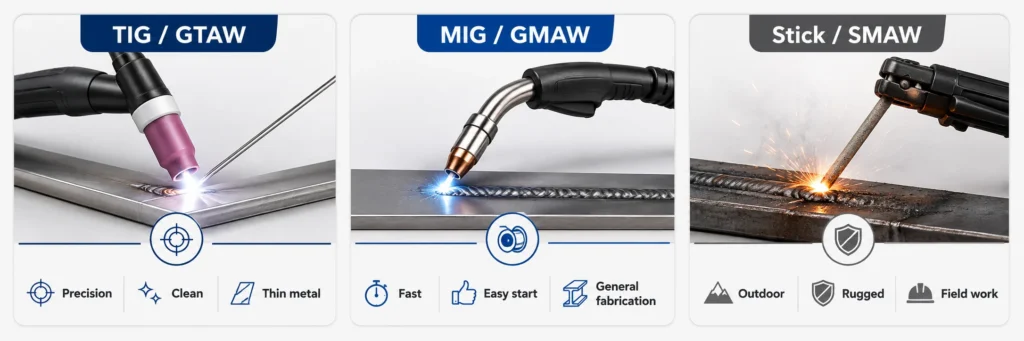
TIG is not automatically the strongest or best process. The right choice depends on the material, working environment, required speed, weld position, finish expectations, and the procedure required for the job.
TIG / GTAW
Excellent for precision, thin material, clean visible work, and controlled heat input. It is slower and generally takes more coordination to learn.
MIG / GMAW
Uses a continuously fed consumable wire. Often faster and easier to begin with for many fabrication jobs, but still needs correct setup and gas protection.
Stick / SMAW
Uses a flux-coated consumable electrode and is widely used for field work. It can be practical outdoors but usually requires more cleanup than TIG.
Common TIG welding mistakes beginners can avoid
Most early TIG problems are not solved by turning up the amperage. They are usually connected to preparation, arc length, contamination, gas coverage, or trying to move too quickly before the puddle is understood.
Watch for these practical warning signs
- A tungsten dipped into the puddle: stop and regrind it. Continuing can leave a wandering, contaminated arc.
- Porosity or dull, dirty-looking welds: check material cleaning, gas flow, hose connections, cup position, and drafts.
- A wide, overheated puddle: reduce heat input, improve fit-up, or change travel technique rather than simply adding more filler.
- A filler rod that oxidizes before reaching the puddle: keep its hot end inside the shielding gas envelope and use deliberate dips.
What to look for when buying a TIG welder
A beginner does not need every advanced feature, but the machine must suit the materials and power available in the workspace. Compare published specifications, included accessories, consumable availability, warranty support, and the documentation behind the headline claims.
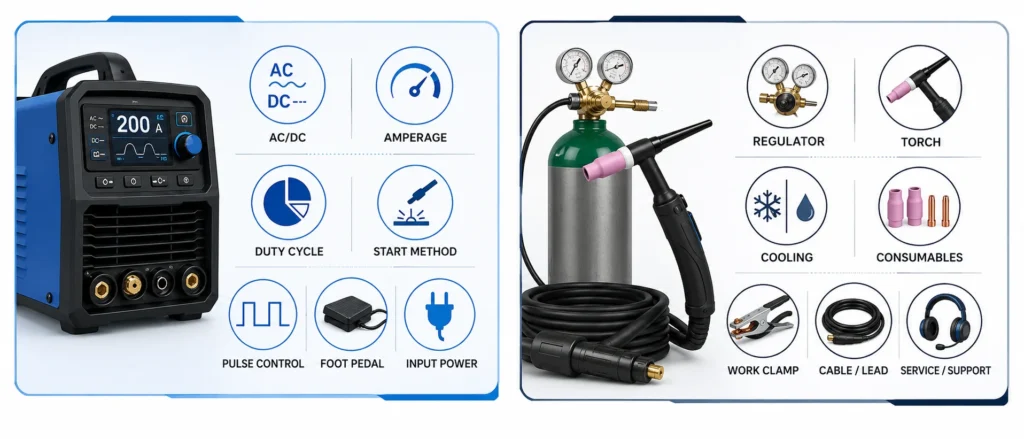
Machine capability
Check AC/DC capability, usable amperage range, low-amperage stability, duty cycle, input-power requirements, start method, pulse controls, and foot-pedal compatibility. AC capability is especially relevant if aluminum work is part of the plan.
Torch, gas, and support gear
Confirm regulator compatibility, torch cooling method, lead length, replacement consumables, work clamp quality, and local service support. Air-cooled and water-cooled torches have different practical limits.
Frequently asked questions
Is TIG welding difficult to learn?
TIG is often more demanding at the start because the operator controls the torch and, when required, the filler rod separately while managing heat. It becomes more approachable when you practice on clean scrap, use a stable setup, and focus first on consistent arc length and puddle control.
Do I always need a filler rod for TIG welding?
No. Some thin, closely fitted joints can be fusion welded without adding filler. Many joints need filler to build the correct weld profile, bridge a gap, reinforce the joint, or meet an approved procedure. Match the filler selection to the base material and application.
Can TIG welding be used outdoors?
Wind can disrupt shielding gas and create porosity or contamination, so TIG is generally best protected from drafts. Do not improvise unsafe enclosures; use suitable wind protection and follow the procedure, equipment instructions, and site safety rules.