

A practical guide to torque range, drive sizes, tool types, and accurate tightening—without guessing at safety-critical specifications.
A torque wrench is a precision hand tool that applies a measured turning force to a fastener. Its torque range tells you the lowest and highest settings it is designed to measure reliably.
An ordinary ratchet can turn a bolt, but it cannot tell you how tightly that bolt is clamping a wheel, brake part, spark plug, bicycle stem, or machine component. A torque wrench helps you stop at the specification set by the vehicle or equipment manufacturer. That difference matters: too little torque can let a joint loosen, while too much can stretch a bolt, strip threads, warp a component, or damage a delicate part.
What does a torque wrench actually measure?
Torque is rotational force. Think of pushing a door at its handle: the same push applied farther from the hinge creates more turning effect. A torque wrench combines force at the handle with the length of the tool and displays or signals the resulting value. Common units are Newton-metres (Nm), foot-pounds (ft-lb), and inch-pounds (in-lb).
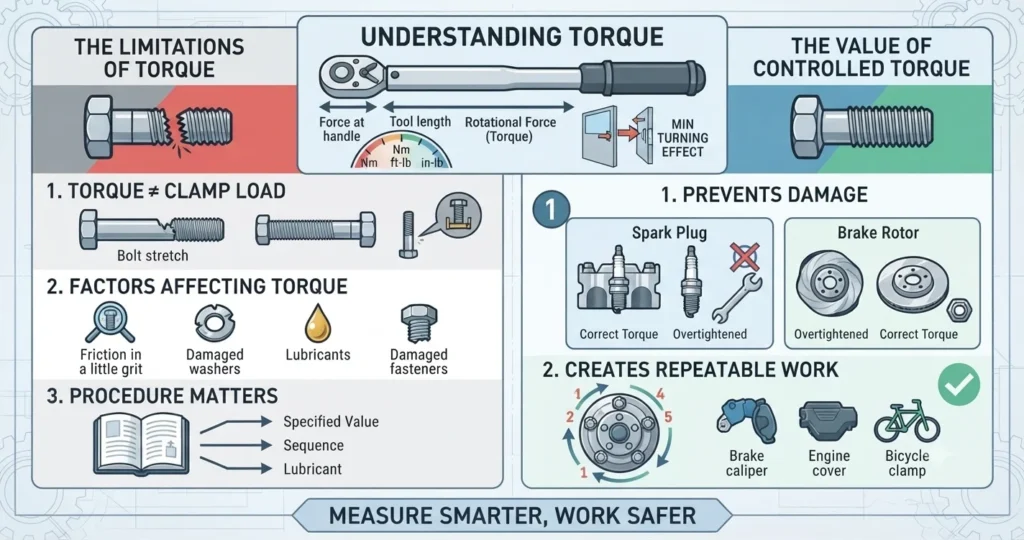
Torque does not directly measure bolt stretch or clamp load. Friction in threads, washers, lubricants, and damaged fasteners can change the result. That is why the exact service procedure matters: use the specified fastener condition, sequence, lubricant, and torque value for your vehicle or equipment.
Prevents avoidable damage
Overtightening a spark plug can damage threads in an aluminum cylinder head. Overtightening a wheel fastener can stretch it or distort a brake rotor. A measured tool reduces the temptation to tighten “until it feels right.”
Creates repeatable work
Torque control is useful when several fasteners must share load evenly, such as wheel nuts, brake hardware, engine covers, bicycle clamps, and machinery assemblies.
What does torque range mean?
Torque range is the span of settings a wrench can apply or indicate—for example, 20 to 100 Nm. It is not a claim that every setting is equally convenient or equally well suited to every job. Many torque wrenches are most dependable when used away from the extreme ends of their stated range, so a tool that places your regular jobs near its middle is usually the better choice.
One large wrench is rarely the best answer for every task. Small fasteners, including many bicycle, motorcycle, and engine jobs, need lower settings and finer resolution. A larger wrench is more appropriate for higher-torque automotive suspension, wheel, and equipment fasteners. Two overlapping tools often provide better control than one very broad-range tool.
Do not use generic torque figures for critical work
Wheel nuts, brake components, suspension hardware, engine fasteners, and structural assemblies require the specification for your exact vehicle, model year, component, and fastener. Check the service manual or official equipment documentation before tightening.
Torque range, units, and drive size at a glance
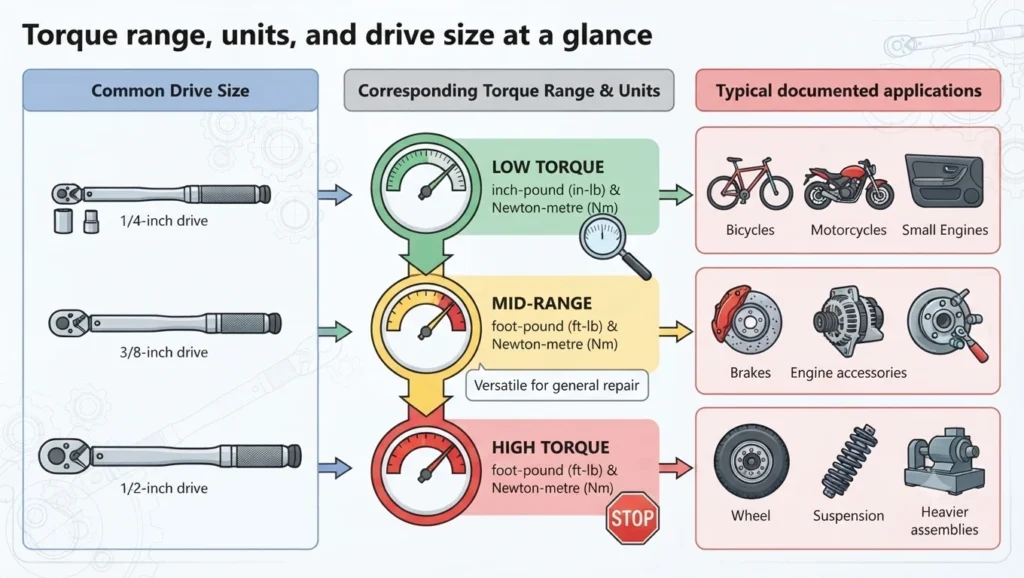
Drive size describes the square end that accepts the socket; it does not guarantee a torque value. In broad terms, ¼-inch tools suit smaller fasteners, ⅜-inch tools cover many general repair tasks, and ½-inch tools are common for larger automotive work. Always choose the range and socket size required by the documented job.
| Typical range category | Common drive | Often used for | Selection note |
|---|---|---|---|
| Low torque / inch-pound | ¼-inch | Bicycles, motorcycles, small engine and interior fasteners | Choose fine scale markings for small specifications. |
| Mid-range | ⅜-inch | Brakes, engine accessories, general vehicle repairs | A versatile starting point for many DIY mechanics. |
| Higher torque | ½-inch | Wheel, suspension, machinery, and heavier assemblies | Avoid using it for delicate, low-torque fasteners. |
Click, digital, beam, and split-beam torque wrenches
Each type can be useful when it is within calibration and used according to its instructions. The best choice depends on how often you use it, the precision you need, the available light, and whether you prefer a physical click or a visible reading.
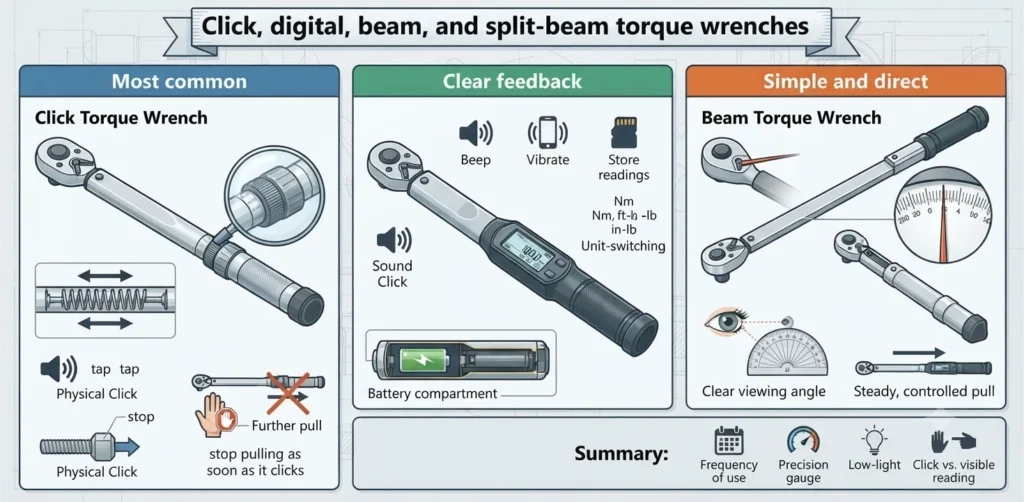
Most common
Click torque wrench
A spring-loaded mechanism clicks when the preset torque is reached. It is straightforward and widely available, but stop pulling as soon as it clicks. Continuing to pull can overtighten the fastener.
Clear feedback
Digital torque wrench
A display shows the applied torque and may beep, vibrate, store readings, or switch units. It can be easier to read, but batteries, operating instructions, and proper calibration still matter.
Simple and direct
Beam torque wrench
A pointer moves across a scale as you pull. Beam wrenches are simple and need no preset mechanism, but require a clear viewing angle and steady technique to read accurately.
How to use a torque wrench correctly
Follow the manufacturer’s instructions for your particular wrench as well as the service procedure for the component. These steps cover the safe general method.
- Find the exact torque specification and tightening sequence in the appropriate vehicle, bicycle, machinery, or equipment documentation.
- Inspect threads, fasteners, and seating surfaces. Use only the specified lubricant, thread locker, washer, or replacement hardware.
- Set the wrench to the required unit and value. Select a range that places the specification comfortably inside the tool’s working span.
- Tighten gradually and smoothly by the handle grip. Keep the wrench square to the fastener and follow any cross-pattern or staged tightening sequence.
- At the click, beep, or target reading, stop immediately. Never use a torque wrench as a breaker bar to loosen stubborn fasteners.
Accuracy, calibration, and storage
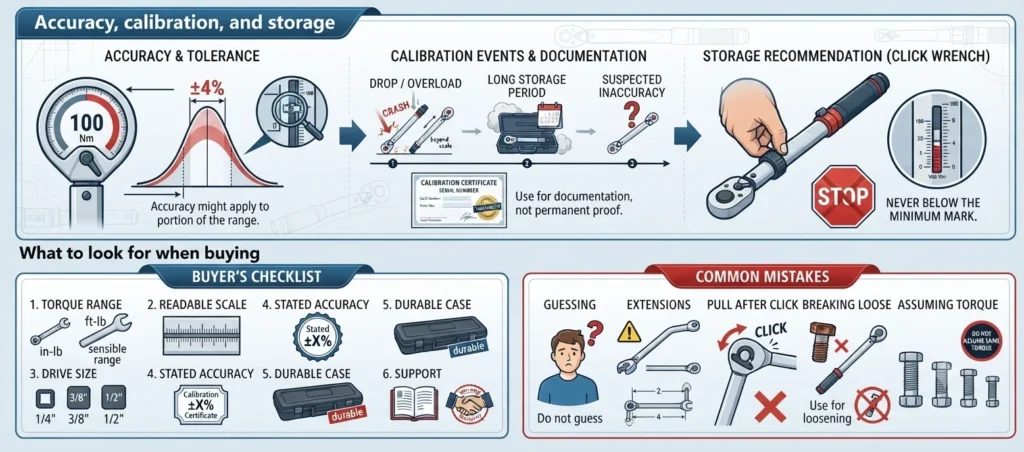
Accuracy claims are usually expressed as a tolerance, such as ±4%, and may apply only in a stated direction or portion of the range. Treat a calibration certificate as useful documentation, not permanent proof. Follow the wrench maker’s recalibration interval and have the tool checked after a drop, overload, long storage period, or suspected inaccurate reading. For many adjustable click wrenches, the maker also recommends returning the setting to the lowest indicated value before storing it—never below the minimum mark.
What to look for when buying
Prioritize a sensible torque range, readable scale, suitable drive size, stated accuracy, clear instruction manual, durable case, and accessible calibration or warranty support. A certificate and serial number improve traceability.
Common mistakes to avoid
Do not guess critical specifications, use extensions without understanding their effect, pull after the click, use the wrench to break fasteners loose, or assume every bolt of the same size needs the same torque.
Frequently asked questions
Can one Torque wrench handle every job?
Usually not well. A low-range wrench gives better control for delicate fasteners, while a larger tool better suits high-torque work. Many active DIY mechanics eventually use two overlapping ranges.
How do I convert NM, ft-1b and in-1b?
Use the unit stated by the manufacturer whenever possible. Roughly, 1 ft-lb equals 1.356 Nm, and 1 ft-lb equals 12 in-lb. For a safety-critical task, use a reliable conversion source and avoid rounding casually.
How often should a torque wrench be a clibrated?
Follow the wrench manufacturer’s instructions. Frequency depends on use, handling, and required confidence level. A professional or high-use environment may need more frequent verification than occasional home use.