Quick, clearly labeled torque guidance for common coarse-thread fasteners—plus the context you need before putting a wrench on the bolt.
Use the vehicle, machine, or engineered-joint manufacturer’s torque specification whenever one exists. These charts are general reference values for standard fasteners only; they do not override torque-to-yield procedures, critical structural joints, wheel fasteners, engine internals, or assemblies with a specified lubricant, coating, washer, or tightening sequence.
Bolt torque chart: use the right row, grade, and condition
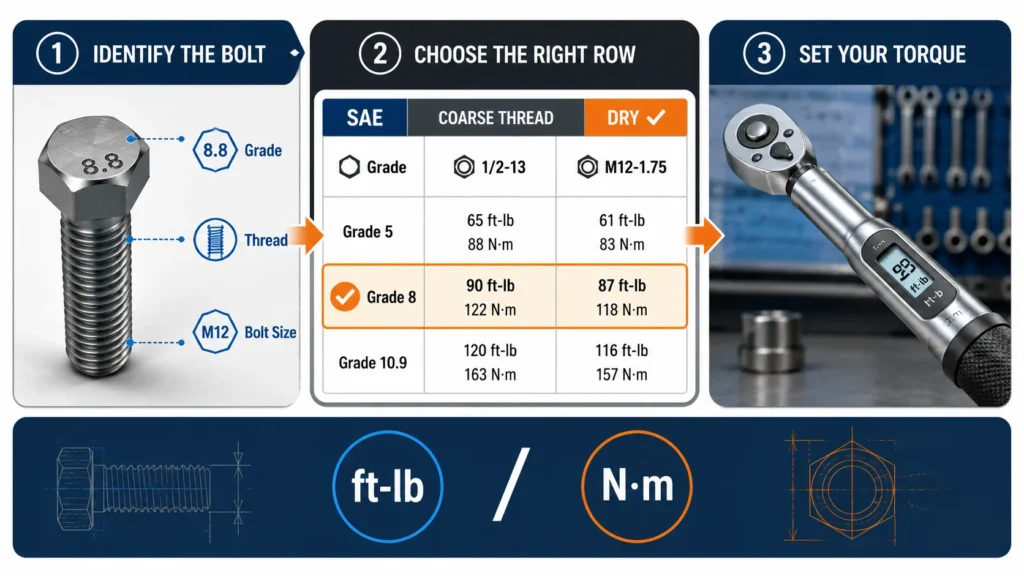
Find the nominal bolt size and thread series or pitch, then match the fastener’s grade or property class. The values below are approximate dry-torque reference values and include both ft-lb and N·m so you can work in the units your torque wrench uses.
SAE bolt torque table — coarse thread, dry
Values shown as ft-lb (N·m). For bolts smaller than 1/4 in., use an inch-pound torque wrench and a source specific to that fastener.
DRY THREADS
| Bolt size | UNC threads/in. | Grade 2 | Grade 5 | Grade 8 |
|---|---|---|---|---|
| 1/4 in. | 20 | 6 ft-lb (8 N·m) | 9 ft-lb (12 N·m) | 13 ft-lb (18 N·m) |
| 5/16 in. | 18 | 12 ft-lb (16 N·m) | 18 ft-lb (24 N·m) | 28 ft-lb (38 N·m) |
| 3/8 in. | 16 | 23 ft-lb (31 N·m) | 35 ft-lb (47 N·m) | 50 ft-lb (68 N·m) |
| 7/16 in. | 14 | 36 ft-lb (49 N·m) | 55 ft-lb (75 N·m) | 80 ft-lb (108 N·m) |
| 1/2 in. | 13 | 55 ft-lb (75 N·m) | 85 ft-lb (115 N·m) | 120 ft-lb (163 N·m) |
| 5/8 in. | 11 | 110 ft-lb (149 N·m) | 170 ft-lb (230 N·m) | 240 ft-lb (325 N·m) |
Metric bolt torque table — coarse pitch, dry
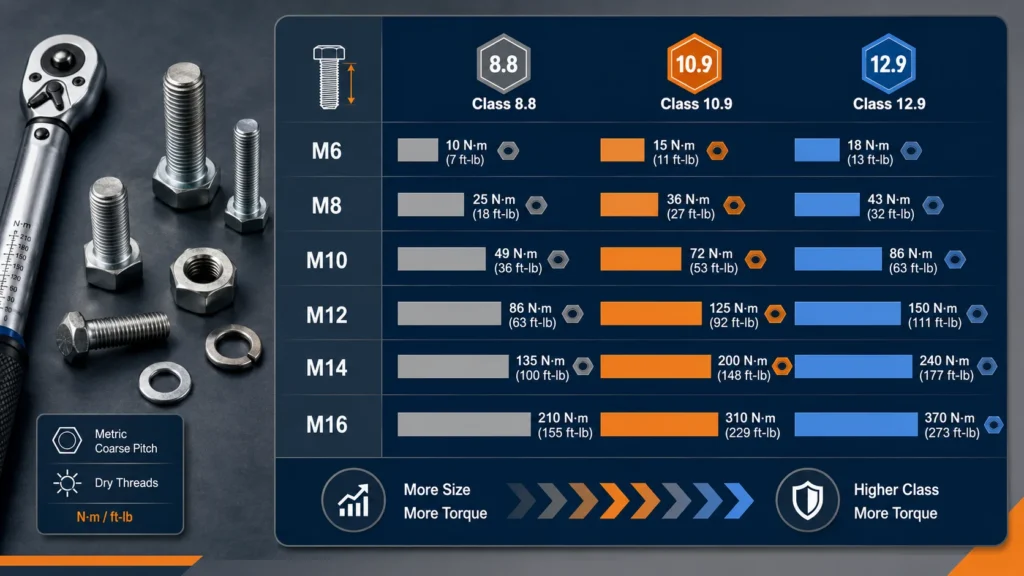
Values shown as N·m (ft-lb). Metric property class is normally marked on the fastener head, for example 8.8 or 10.9.
DRY THREADS
| Bolt size | Coarse pitch | Class 8.8 | Class 10.9 | Class 12.9 |
|---|---|---|---|---|
| M6 | 1.0 mm | 10 N·m (7 ft-lb) | 15 N·m (11 ft-lb) | 18 N·m (13 ft-lb) |
| M8 | 1.25 mm | 25 N·m (18 ft-lb) | 36 N·m (27 ft-lb) | 43 N·m (32 ft-lb) |
| M10 | 1.5 mm | 49 N·m (36 ft-lb) | 72 N·m (53 ft-lb) | 86 N·m (63 ft-lb) |
| M12 | 1.75 mm | 86 N·m (63 ft-lb) | 125 N·m (92 ft-lb) | 150 N·m (111 ft-lb) |
| M14 | 2.0 mm | 135 N·m (100 ft-lb) | 200 N·m (148 ft-lb) | 240 N·m (177 ft-lb) |
| M16 | 2.0 mm | 210 N·m (155 ft-lb) | 310 N·m (229 ft-lb) | 370 N·m (273 ft-lb) |
Dry vs. lubricated bolts: why the same number can be wrong
Torque is only an indirect way to create preload. Much of the turning effort is lost to friction under the bolt head and in the threads. Adding oil, grease, anti-seize, or some coatings can reduce friction enough that using a dry torque value may overtighten the fastener.
Dry, clean threads
Use the chart only when its stated dry condition matches the actual assembly. Remove debris, chase damaged threads when appropriate, and ensure the nut runs freely by hand before final tightening.
Lubricated, coated, or anti-seize threads
Use the torque supplied by the manufacturer of the assembly or lubricant. A common rule-of-thumb reduction is not a reliable engineering specification because friction, finish, and joint design all change the result.
How to use a torque wrench correctly
A torque wrench is a precision measuring tool. Correct fastener identification and joint preparation are just as important as the final setting.
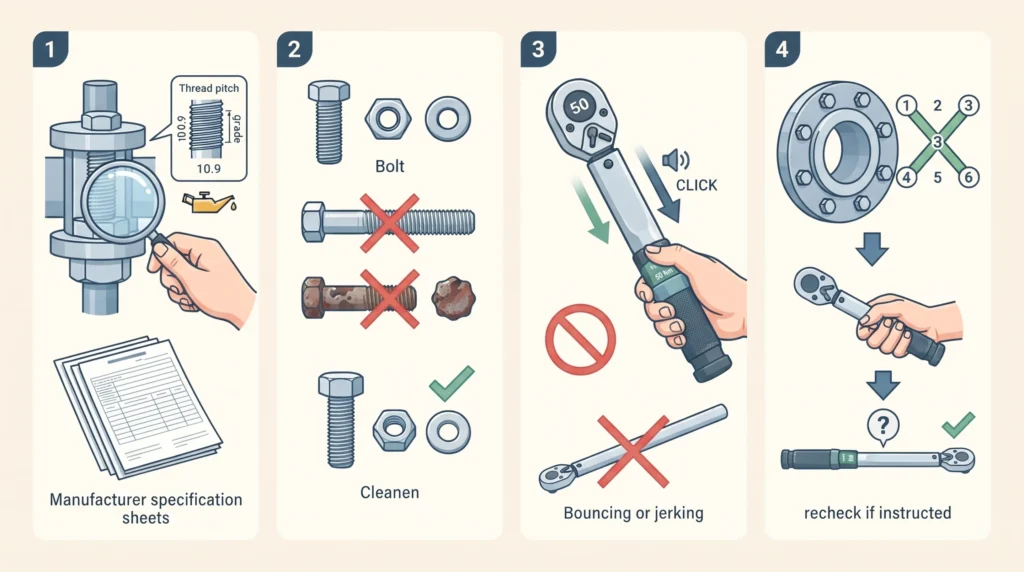
- Confirm the manufacturer specification first, then identify the exact bolt size, thread pitch, grade or property class, and intended lubrication condition.
- Inspect the bolt, nut, washer, and threads. Replace stretched, corroded, damaged, or unknown fasteners rather than trying to torque around a defect.
- Set a calibrated torque wrench within its working range. Pull smoothly at the handle grip until it clicks or indicates the target—do not jerk, bounce, or use extensions unless the procedure accounts for them.
- For multi-bolt covers, wheels, heads, flanges, and similar joints, follow the specified sequence and staged tightening pattern. Recheck only if the manufacturer procedure instructs you to do so.
Bolt torque chart FAQs
Can I use a generic bolt torque chart for automotive repairs?
Only as a fallback for a non-critical standard fastener when no vehicle specification applies. Automotive service manuals take priority because components may use special bolt designs, torque-angle tightening, coatings, stretch bolts, sealing requirements, aluminum threads, or a required sequence.
Does thread pitch change torque?
Yes. A fine-thread bolt and coarse-thread bolt of the same nominal diameter have different thread geometry and tensile-stress area, so they should not automatically use the same torque. Match the chart or service specification to the actual pitch.
What is the difference between SAE Grade 5 and Grade 8, or metric 8.8 and 10.9?
The markings indicate strength classifications. Higher-grade or higher-property-class fasteners can generally tolerate more preload, but they are not interchangeable by torque alone. The joint design determines which fastener and torque are correct.