
Learn what a combination wrench is, why the box end grips differently, which sizes matter most, and how to choose a wrench set that suits real repair work.
A combination wrench has an open end on one side and a same-size box end on the other. A dedicated box-end wrench has enclosed ends at both sides. Use the open end when you need side access or quick repositioning; use the box end when you want more contact around the fastener and a lower risk of rounding its corners.
What is a combination wrench, and is it the same as a box wrench?
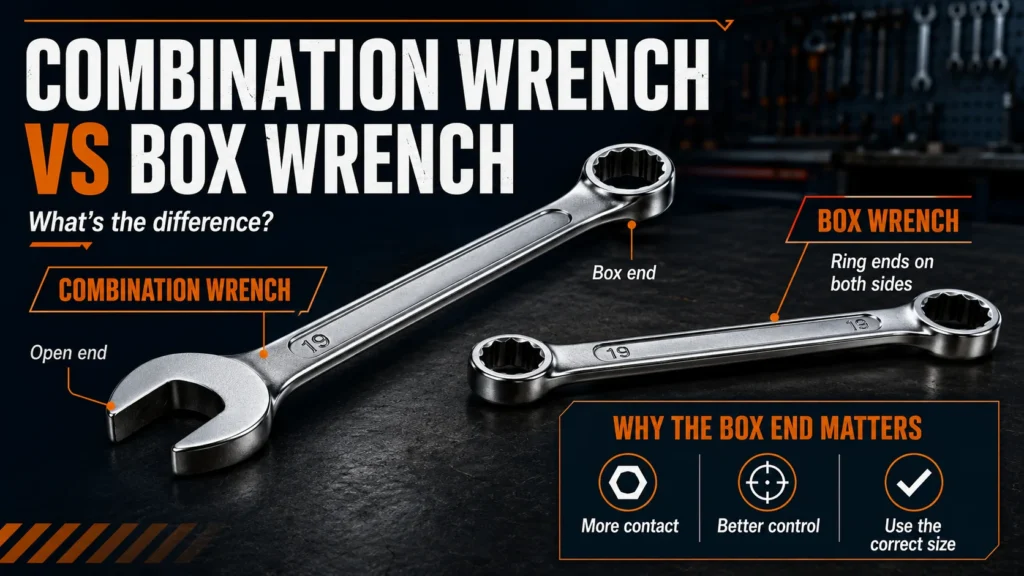
A combination wrench, often called a combo wrench, pairs two head styles on one handle: an open jaw at one end and an enclosed box end at the other. Both ends are normally the same size, such as 13 mm or 1/2 inch. That makes a combination wrench a versatile everyday choice for nuts and bolt heads with standard hex flats.
The phrases box wrench, box-end wrench, boxed end wrench, and box end of a wrench are used inconsistently. In practical use, a box end means the closed ring that slips over a fastener from above. A dedicated double box-end wrench has ring ends at both sides, usually in two different sizes. It is especially useful where side access is blocked.
Why the box end matters
The box end surrounds far more of a correctly sized fastener than an open jaw. This spreads load across more contact points and generally gives better control on tight or slightly stubborn hardware. It is not unlimited torque capacity: wrench quality, fastener condition, full seating, and the manufacturer’s rating still matter.
Open end versus box end: choose access first, then grip
Neither end is automatically better for every task. The right choice depends on whether the wrench can approach the fastener from above, how much swing room is available, and how tight or damaged the hardware is. Starting with the best-fitting end helps prevent rounded corners before they become a larger repair problem.
Open end: fast side access
Slide an open end over a nut from the side when tubing, wiring, a stud, or a nearby surface prevents the wrench from dropping over the top. It is also convenient for quick turns after a fastener is already loose.
Box end: better engagement
Choose the box end when it fits over the fastener and you need stronger engagement. Seat it fully before pulling. This is usually the preferred end for breaking free ordinary tight fasteners or applying controlled final tightening.
Offset box ends: knuckle clearance

Many combination and double box-end wrenches have a shallow offset near the ring. The raised handle clears a nut sitting against a flat surface and gives your fingers room, but the angle may require more vertical access.
Double box-end: access-focused

A double box wrench trades the open jaw for a second enclosed ring. Angled or deeply offset versions reach recessed nuts, fittings, and cramped machinery where a combination wrench cannot approach cleanly from the side.
Combination wrench sizes worth owning first
Buy the measuring system your equipment actually uses. Metric sizes dominate most modern vehicles, bicycles, appliances, and imported machinery. SAE, also called inch or imperial sizing in many tool catalogs, remains common on older North American equipment and some household hardware. A practical workshop often benefits from both, but they should not be treated as interchangeable.
| Size range | Common use | Buying note |
|---|---|---|
| 8 mm–10 mm | Small brackets, clamps, battery hardware, trim fasteners | High-use range for automotive and appliance repairs |
| 11 mm–13 mm | General vehicle, bicycle, equipment, and furniture fasteners | Core sizes for a first metric set |
| 14 mm–17 mm | Engine accessories, mounts, larger brackets, machinery | A longer-pattern wrench can add useful leverage |
| 18 mm–19 mm | Suspension, agricultural equipment, and larger hardware | Check service information before final tightening |
| SAE 3/8 in.–3/4 in. | Older domestic equipment and mixed-system workshops | Useful alongside—not instead of—a metric set |
6-point versus 12-point box ends: strength, access, and fit
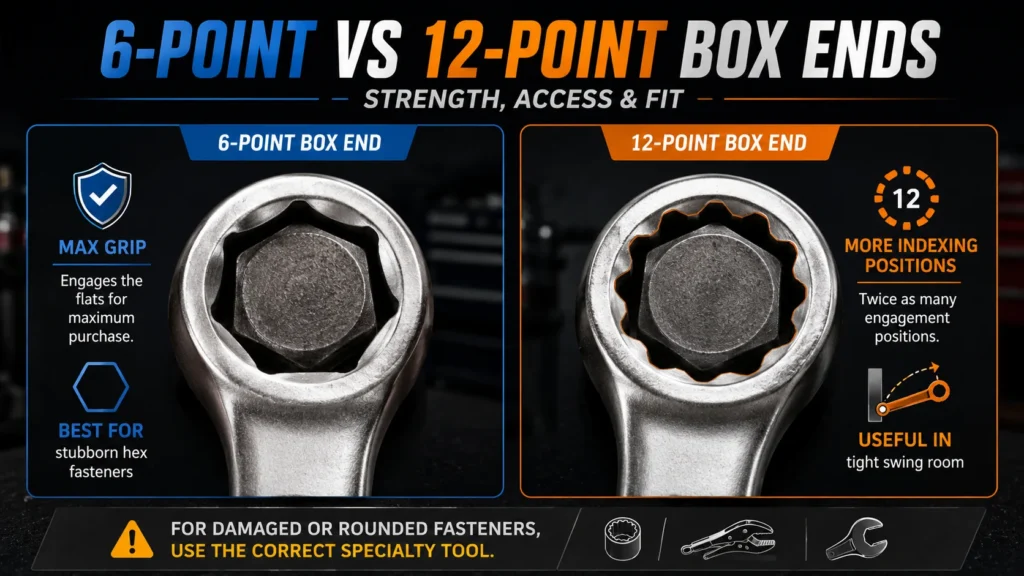
The points describe the internal shape of the box end. A 6-point box end aligns with the six flats of a standard hex fastener. A 12-point box end has twice as many engagement positions, so it can be placed onto the fastener with less handle rotation, useful where swing room is tight.
For a clean, ordinary hex fastener, both styles can work well when the wrench is accurately made and fully seated. Many technicians favor 6-point tools for stubborn or corroded hex hardware because their geometry engages closer to the flats. A 12-point box end is common in general combination wrench sets because its extra indexing positions are convenient.
- Use a 6-point box end where maximum purchase on a standard hex fastener is the priority.
- Use a 12-point box end when restricted swing room makes frequent repositioning necessary.
- For rounded, seized, or safety-critical fasteners, stop before damage escalates and choose the correct specialty tool or repair method.
What should a first wrench combination set include?
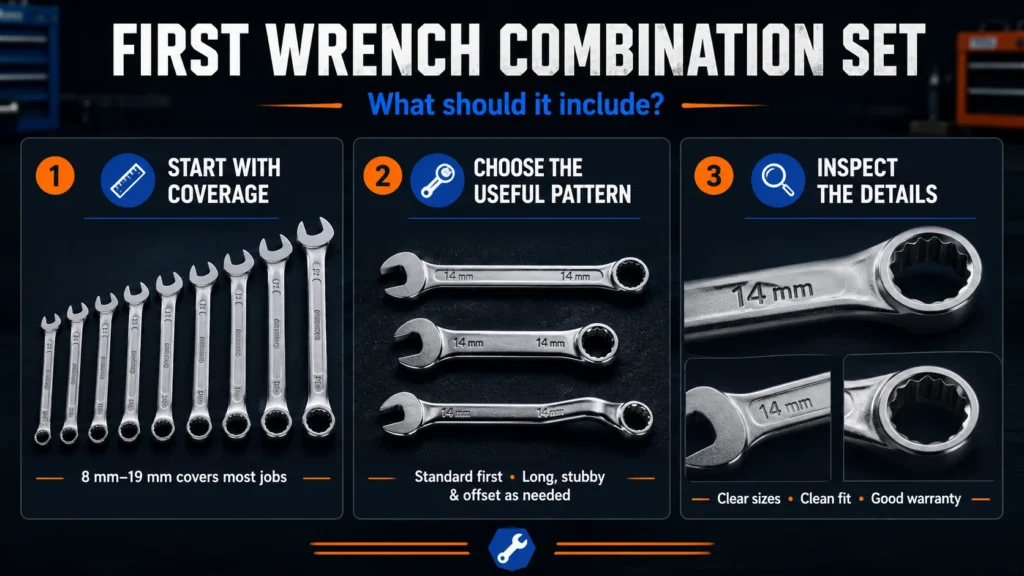
Start with coverage
For most metric repair work, a set spanning roughly 8 mm through 19 mm covers the sizes you will reach for first. Add smaller or larger sizes only when your equipment calls for them.
Choose the useful pattern
Standard-length combination wrenches handle most work. Long-pattern tools add leverage and reach; stubby and offset box-end wrenches earn their place when access matters more than force.
Inspect the practical details
Look for clearly stamped sizes, clean head geometry, a finish you can keep clean, and a warranty that matches your use. Fit and consistent manufacturing matter more than an oversized set full of rarely used pieces.
How to use combination and box-end wrenches without damaging fasteners
Good wrench technique protects the hardware, the tool, and your hands. The strongest-looking wrench is still the wrong choice if it is loose on the fastener, partly engaged, or being forced far beyond the intended job.
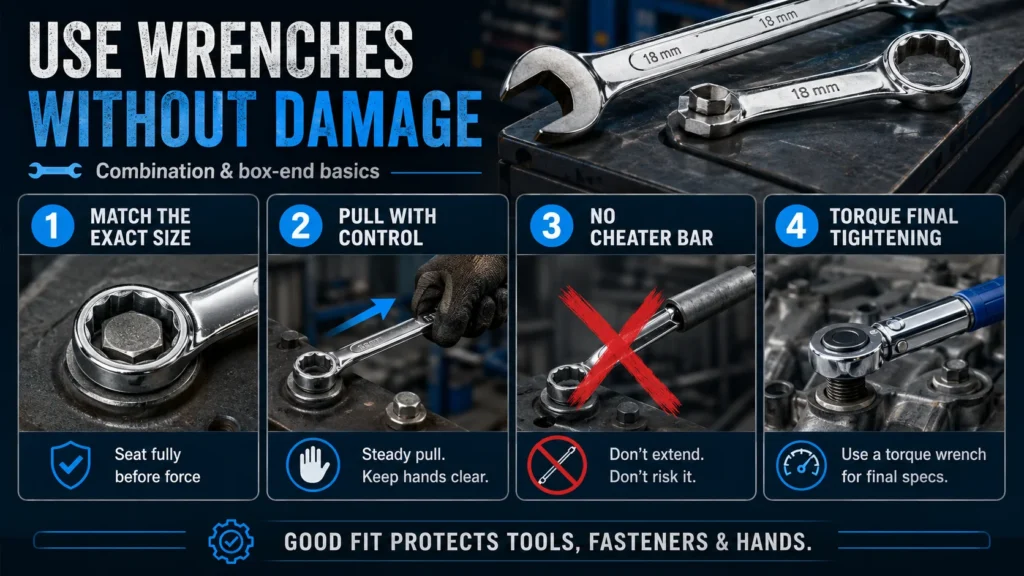
- Confirm the exact size and seat the box end fully over the fastener before applying force. If the wrench rocks or slips on easily, stop and verify the size.
- Pull with controlled force where possible and keep your hand clear of sharp edges in case the wrench slips. Avoid sudden jerks that can damage hardware or injure your knuckles.
- Do not extend a wrench with a cheater bar unless the manufacturer specifically permits it. Extra leverage can overload the tool, stretch a fastener, or cause abrupt failure.
- Use a torque wrench for final tightening whenever a service specification matters. A combination wrench can turn a fastener, but it cannot verify torque by feel.
Combination and box-end wrench FAQs
Is a box wrench the same as a box-end wrench?
Usually, yes. In everyday tool language, box wrench commonly refers to a wrench with enclosed box ends. A combination wrench includes one box end, while a double box-end wrench has enclosed ends on both sides.
Can a box-end wrench handle more torque than an open-end wrench?
A fully seated box end generally engages more of the fastener and is less likely to spread or slip than an open end. That often makes it the better choice for tight hardware, but safe torque still depends on the tool’s rating, the fastener’s condition, and correct technique.
Are ratcheting box-end wrenches the same as conventional box-end wrenches?
No. A ratcheting box end contains an internal mechanism that lets the handle return without removing the wrench. It is useful for speed in confined spaces, but a conventional box end is simpler and is often the better choice for initial breakaway or high-load work unless the ratcheting wrench is specifically rated for it.