
A practical guide to hex keys: where the name came from, how metric and SAE sizes differ, which style to use, and how to protect both the tool and fastener.
The quick answer
An Allen wrench, Allen key, and hex key generally describe the same basic tool: a six-sided driver made for a hexagonal socket screw. “Allen” is a brand-associated name, while “hex key” is the generic term.
What is an Allen wrench?
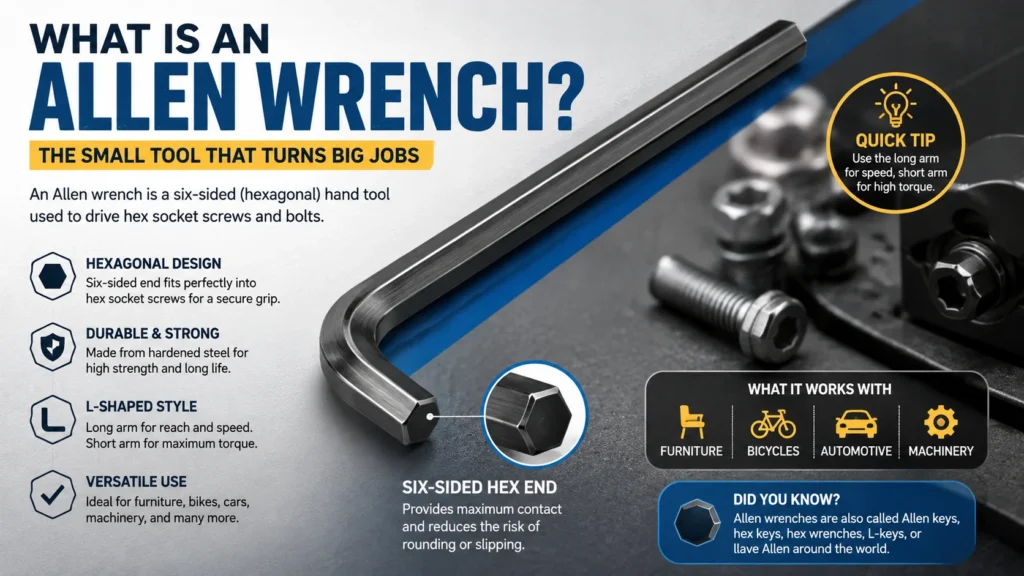
An Allen wrench is a compact hand tool with a six-sided, or hexagonal, cross-section. Its end fits into the matching six-sided recess in a screw or bolt head. The tool is commonly called an Allen key, hex key, hex wrench, L-key, or—internationally—llave Allen.
The classic version is an L-shaped piece of hardened steel. One arm reaches into recessed hardware; the other acts as a handle. That simple shape gives two useful options: use the long arm for reach and faster turning, or use the short arm for greater turning leverage.
The parts that matter
Hex fasteners are measured across the flats of the socket. A correctly sized key fills that socket with very little play.
- Straight tip: provides the fullest contact and should be your default choice for loosening or final tightening.
- Ball end: lets you turn a fastener from an angle when a frame or panel blocks straight access.
- Long and short arms: the same key offers a trade-off between reach, speed, and leverage.
Why is it called an Allen wrench?
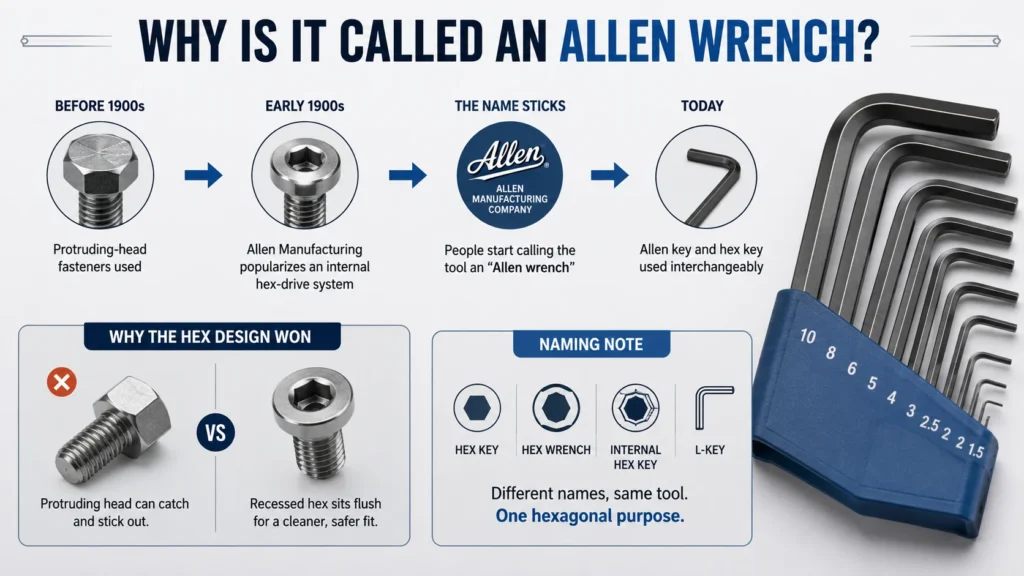
The generic name is hex key because the tool drives a hexagonal socket. “Allen wrench” became common in everyday language after the Allen Manufacturing Company popularized an internal hex-drive system in the early twentieth century.
The recessed design offered a practical advantage over many protruding-head fasteners: it could sit more flush with machinery and was less likely to catch on clothing, equipment, or surrounding parts. Today, the names Allen key and hex key are often used interchangeably, even though hex key is the broader generic term.
Naming note: “Allen wrench” is widely understood, but product labels may use hex key, hex wrench, internal hex key, or L-key.
How hex keys are made—and why material matters
Most quality hex keys are made from hardened alloy steel. The exact alloy and heat treatment vary by maker, but the goal is consistent: the key needs enough hardness to resist wear while still having enough toughness to avoid snapping under normal use.
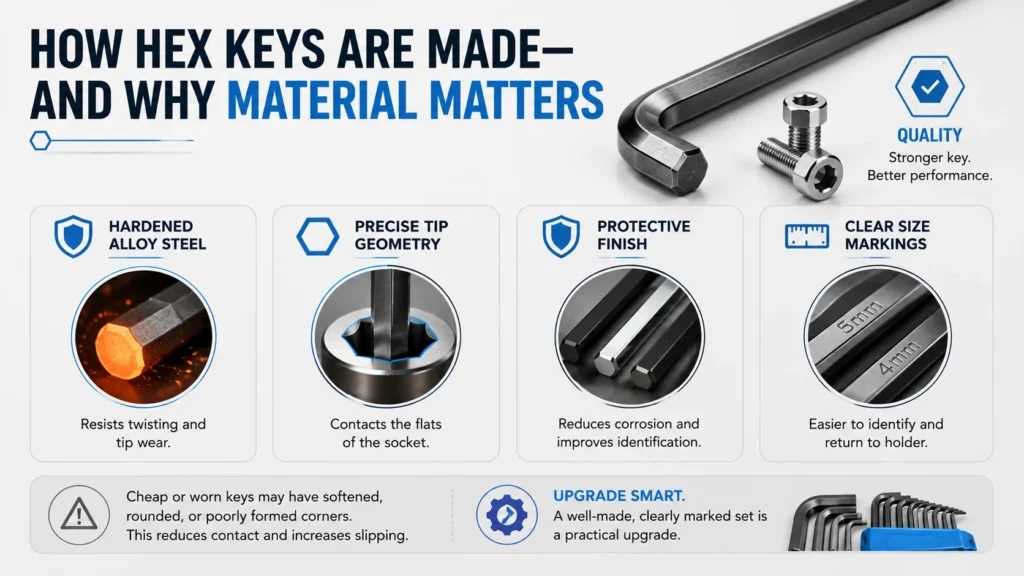
| Tool feature | Why it matters in use |
|---|---|
| Hardened alloy steel | Helps the key resist twisting and tip wear under normal hand torque. |
| Precise tip geometry | Lets the tool contact the flats of the socket instead of only its corners. |
| Protective finish | Black oxide, chrome, or other finishes help reduce corrosion and improve identification. |
| Clear size markings | Reduces guesswork and makes it easier to return each key to the correct holder. |
A cheap or worn key may look usable but can have softened, rounded, or poorly formed corners. Those small defects reduce contact inside the fastener and make slipping more likely. For frequent work, a well-made, clearly marked set is a practical upgrade.
Allen wrench sizes: metric and SAE
Metric and SAE hex keys can look nearly identical, but they are not safely interchangeable. The exact size depends on the fastener, not the object you are repairing. Keep both systems in a general-purpose set whenever you work on mixed household, automotive, or imported equipment.
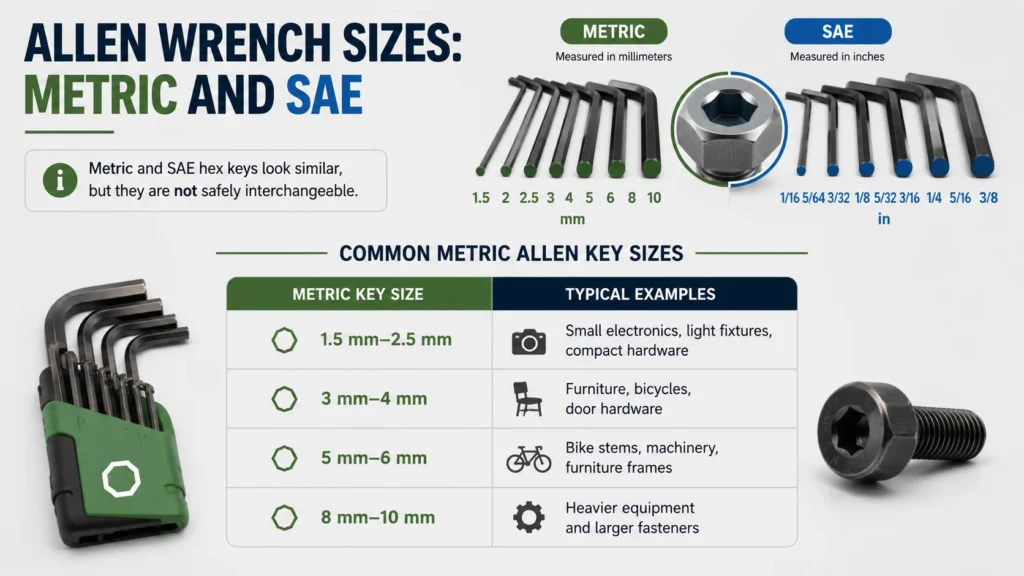
Common metric Allen key sizes
| Metric key size | Typical examples |
|---|---|
| 1.5 mm–2.5 mm | Small electronics, light fixtures, compact hardware |
| 3 mm–4 mm | Furniture, bicycles, door hardware |
| 5 mm–6 mm | Bike stems, machinery, furniture frames |
| 8 mm–10 mm | Heavier equipment and larger fasteners |
Common SAE Allen key sizes
| SAE key size | Typical examples |
|---|---|
| 1/16″, 5/64″, 3/32″ | Small set screws and household hardware |
| 7/64″, 1/8″, 5/32″ | General repair and equipment hardware |
| 3/16″, 7/32″, 1/4″ | Automotive, furniture, and shop fixtures |
| 5/16″, 3/8″ | Larger machinery and structural fittings |
Close sizes that still should not be substituted
Some sizes appear close enough to work, especially 4 mm and 5/32 inch. In practice, even a tiny mismatch concentrates force on the socket corners instead of its flats. That is exactly how a fastener gets rounded.
| Metric size | Nearby inch size | Practical advice |
|---|---|---|
| 2.5 mm | 3/32″ (2.38 mm) | Too loose for reliable torque; do not substitute. |
| 3 mm | 1/8″ (3.18 mm) | Too large to seat correctly in a 3 mm socket. |
| 4 mm | 5/32″ (3.97 mm) | Very close, but still not a safe replacement for routine use. |
| 5 mm | 3/16″ (4.76 mm) | Undersized enough to risk rounding the socket. |
| 6 mm | 1/4″ (6.35 mm) | Oversized; it will not fit a 6 mm recess. |
Do not force a near-fitting key. A slightly undersized metric or SAE key can slip under load and round the inside corners of the hex socket.
Types of Allen wrenches and hex drivers
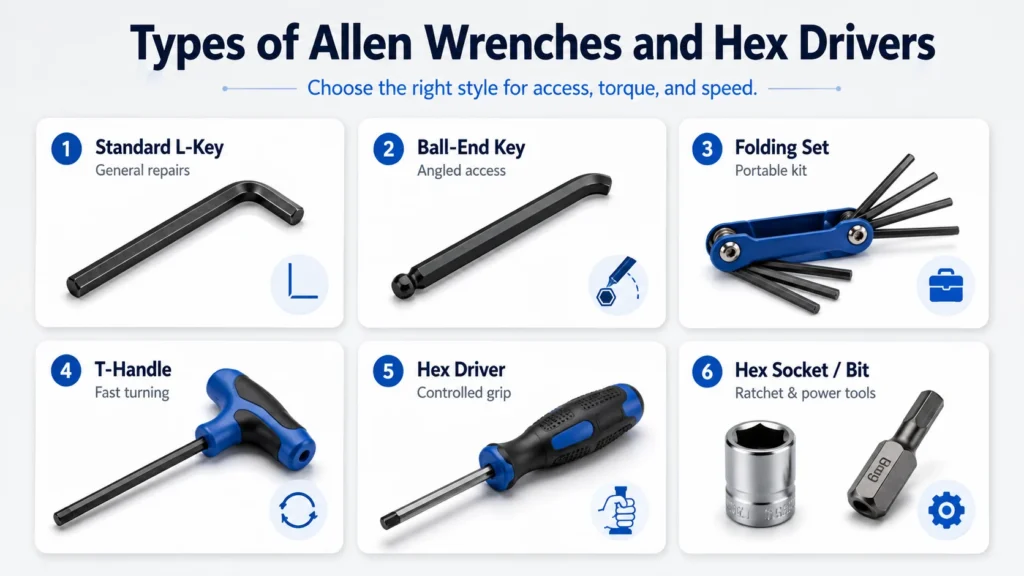
The best style depends on access, torque, and how often you need to turn the fastener. A basic L-shaped key is enough for many jobs, but specialty forms can make repetitive or awkward work easier.
| Tool style | Best for | Know this first |
|---|---|---|
| Standard L-shaped key | Most household repairs | Long arm adds reach; short arm adds leverage. |
| Ball-end hex key | Turning at an angle in tight spaces | Use the straight end for final tightening and breakaway torque. |
| Folding hex key set | Portable bike or household kits | Convenient, but handle clearance can be limited. |
| T-handle hex wrench | Fast repetitive work | Comfortable grip and fast spinning, with good reach. |
| Hex driver / screwdriver handle | Controlled hand work | Useful where an L-key is awkward. |
| Hex socket or bit | Ratchets, torque tools, power tools | Power tools can over-tighten small fasteners quickly. |
How to choose the correct Allen wrench size
- Clean the socket first. Dirt, paint, rust, or debris can make a correct key feel too large.
- Try the likely size by hand and press it fully into the recess before turning.
- The right key should seat deeply with almost no side-to-side movement. If it rocks, stop and test another size.
- If the hardware source is known, check its manual. Bicycles and flat-pack furniture are often metric; older U.S.-made equipment may use SAE.
Torque, leverage, and the right amount of force
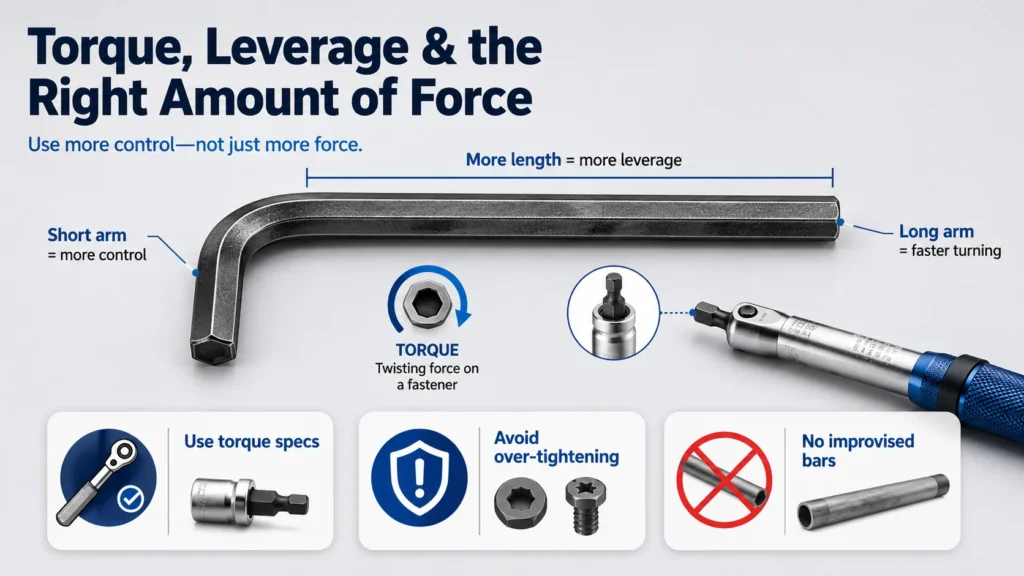
Torque is the twisting force applied to a fastener. A longer handle makes it easier to apply more torque, which is helpful for some larger fasteners but can be risky on small screws, soft metals, bicycle components, and threaded inserts in furniture.
Use specifications when available
If a manufacturer lists a torque value, use a suitable torque wrench or hex-bit torque tool. “Tight enough by feel” is not a substitute on safety-critical equipment.
- Use the short arm of an L-key as the handle when you need more controlled leverage.
- Use the long arm as the handle for light, fast turning once the fastener is already loose.
- Avoid extension pipes or improvised cheater bars unless the tool, fastener, and repair procedure are specifically designed for that force.
Common Allen wrench uses
Hex socket fasteners are popular because their recessed shape is compact and resists accidental snagging. You will find them in everyday home projects as well as shop work.
Furniture assembly
Flat-pack furniture frequently includes a basic metric L-key. A better-fitting replacement key can make assembly easier and reduce hand fatigue.
Bicycles
Metric keys are common for stems, seatposts, brake components, and accessories. Follow torque markings where provided.
Automotive and machinery
Hex sockets and bit sets pair with ratchets when access, repeatability, or controlled torque is important.
Doors, appliances and fixtures
Set screws in handles, faucets, hardware, and appliances are often driven by small hex keys.
Garbage disposal note: many disposals include a dedicated hex key for manually freeing a jammed unit. Use only the manufacturer’s specified procedure, and disconnect power before working near the disposal.
How to use a hex key safely without stripping the bolt
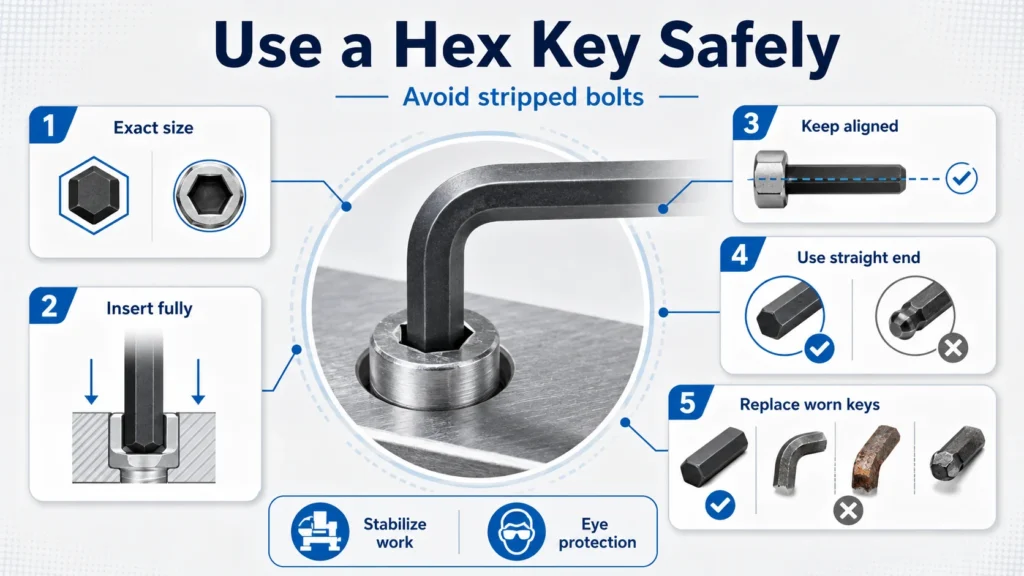
Most damaged hex sockets are not caused by the tool itself—they result from a poor fit, incomplete engagement, or too much force. A few careful habits prevent most problems.
- Use the exact size and insert it fully into the socket before applying force.
- Use the straight end—not the ball end—when breaking a tight fastener loose or applying final torque.
- Keep the key aligned with the fastener. Side-loading can cam the tool out of the socket.
- Replace worn, bent, rusty, or rounded keys. Tool wear transfers directly to the fastener.
- Stabilize the workpiece, keep fingers clear of pinch points, and wear appropriate eye protection when working around damaged, spring-loaded, or powered equipment.
What to look for in an Allen key set
For a first set, prioritize coverage and clear size markings over brand claims. Folding sets, ball-end sets, and color-coded systems can all be useful, but the best choice depends on your jobs and the quality of the individual tools.
- Include both metric and SAE ranges if you repair varied equipment.
- Look for clearly marked sizes and a holder that keeps keys organized.
- Choose ball-end keys for access, but keep standard straight-ended keys for higher-torque work.
- Add hex sockets or a T-handle only if your projects call for faster work, deeper reach, or measured torque.
Allen key vs. Torx: do not substitute
A hex socket has six straight sides; a Torx socket has a six-lobed star shape. They are different drive systems. A hex key will not correctly drive a Torx fastener, and forcing either tool into the other can damage the fastener.
Frequently asked questions
Is an Allen wrench the same as a hex key?
In ordinary use, yes. Both describe a six-sided tool for hex socket screws. “Allen wrench” is a widely used brand-associated term, while “hex key” is the generic name.
Can I use SAE Allen keys on metric bolts?
Only if the size is truly exact, which is uncommon between systems. A key that merely seems close can slip and round out the socket. Use the correctly measured metric or SAE size.
What size Allen key is most useful for home repairs?
A full metric set from 1.5 mm to 10 mm covers many home and bicycle jobs. Adding an SAE set from 1/16 inch through 3/8 inch gives broader coverage for older or U.S.-sized hardware.
Are ball-end Allen keys weaker?
Ball ends are designed for angled access and light-to-moderate turning, but they have less contact than a straight end. Use the straight end whenever you need to loosen a tight fastener or apply final torque.