A practical guide to choosing a DeWalt drill-driver, hammer drill, or rotary hammer for wood, steel, masonry, concrete anchors, and everyday trade work.
A DeWalt cordless drill-driver handles most wood, drywall, and light metal work. Use a hammer drill when you occasionally drill smaller holes in brick or block, and move to an SDS-plus rotary hammer when concrete, repeated anchors, or larger masonry holes become routine.
A DeWalt drill is not one category of tool. The compact drill-driver used for cabinet hardware works very differently from a DeWalt hammer drill pushing a masonry bit through block, and both are outmatched by an SDS-plus rotary hammer when concrete aggregate and repeated anchor holes are involved. The practical buying decision starts with your material, hole diameter, bit type, access, and how long the tool must work under load. That approach avoids common jobsite problems: wrist-twisting kickback, overheated batteries, slipping bits, and an underpowered drill stalled halfway through dense lumber.
Start with the drilling action your work actually needs
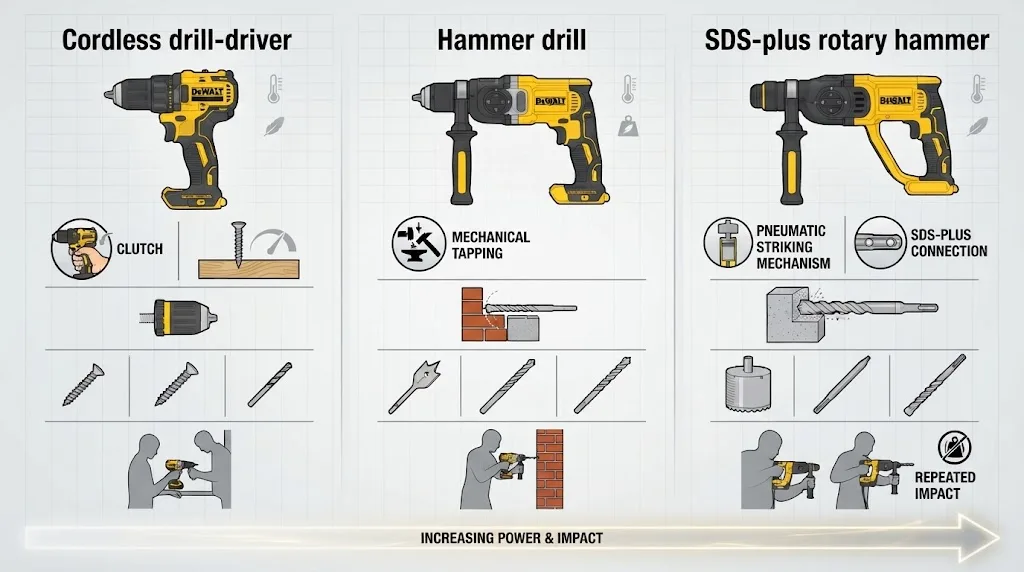
A standard DeWalt drill driver spins the bit and gives you a clutch for controlled fastening. A DeWalt hammer drill adds a rapid mechanical tapping action to help a masonry bit cut brick, block, and lighter concrete. A DeWalt rotary hammer uses a pneumatic striking mechanism and an SDS-plus bit connection; it is designed for repeated concrete drilling, larger anchor holes, and demanding masonry work. More impact is not automatically better. On wood, steel, finish work, and small fasteners, a compact drill-driver is usually lighter, easier to control, and less fatiguing.
Cordless drill-driver
The everyday DeWalt cordless drill for timber, drywall, sheet metal, pilot holes, fixtures, and controlled screwdriving. Choose compact 12V tools for access or 20V MAX brushless models for broader trade use.
Hammer drill
A versatile DeWalt hammer drill for mixed work: framing, large wood bits, metal drilling, and occasional masonry holes. Turn hammer mode off for normal drilling and fastening.
SDS-plus rotary hammer
The specialist for concrete anchors, repetitive holes, dense masonry, and light chipping. Its SDS system transmits impact efficiently and reduces the strain a standard hammerdrill experiences.
Do not force a small drill through a large self-feed bit or bind a long auger without a stable stance. When a bit catches, the drill body can react sharply. Use the side handle where supplied, brace the work, and select a tool with anti-rotation protection for demanding drilling.
Match the DeWalt drill to the bit, material, and hole diameter
Motor power matters, but it only becomes useful through the correct bit and drilling method. A sharp brad-point or auger bit in timber, a properly lubricated twist bit in steel, and a masonry bit in concrete each load the tool differently. Brushless DeWalt drills generally manage sustained work more efficiently because the motor controls current electronically, but no cordless drill can compensate for a dull bit, excessive feed pressure, or a hole size beyond its intended range.
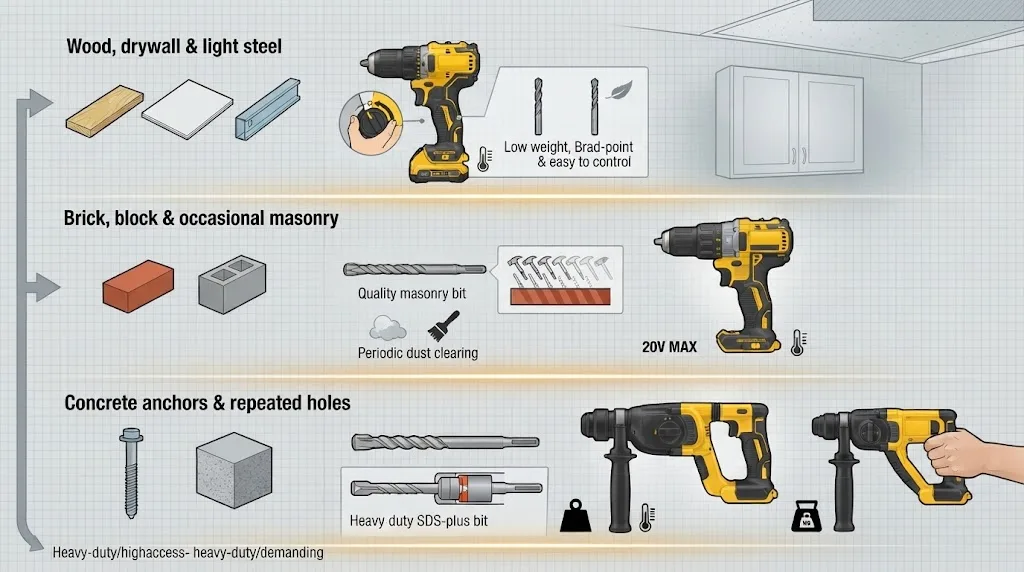
| Material / task | Best tool choice | Practical guidance |
|---|---|---|
| Wood, drywall & light steel | 12V or 20V MAX drill-driver | Use drill mode, choose the correct speed range, and let the bit cut. Compact tools reduce fatigue when working overhead or inside cabinets. |
| Brick, block & occasional masonry | 20V MAX hammer drill | Use a quality masonry bit and hammer mode. Clear dust periodically; packed dust raises heat and slows progress. |
| Concrete anchors & repeated holes | SDS-plus rotary hammer | Pneumatic impact makes the difference in hard aggregate. A rotary hammer is faster, cooler-running, and less punishing than forcing a hammer drill. |
Published RPM, BPM, and torque figures are useful for comparing similar tools, but drilling speed also depends on bit geometry, battery temperature, feed pressure, and the material itself.
A hammer drill is not a smaller rotary hammer
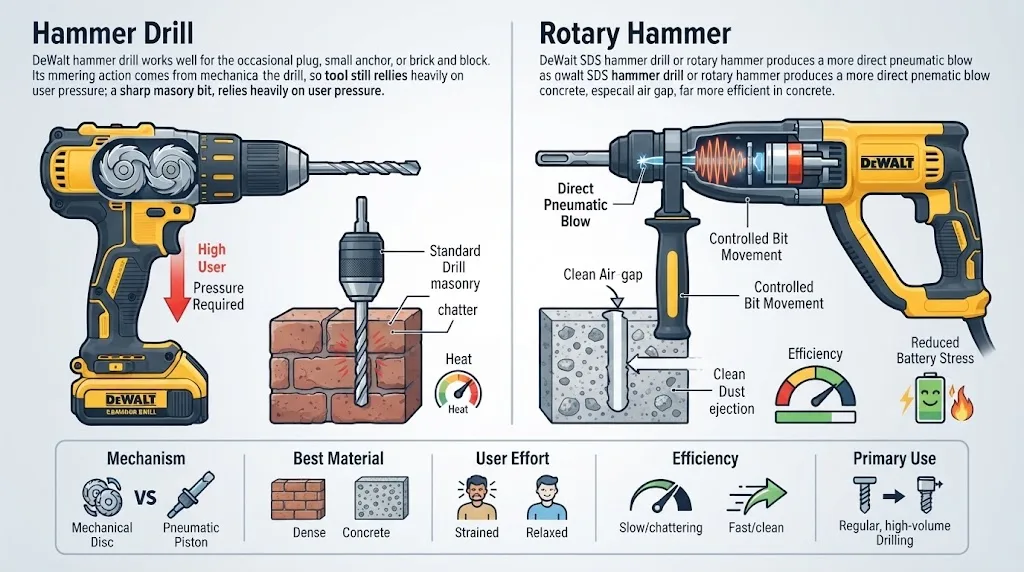
A DeWalt hammer drill works well for the occasional plug, small anchor, or hole through brick and block. Its hammering action comes from mechanical discs inside the drill, so the tool still relies heavily on user pressure and a sharp masonry bit. A DeWalt SDS hammer drill or rotary hammer produces a more direct pneumatic blow and lets the SDS-plus shank move slightly in the chuck. That combination is far more efficient in concrete, especially when aggregate causes an ordinary hammer drill to chatter, stall, or overheat.
If you are drilling several concrete anchors every week, the rotary hammer usually earns its place quickly. It saves time, reduces battery stress, and avoids treating a cordless hammer drill as demolition equipment.
Battery size affects drilling performance, not just runtime
DeWalt 12V Xtreme tools make sense for electricians, cabinet installers, service work, and tight spaces where a short head and low weight matter most. A 20V MAX drill gives general contractors and remodelers a stronger all-round platform for larger bits, longer fasteners, and demanding daily use. For heavy holes and high-draw tasks, battery capacity affects how consistently a tool can deliver power. A compact pack keeps the drill nimble, while a healthy 5Ah or larger pack is usually better for repeated large holes, concrete work, or long periods at high load.
Pair the pack to the workload
Use compact packs for access and finish work; move to a larger 20V MAX pack when drilling repeated holes, running large spade or self-feed bits, or using hammer mode. Let hot batteries cool before charging and replace damaged packs. Thermal shutdown is a protection feature, not a signal to keep forcing the tool.
Choose the lightest drill that reliably finishes the shift
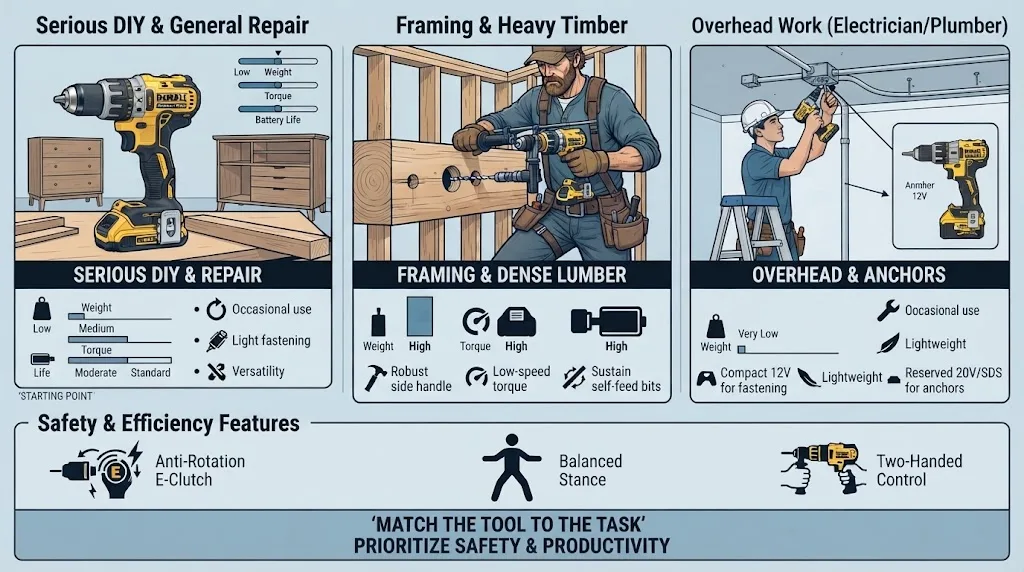
For most serious DIY projects and general repair work, a brushless DeWalt 20V drill driver or compact hammer drill is the sensible starting point. Framing carpenters who regularly bore dense lumber should prioritize a robust side handle, low-speed torque, and the battery capacity to sustain self-feed bits. Electricians and plumbers working overhead often benefit from a compact 12V drill for daily fastening, with a 20V hammer drill or SDS-plus rotary hammer reserved for penetrations and anchors. When drilling can bind, look for features such as DeWalt’s Integrated E-Clutch anti-rotation system, maintain a balanced stance, and keep both hands on the tool.
DeWalt drill questions, answered
Do I need a DeWalt hammer drill for everyday wood and drywall work?
No. A normal drill-driver is usually the better choice for routine wood, drywall, hardware, and light metal tasks because it is lighter and gives excellent clutch control. A hammer drill is worthwhile when masonry drilling is part of your regular work, but its hammer mode should remain off for standard drilling and fastening.
Is a DeWalt 12V drill powerful enough for trade work?
A 12V drill can be an excellent professional tool when compact size and control are the priority: service calls, electrical trim-out, cabinet installation, small fasteners, and work in confined spaces. For repeated large holes, structural screws, self-feed bits, or heavy masonry drilling, a 20V MAX model offers more useful reserve power.
When should I choose an SDS-plus rotary hammer over a hammerdrill?
Choose an SDS-plus rotary hammer when concrete drilling is frequent, anchor holes are larger, or a hammerdrill is taking too long and heating up. The rotary hammer’s pneumatic mechanism is built for hard concrete and repeated drilling. It is not the everyday replacement for a drill-driver, however, because it is larger and less suited to precise wood or metal work.