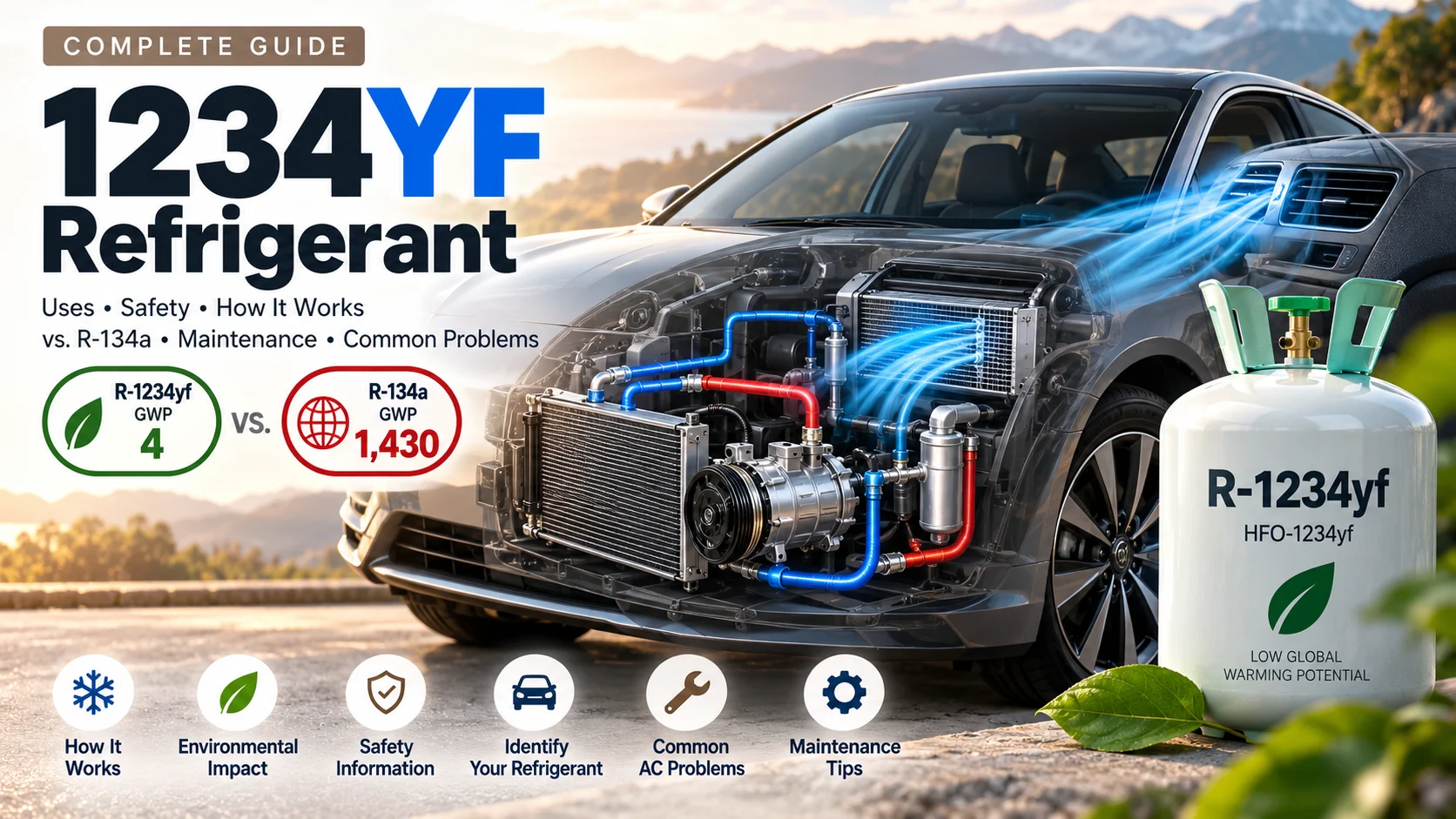
Your car’s air conditioner suddenly stops blowing cold air, and a mechanic tells you the system uses 1234yf refrigerant. You may wonder what it is, why it differs from older R-134a refrigerant, and whether the AC system can be recharged using ordinary equipment.
R-1234yf is widely used in modern automotive air-conditioning systems, but its servicing requirements differ from those of older refrigerants. Understanding these differences helps you recognize possible AC problems, avoid incompatible products, and make informed decisions about professional repairs.
1234yf refrigerant, technically known as R-1234yf or HFO-1234yf, is a low-global-warming-potential refrigerant used in many modern vehicle air-conditioning systems. It transfers heat from the passenger cabin to the outside air.
Unlike older R-134a refrigerant, R-1234yf has an A2L lower-flammability classification and requires compatible service equipment and procedures. It should not be mixed with R-134a.
What Is 1234YF Refrigerant?
R-1234yf is a hydrofluoroolefin (HFO) refrigerant used in modern air-conditioning applications, including many motor vehicle AC systems.
A refrigerant is a fluid that transfers heat while circulating through a refrigeration system. As it changes pressure, temperature, and physical state, it can absorb heat from one location and release it elsewhere.
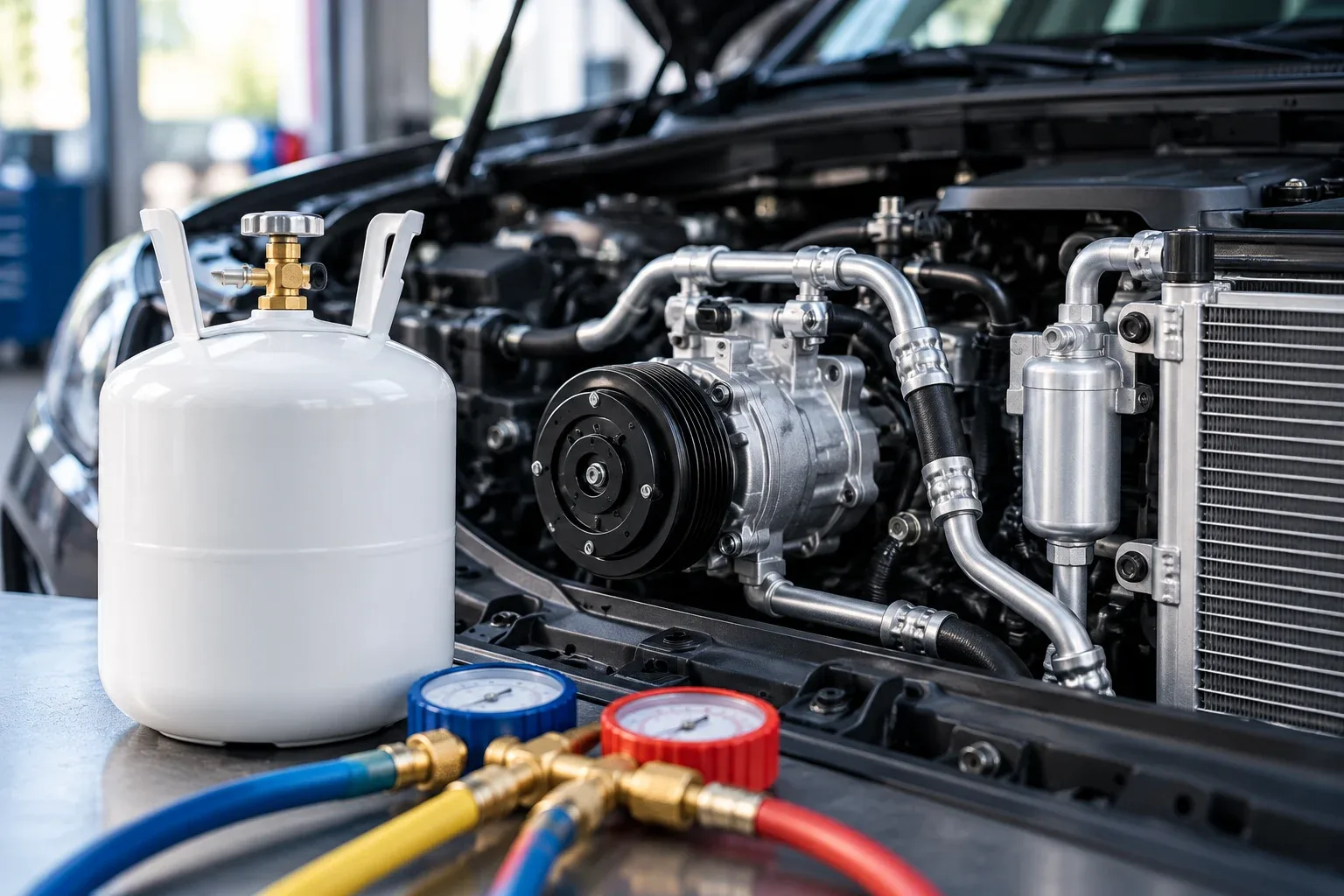
What Does HFO-1234yf Mean?
HFO stands for hydrofluoroolefin, a family of fluorinated compounds. R-1234yf is also identified as HFO-1234yf.
It was introduced as a lower-global-warming-potential alternative to R-134a in automotive air-conditioning systems. That does not mean these refrigerants are interchangeable.
Where Is R-1234yf Used?
Many newer passenger cars, SUVs, and light trucks use R-1234yf. However, the type varies by vehicle manufacturer, production year, model, and intended market.
The vehicle’s AC identification label and manufacturer service information provide a more reliable answer than assuming its refrigerant type from age alone.
Key fact: Refrigerant normally remains inside a sealed AC system. It is not routinely consumed during normal operation.
How Does R-1234yf Work in a Car AC System?
A vehicle air-conditioning system moves heat from the passenger compartment to the outside environment using a refrigerant cycle.
The compressor, condenser, expansion device, and evaporator are four important parts of a typical automotive AC system.
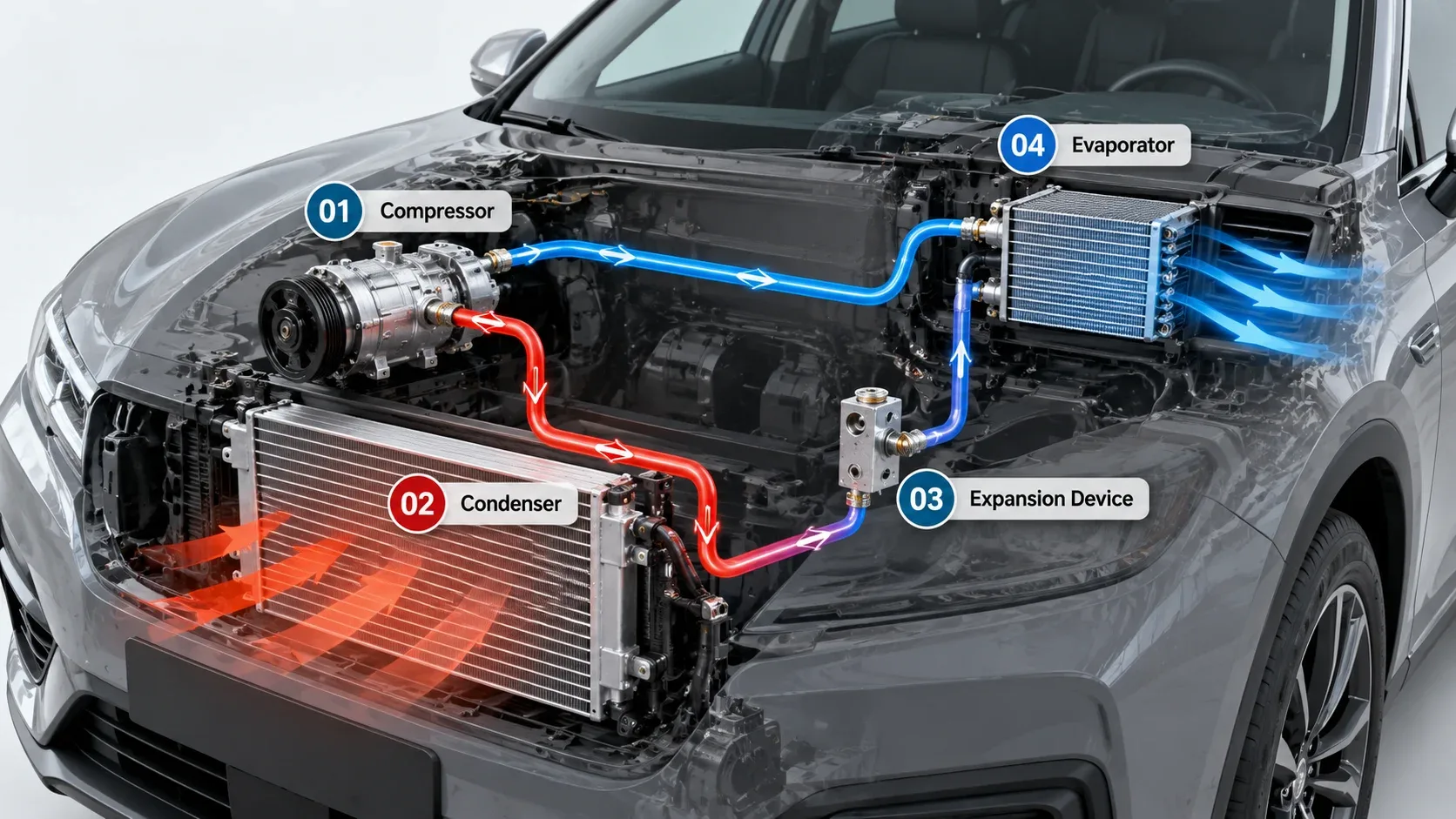
The Four Main AC Components
Compression
The compressor raises the pressure and temperature of refrigerant vapor, preparing it to release heat through the condenser.
Heat Rejection
The condenser transfers heat from the refrigerant to outside air. The refrigerant generally changes into a liquid as it releases heat.
Pressure Reduction
The expansion device reduces refrigerant pressure before the refrigerant enters the evaporator.
Cabin Cooling
Inside the evaporator, the refrigerant absorbs heat from cabin air. The blower moves cooled air through the dashboard vents.
The refrigerant returns toward the compressor, and the cooling cycle repeats. Actual components and configurations vary between vehicles.

Why Do Modern Cars Use R-1234yf?
One major reason manufacturers adopted R-1234yf is its significantly lower global warming potential compared with R-134a.
Global warming potential, or GWP, expresses the warming impact of a greenhouse gas relative to carbon dioxide over a specified time period.
Lower Global Warming Potential
The US Environmental Protection Agency lists a global warming potential of approximately 4 for HFO-1234yf and 1,430 for HFC-134a. Values can differ depending on the scientific assessment and calculation method.
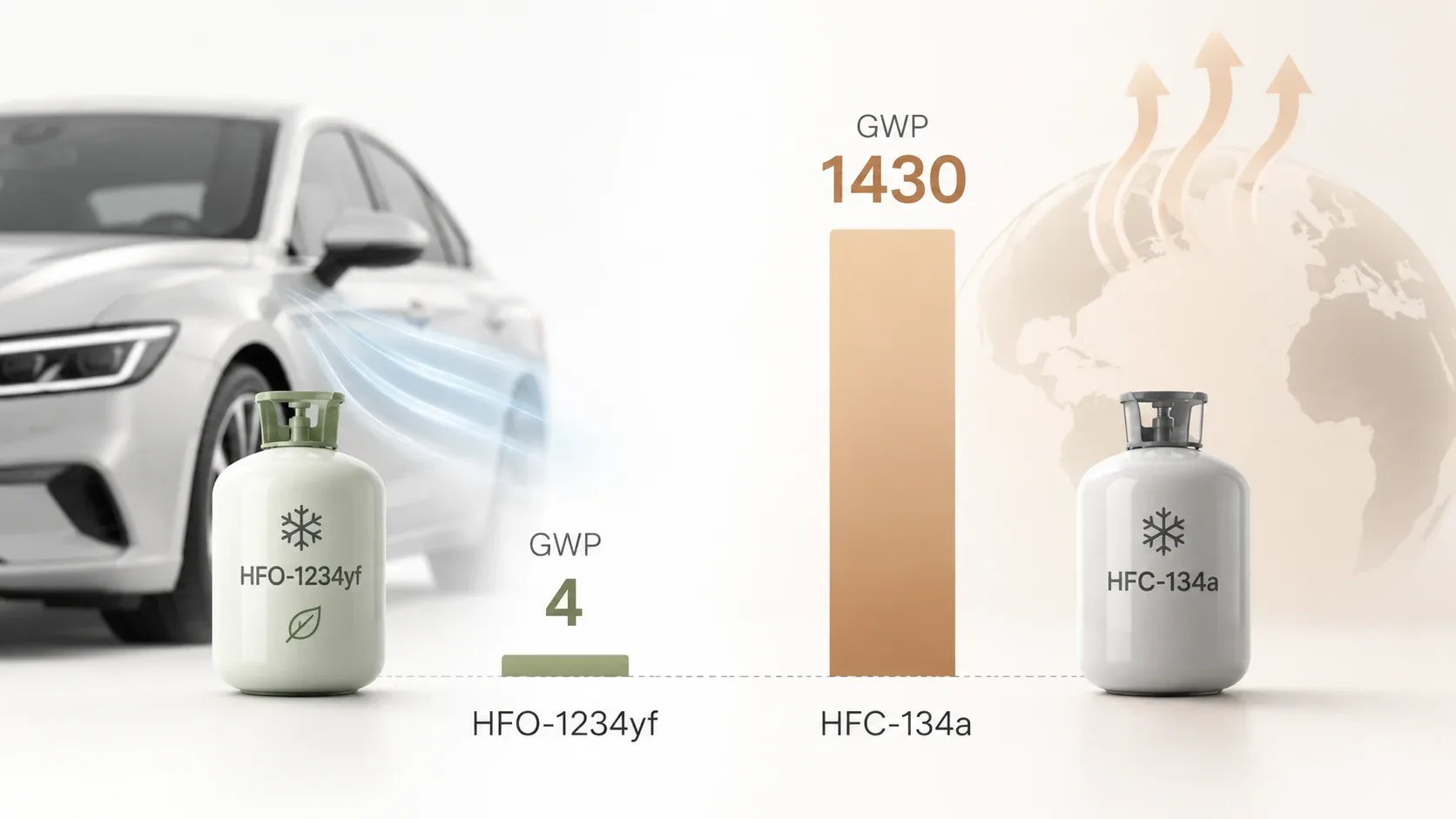
This considerable difference helps explain why R-1234yf became an important option for reducing climate-related emissions from vehicle air-conditioning systems.
The Automotive Industry Transition
Manufacturers developed new systems compatible with approved lower-GWP refrigerants in response to environmental regulations and changing vehicle design requirements.
However, not every modern vehicle uses R-1234yf. Some approved systems use other refrigerants, including carbon dioxide.
Remember: A lower GWP does not eliminate the need for proper refrigerant handling, recovery, and safe system servicing.
R-1234yf vs. R-134a: Key Differences
Both R-1234yf and R-134a are used in automotive air-conditioning systems, but their chemical properties, environmental characteristics, and servicing requirements differ.
Knowing these differences can help you understand repair quotes, identify the correct refrigerant, and avoid improper substitutions.
| Feature | R-1234yf | R-134a |
|---|---|---|
| Chemical family | Hydrofluoroolefin (HFO) | Hydrofluorocarbon (HFC) |
| Common application | Many newer vehicle AC systems | Many older vehicle AC systems |
| EPA-listed GWP | 4 | 1,430 |
| ASHRAE safety classification | A2L | A1 |
| Flammability classification | Lower flammability | No flame propagation under classification test conditions |
| System compatibility | Approved R-1234yf systems | Approved R-134a systems |
| Service connections | Refrigerant-specific | Refrigerant-specific |
| Service equipment | Compatible R-1234yf equipment | Compatible R-134a equipment |
Which Refrigerant Is Better?
In terms of global warming potential, R-1234yf has a substantial environmental advantage over R-134a.
However, the correct refrigerant for an individual car is determined by the manufacturer’s approved system specification, not by personal preference.
Compatibility warning: Do not replace R-1234yf with R-134a or mix refrigerants unless a specific manufacturer-approved procedure explicitly permits the intended change.
Is 1234YF Refrigerant Safe?
R-1234yf is approved for specified automotive applications under applicable requirements and conditions.
It has an A2L refrigerant safety classification, which represents lower toxicity and lower flammability under the relevant classification standard.
What Does A2L Mean?
The letter A places the refrigerant in the lower-toxicity category. The 2L classification indicates lower flammability with low burning velocity.
Lower flammability does not mean the refrigerant is nonflammable or harmless under every condition.
Important Handling Precautions
- Use approved refrigerant-specific servicing equipment.
- Follow manufacturer repair and safety procedures.
- Avoid potential ignition sources during servicing.
- Use suitable ventilation and personal protective equipment.
- Do not deliberately release refrigerant.
- Avoid mixing incompatible refrigerants.
- Follow approved methods when locating leaks.
Safety warning: Improper refrigerant handling can expose people to pressure hazards, cold-temperature injuries, oxygen displacement, and potential fire risks. Service work should follow vehicle manufacturer procedures and applicable regulations.
How to Know If Your Car Uses R-1234yf
The most reliable way to identify your vehicle’s refrigerant type is to consult official system information rather than relying only on its model year.
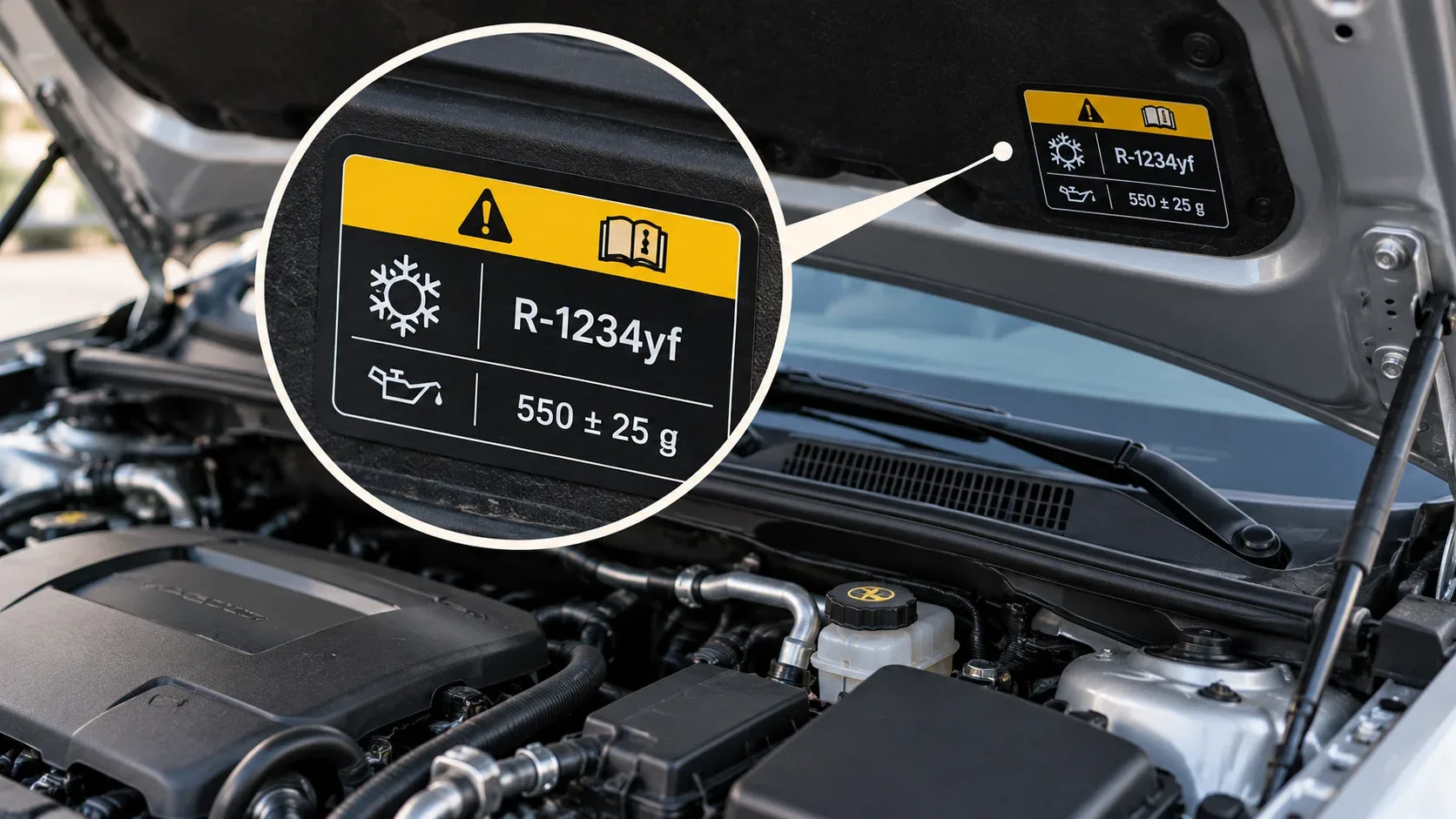
Many vehicles have an air-conditioning information label in the engine compartment. This commonly identifies the refrigerant and specified charge quantity.
Check the Under-Hood AC Label
Look for an air-conditioning label near the engine compartment or another manufacturer-specified location.
The label may identify the refrigerant designation and the required charge. Always use the specification for that vehicle.
Read the Owner’s Manual
The owner’s manual or vehicle maintenance information may identify the AC refrigerant or point to the correct technical specifications.

Consult Manufacturer Service Information
If the label is missing or unreadable, a qualified technician can verify the specification using manufacturer service information and vehicle identification details.

Important: Do not select refrigerant solely from the car’s age or the appearance of a service fitting.
Signs Your Car AC System Needs Inspection
Reduced cooling performance may indicate an AC problem, but it does not automatically prove that the system needs more R-1234yf refrigerant.
Several mechanical and electrical components contribute to cooling, including the compressor, condenser, cooling fans, sensors, and climate controls.

Common Warning Signs
- Warm air coming from AC vents
- Weak or inconsistent cooling performance
- Poor cooling while idling
- Unusual noises when the AC operates
- Climate-control warnings or diagnostic faults
- Oily residue or visible damage near AC components
Symptoms and Possible Causes
| Symptom | Possible Cause | Recommended Action |
|---|---|---|
| Warm air from vents | Refrigerant loss, compressor fault, or climate-control issue | Arrange complete AC diagnosis |
| Poor cooling at idle | Condenser airflow or cooling fan problem | Check cooling fan and condenser operation |
| Intermittent cooling | Electrical, sensor, or compressor-related issue | Inspect system performance and fault information |
| Unusual mechanical noise | Compressor or accessory drive problem | Inspect affected components |
| Visible oily residue | Possible refrigerant and oil leakage | Request appropriate leak inspection |
These signs indicate possible issues rather than definitive diagnoses. Testing is needed to identify the real problem.
Useful distinction: Low refrigerant charge may result from a leak. Repeated charging without repairing the cause can lead to recurring problems.
Can You Recharge an R-1234yf AC System Yourself?
Consumer refrigerant products may be available, but properly charging a modern automotive AC system can require specialized equipment and diagnostic procedures.
The correct refrigerant type, specified charge quantity, and condition of the system all matter for proper operation.
Why Accurate Refrigerant Charge Matters
A vehicle manufacturer specifies how much refrigerant the AC system should contain.
Too little or too much refrigerant can affect cooling performance and system operation.
Refrigerant pressure depends on environmental and operating conditions. A single gauge reading does not reliably measure the system’s refrigerant charge mass.
Why Leak Diagnosis Comes First
If a system is low on refrigerant, the cause should be investigated. Leakage or a previous service issue may be involved.
When Professional Service Makes Sense
Professional inspection is particularly appropriate when the refrigerant type is unknown, system contamination is suspected, a leak needs diagnosis, or approved recovery and charging equipment is unavailable.
Do not charge blindly: Warm air does not always mean low refrigerant. Adding refrigerant without proper diagnosis can make a problem worse.
R-1234yf Service Equipment and Requirements
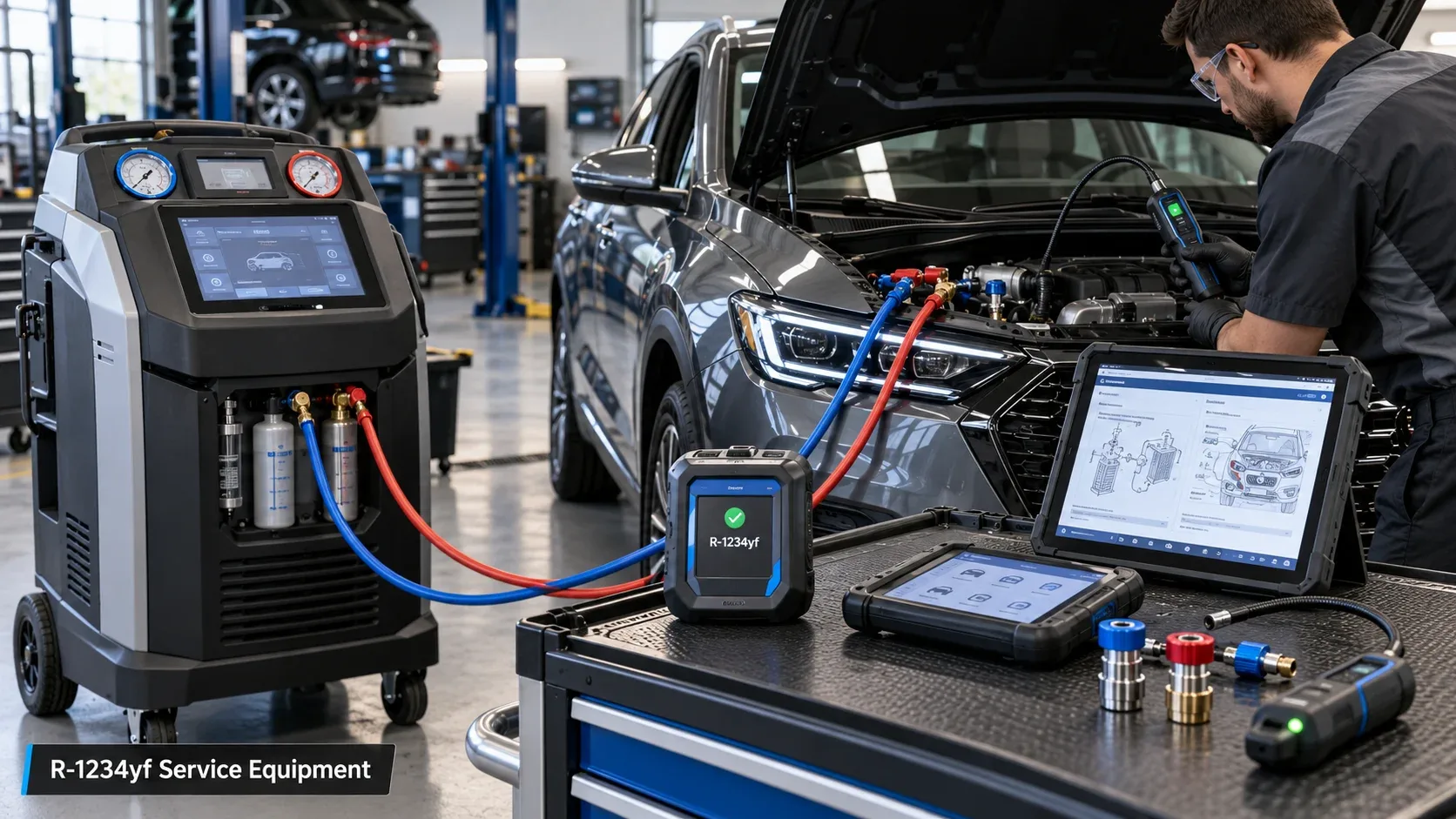
Proper R-1234yf servicing requires compatible equipment and established repair procedures.
Professional workshops may use refrigerant identification tools, recovery and charging equipment, leak detection devices, and vehicle-specific diagnostics.
Common Equipment Used During Service
| Equipment | Purpose |
|---|---|
| Refrigerant identifier | Verifies refrigerant composition and helps identify contamination |
| Recovery and charging station | Handles refrigerant and charges the specified quantity |
| Compatible hoses and fittings | Connects equipment to the intended refrigerant system |
| Leak detection equipment | Helps locate refrigerant leaks |
| Diagnostic scan tool | Checks relevant system controls and fault information |
| Manufacturer service information | Provides vehicle-specific specifications and procedures |
US EPA Section 609 Requirements
In the United States, motor vehicle air-conditioning service is subject to applicable Clean Air Act and EPA requirements.
Technicians who perform covered motor vehicle AC servicing for consideration must meet applicable Section 609 certification requirements.
Proper refrigerant handling also involves appropriate equipment and compliance with applicable restrictions on refrigerant venting.

Service note: Refrigerant-specific service connections help reduce accidental mixing. Improvised adapters should not be used to bypass those safeguards.
Can You Mix R-1234yf With R-134a?
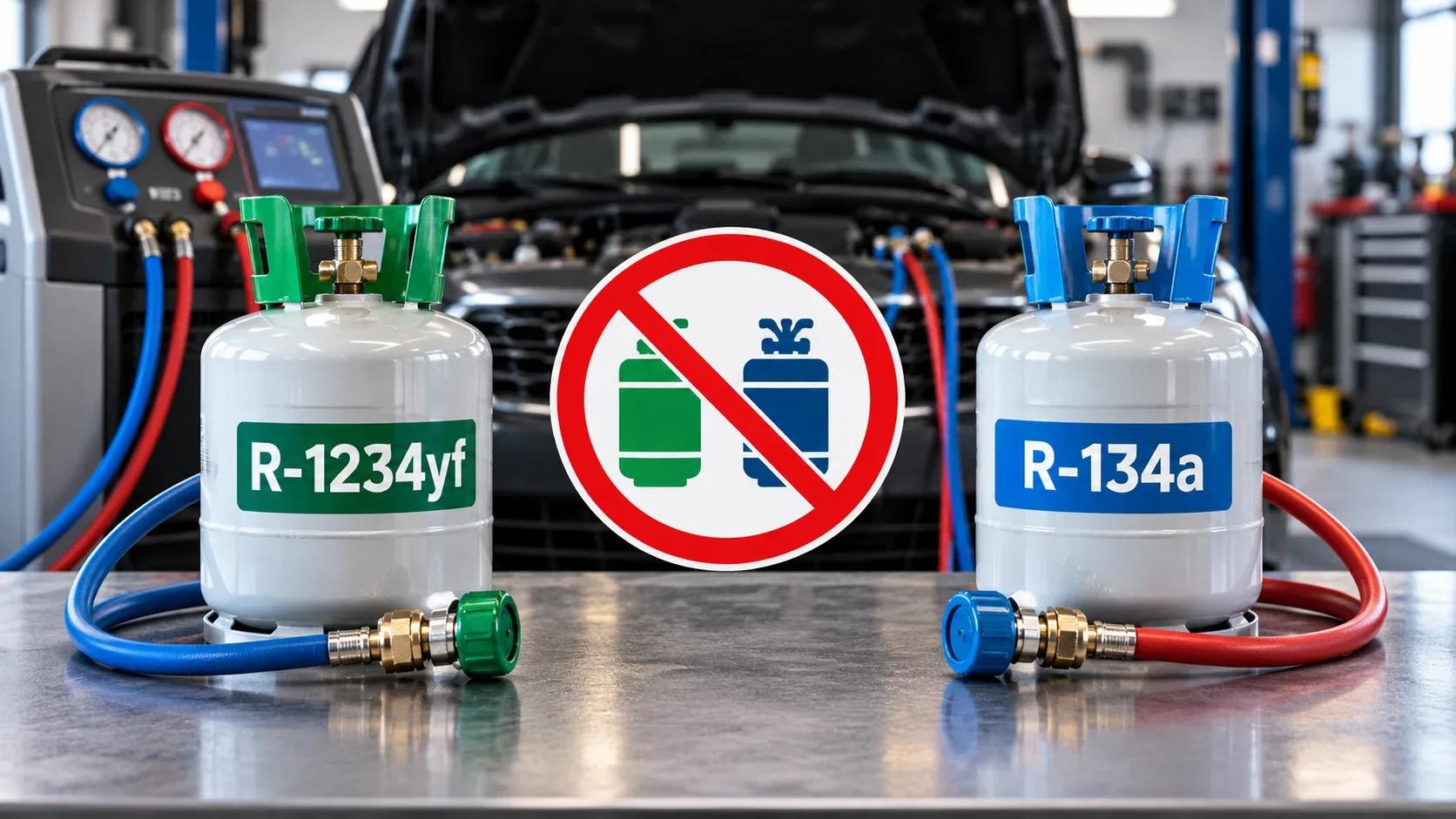
No. R-1234yf and R-134a should not be intentionally mixed in an automotive air-conditioning system.
Although both can perform similar cooling functions, they have different characteristics and system requirements.
Why Mixing Refrigerants Is a Problem
- It can contaminate the refrigerant charge.
- It may create compatibility concerns with components and lubricants.
- It complicates refrigerant recovery and recycling.
- Contamination may prevent standard equipment from processing the refrigerant.
- It departs from the vehicle’s approved refrigerant specification.
What if the Wrong Refrigerant Was Added?
Do not attempt to correct the mixture by adding more of either refrigerant.
Tell a qualified AC technician what may have entered the system. Additional refrigerant identification, recovery, and contamination management may be required.
Important: Do not use improvised refrigerant adapters or unapproved substitutes to work around incompatible service connections.
Does R-1234yf Refrigerant Affect Car Heating?
In many conventional gasoline and diesel vehicles, the cabin heating system uses hot engine coolant flowing through a heater core.
In these vehicles, refrigerant primarily supports air conditioning, although the AC system can also remove moisture from the air during defogging.
Conventional Cabin Heating
Engine coolant carries heat toward the heater core. Cabin air passing through the heater core absorbs this heat before entering the passenger compartment.
Heat-Pump Heating in Some Vehicles
Certain electric and hybrid vehicles have heat-pump climate-control systems that can use refrigerant to transfer heat into the cabin.
The refrigerant type, system layout, and operating strategy depend on the specific vehicle.
| System | Main Heat Source | Role of Refrigerant |
|---|---|---|
| Conventional engine heating | Engine coolant | Generally not the primary cabin-heating source |
| Automotive heat pump | Heat transferred using a refrigerant circuit | Can directly contribute to cabin heating |
If the heater stops working, first determine which type of climate-control system the vehicle uses before assuming the refrigerant is responsible.
Common R-1234yf AC Problems
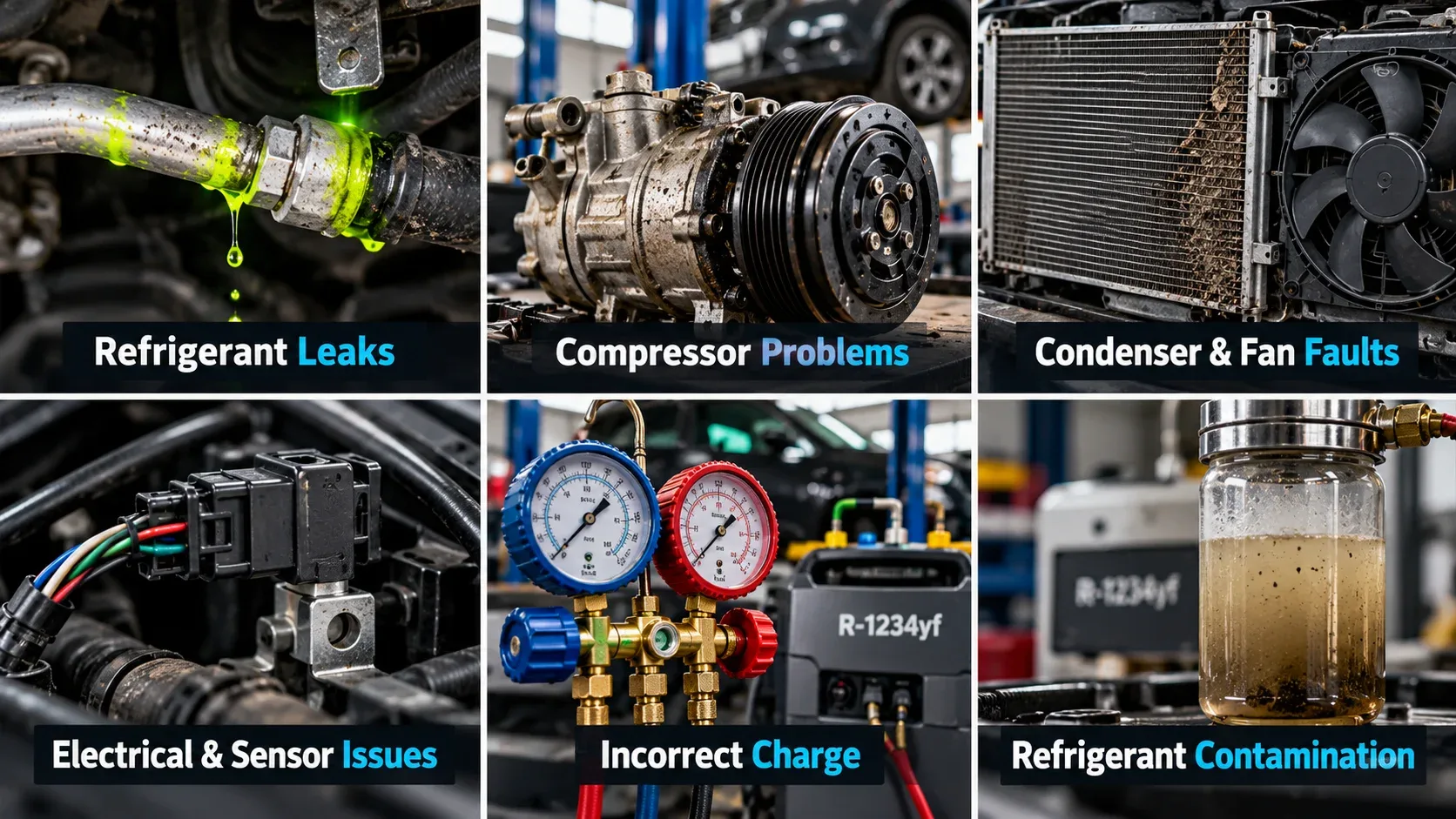
R-1234yf systems can experience many of the same mechanical, electrical, and refrigerant-related problems as other automotive AC systems.
Different faults can create similar symptoms, making proper diagnosis important.
Refrigerant Leaks
Damaged refrigerant lines, seals, condensers, or other components may allow refrigerant to escape from the system.
Compressor Problems
Mechanical or electrical compressor faults may reduce cooling or prevent normal AC operation.
Condenser and Fan Faults
Poor airflow through the condenser can reduce cooling effectiveness, especially when the vehicle is stationary.
Electrical and Sensor Issues
Faulty sensors, wiring, or climate-control components can interfere with proper cooling.
Incorrect Refrigerant Charge
Undercharging or overcharging can affect cooling performance. The correct charge amount is specified by the vehicle manufacturer.
Refrigerant Contamination
An incorrect refrigerant or improper servicing may introduce contamination that complicates future repair work.
Diagnostic principle: Similar AC symptoms can have different causes. Avoid replacing components or adding refrigerant without identifying the fault.
How to Maintain an R-1234yf AC System
Good AC maintenance focuses on keeping the climate-control system working correctly and detecting changes in performance early.
While refrigerant normally does not need routine replacement, other parts of the air-conditioning system benefit from inspection and maintenance.
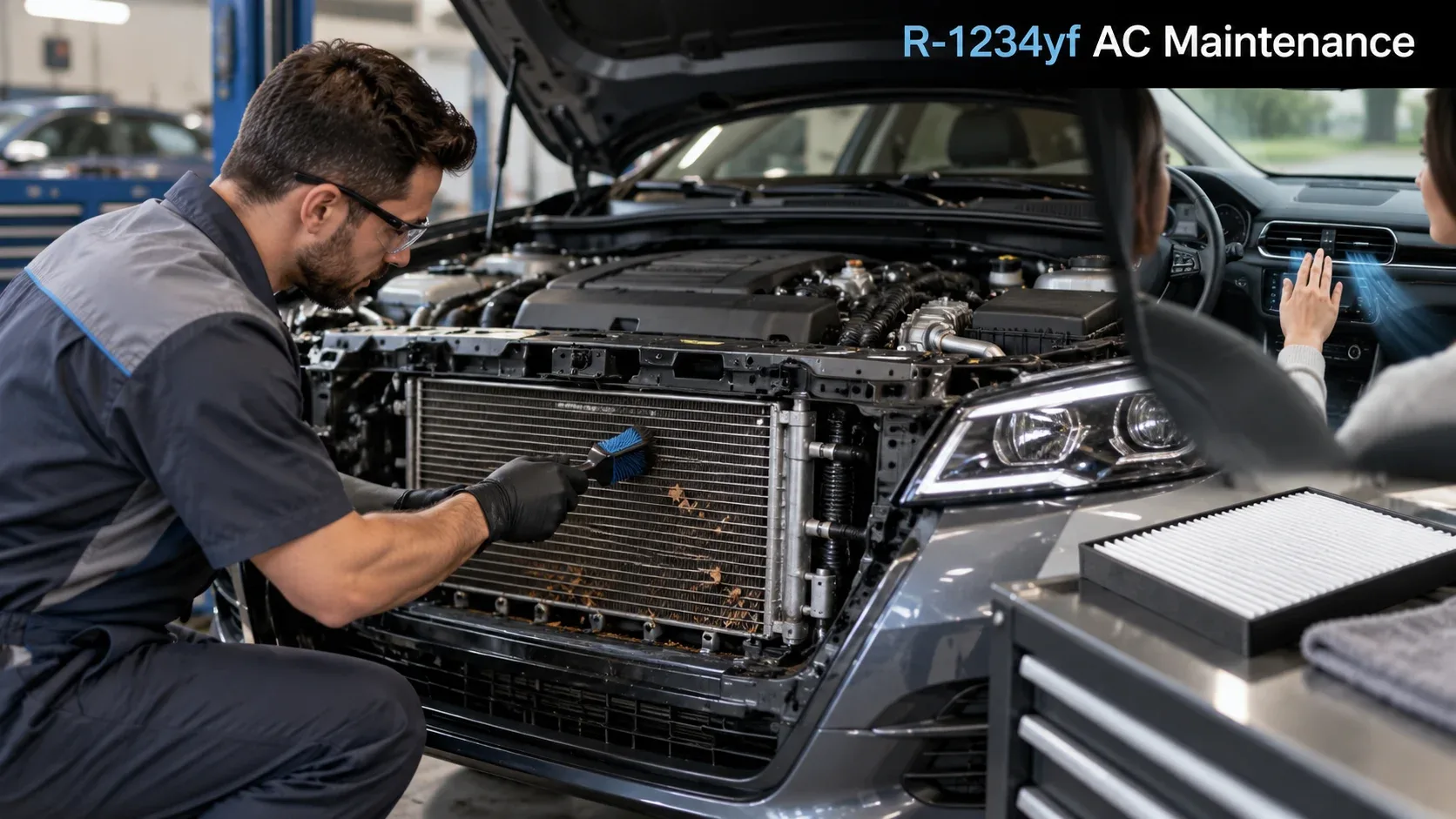
Keep the Condenser Area Clear
Leaves, dirt, and debris can restrict airflow across the condenser and reduce heat transfer.
Clean accessible areas only using suitable vehicle maintenance procedures.
Replace Cabin Air Filters as Recommended
A clogged cabin air filter can reduce airflow from the dashboard vents, even when the refrigerant system works correctly.
Monitor Cooling Performance
Changes in cooling, unusual sounds, or inconsistent operation may indicate the need for inspection.
Operate the AC According to Vehicle Guidance
Use and maintain the climate-control system according to the manufacturer’s instructions. Modern systems may automatically manage compressor operation.
Investigate Refrigerant Loss
Refrigerant is not normally consumed during operation. If low charge is diagnosed, the underlying cause should be investigated.
Maintenance takeaway: A properly operating AC system usually does not need refrigerant added at every maintenance visit.
Frequently Asked Questions About 1234YF Refrigerant
Is R-1234yf the same as R-134a?
No. Both refrigerants are used in automotive air-conditioning systems, but they differ in chemical properties, environmental impact, safety classifications, and servicing requirements.
Is R-1234yf refrigerant flammable?
R-1234yf has an A2L lower-flammability classification. It is not considered nonflammable. Proper equipment and safety procedures are necessary.
Why do newer cars use R-1234yf?
One important reason is its significantly lower global warming potential compared with R-134a. Its adoption also reflects environmental regulations and changes in vehicle design.
How do I know which refrigerant my car uses?
Check the under-hood AC information label or official manufacturer service documentation. If the label is missing, a qualified technician can verify the specification.
Can I put R-134a in an R-1234yf system?
Do not substitute R-134a for R-1234yf in a vehicle designed for R-1234yf. Use the manufacturer’s specified refrigerant and approved service procedures.
Does R-1234yf need regular replacement?
Refrigerant generally does not require replacement merely because of age. An AC system is designed to retain its refrigerant. Low charge may indicate leakage or previous improper service.
Why is my R-1234yf AC blowing warm air?
Possible causes include refrigerant loss, compressor faults, condenser airflow problems, electrical issues, or climate-control malfunctions. Proper diagnosis is needed.
Can R-1234yf refrigerant leak?
Yes. Leaks can develop in refrigerant lines, seals, condensers, or other components. Appropriate leak detection can help locate the problem.
Can I recharge an R-1234yf system myself?
Consumer products may be available, but accurate refrigerant charging, safe handling, and proper fault diagnosis can require specialized tools. Professional service is often the appropriate choice.
Does R-1234yf provide cabin heating?
In many conventional vehicles, cabin heating primarily uses engine coolant. Some electric and hybrid vehicles use refrigerant-based heat-pump systems that can also provide cabin heating.