In 2024, 11,904 people died in alcohol-impaired-driving crashes in the United States, accounting for about 30 percent of all traffic deaths. In Connecticut, 105 people died in alcohol-impaired crashes that year, about 34 percent of the state’s traffic deaths.
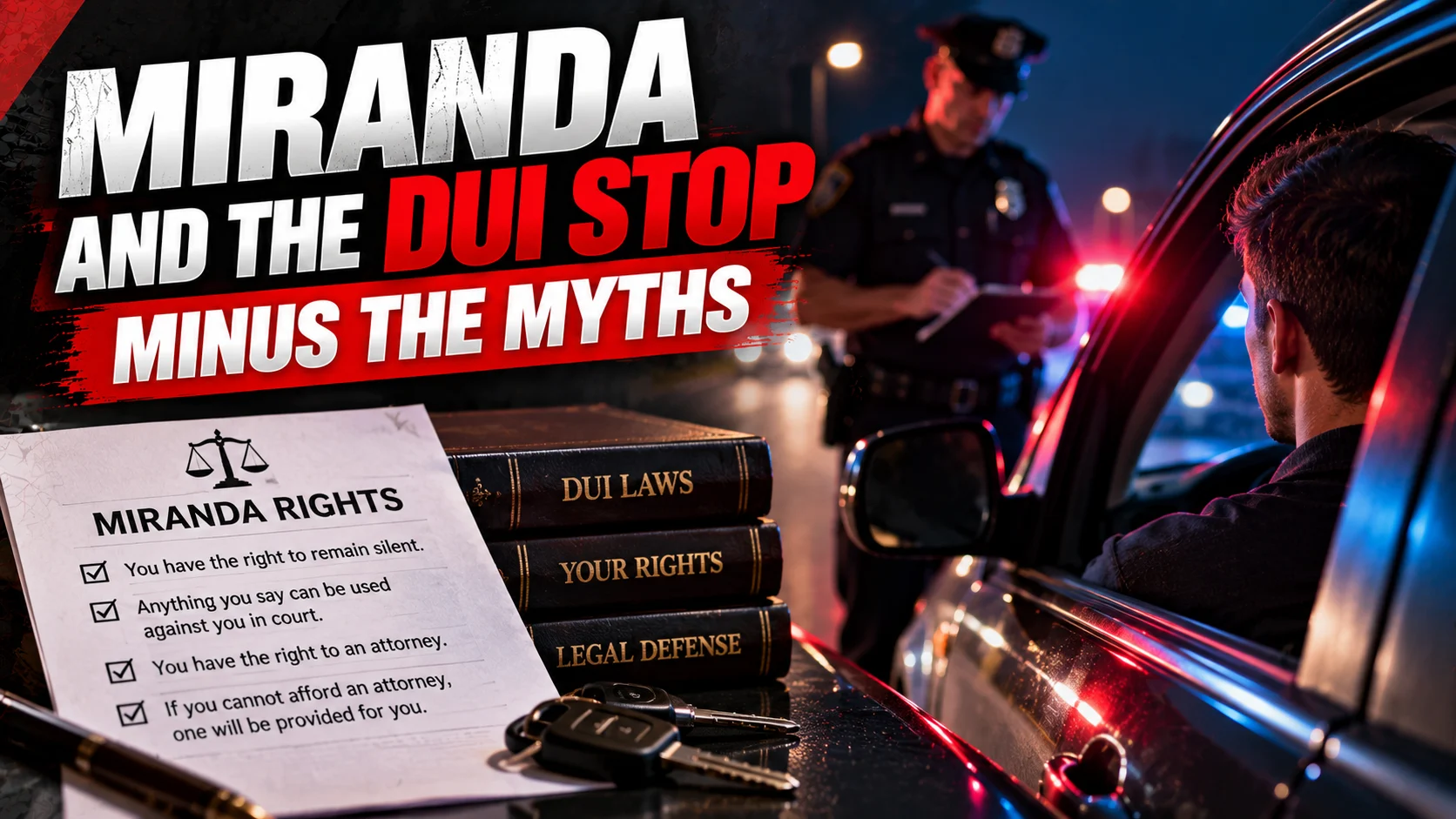
These crashes often lead to arrests, which is where Miranda rights tend to come up. But what are Miranda rights, and when do they apply?
According to Berkemer v. McCarty (1984), a motorist’s detainment during a traffic stop does not create custody for purposes of the Miranda warnings. Roadside questioning of a driver after a traffic stop is usually not custodial, so Miranda does not apply. The warning should be given if a person is under custody and subject to questioning. The determination of whether those requirements have been met relies on the facts, which include the type and length of custody. Courts also consider whether the restraint on movement reaches the degree associated with formal arrest.
Two Conditions and the Roadside Usually Lacks Custody
The warning obligation applies only in circumstances where custody and interrogation exist together. Custody means restraint comparable to formal arrest. Interrogation means questioning, or its functional equivalent, that police should know is reasonably likely to draw an incriminating response. The initial stopping on the side of the road to observe if there are any indications of drinking alcohol is different. No warning is required before field sobriety exercises or drinking questions at this stage. The Fifth Amendment privilege is doing different work than people assume.
Arrest by itself does not change that either. An officer who cuffs a driver and says nothing on the ride to the station owes nothing until questioning starts. Unprompted statements a driver offers during the ride are admissible because the rule applies to the forced answering of questions rather than to every sentence spoken in the backseat of a car.
An injured party from Eastern Connecticut may consult New London DUI lawyer John A. Collins, III about seeking compensation for medical treatment, lost wages, and pain and suffering.
The Fruits Doctrine Does Not Reach a Missing Warning
A common belief holds that excluding an unwarned statement also removes anything police found because of it. That belief draws on the fruit of the poisonous tree doctrine, but the Supreme Court has not applied the doctrine this way. In United States v. Patane (2004), a plurality of the Court ruled that physical evidence located through a voluntary but unwarned statement can still be admitted at trial.
The Court had reached a parallel result decades earlier for a witness located through an unwarned statement and again for a properly warned statement that followed an unwarned one. In Patane, the plurality reasoned that a failure to warn is not itself a constitutional violation, so excluding the statement is a complete remedy.
In practice, a successful Miranda suppression motion in a DUI case removes only the unwarned statement. Breath and blood test results, dashcam video of the driving and field sobriety exercises, and an officer’s testimony about observations such as odor or slurred speech are not affected by the ruling, although each can still be challenged on separate legal grounds.
Booking Questions and the Line That Runs Through Them
Routine booking questions are not covered by the rule. Name, address, date of birth, and height are the details that someone in custody provides to law enforcement officers.
Booking questions are not exempt in every case. Pennsylvania v. Muniz (1990) stemmed from an arrest for driving under the influence. The Supreme Court of the United States issued its opinion on the basis of the federal Fifth Amendment. This ruling holds in all states. The Court ruled that responses to basic demographic questions such as those involving one’s name, address, and age were admissible even without any prior warnings. A question asking for the date of the driver’s sixth birthday was treated differently. Because the answer could point to a confused mental state, the response was testimonial and should have been suppressed. The driver’s slurred speech while answering counted as physical evidence and was not excluded.
Suppression Removes Less Than People Expect
A driver in custody can still make voluntary statements. A statement given in response to questioning without warnings is generally barred from the prosecution’s main case. It may still be used to impeach the driver on cross-examination if the driver takes the stand. Breath and blood test results and officer observations typically remain admissible.
Invocation has its own trap. Silence alone does not invoke anything. Courts require a clear and unambiguous assertion, and ambiguous phrasing leaves questioning lawful. Once counsel is clearly requested, interrogation has to stop until a lawyer is present or the suspect restarts the conversation.
The Criminal Case Is Rarely the Only Case
A drunk-driving arrest that involved a collision often leads to a second proceeding. The civil claim brought by anyone injured runs on a lower standard of proof, and the exclusionary rule that governs a criminal suppression motion generally does not apply there at all. Winning suppression in criminal court decides very little about the civil side.
A roadside warning, or the absence of one, does not resolve the issue. What counts is whether police asked the driver about the offense after custody began and before any warning was given.