XR and Atomic are not a simple good-better hierarchy. The right DeWalt cordless tool depends on the exact model, the work you do, the space you work in, and whether extra output matters more than a smaller, lighter tool.
Quick answer: choose the tool, not the label
Atomic tools generally emphasize compact dimensions and lighter handling, which can be valuable for overhead fastening, cabinet work, service calls, and tight mechanical or electrical spaces. XR tools often sit higher in DeWalt’s performance-oriented range and may offer stronger published output, more settings, or features aimed at sustained work. But those are broad tendencies—not guarantees. An Atomic impact driver can be a very capable professional tool, while a particular XR tool may be larger than a homeowner needs.
The trust rule: compare exact model numbers
Do not choose solely because a tool says “XR” or “Atomic.” DeWalt sells multiple generations and tool types under both names. Before buying, compare the manufacturer’s listing for the exact bare-tool or kit model: dimensions, weight, speed, impact rate, rated output where published, modes, chuck or anvil type, included battery, and current warranty terms.
DeWalt Atomic vs XR at a glance
Use this table as a buying framework, not as a substitute for the specification sheet of the exact tools in your cart.
| Factor | DeWalt Atomic | DeWalt XR |
|---|---|---|
| Performance | Often designed to deliver useful everyday output from a compact package. Check the individual tool’s published ratings. | Often offers higher-output options, advanced electronics, or additional modes in comparable tool categories. |
| Size and weight | Frequently the stronger choice where head length, reach, and reduced fatigue matter most. | Can be larger or heavier when the design prioritizes motor capacity, control features, or cooling. |
| Battery platform | Many Atomic 20V MAX tools use the same 20V MAX battery family as comparable XR tools. | Many XR 20V MAX tools share that battery family; verify compatibility for your region and exact product. |
| Features | Compact design may be the defining feature; controls vary by tool and generation. | Some models add multi-speed controls, tool-connect capability, high-output compatibility, or specialized modes. |
| Best fit | Tight spaces, overhead work, portable kits, general repairs, and users who value lower bulk. | Demanding drilling or fastening, repeated daily use, and buyers who need the advantages of a specific higher-spec model. |
A practical drill example: DCD708 Atomic vs DCD805 XR
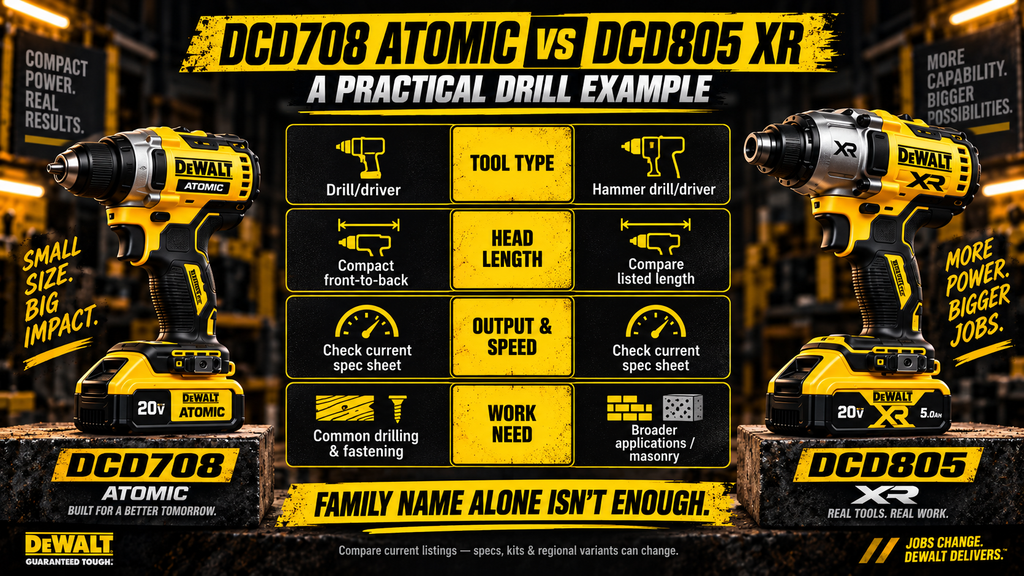
A compact drill comparison illustrates why the family name alone is not enough. The DCD708 Atomic compact drill/driver and DCD805 XR hammer drill/driver have different intended capabilities, layouts, and published specifications. They are not interchangeable categories simply because both use the 20V MAX platform.
What to verify before comparing these two tools
| Tool type Drill/driver versus hammer drill/driver | Head length Compare the listed front-to-back length |
| Output and speed Use the current manufacturer specification sheet | Work requirement Do you need masonry drilling or maximum compactness? |
The Atomic DCD708’s appeal is its compact form factor for common drilling and fastening work. The XR DCD805 is a hammer drill/driver aimed at users who may need its application range and model-specific performance features. Compare the official current listings where you shop, because specifications, kit contents, and regional variants can change.
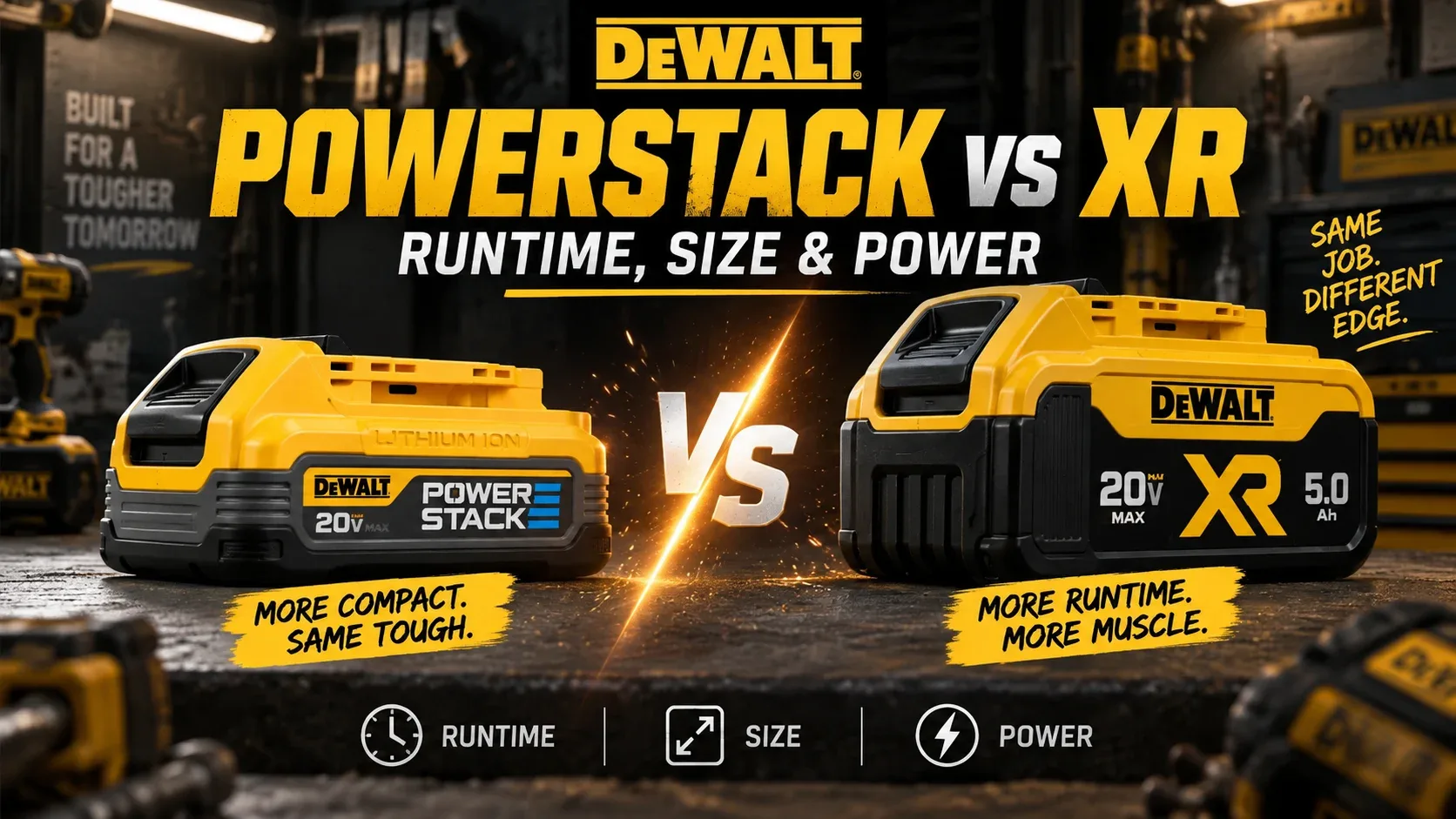
Do XR and Atomic use the same DeWalt batteries?
For many tools sold under the DeWalt 20V MAX system, yes: Atomic and XR tools use compatible 20V MAX battery packs. That is a major advantage for an existing DeWalt owner building a mixed kit. Battery size still changes the experience. A larger Ah pack can extend runtime but may reduce the compact, balanced feel that made an Atomic tool attractive in the first place. Check the manual and product page for compatibility with your exact battery and market.
Which line is better for professional use?
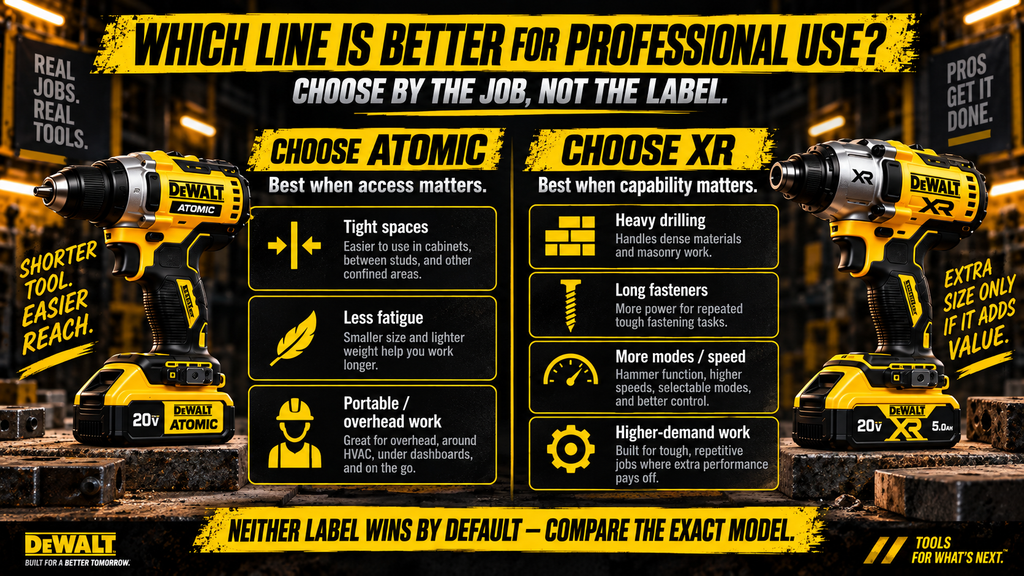
Neither label automatically decides whether a tool is professional-grade for your work. Plenty of professionals benefit from Atomic tools because access and fatigue are productivity issues. At the same time, a contractor drilling repeated large holes, driving structural fasteners, or working through long days may reasonably favor a particular XR model that offers the capacity, speed modes, runtime setup, or durability features the job demands.
Choose Atomic when access is the bottleneck
Shorter tools can be meaningfully easier to use inside cabinets, between studs, above shoulder height, around HVAC equipment, or beneath vehicle dashboards. Electricians, installers, cabinetmakers, mechanics, and maintenance technicians should look first at actual tool length and bare-tool weight. A smaller tool that reaches the fastener cleanly can be faster than a larger tool with more theoretical output.
Choose XR when the exact model earns its extra bulk
For regular heavy drilling, long fasteners, dense material, masonry work, or repeated production tasks, look for the specific capability you need: a hammer function, higher rated speed, an appropriate chuck, stronger impact performance, selectable modes, or better thermal management. If an XR model provides a measurable benefit for your recurring work, its extra cost and size can be justified. If it does not, buying the larger tool may only add fatigue.
Is the XR price difference worth it?
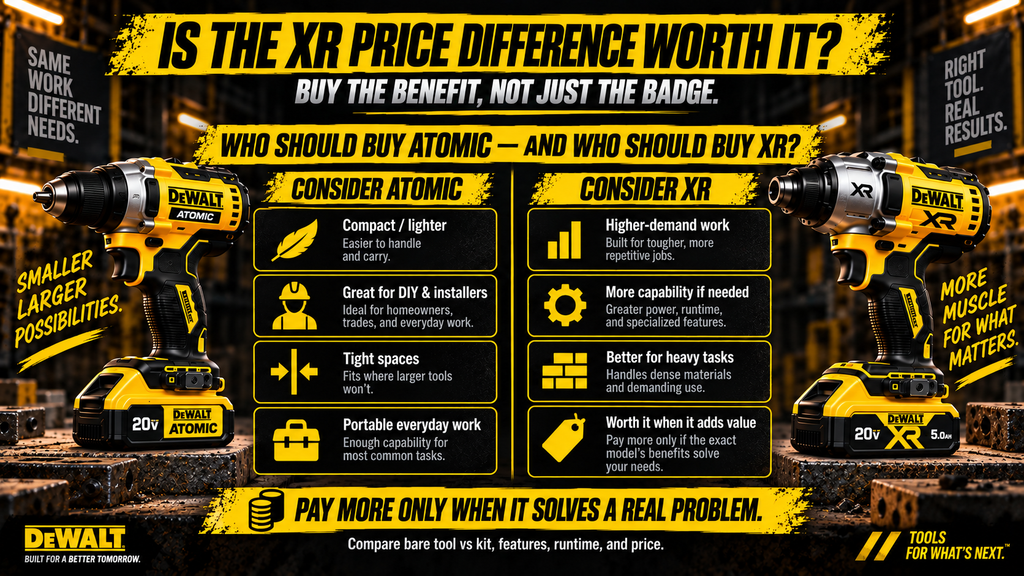
It is worth paying more only when the higher-priced tool solves a real problem: it saves time on your usual material, adds a mode you will use, withstands the workload better, or lets you avoid buying a second specialized tool. Compare bare tool against bare tool, then compare kits separately. A kit’s price can be driven by battery capacity, charger type, bag, and promotion—not just by the tool itself. If the models have similar specifications for your task, the better value may simply be the lighter or less expensive option.
Who should buy Atomic—and who should buy XR?
Consider Atomic if…
You are a homeowner, DIYer, installer, mechanic, or trade professional who prioritizes compact dimensions, easier overhead handling, confined-space access, portability, and enough capability for regular everyday work. It is often the sensible first choice when you do not have a clear need for a larger, more specialized tool.
Consider XR if…
The particular XR model offers published performance, runtime capability, controls, or a tool function that directly matches your heavier workload. It can be a better long-term purchase for demanding use—but only after you have identified the model-specific benefit you will actually use.
A five-minute comparison checklist
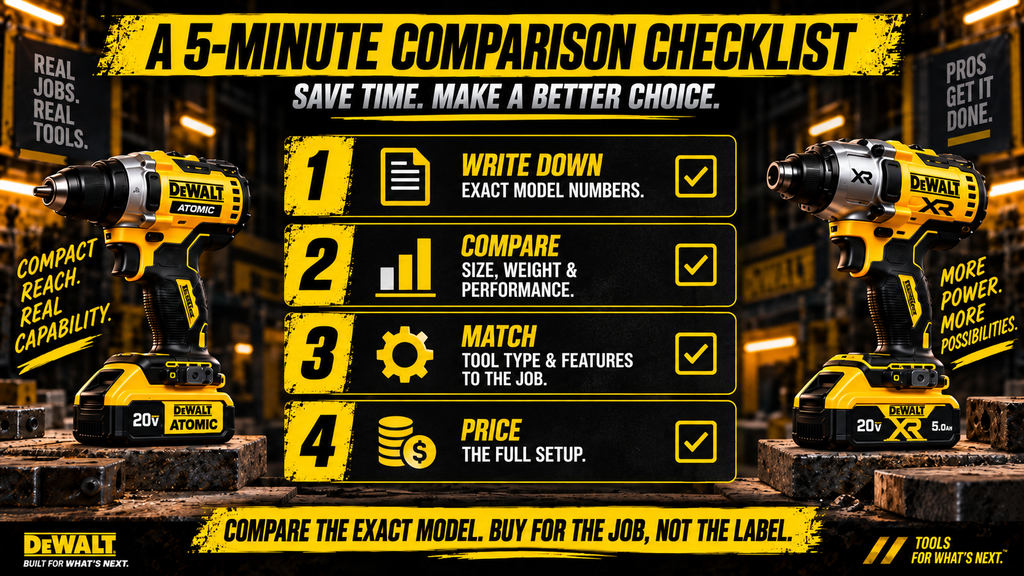
- Write down the exact model numbers, not just “XR” or “Atomic.”
- Compare bare-tool length, weight, speed, impact rate, and rated output where the manufacturer publishes it.
- Check whether the tool type and included features fit your actual materials and fasteners.
- Price the complete setup: bare tool or kit, battery capacity, charger, warranty, and the batteries you already own.
Frequently asked questions
Is DeWalt XR better than Atomic?
Not automatically. XR often includes performance-oriented models, while Atomic often emphasizes compactness. The better tool is the exact model whose specifications and ergonomics suit your work. Compare model numbers rather than treating either label as a universal quality ranking.
Is Atomic simply a smaller version of XR?
No. Atomic is a compact-focused family, but tool types, generations, motors, and features differ across the DeWalt range. A compact Atomic tool may be ideal for access and everyday work, while an XR model may have a different application focus rather than being a direct larger equivalent.
Can I use my existing 20V MAX batteries with both?
Many DeWalt Atomic and XR tools in the 20V MAX platform use compatible 20V MAX battery packs. Always confirm the product page or manual for the exact tool, battery, and region. Also remember that a large pack can make a compact tool feel heavier and longer in use.