A practical guide to choosing a DeWalt impact wrench for tire service, seized fasteners, suspension work, structural fastening, and everyday shop use.
For most automotive work, a DeWalt 1/2-inch impact wrench is the versatile default. Choose 3/8-inch when access and control matter more than brute force, and step up to a high-torque 1/2-inch or 3/4-inch tool for consistently seized, oversized, or structural fasteners.
A DeWalt impact wrench can save minutes on every wheel service, suspension repair, or steel-fastener task—but only if its drive size, torque tier, and battery are matched to the work. The usual mistake is shopping by the biggest published number alone. A heavy high-torque tool can be excellent for a rust-belt truck bay, yet tiring and unnecessary for daily brake work. Start with the fasteners you actually meet, the clearance around them, and how often the tool must work at full load.
3/8-inch vs. 1/2-inch: choose the anvil for the job
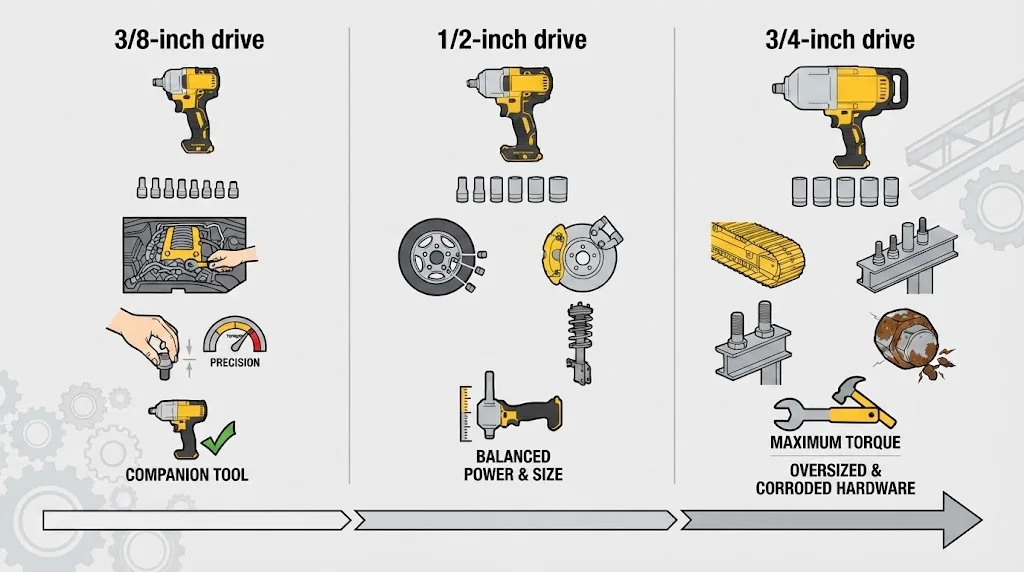
The 1/2-inch DeWalt impact wrench is the practical center of the range because it accepts the sockets most technicians already use for wheel, brake, suspension, and general repair work. A 3/8-inch impact wrench belongs where compact sockets, shorter heads, and finesse matter: engine bays, interior fasteners, smaller brackets, and crowded assemblies. The larger 3/4-inch class is specialized equipment for heavy equipment, large structural hardware, and fasteners that regularly defeat a mid-torque tool.
3/8-inch drive
Best for access, smaller sockets, and controlled fastening. A smart companion tool for technicians who already own a 1/2-inch impact.
1/2-inch drive
The all-round automotive and trade choice. It covers lug nuts, brake hardware, suspension work, anchors, and many structural fastening tasks.
3/4-inch drive
Built for larger sockets and repeat heavy fastening. It makes sense for fleet, heavy equipment, and consistently oversized or corroded hardware.
Published torque needs context before it becomes useful
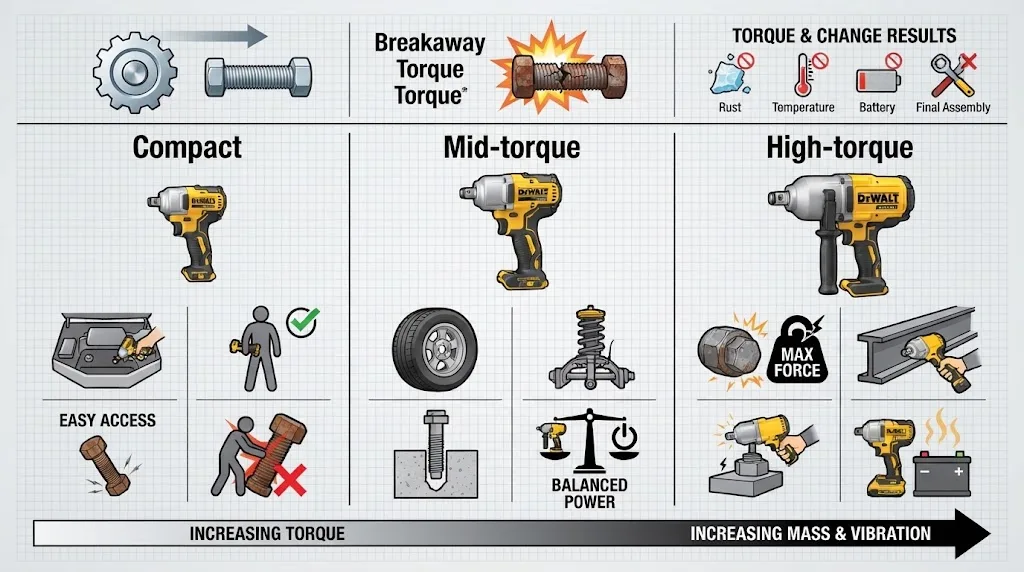
Impact wrench listings often separate fastening torque from breakaway, or nut-busting, torque. Fastening torque describes the tool’s ability to drive a fastener under load; breakaway torque refers to the moment needed to start a seized fastener moving. Neither figure tells the whole story. Rust, thread condition, socket fit, battery charge, temperature, and tool mode can all change real results. Use the numbers to compare tools in the same class—not as a replacement for a torque wrench on final assembly.
| Impact tier | Typical work | What to expect |
|---|---|---|
| Compact | Tight clearances, smaller bolts, routine service | Lower weight and easier access, but not designed to win every seized-fastener fight. |
| Mid-torque | Tire rotations, suspension, fleet maintenance, anchors | The most balanced 1/2-inch class for professionals who need power without carrying a large high-torque body all day. |
| High-torque | Seized suspension bolts, truck work, heavy steel and large hardware | More leverage for stubborn work, with a trade-off in tool mass, length, vibration, and battery draw. |
Why the DeWalt DCF891 class gets so much attention
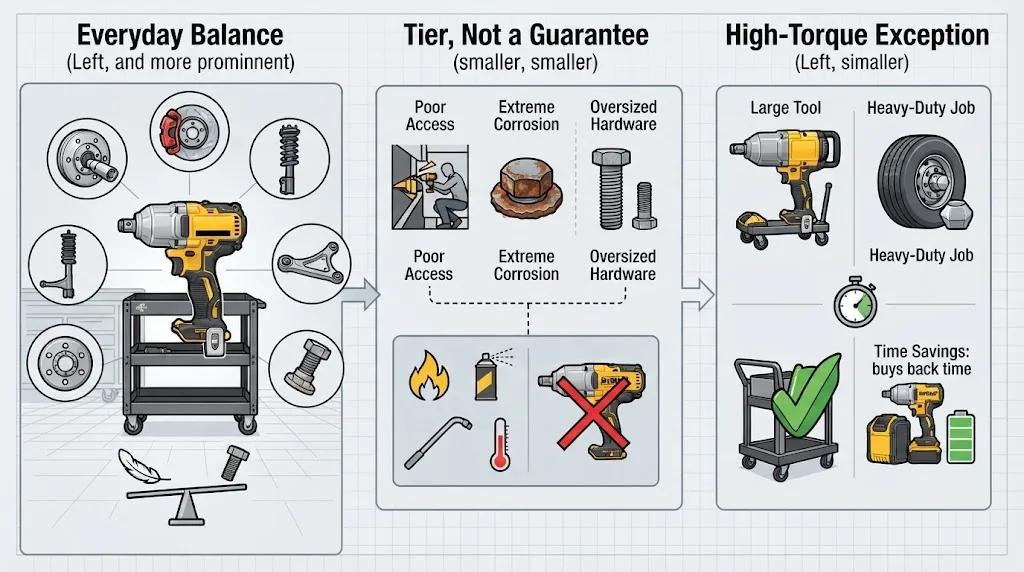
The DeWalt DCF891 sits in the modern mid-torque category: a 1/2-inch cordless impact wrench intended to cover the work that once pushed users toward larger tools. For a technician handling wheels, brakes, suspension arms, hub-related hardware, and general repair, this is often the better everyday balance than a high-torque model. It is still important to treat it as a tool tier rather than a guarantee—extreme corrosion, oversized hardware, and poor access can still call for heat, penetrant, a breaker bar, or a larger impact.
A mid-torque 1/2-inch impact is often the tool that stays on the cart. Reserve a high-torque impact for the jobs where its additional size and battery consumption genuinely buy back time.
Battery size affects performance, not just runtime
A cordless DeWalt impact wrench can demand high current when it meets a fastener that will not move. Small 2Ah packs are convenient for short, light work, but they can limit sustained output and empty quickly under repeated hard pulls. A healthy 5Ah or larger 20V MAX battery generally gives a mid-torque or high-torque tool more room to deliver consistent performance. Battery condition matters too: a worn, overheated, or very cold pack can make a capable impact feel weak.
Pair the battery to the workload
For regular lug-nut and suspension work, keep at least two quality packs in rotation and let hot packs cool before charging. Avoid judging a high-draw impact wrench with one small, partly discharged battery; that setup can make the tool seem underpowered when the battery is the constraint.
Choose the lightest impact wrench that reliably completes the shift
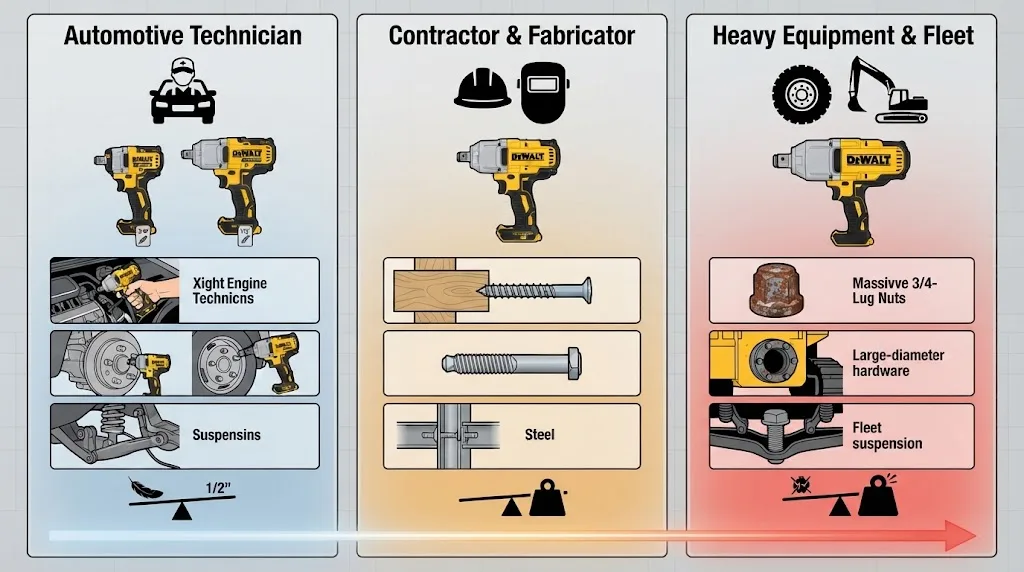
Automotive technicians usually benefit most from a compact 3/8-inch impact plus a capable 1/2-inch mid-torque wrench. That combination handles access work and the usual heavy jobs without forcing a high-torque tool into every wheel well. Contractors and fabricators should consider the fastener schedule: repeated lag bolts, anchors, and steel hardware may justify a more powerful 1/2-inch impact. Heavy equipment and fleet work often need a dedicated high-torque or 3/4-inch solution where rusted, larger-diameter hardware is normal rather than occasional.
DeWalt impact wrench questions, answered
Is a 1/2-inch DeWalt impact enough for lug nuts?
For normal passenger vehicle lug nuts, a capable 1/2-inch mid-torque impact wrench is often the right choice. Conditions vary, however: rust, overtightening by a previous shop, large truck hardware, and socket fit can all increase the required breakaway force. Always torque lug nuts to the vehicle specification after installation.
Should I buy 3/8-inch or 1/2-inch first?
Buy 1/2-inch first if you service wheels, suspension, outdoor equipment, anchors, or larger fasteners. Start with 3/8-inch if your work is primarily compact engine-bay hardware and you already have another method for wheels and stubborn bolts. Many working technicians eventually use both.
Can an impact wrench replace a torque wrench?
No. Impact wrenches are efficient for removal and run-down, but their final output changes with mode, battery charge, socket extension, fastener condition, and trigger time. Use a calibrated torque wrench for wheel nuts, engine components, suspension fasteners, and any assembly with a specified final torque.