
Automotive Electrical Maintenance
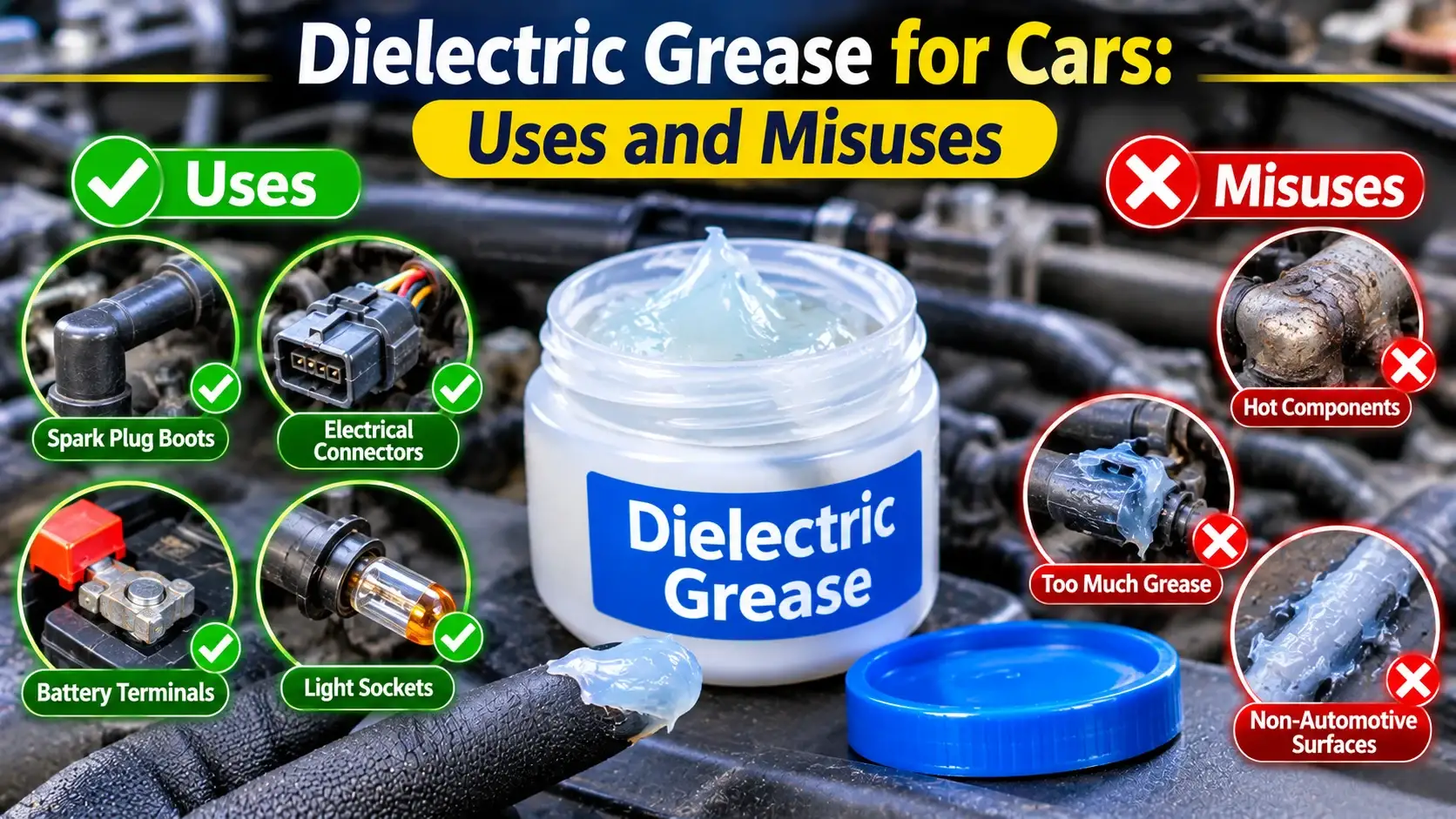
Dielectric grease is commonly used on spark plug boots, ignition components, and certain automotive electrical connectors. But there is one important detail many DIY mechanics misunderstand: dielectric grease does not conduct electricity.
When used correctly, it can help protect compatible parts from moisture, dirt, and corrosion while lubricating rubber boots and seals. When applied incorrectly, it may interfere with proper connector seating or create unnecessary maintenance problems.
This guide explains what dielectric grease does, where to use it in a car, where to avoid it, and how to apply it according to vehicle and product manufacturer instructions.
Quick Answer: What Is Dielectric Grease Used For?
Dielectric grease is a nonconductive protective lubricant, commonly formulated with silicone. In automotive maintenance, it is often used on compatible spark plug boots, ignition components, weather seals, and selected electrical connectors.
Its main jobs are insulation, lubrication, and protection from moisture. It does not repair damaged wiring, restore corroded terminals, or increase electrical conductivity.
Important: Always follow your vehicle’s service manual and the grease manufacturer’s directions. Not every connector or electrical system is designed for added lubricant. Never apply a general-purpose grease to an electrical component simply because it looks similar to dielectric grease.
What Is Dielectric Grease?
Dielectric grease is an electrically insulating lubricant designed to protect compatible components from moisture and environmental exposure. Many automotive products use silicone-based formulations.
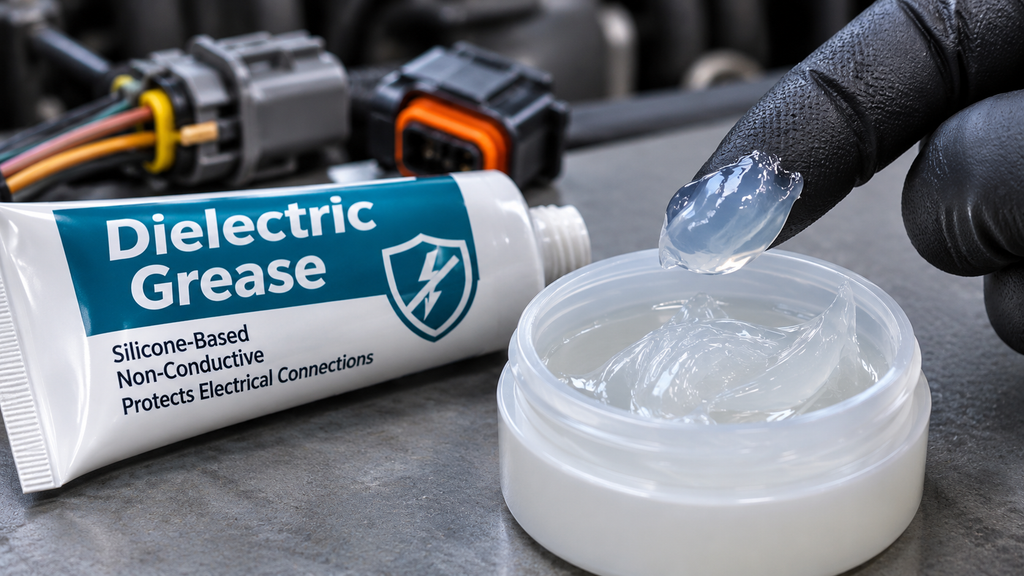
It usually appears as a clear or translucent gel-like substance. Unlike ordinary grease used for bearings or chassis components, dielectric grease is selected for its insulating and protective properties.
Its formulation may help reduce moisture exposure around suitable electrical connections and provide lubrication for compatible rubber, plastic, and ceramic surfaces.
However, the exact temperature limits, material compatibility, and recommended applications depend on the product. Always check its technical data sheet.
For a broader explanation of the product’s properties, see our existing article, What Is Dielectric Grease? .
What Does Dielectric Grease Do?
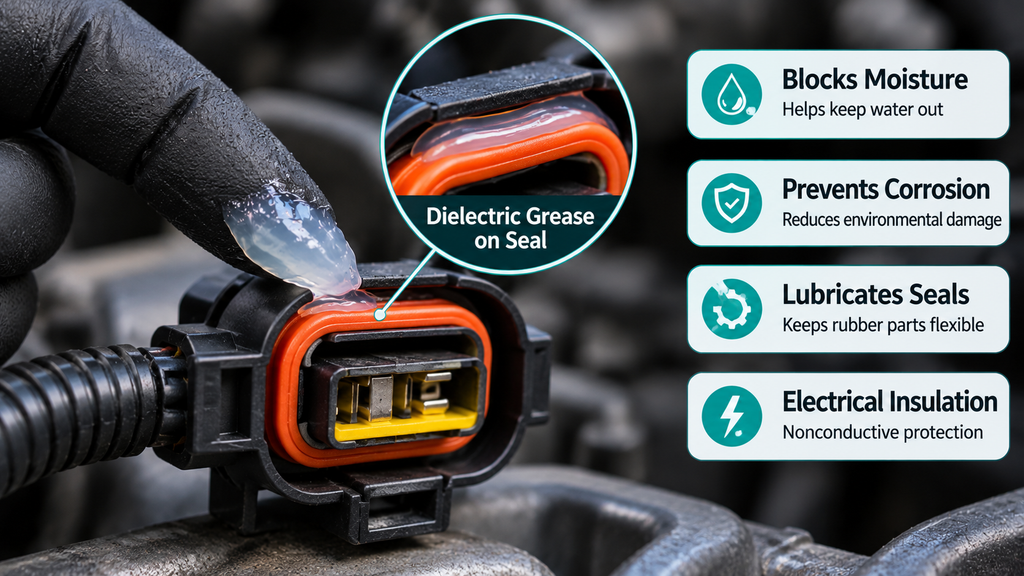
The main purpose of dielectric grease is not to carry electricity. It is to protect or lubricate components where an insulating compound is appropriate.
1. Helps Resist Moisture
A suitable grease layer can help exclude water from certain sealing surfaces and protective areas. This is especially useful for approved applications exposed to damp conditions.
2. Lubricates Rubber Boots
A small amount of compatible grease can reduce friction between a spark plug’s ceramic insulator and its rubber boot.
This may make boot installation and future removal easier while reducing the chance of the rubber sticking to the ceramic surface.
3. Provides Electrical Insulation
The grease itself resists electrical current flow. In specified ignition applications, its insulating properties can help protect surfaces against unwanted high-voltage leakage.
4. Helps Protect Suitable Surfaces
When used as directed, dielectric grease can act as a protective barrier against moisture, dirt, and some environmental contaminants.
It cannot remove existing corrosion or repair a damaged terminal. Those faults must be addressed first.
Is Dielectric Grease Conductive?
No. Dielectric grease is electrically nonconductive. That means the grease itself does not provide an electrical path between two terminals
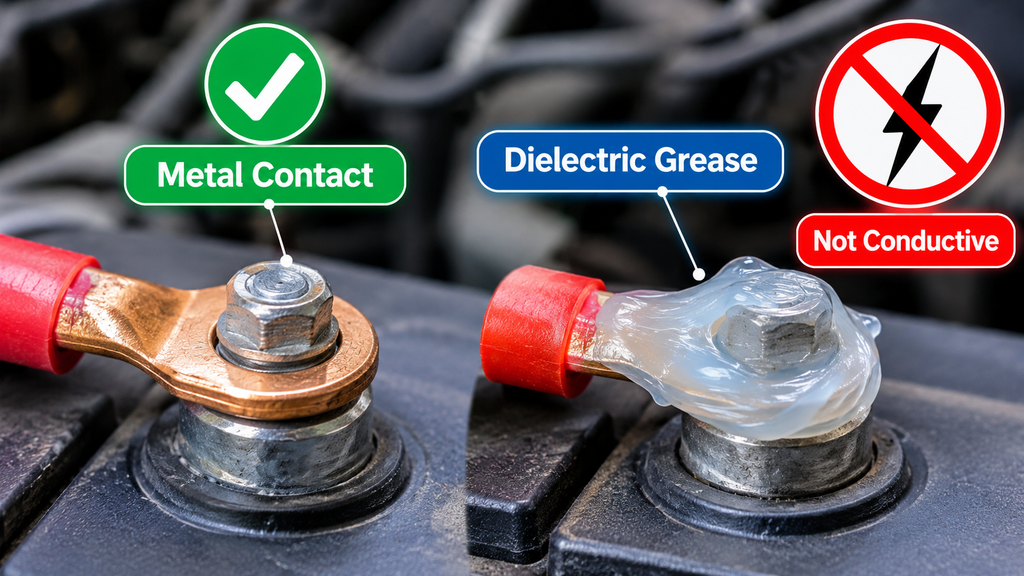
So why do some electrical connector manufacturers allow it?
Properly designed and maintained electrical terminals establish contact through their mating metal surfaces. Depending on the connector design, contact pressure may displace an approved grease at the contact interface.
The grease then serves a protective role rather than functioning as the conductor.
However, this does not mean every connector should be filled with dielectric grease. Excess grease, weak terminal tension, or incompatible connector construction can interfere with proper seating.
Remember: Dielectric grease does not improve conductivity. Any electrical benefit comes from protecting an already properly functioning connection in an approved application.
Where to Use Dielectric Grease in a Car
Several automotive components may benefit from dielectric grease when the vehicle manufacturer and grease manufacturer approve its use. The correct application depends on the component’s construction.
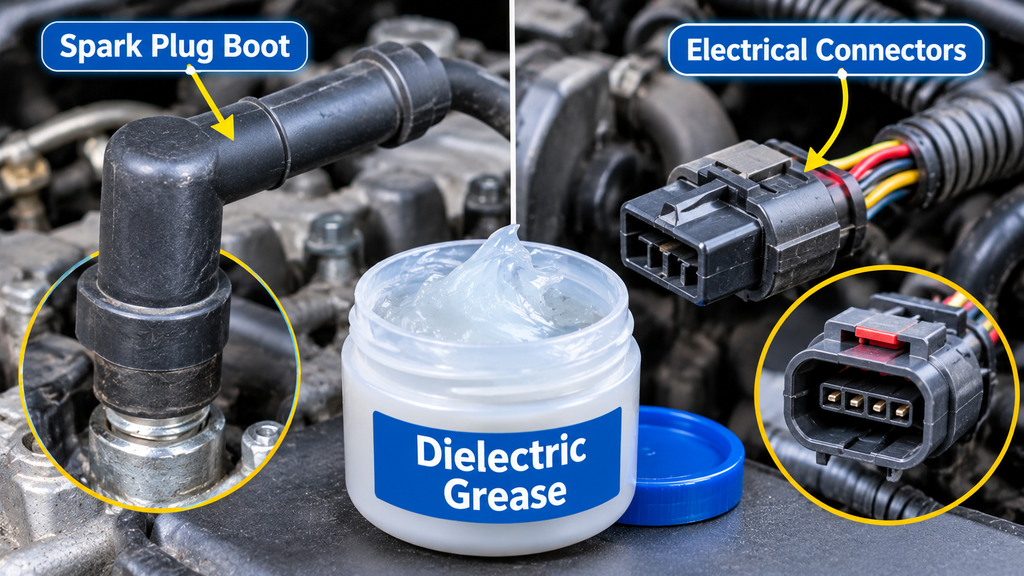
1. Spark Plug Boots
Spark plug boots are one of the most familiar automotive uses for dielectric grease.
When the instructions permit, a thin film may be applied to the specified inner rubber surface that contacts the spark plug’s ceramic insulator.
This can help prevent the boot from sticking to the ceramic and may improve protection against moisture intrusion.
Do not pack the metal terminal cavity with grease unless the specific product and component instructions call for that application.
If your engine is misfiring, grease is not a substitute for diagnosis. Worn plugs, damaged boots, and failing ignition coils can produce similar symptoms.
2. Ignition Coil Boots
Many modern engines use coil-on-plug ignition systems. The ignition coil or its boot fits over the spark plug.
A compatible dielectric lubricant may be specified for the boot-to-ceramic interface.
Use only the recommended amount and avoid contaminating electrical terminals unless the manufacturer permits it.
Our guide to bad ignition coil symptoms, testing, and replacement explains how to investigate ignition problems before replacing components.
3. Electrical Connectors
Some weather-resistant automotive connectors use seals designed to exclude water, dust, and road contamination.
In approved applications, a compatible dielectric compound may help maintain the protective sealing surfaces.
However, some connector systems use specialized contact treatments, pre-applied lubricants, or strict no-grease requirements.
Do not apply grease to ECU, sensor, or control-module connectors without checking the service documentation.
4. Battery Terminal Protection
Battery terminal connections are another area where protective compounds may be used according to the manufacturer’s procedure.
The electrical contact must first be clean, properly assembled, and secured.
An approved protective product may then be applied to specified exposed surfaces to help reduce environmental corrosion.
Do not use grease to compensate for loose clamps, heavy corrosion, or damaged battery cables.
For a complete maintenance procedure, see how to clean car battery corrosion and terminals safely .
5. Trailer Wiring Connectors
Trailer connectors are exposed to rain, road spray, dirt, and sometimes road salt.
A dielectric grease approved for the connector may help protect appropriate sealing areas or contact assemblies.
First inspect the terminals for damage, looseness, and corrosion. Confirm that the connector is designed to accept the chosen product.
6. Certain Bulb Sockets and Ignition Components
Some manufacturers specify dielectric compounds for particular lamp connectors, distributor components, and insulating surfaces.
Use these products only where the service procedure or product label identifies the application as suitable.
Where Should You Not Use Dielectric Grease?
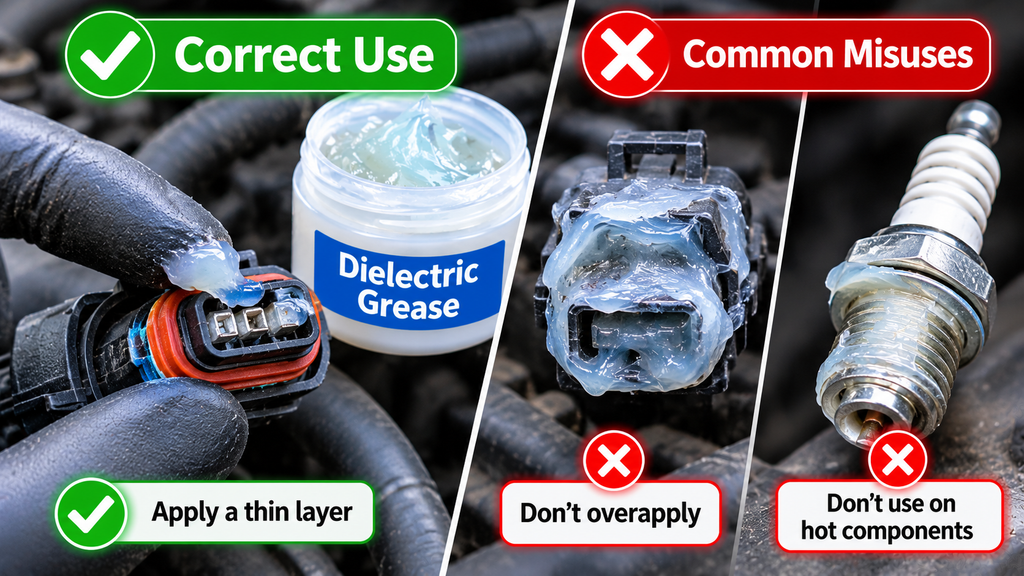
The most common misuse is treating dielectric grease as a universal electrical repair product. Its insulating properties make correct placement important.
| Application | Why Caution Is Needed |
|---|---|
| Damaged electrical terminals | Grease cannot repair bent, burned, loose, or corroded contacts. |
| Unspecified sensor connectors | Some require special materials or prohibit additional grease. |
| Connector cavities packed with grease | Excess product may affect seating or terminal engagement. |
| Spark plug firing tips or electrodes | These are not normal application points for boot grease. |
| Spark plug threads | Dielectric grease is not a substitute for the manufacturer’s specified thread treatment. |
| Unapproved high-current contacts | Contact design, resistance, heating, and lubricant compatibility must be considered. |
| Damaged wiring insulation | Grease does not replace electrical insulation or wiring repairs. |
Can You Put It Directly on Metal Contacts?
There is no universal yes-or-no answer for every connector. Some grease manufacturers specifically permit particular terminal-contact applications.
Other connector and ignition component manufacturers warn against excessive grease at mating contact points.
The correct decision depends on the component design, the lubricant formulation, and the manufacturer’s instructions.
Important: Do not assume that because a product is sold as electrical grease, it is automatically suitable for every automotive electrical contact or connector.
How to Apply Dielectric Grease Correctly
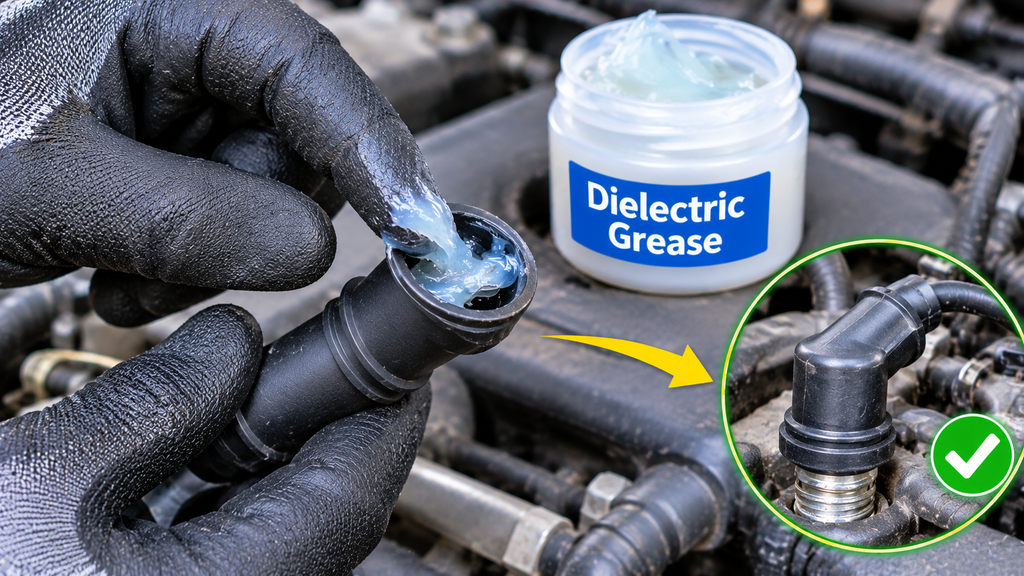
Applying dielectric grease properly starts with identifying the component and checking whether the manufacturer recommends its use. More grease does not automatically mean better protection
Check the Application
Identify the component and consult the vehicle service instructions and dielectric grease product label. Confirm the intended application and material compatibility.
Make the Vehicle Safe
Turn off the ignition and allow hot engine components to cool. Follow the relevant service procedure for any electrical isolation or disconnection.
High-voltage ignition systems, hybrid vehicles, and electric vehicles may require specialized safety procedures.
Inspect the Component
Check for cracked rubber, corroded terminals, damaged wires, broken seals, or signs of overheating.
Replace or repair faulty components rather than hiding the problem with grease.
Clean Only as Directed
If cleaning is required, use the manufacturer-approved method and suitable products. Ensure the relevant surfaces are ready for reassembly.
Apply the Recommended Amount
Use a thin layer or small amount only where specified. For an approved spark plug boot application, this is often the inner insulating surface of the boot.
Avoid filling the entire cavity or covering parts that must remain untreated.
Reassemble and Verify
Reconnect components according to the manufacturer’s procedure. Ensure electrical connectors and ignition boots are fully seated and secured.
Confirm the system operates normally after reassembly. If a fault remains, continue diagnosis rather than applying additional grease.
Practical Tip: For spark plug servicing, follow the exact instructions supplied with the plugs, ignition boots, and dielectric grease. Different manufacturers may specify different application points.
Dielectric Grease vs. Regular Grease vs. Conductive Grease
Automotive lubricants are not interchangeable simply because they have a similar appearance. Their composition and intended uses can differ significantly.
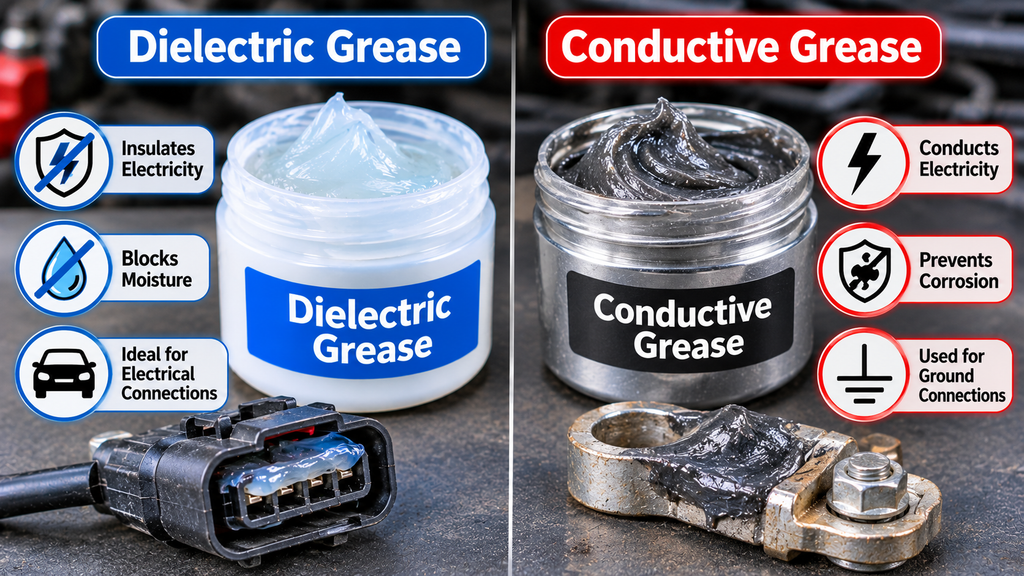
| Grease Type | Main Purpose | Important Difference |
|---|---|---|
| Dielectric grease | Insulation, lubrication, and moisture protection. | Normally electrically nonconductive. |
| General-purpose automotive grease | Mechanical lubrication. | Not automatically compatible with electrical parts or seals. |
| Conductive compound | Application-specific electrical or electronic uses. | Properties depend on formulation; not a universal connector lubricant. |
| Anti-seize compound | Reduce seizure of specified fasteners. | Not interchangeable with dielectric grease or automatically suitable for spark plug threads. |
Is Dielectric Grease the Same as Silicone Grease?
Many dielectric greases are silicone-based, but not every silicone grease is intended for every automotive electrical application.
Compare the product specifications, material compatibility, operating temperature range, and stated uses.
Does Conductive Grease Improve Electrical Connections?
A product described as conductive is not automatically appropriate for vehicle connectors.
Electrical contact compounds may be engineered for specific materials, temperatures, pressures, and contact designs.
Use only products specifically approved for the intended component.
Can Dielectric Grease Cause Electrical Problems?
Incorrect application can contribute to connection problems, but grease is not automatically responsible for every fault that appears after electrical maintenance.
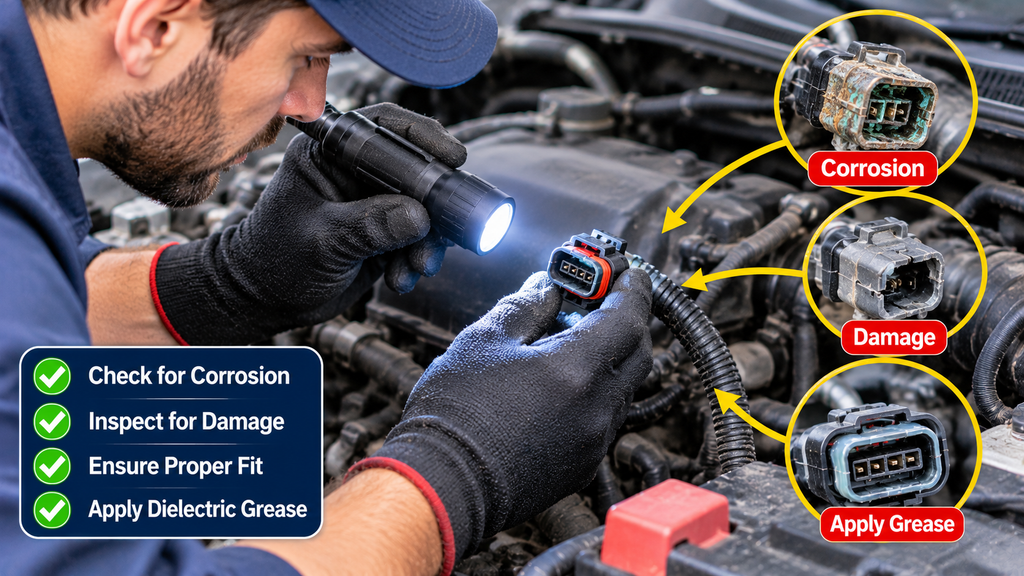
Possible Problems After Application
- An electrical connector may not be fully seated.
- Too much grease may interfere with terminal engagement.
- A spark plug boot may not be properly attached.
- Corroded or damaged terminals may remain faulty.
- An incompatible lubricant may affect certain seals or materials.
- The original electrical fault may not have been repaired.
For example, suppose a vehicle begins misfiring after an ignition coil replacement.
The problem may involve an improperly seated coil boot, a damaged connector, a faulty new component, or another ignition issue.
Applying more dielectric grease without identifying the cause is not a reliable repair strategy.
Our article on oil on a spark plug: causes and repair urgency explains another issue that can affect ignition components.
For connector-related starting and electrical problems, see ignition switch wiring, terminals, and testing .
Common Dielectric Grease Mistakes to Avoid
Most problems associated with dielectric grease involve incorrect product selection, poor application practices, or assuming grease can repair an existing fault.
| Mistake | Better Approach |
|---|---|
| Using too much grease | Apply only the amount recommended for the component. |
| Applying it to every connector | Check the specific connector’s service instructions. |
| Ignoring corroded terminals | Inspect, clean, repair, or replace faulty contacts as required. |
| Using regular grease instead | Use an approved electrical lubricant with suitable specifications. |
| Applying grease to spark plug threads | Follow spark plug installation instructions and torque specifications. |
| Expecting grease to fix misfires | Diagnose ignition coils, plugs, boots, wiring, and other possible causes. |
| Ignoring material compatibility | Verify compatibility with rubber, plastic, and connector materials. |
The safest practice is to use the minimum product needed for a verified application, rather than treating dielectric grease as a universal electrical-maintenance solution.
How Long Does Dielectric Grease Last?
There is no universal replacement interval for all dielectric grease applications. Service life depends on the product formulation, operating temperature, environmental exposure, and component design.
A high-quality compound may remain effective for an extended period under suitable conditions, but exposure to contaminants, repeated disassembly, and component deterioration can change its condition.
During scheduled maintenance, inspect the relevant boots, seals, and electrical connections according to the vehicle manufacturer’s recommendations.
Replace damaged components and reapply an approved compound only when the service procedure calls for it.
Can Dielectric Grease Dry Out?
Its behavior depends on the specific formulation and conditions. Do not assume a particular grease has an unlimited service life.
Follow the product manufacturer’s shelf-life, storage, and service recommendations.
Frequently Asked Questions About Dielectric Grease
What is dielectric grease used for in cars?
It is used to lubricate and protect suitable automotive components, including specified spark plug boots, ignition parts, seals, and selected electrical connectors. Applications must follow manufacturer instructions.
Is dielectric grease conductive?
No. Dielectric grease is an electrical insulator. It does not create conductivity between terminals.
Can dielectric grease go on spark plug boots?
Yes, when recommended for the specific ignition system. A small amount may be applied to specified insulating boot surfaces according to manufacturer instructions.
Can I put dielectric grease on battery terminals?
Certain products are suitable for battery-terminal protection. The connection must first be clean and properly secured. Follow the battery and vehicle manufacturer’s instructions for application.
Does dielectric grease prevent corrosion?
It can help reduce exposure to moisture and contaminants in approved applications. It does not remove existing corrosion or restore damaged electrical contacts.
Can too much dielectric grease cause problems?
Yes. Excessive grease may interfere with connector seating or terminal engagement in certain designs. Use only the recommended quantity.
Is dielectric grease safe for all electrical connectors?
No. Some connectors permit specified protective compounds, while others require different materials or prohibit added grease. Always check the service manual.
Can dielectric grease fix a misfire?
No. It is not a repair for failed spark plugs, damaged coil boots, faulty ignition coils, or wiring defects. Accurate diagnosis is required.
Is dielectric grease the same as silicone grease?
Many dielectric greases are silicone-based, but individual silicone grease formulations can have different technical properties and intended uses.
Should dielectric grease go on spark plug threads?
Not as a general practice. Follow the spark plug manufacturer’s specified installation and thread treatment instructions.
Can dielectric grease damage rubber?
Many automotive dielectric greases are designed for compatible rubber surfaces. However, material compatibility depends on both the lubricant and the rubber formulation.
Do all cars need dielectric grease?
No. Many electrical connections are designed to operate without additional grease. Use it where specified or approved by the relevant manufacturer.
Final Thoughts: Use Dielectric Grease Where It Belongs
Dielectric grease can be a useful automotive maintenance product when applied to the right surfaces and used according to manufacturer instructions.
Its purpose is to provide insulation, lubrication, and environmental protection where those properties are appropriate.
It does not improve electrical conductivity, correct loose terminals, or repair faulty ignition components.
The key is to confirm the application, use the correct product and amount, and maintain proper electrical contact and connector seating.
When electrical problems are present, identify the underlying fault rather than relying on grease as a repair.