
Choose a chainsaw chain or chain saw blade that fits properly, cuts efficiently, and supports safer work around your property.
A dull or poorly matched chainsaw chain can turn a simple firewood job into slow, tiring, and potentially unsafe work. This guide separates the terms chainsaw blade, chain saw blade, chainsaw chain, and chain saw chain, then shows how to identify the replacement part that suits your saw and the timber you cut most often.
Is a chainsaw blade the same thing as a chainsaw chain?
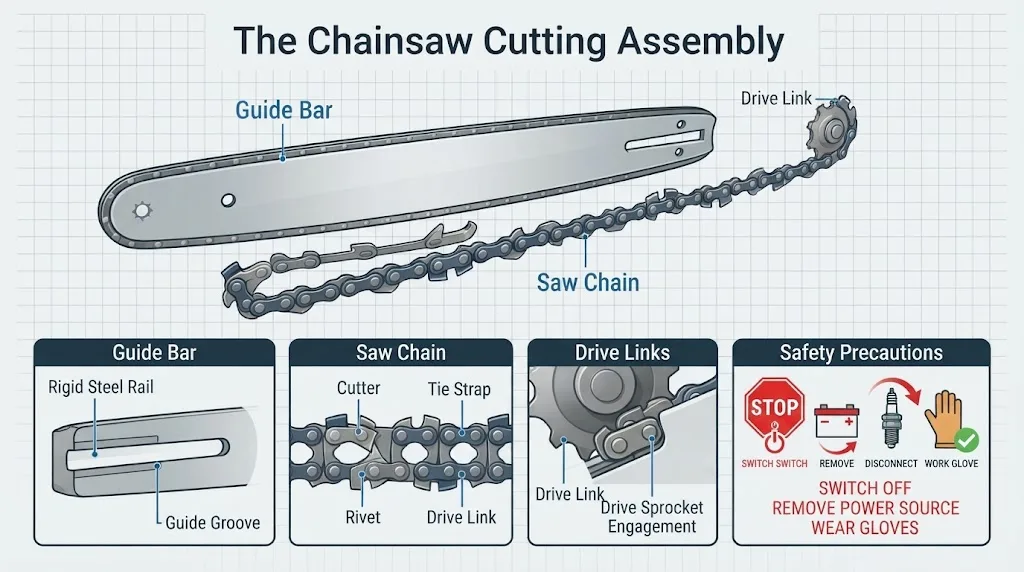
In everyday conversation, people often call the entire cutting assembly a chainsaw blade or chain saw blade. Technically, the guide bar is the long steel rail that supports and guides the moving chainsaw chain. The chain is the loop with cutters, tie straps, rivets, and drive links. Both parts must work together, so replacement decisions should always start with your saw manual and the markings stamped on the guide bar.
Guide bar
The rigid rail often called the chainsaw blade. Its groove holds and guides the chain drive links.
Saw chain
The cutting loop that travels around the bar. Its pitch, gauge, and drive-link count must match.
Drive links
The lower tabs that sit inside the bar groove and engage with the saw’s drive sprocket.
Before inspecting, tensioning, sharpening, or replacing a chain, switch off the saw, remove its battery or disconnect the spark plug as directed by the manual, and wear gloves. A stopped chain can still have sharp cutters.
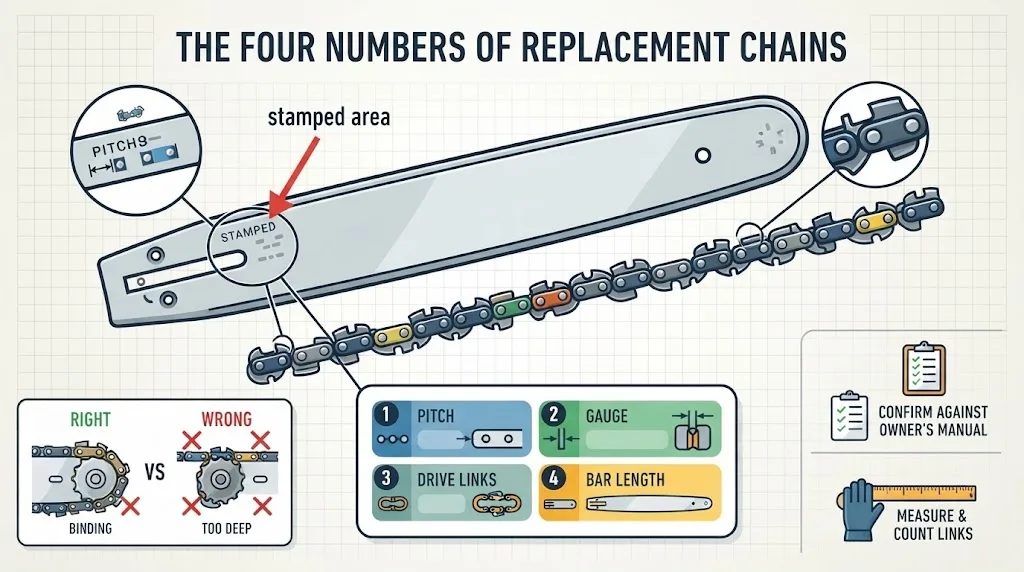
Four numbers identify the right replacement chain
The safest route is to read the chain specification stamped near the mounting end of the guide bar, then confirm it against the owner’s manual. Record the bar’s usable cutting length, chain pitch, gauge, and drive-link count. A chain can look nearly identical to the old loop but still be wrong for the sprocket or bar groove. Never force a chain that binds, rides high in the groove, or does not tension correctly.
Bar length narrows the choices, but it does not determine the correct chain by itself. Two 18-inch bars can use different gauges or drive-link counts depending on their mount and manufacturer.
Choose a chain type for your work, not just maximum speed
Low-profile chains are common on homeowner saws and use safety features designed to reduce kickback risk when paired with compatible equipment. Semi-chisel chains have rounded cutter corners and generally hold an edge better in dusty, dry, or less-than-clean wood. Full-chisel chains have sharper square cutter corners and can cut faster in clean timber, but they dull more quickly if they contact dirt, sand, or bark with embedded debris.
A practical starting point for most landowners
For routine pruning, storm cleanup, and firewood from wood that may touch soil or carry dust, a manufacturer-approved low-profile or semi-chisel chain is often the more forgiving option. A faster chain is not automatically the better chain if your wood is dirty or your sharpening routine is inconsistent.
Match your chainsaw chain to the wood condition
Clean, freshly felled softwood is easier on a sharp chain than dry hardwood, reclaimed timber, or fallen branches dragged through soil. Even the best chain will lose performance quickly after striking earth, rocks, nails, or wire. Brush loose grit from logs before cutting whenever practical, keep the bar oil reservoir filled with the recommended lubricant, and let the chain do the work rather than pushing the saw through the cut.
Know when to sharpen and when to replace a chain
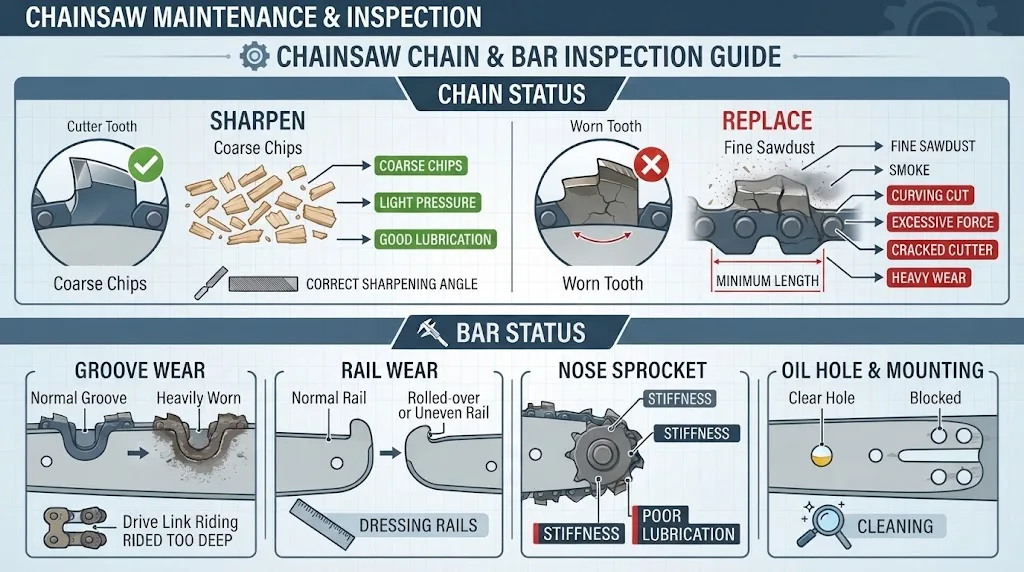
A sharp chainsaw chain throws coarse chips and pulls itself into the wood with light, controlled pressure. Fine sawdust, smoke with proper lubrication, a cut that curves, or a saw that needs excessive force are common signs the cutters need attention. Use the file size, filing angle, and depth-gauge setting specified for your particular chain. If cutters are cracked, badly damaged, or worn to the manufacturer’s minimum length, replace the chain rather than trying to extend its service life.
Do not overlook the bar
A new chain on a worn guide bar can still cut poorly. Inspect the bar groove, rails, nose sprocket, oil hole, and mounting area. Follow your manual’s instructions for cleaning, dressing rails, rotating the bar, or replacing it.
Chainsaw chain types at a glance
Use this high-level comparison to understand the trade-offs. Your saw’s manual and guide-bar marking always take priority over a general recommendation.
| Chain type | Best fit | What to know |
|---|---|---|
| Low-profile | Homeowner saws, pruning, light firewood, and general property work. | Often includes kickback-reduction features. Use only on approved saw and bar combinations. |
| Semi-chisel | Mixed firewood, dry hardwood, and timber where dust or light debris is likely. | Rounded cutters are more forgiving and can stay useful longer in imperfect conditions. |
| Full-chisel | Experienced users cutting clean, larger timber where speed is important. | Fast in clean wood, but sharper cutter corners dull quickly after contact with dirt or debris. |
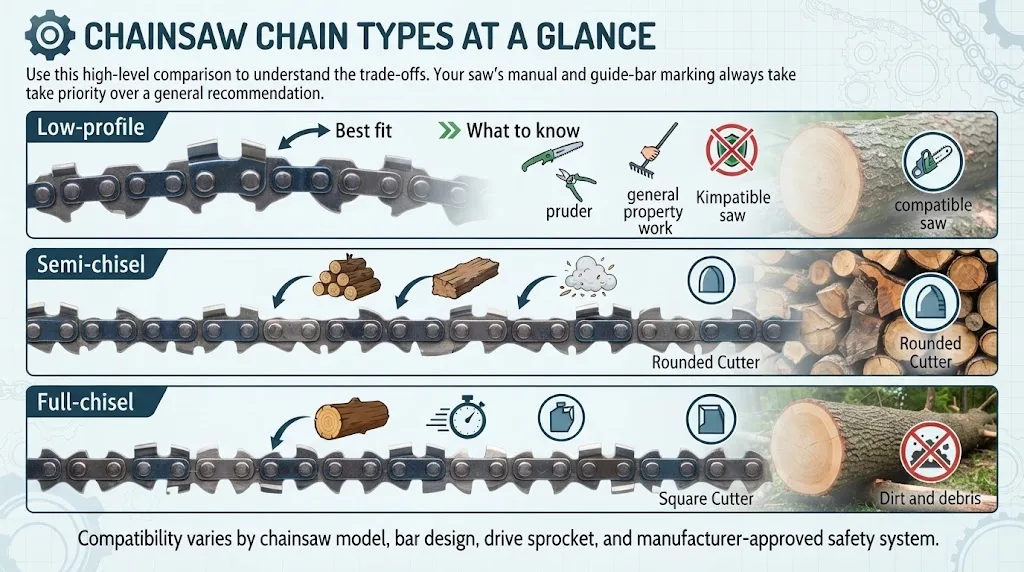
Compatibility varies by chainsaw model, bar design, drive sprocket, and manufacturer-approved safety system.
Chainsaw chain and blade questions, answered
Can I use any chain that fits my bar length?
No. Bar length is only one part of compatibility. The replacement chain must also match pitch, gauge, drive-link count, and the chain type approved for your saw and bar. Check the bar stamp and owner’s manual before ordering.
What is the difference between semi-chisel and full-chisel chain?
Semi-chisel cutters have rounded outer corners and tend to tolerate dusty or slightly dirty wood better. Full-chisel cutters have square corners that can cut faster in clean timber but generally need sharpening sooner after contact with grit or debris.
How tight should a new chainsaw chain be?
With the saw powered down, the chain should sit snugly against the underside of the bar while still moving freely by hand with gloves. The drive links must remain engaged in the bar groove. Follow your manual’s tensioning method and recheck a new chain after the first few cuts.