
A plain-language guide to throttle body service, dirty-throttle symptoms, DIY safety, and when diagnosis matters more than cleaning.
Throttle body cleaning can help when deposits are confirmed, but it is not universal maintenance for every car.
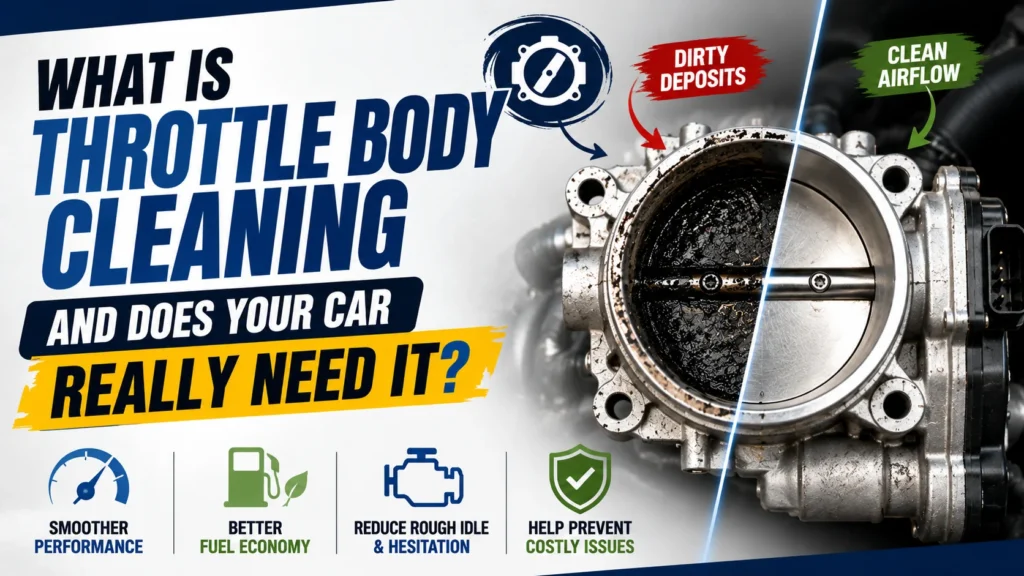
A throttle body service removes deposits from the throttle plate and bore that may interfere with airflow. Cleaning can make sense when a relevant symptom, inspection finding, or manufacturer procedure supports it. It should not be sold as a guaranteed cure for rough idle, hesitation, poor fuel economy, or a check-engine light.
The throttle body is the air-control gateway between the intake system and the engine. When you press the accelerator, its throttle plate opens to let more air in. On many modern cars, an electronic throttle body uses a motor and sensors rather than a traditional cable. Over time, vapour from the crankcase ventilation system and normal intake deposits can leave a carbon ring around the plate and bore.
Start with the manufacturer
Check your owner’s manual, maintenance schedule, and model-specific repair guidance first. Unless your manufacturer specifically lists throttle body cleaning, there is no universal mileage interval that makes every vehicle due for the service.
What is included in a throttle body service?
A careful throttle body cleaning service is more than spraying cleaner into an intake. The technician should identify whether deposits are actually present, inspect related intake components, use a cleaner suitable for the vehicle, and follow the correct electronic throttle control procedure. Depending on the car, the throttle body may be cleaned in place or removed for access, with a gasket replaced if required.
Inspect and scan first
A useful service begins with fault-code and live-data checks, plus a visual inspection for a deposit ring, intake leaks, and related problems.
Clean the plate and bore
Approved throttle body cleaner is applied carefully to remove deposits without flooding electronic parts or damaging protective coatings.
Relearn if required
Some drive-by-wire vehicles need idle or throttle adaptation after cleaning or component disconnection. The exact procedure is model-specific.
Ask before approving the work
Ask for the scan findings, evidence of deposits, cleaner and method used, whether a gasket is needed, and confirmation that any required idle relearn, road test, and warning-light check were completed.
Can a dirty throttle body cause rough idle or hesitation?
It can contribute in some vehicles, especially if deposits affect the small closed-throttle airflow area. But these symptoms overlap with many other faults. A dirty throttle body is one possible explanation—not a diagnosis by itself.
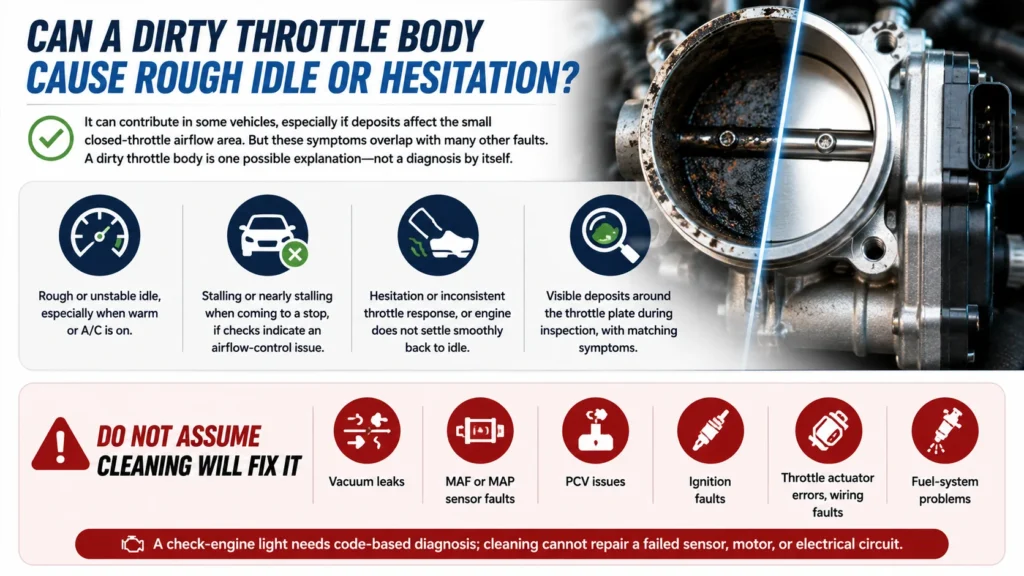
- Rough or unstable idle, particularly after the engine is warm or when the air conditioning switches on.
- Stalling or nearly stalling when coming to a stop, if related diagnostic checks support an airflow-control issue.
- Hesitation, inconsistent throttle response, or a sensation that the engine does not settle smoothly back to idle.
- Visible deposits around the throttle plate during a proper inspection, alongside symptoms that fit the vehicle’s service information.
Do not assume cleaning will fix it
Vacuum leaks, MAF or MAP sensor faults, PCV issues, ignition faults, throttle actuator errors, wiring faults, and fuel-system problems can cause similar symptoms. A check-engine light needs code-based diagnosis; cleaning cannot repair a failed sensor, motor, or electrical circuit.
Can you use throttle body cleaner for your car yourself?
DIY throttle body cleaning is possible on some vehicles, but the procedure depends on engine design and especially whether the car uses electronic throttle control. Use only a throttle body cleaner for car applications that is compatible with your vehicle’s materials and coatings. Do not substitute brake cleaner or a harsh general solvent.
Safer DIY decision points
- Find the exact manufacturer procedure for your model before disconnecting ducts, connectors, or the throttle body.
- Use a lint-free cloth and an approved throttle body cleaner sparingly; avoid soaking the electronic housing or allowing pooled solvent into sensitive areas.
- Complete the specified idle or throttle relearn procedure if required, then stop and seek diagnosis if the idle remains unstable or a warning light appears.
Electronic throttle body caution
Do not force an electronic throttle plate open unless the manufacturer’s procedure explicitly permits it. Prying or forcing the plate can damage the motor or gears. Some vehicles also require scan-tool adaptation after cleaning, so professional service may be the safer choice.
How much does throttle body cleaning cost?
In Pakistan, a standalone electronic throttle body cleaning is often quoted around PKR 2,000–6,000 at an independent workshop, with OBD diagnostics or adaptation sometimes charged separately. Common jobs that include proper scanning and relearn may reasonably land around PKR 3,000–7,000, while difficult access, larger engines, dealer labour, gaskets, or required adaptation can cost more. Treat estimates as local benchmarks, not fixed prices.
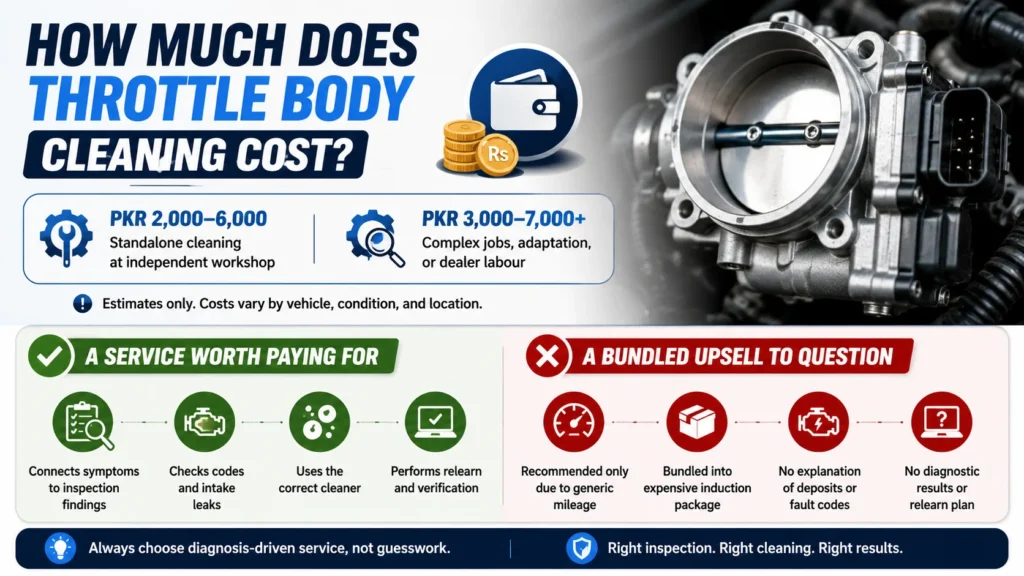
A service worth paying for
It connects symptoms to inspection findings, checks codes and intake leaks, documents deposits, uses the correct cleaner, and performs any required relearn and post-service verification.
A bundled upsell to question
It is recommended only because the car reached a generic mileage, bundled into an expensive induction package, or offered with no explanation of deposits, fault codes, diagnostic results, or relearn needs.
Throttle body cleaning FAQ
Does every car need a throttle body service?
No. Follow your vehicle manufacturer’s maintenance information. If cleaning is not listed as scheduled maintenance, base the decision on relevant symptoms, confirmed deposits, and proper diagnosis, not a universal mileage recommendation.
Will throttle body cleaning turn off a check-engine light?
Not reliably. A warning light can be triggered by many systems and requires a scan for diagnostic trouble codes. Cleaning may be part of a repair only if the inspection and manufacturer procedure support that conclusion.
Can cleaning damage an electronic throttle body?
Yes, incorrect methods can create problems. Forcing the plate, using incompatible solvent, flooding electronics, damaging a coating, or skipping a required relearn can cause drivability issues. Use the model-specific procedure or have a qualified technician perform the work.
When should I get professional diagnosis instead?
Arrange diagnosis for a persistent check-engine light, stalling, reduced-power warnings, major hesitation, electrical throttle faults, or symptoms that continue after cleaning. These conditions can involve safety and reliability issues beyond normal deposits.