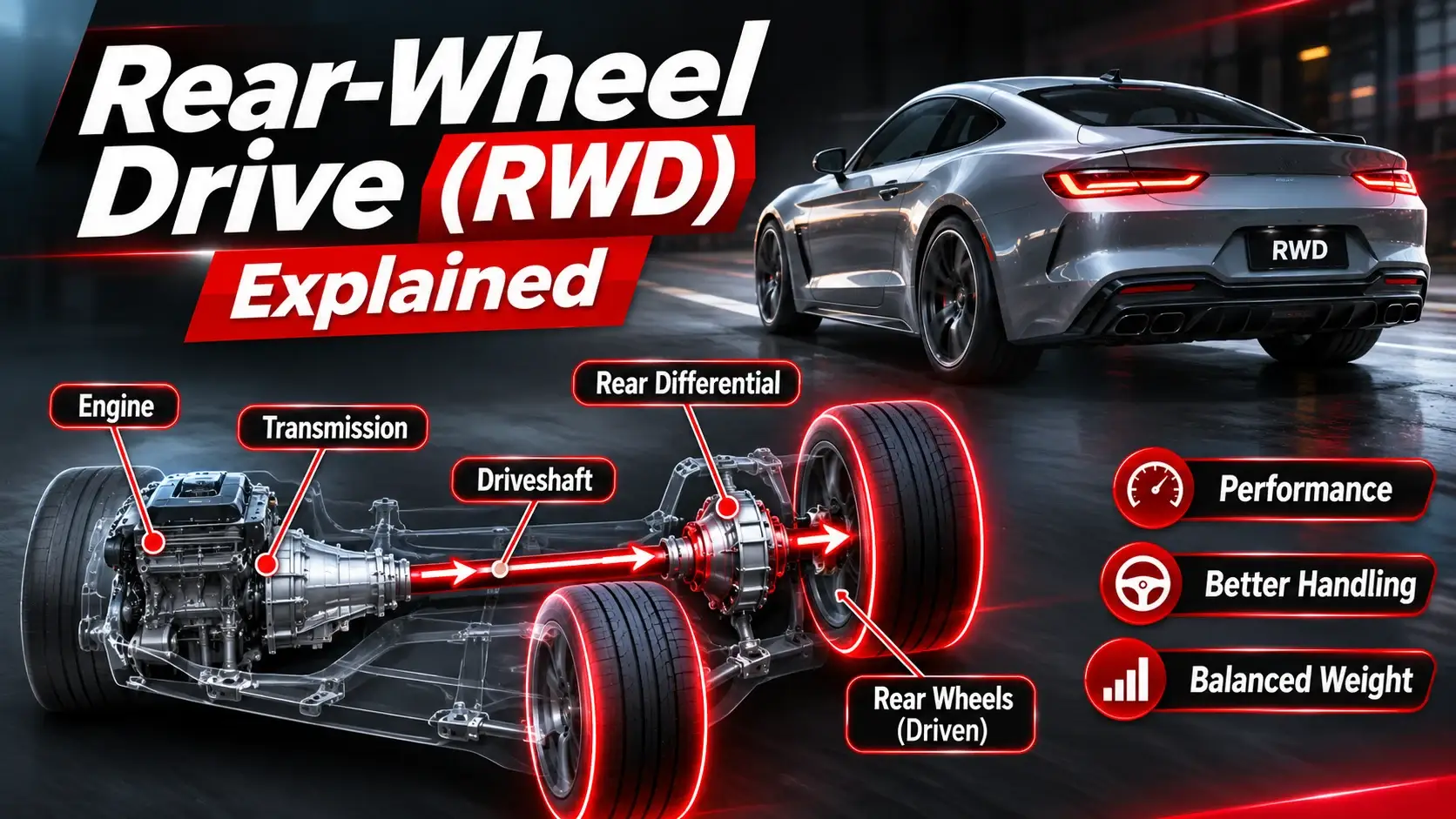
Rear-wheel drive (RWD) is a drivetrain layout in which the vehicle’s rear wheels receive the power needed to move it forward. While the front wheels primarily handle steering, the rear wheels generate the driving force that accelerates the vehicle.
This arrangement has been used for decades in sports cars, performance sedans, pickup trucks, and many commercial vehicles. Drivers often associate rear-wheel drive with balanced handling and strong acceleration, but its actual performance depends on tire grip, weight distribution, suspension design, and road conditions.
If you are considering buying an RWD vehicle, comparing it with front-wheel drive or all-wheel drive, or simply learning how automotive drivetrains operate, understanding the mechanical differences will help you make better decisions.
This guide explains how rear-wheel drive works, its major components, advantages and disadvantages, driving behavior in rain and snow, maintenance requirements, and whether it is the right choice for your needs.
Quick Answer: What Is Rear-Wheel Drive?
Rear-wheel drive means the vehicle’s rear wheels receive propulsion torque. In a conventional front-engine RWD car, power travels from the engine through the transmission, driveshaft, rear differential, and axle shafts before reaching the rear wheels. RWD can provide useful acceleration and handling characteristics, but traction depends heavily on tires, road conditions, and vehicle design.
What Is Rear-Wheel Drive (RWD)?
Rear-wheel drive describes a vehicle drivetrain in which propulsion torque is delivered to the rear wheels rather than the front wheels.
In a traditional front-engine RWD vehicle, the engine and transmission are generally positioned toward the front, while the driven axle is located at the rear. A rotating driveshaft connects the transmission output to the rear differential.
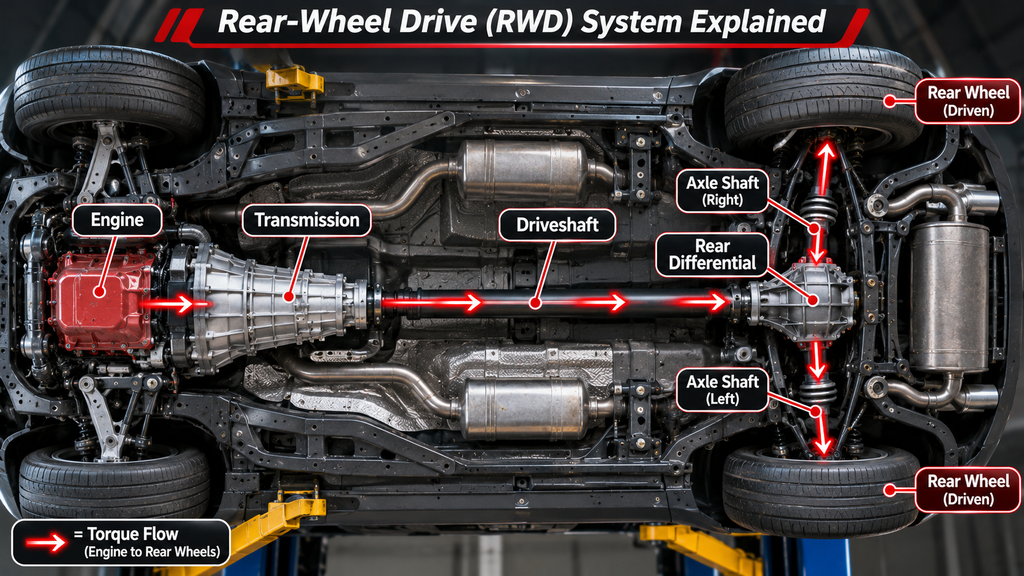
The rear differential distributes torque to the left and right rear wheels while allowing them to rotate at different speeds when turning.
Because the front wheels are not normally responsible for transmitting propulsion torque, steering and driving forces are divided between the two axles.
However, not every RWD vehicle uses the same arrangement. Rear-engine sports cars, vehicles with rear transaxles, and many rear-wheel-drive electric cars use different component layouts.
The defining characteristic is which wheels receive propulsion torque, not where the engine or motor is installed.
How Does Rear-Wheel Drive Work?
In a conventional gasoline-powered RWD vehicle, the engine generates torque through combustion. The transmission changes the relationship between engine speed and output speed to provide suitable torque and speed at the wheels.
The rotating output then passes through a driveshaft toward the rear axle, where the differential changes the direction of torque transmission and distributes it to the rear wheels.
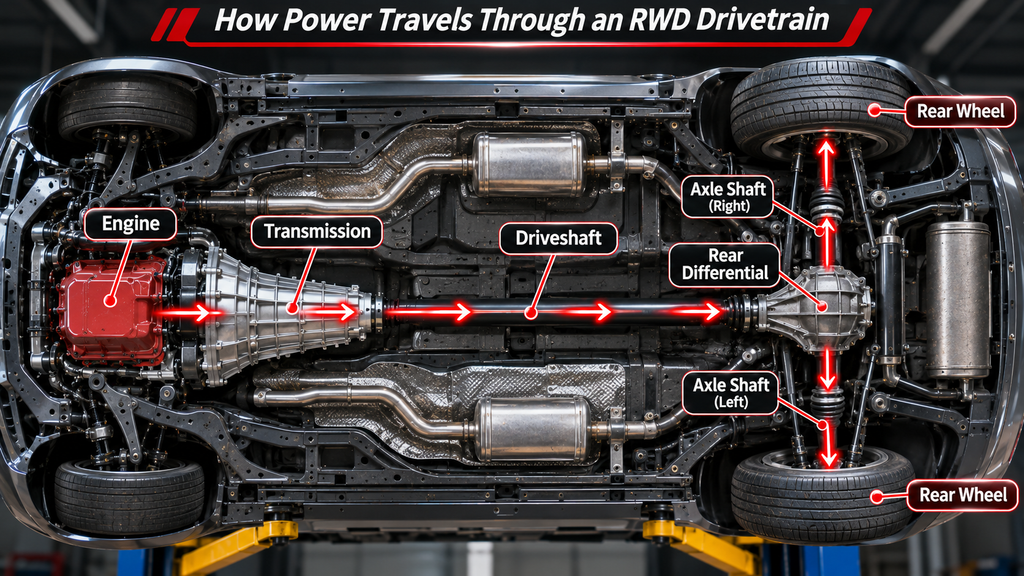
Step-by-Step RWD Power Transfer
STEP 01
Engine Produces Torque
Combustion forces rotate the crankshaft, generating the mechanical output required to propel the vehicle.
STEP 02
Transmission Adjusts Speed
The selected gear ratio changes output speed and torque to match acceleration, climbing, or cruising demands.
STEP 03
Driveshaft Transfers Rotation
The propeller shaft carries rotational torque from the transmission output toward the rear differential.
STEP 04
Differential Distributes Torque
The differential sends torque to both rear axle shafts and allows different wheel speeds during turns.
STEP 03
Driveshaft Transfers Rotation
The propeller shaft carries rotational torque from the transmission output toward the rear differential.
The drivetrain contains several mechanical interfaces, each introducing some friction and power loss. The actual efficiency depends on transmission design, bearings, joints, gear geometry, and operating conditions.
For additional mechanical detail, read our guide explaining how a propeller shaft transfers torque and why it can fail.
Main Components of a Rear-Wheel-Drive System
Understanding the components of an RWD system helps explain how torque reaches the wheels and why certain mechanical faults cause vibration, noise, or loss of propulsion.
Although exact configurations vary, conventional front-engine RWD vehicles use several recognizable drivetrain components.
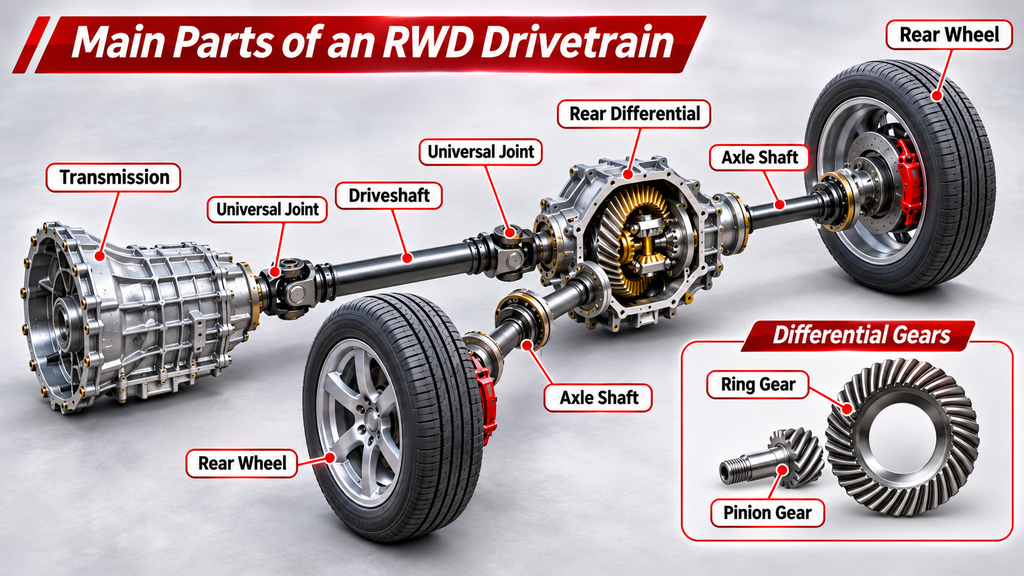
1. Transmission
The transmission provides gear ratios that allow the engine to operate over a useful speed range while meeting the vehicle’s torque requirements.
Both automatic and manual transmissions can be used with rear-wheel drive. Their internal operating methods differ, but both transmit torque into the rest of the drivetrain.
Our manual transmission operation and maintenance guide explains one of these designs in more detail.
2. Driveshaft or Propeller Shaft
A driveshaft, also called a propeller shaft, carries rotational torque between the transmission and rear differential in many front-engine RWD vehicles.
It may incorporate universal joints, constant-velocity joints, flexible couplings, or slip connections to accommodate relative movement between components.
Longer vehicles may use a two-piece shaft supported by a carrier bearing.
3. Rear Differential
The rear differential transmits torque to the rear axle shafts while allowing the wheels to rotate at different speeds when cornering.
During a turn, the outside wheel travels farther than the inside wheel and normally rotates faster. Differential gearing accommodates this difference.
Open vs Limited-Slip Differential
An open differential allows the two wheels to rotate at different speeds, but its available axle torque can be limited when one tire loses traction.
A limited-slip differential (LSD) uses a mechanical, viscous, or electronically controlled mechanism to resist excessive speed differences and improve torque delivery in some low-grip conditions.
An LSD does not create additional tire grip; it changes how torque is managed between the driven wheels.
4. Rear Axle Shafts
Axle shafts transfer torque from the differential to the rear wheels. Solid rear axle vehicles and independent rear suspension systems use different shaft and joint arrangements.
Independent rear suspension often uses CV joints to accommodate wheel and suspension movement.
Learn more in our guide to car axles and their functions.
5. Rear Tires and Electronic Controls
The rear tires convert drivetrain torque into driving force at the road surface. Their grip depends on compound, tread, inflation, loading, temperature, and road conditions.
Modern RWD vehicles also use traction control and electronic stability control to help manage excessive wheel slip or vehicle instability within the limits of available tire grip.
Advantages of Rear-Wheel Drive
Rear-wheel drive offers several engineering advantages, particularly in vehicles designed for performance, towing, or carrying substantial loads.
However, the benefits depend on the specific vehicle rather than the drivetrain layout alone.
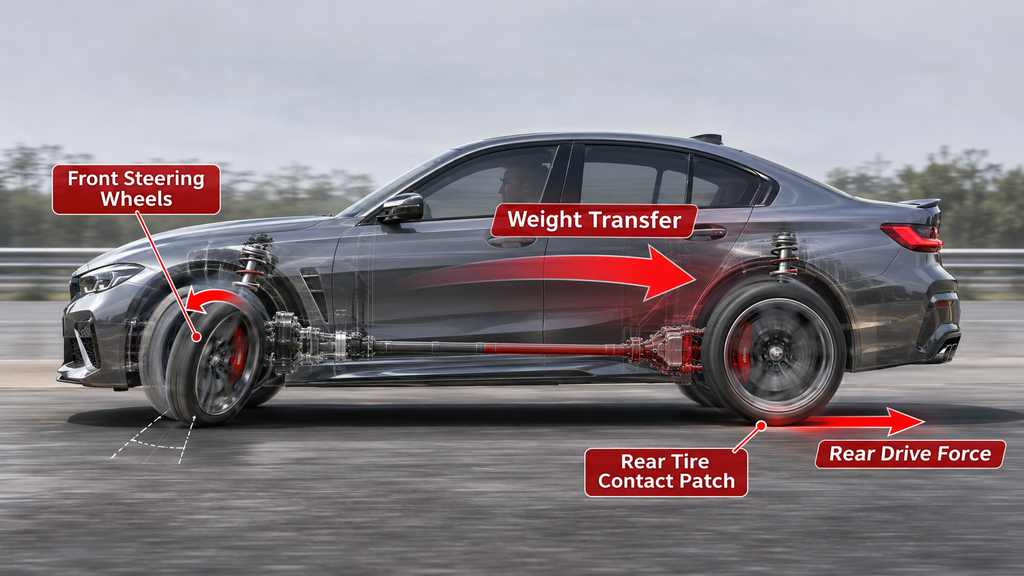
1. Potential Acceleration Benefits
Acceleration transfers load toward the rear axle. In a suitably designed RWD vehicle, that additional rear tire loading can help transmit propulsion torque effectively.
2. Steering and Propulsion Separation
Front tires generally do not need to transmit engine propulsion torque, giving chassis engineers different options for steering geometry and handling calibration.
3. Flexible Weight Distribution
Separating drivetrain components across the vehicle can help designers target particular front-to-rear mass distributions, though RWD does not guarantee a 50:50 balance.
4. Heavy-Duty Applications
Many pickups and commercial vehicles use robust rear-drive axles for payload and towing requirements. Vehicle ratings and hardware ultimately determine capability.
Why Performance Cars Often Use RWD
Performance-oriented RWD vehicles can be engineered for responsive steering, controlled weight transfer, and predictable torque delivery.
Separating front steering demands from rear propulsion may help with certain handling objectives, although suspension design, tires, steering calibration, and electronic controls are equally important.
RWD does not automatically make a vehicle faster or better at cornering than a comparable FWD or AWD car.
Disadvantages of Rear-Wheel Drive
Rear-wheel drive also introduces practical limitations that matter to everyday drivers. The most noticeable issues generally involve slippery-road traction, drivetrain packaging, and component complexity.
The severity of these disadvantages varies considerably between vehicles.
1. Challenging Low-Grip Acceleration
A lightly loaded rear axle can struggle for traction on snow or ice, particularly with unsuitable tires or abrupt throttle inputs.
2. Additional Driveline Components
Conventional front-engine RWD vehicles require a driveshaft and rear final drive, introducing additional joints, seals, bearings, and maintenance points.
3. Interior Packaging Constraints
A transmission tunnel and propeller shaft may reduce usable floor space in some passenger vehicle designs.
4. Potential for Power Oversteer
Excessive rear-wheel torque during cornering can overwhelm available rear tire grip, causing the rear of the vehicle to rotate outward.
Does RWD Cost More to Maintain?
Some front-engine RWD vehicles contain additional driveline components compared with compact transverse-engine FWD designs.
However, maintenance costs depend on the actual vehicle, service intervals, component accessibility, drivetrain loads, and repair history.
A durable RWD truck may have different service requirements from a high-performance RWD coupe. Drivetrain layout alone does not determine repair expense.
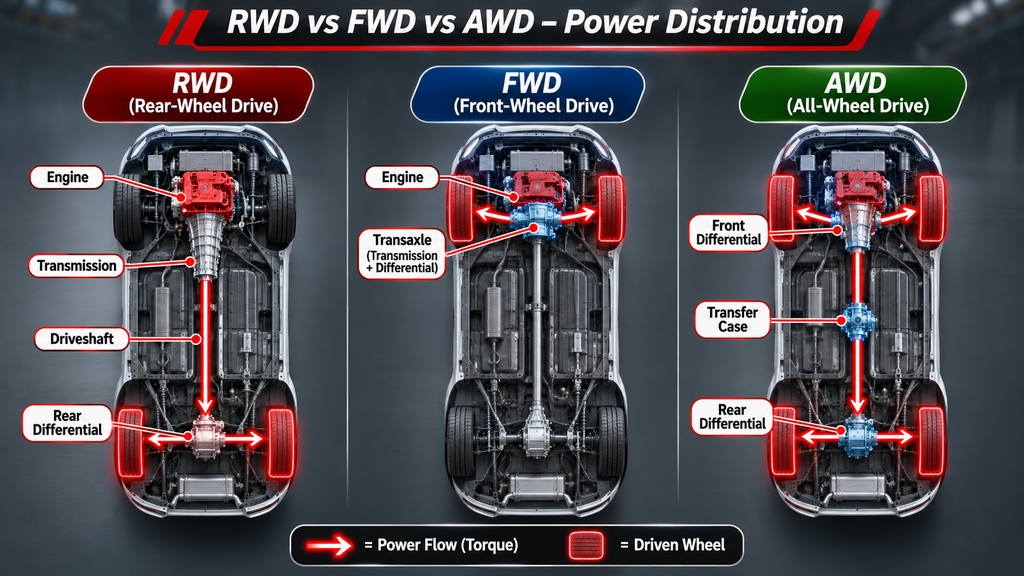
Rear-Wheel Drive vs Front-Wheel Drive vs All-Wheel Drive
The main distinction between RWD, FWD, and AWD is how propulsion torque reaches the vehicle’s wheels.
Each layout offers different tradeoffs in packaging, acceleration traction, drivetrain complexity, and handling characteristics.
| Feature | RWD | FWD | AWD |
|---|---|---|---|
| Driven Wheels | Rear | Front | Front and rear, as system permits |
| Packaging | Often needs longitudinal driveline space | Often compact transverse layout | Varies; additional drive hardware |
| Launch Traction | Can benefit from rearward load transfer | Often benefits from front engine weight at rest | Can distribute torque across both axles |
| Snow Starts | Can be challenging with limited rear grip | Often practical on treated roads | Often advantageous for getting moving |
| Components | Rear drive components | Often integrated transaxle | Additional torque-distribution components |
| Common Uses | Sports cars, trucks, luxury sedans | Many compact and family cars | Crossovers, SUVs, performance vehicles |
RWD vs FWD: Which Is Better?
Front-wheel drive commonly offers efficient packaging and cost advantages in compact passenger vehicles. Having engine mass over the front driven axle can also help traction during some low-speed, low-grip situations.
Rear-wheel drive can provide useful acceleration characteristics and chassis tuning flexibility, particularly in performance-oriented vehicles.
Neither is inherently superior for every driver. A vehicle’s tires, suspension, weight distribution, and safety systems can matter more than its drivetrain label.
RWD vs AWD: Which Is Better?
AWD systems can transmit torque to both axles, often improving the ability to accelerate on slippery surfaces or climb a snow-covered incline.
RWD systems may offer lower drivetrain complexity than comparable AWD configurations, depending on vehicle design.
AWD does not automatically improve braking distance or overcome poor tire grip.
For a more detailed comparison, read AWD vs RWD: performance, traction, and key differences.
How Rear-Wheel Drive Affects Handling and Traction
Rear-wheel drive can influence how a car responds during acceleration and cornering, but drivetrain configuration is only one part of vehicle dynamics.
Weight distribution, tire grip, suspension geometry, steering input, and electronic control systems work together to determine the vehicle’s actual behavior.
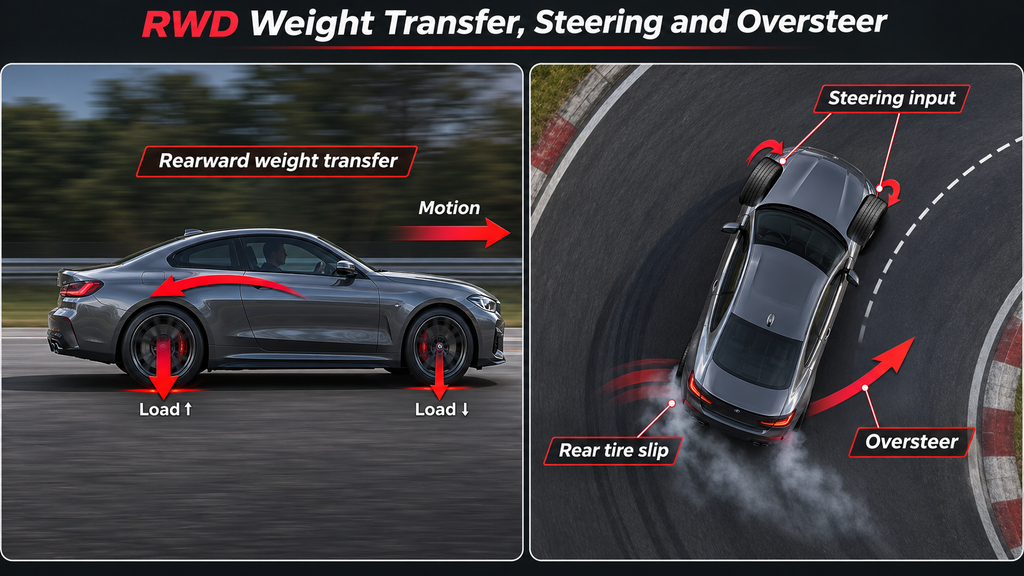
Weight Transfer During Acceleration
When a vehicle accelerates, longitudinal load transfer increases the normal force at the rear tires and reduces it at the front tires.
For an RWD vehicle, this can support stronger traction during acceleration when the rear tires have sufficient grip.
However, rearward load transfer alone does not guarantee superior acceleration. Available tire grip and the complete vehicle setup remain decisive.
Understanding Oversteer
Oversteer occurs when the vehicle rotates more into a corner than intended for the driver’s steering input, usually because rear tire lateral grip becomes insufficient relative to the front.
In an RWD vehicle, excessive throttle during a turn can contribute to rear tire slip, particularly on slippery surfaces.
Oversteer is not exclusive to RWD vehicles. Tire condition, suspension behavior, braking, and driver inputs can create oversteer in other drivetrain layouts too.
What Does Traction Control Do?
Traction control monitors wheel-speed information and detects excessive driven-wheel slip under acceleration.
Depending on the system, it may reduce engine or motor torque and apply braking to selected wheels to help manage slip.
Electronic stability control performs a related but broader function by monitoring vehicle movement and intervening when it detects a developing loss of directional control.
These systems help manage available grip but cannot overcome the physical limitations of the tires.
For diagnostic information, see our guide to traction control warnings, causes, and inspection steps.
Is Rear-Wheel Drive Good in Rain and Snow?
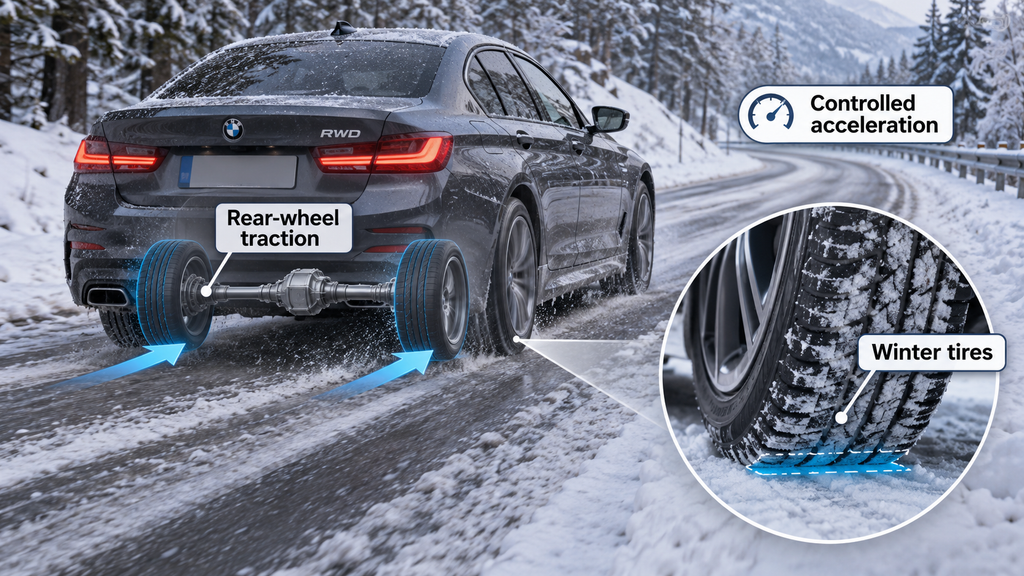
Rear-wheel drive can operate safely in wet and winter conditions when the vehicle has appropriate tires, functioning safety systems, and suitable driver inputs.
However, slippery surfaces reduce available traction. Sudden acceleration, braking, or steering can exceed the tire’s grip limits, regardless of drivetrain configuration
RWD Performance in Rain
Wet roads reduce the amount of friction available between tires and pavement, especially when water depth or tire condition increases the risk of hydroplaning.
Strong acceleration in a turn may cause rear-wheel slip if the available grip is exceeded.
Reduce speed when conditions deteriorate, use smooth controls, and maintain suitable tire tread depth and inflation.
RWD Performance in Snow
Some front-engine RWD vehicles have relatively little static weight over the driven rear axle. This can make starting on an icy incline challenging.
Modern traction control can help limit wheelspin, but suitable winter tires are often crucial to practical snow performance.
Winter tires are designed with compounds and tread patterns intended to improve grip in cold conditions. Installing appropriate matching tires at all four wheel positions is important for predictable handling.
Practical Winter Driving Tips
- Use winter tires when seasonal temperatures and road conditions require them.
- Apply the accelerator gradually to reduce wheelspin.
- Leave additional following distance for braking.
- Avoid sudden steering and braking inputs.
- Keep traction and stability control enabled for normal road driving.
- Check tire pressure, tread condition, and the vehicle’s recommended tire sizes.
- Avoid driving when conditions exceed your vehicle’s capabilities or your experience.
Important: AWD may help a vehicle start moving on slippery roads, but it does not remove the need for good tires or careful braking. Every vehicle still relies on its tire contact patches to stop and turn.
What Types of Vehicles Use Rear-Wheel Drive?
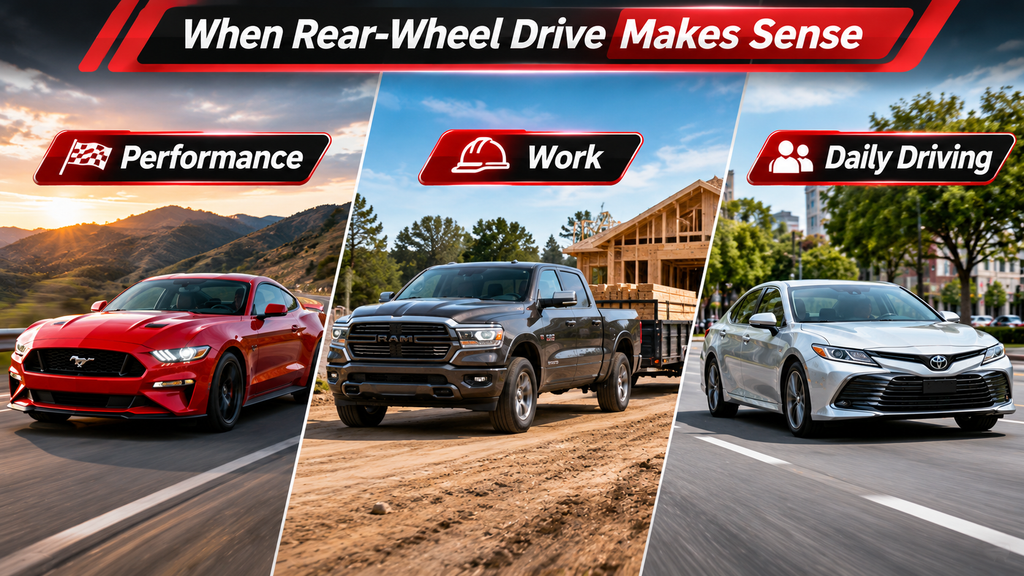
Rear-wheel drive is common across several vehicle categories, although many models now offer different drivetrain configurations depending on trim, model year, and market.
Its continued use reflects the range of engineering requirements that can benefit from driven rear wheels.
| Vehicle Category | Examples | Why RWD Is Used |
|---|---|---|
| Sports Cars | Mazda MX-5 Miata, Toyota GR86 | Handling objectives and performance-oriented packaging |
| Performance Coupes | Selected Ford Mustang models | Power delivery and chassis configuration |
| Luxury Sedans | Selected BMW 3 Series variants | Chassis tuning and drivetrain packaging |
| Pickup Trucks | Selected 2WD Ford F-150 and Chevrolet Silverado variants | Load-bearing drivetrain architecture |
| Electric Vehicles | Selected rear-motor electric vehicle variants | Compact rear electric drive unit and packaging flexibility |
These examples illustrate vehicle families or configurations known to use RWD; they do not mean every version or production year is rear-wheel drive.
Do Electric RWD Cars Have Driveshafts?
Many rear-wheel-drive electric vehicles position an electric motor and reduction gearbox near the rear axle.
This arrangement can deliver torque directly into a rear differential or integrated electric drive unit without the long propeller shaft found in traditional front-engine vehicles.
The vehicle is still classified as RWD because its rear wheels receive propulsion torque.
Rear-Wheel Drive Maintenance and Common Problems
Rear-wheel-drive systems are generally durable when properly maintained, but their rotating components, seals, joints, and bearings can wear over time.
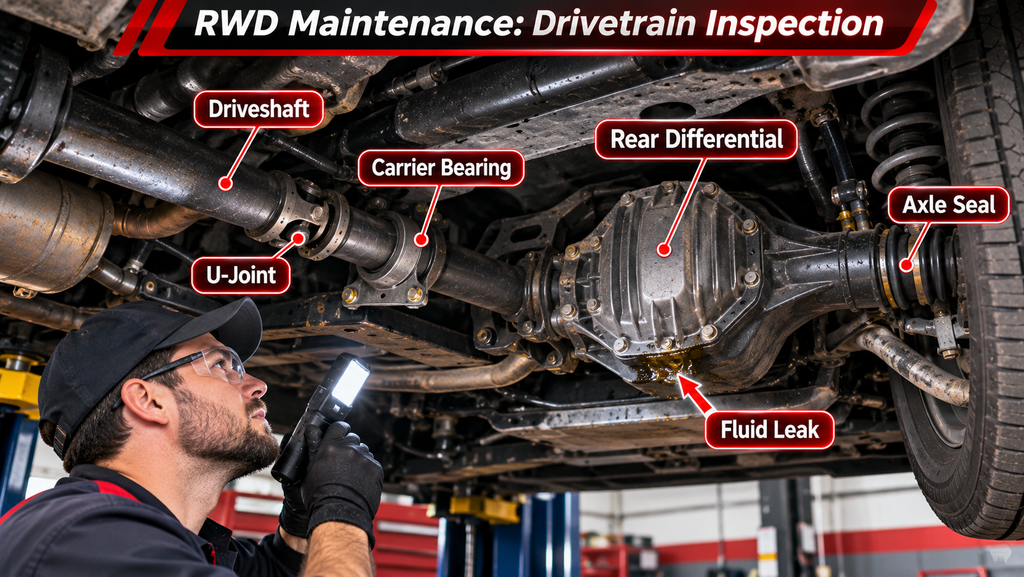
Understanding the symptoms helps drivers recognize when professional inspection may be necessary. Symptoms alone cannot identify the failed part because tire, suspension, transmission, and driveline problems can overlap.
Common RWD Problems and Symptoms
| Symptom | Possible Causes | Recommended Check |
|---|---|---|
| Vibration with road speed | Tires, shaft imbalance, worn joints, carrier bearing | Inspect tires, wheels, shaft and support hardware |
| Whining or howling noise | Differential gears or bearings; wheel bearings | Identify noise conditions and isolate source |
| Clunk during direction changes | Joint wear, mounts, excessive driveline play | Inspect joints, mounts and driveline clearance |
| Fluid near rear differential | Axle seal, pinion seal, cover or housing leak | Confirm leak source and check lubricant level safely |
| Shudder during acceleration | Driveline joints, mounts, tires, transmission faults | Perform system-level diagnosis before replacement |
Differential Fluid Maintenance
Many rear differentials contain lubricant that protects gear teeth and bearings under high contact loads.
The correct fluid specification, quantity, and service interval depend on the differential design and manufacturer requirements.
Some limited-slip units require particular lubricants or additives. Always follow the service manual instead of assuming all differentials use the same oil.
Driveshaft and Joint Inspection
Driveshaft joints accommodate relative movement between the transmission and axle. Excessive wear can create vibration, clunking, or mechanical instability.
Some designs use serviceable universal joints, while others use sealed components or flexible couplings.
Read our driveshaft and propshaft maintenance guide for additional explanations of joint types, wear, and inspection.
Important Safety Note
Do not work beneath a vehicle supported only by a jack. Use properly rated support equipment and follow the manufacturer’s lifting procedures. Severe driveshaft damage, significant differential lubricant loss, or rapidly worsening vibration requires prompt professional inspection
Is Rear-Wheel Drive Right for You?
Choosing the right drivetrain depends on how and where you drive, the type of vehicle you need, and the balance of performance, cost, space, and traction you value.
RWD can be an excellent choice for some drivers, while FWD or AWD may better suit others.
| Your Main Priority | Drivetrain Consideration |
|---|---|
| Sporty driving experience | Consider RWD performance vehicles, while comparing tires and chassis design. |
| Economical compact commuting | FWD models often offer efficient packaging and practical value. |
| Frequent snow-covered roads | Consider AWD or suitable FWD/RWD vehicles with proper winter tires. |
| Pickup towing or hauling | RWD trucks may be suitable; compare actual tow and payload ratings. |
| Everyday mixed driving | Compare complete vehicles rather than choosing based on drivetrain alone. |
Questions to Ask Before Buying an RWD Car
- Will I regularly drive on snow, ice, steep hills, or poorly maintained roads?
- Does the vehicle have suitable tires and functioning traction and stability control?
- What are the differential and drivetrain service requirements?
- Does the specific model meet my passenger, cargo, or towing needs?
- Am I comfortable with its acceleration and handling behavior during a proper test drive?
For most buyers, the condition and overall design of the vehicle matter more than whether the specification sheet simply says RWD, FWD, or AWD.
Frequently Asked Questions About Rear-Wheel Drive
What Does Rear-Wheel Drive Mean?
Rear-wheel drive means the rear wheels receive propulsion torque from the vehicle’s engine or electric motor. The front wheels primarily handle steering.
Is RWD Better Than FWD?
Neither drivetrain is universally better. RWD can offer useful performance and chassis-design characteristics, while FWD often provides economical packaging and practical everyday traction. Vehicle design and tires matter greatly.
Is Rear-Wheel Drive Good for Daily Driving?
Yes. Modern RWD vehicles can work well for daily driving when properly maintained and equipped with suitable tires for the climate and road conditions.
Is Rear-Wheel Drive Bad in Snow?
RWD can have traction challenges on snow and ice, especially when rear axle loading is low. Suitable winter tires, smooth driving, and electronic traction aids improve usability, but no system guarantees grip.
Does RWD Accelerate Faster Than FWD?
Not necessarily. RWD may benefit from rearward weight transfer during acceleration, but actual results depend on power, tires, gearing, vehicle mass, road conditions, and traction control.
Does Rear-Wheel Drive Cause Oversteer?
RWD can contribute to power oversteer if the rear tires lose traction under acceleration in a turn. However, oversteer can occur with other drivetrain configurations, and normal RWD driving does not inherently cause it.
Does RWD Require More Maintenance?
Some RWD vehicles have additional driveshaft joints, differential components, and seals compared with compact FWD layouts. Maintenance costs depend on vehicle design and service requirements rather than drivetrain type alone.
Can an RWD Vehicle Have All-Wheel Drive?
A vehicle model designed around a rear-drive platform may also offer an AWD version. However, when a vehicle is operating with torque delivered to both axles, it is functioning as AWD rather than strictly RWD.
Do RWD Electric Cars Need a Driveshaft?
Not necessarily. Many RWD electric vehicles use a compact rear-mounted motor and reduction gearbox integrated with the rear drive unit, eliminating the long propeller shaft common in front-engine RWD cars.
Conclusion
Rear-wheel drive is a proven drivetrain configuration that delivers propulsion torque through the rear wheels. In conventional front-engine vehicles, the transmission, driveshaft, differential, and axle shafts work together to transfer engine power to the road.
RWD can offer meaningful benefits for certain performance vehicles, luxury sedans, pickups, and commercial applications. However, it also introduces specific considerations involving traction, packaging, and driveline maintenance.
The most important factor is matching the vehicle to the intended driving conditions. Suitable tires, balanced vehicle engineering, electronic safety systems, and responsible driving habits remain essential regardless of drivetrain layout.
For buyers, the best approach is to compare complete vehicles rather than assuming that one drivetrain configuration is always superior.
Key Takeaway: RWD can provide excellent performance and everyday usability, but it does not automatically guarantee better traction, handling, or acceleration. The complete vehicle design, tires, road conditions, and driver inputs determine real-world results.