Should you choose all-wheel drive or rear-wheel drive for your next car? The answer depends less on which drivetrain sounds more advanced and more on where you drive, what tires you use, and what you expect from your vehicle.
Quick answer: All-wheel drive (AWD) can send power to both axles, helping a vehicle get moving when traction is limited. Rear-wheel drive (RWD) powers the rear wheels and can deliver an engaging, well-balanced driving experience with fewer driven components. AWD does not automatically help a car stop faster on snow or ice. Tires, speed, and road conditions matter with either system.

What Is AWD (All-Wheel Drive)?
All-wheel drive is a drivetrain system that can deliver power to both the front and rear wheels. That does not mean every AWD vehicle sends equal power to all four wheels all the time. The amount of power and when it is delivered depend on the vehicle’s design and driving conditions.
AWD is common in crossovers, SUVs, sedans, and performance cars. Its main advantage is improving the ability to put power down when one axle has less grip, such as when starting on a snowy hill or accelerating on a wet road.
How Does AWD Work?
An AWD vehicle uses a combination of drivetrain components and electronic controls to distribute torque between the axles. Depending on the vehicle, these may include a transfer case or power transfer unit, driveshaft, differentials, multi-plate clutch, and wheel-speed sensors. Some electric vehicles achieve AWD with separate motors driving the front and rear axles.
In many on-demand systems, one axle does most of the work during easy cruising while the other receives power when needed. Other systems can drive both axles more consistently. The owner’s manual explains the specific system fitted to a vehicle.

Advantages of AWD
- Often improves launch traction on snow, slush, gravel, or wet pavement.
- Can help distribute strong engine torque during acceleration.
- May make hilly winter starts easier with appropriate tires.
- Available in practical everyday vehicles and performance models.
Disadvantages of AWD
- Often costs more to purchase than a comparable RWD version.
- Additional hardware can increase weight and mechanical complexity.
- Some systems have additional maintenance needs and repair expenses.
- Does not replace suitable tires or cautious driving.
What Is Rear-Wheel Drive (RWD)?
Rear-wheel drive means the vehicle’s rear wheels receive propulsion power, while the front wheels primarily handle steering. The setup is found in many sports cars, luxury sedans, pickup trucks, and some SUVs.
How Does Rear-Wheel Drive Work?
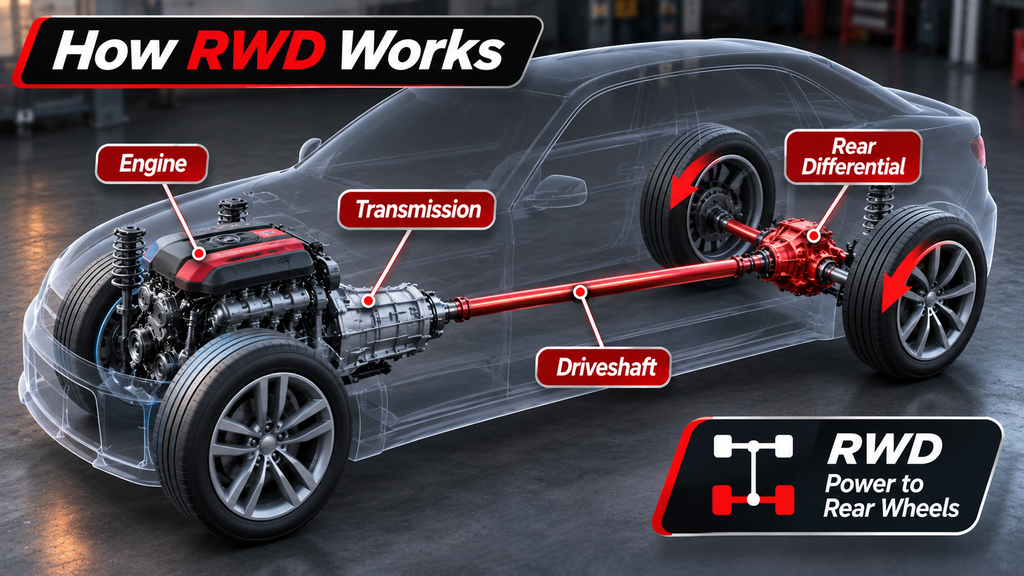
In a traditional front-engine RWD vehicle, the engine sends power through the transmission and a driveshaft to a rear differential. The differential then delivers torque to the rear wheels while allowing them to rotate at different speeds during turns. Some vehicles place the engine elsewhere, and many RWD electric cars use a rear electric drive unit instead of a long driveshaft.
Because the front wheels are not normally responsible for driving the car, steering and propulsion are divided between axles. This can help designers tune steering feel and vehicle balance, although the results vary widely between models.
Advantages of RWD
- Can provide responsive steering feel and sporty driving dynamics.
- May have fewer driven components than a comparable AWD version.
- Can be efficient and relatively simple in some vehicle designs.
- Well suited to many performance-oriented cars and work vehicles.
Disadvantages of RWD
- May struggle to get moving on slippery inclines with unsuitable tires.
- Hard acceleration on low-grip roads can cause rear-wheel slip.
- Some layouts require a driveshaft tunnel that uses cabin space.
- Traction varies considerably with tires, vehicle weight, and electronic aids.
AWD vs RWD: Key Differences at a Glance
Neither system wins every category. The following table describes common tendencies—not guarantees for every car, truck, or SUV.
| Feature | AWD | RWD |
|---|---|---|
| Driven wheels | Both axles can receive power | Rear axle receives power |
| Snowy-hill starts | Usually an advantage with suitable tires | Can be more challenging without winter tires |
| Braking on ice | No inherent braking-distance advantage | Also depends primarily on tire grip, ABS, and conditions |
| Dry-road acceleration | Can launch well when traction limits power | Can be excellent, depending on tires and vehicle setup |
| Handling feel | Varies; often confidence-inspiring under power | Often favored for traditional sporty balance |
| Fuel efficiency | May use more energy with added weight and drag | May be more efficient in comparable models |
| Maintenance | Potentially more components to service | Often less drivetrain hardware, model-dependent |
| Purchase price | Often higher when AWD is optional | Often lower in an otherwise comparable trim |
IMAGE 04 — AWD vs RWD key differences
Upload a 16:9 visual comparisonThe key distinction is which wheels receive engine or motor torque—not whether a car is automatically safer.
AWD vs RWD in Snow and Rain
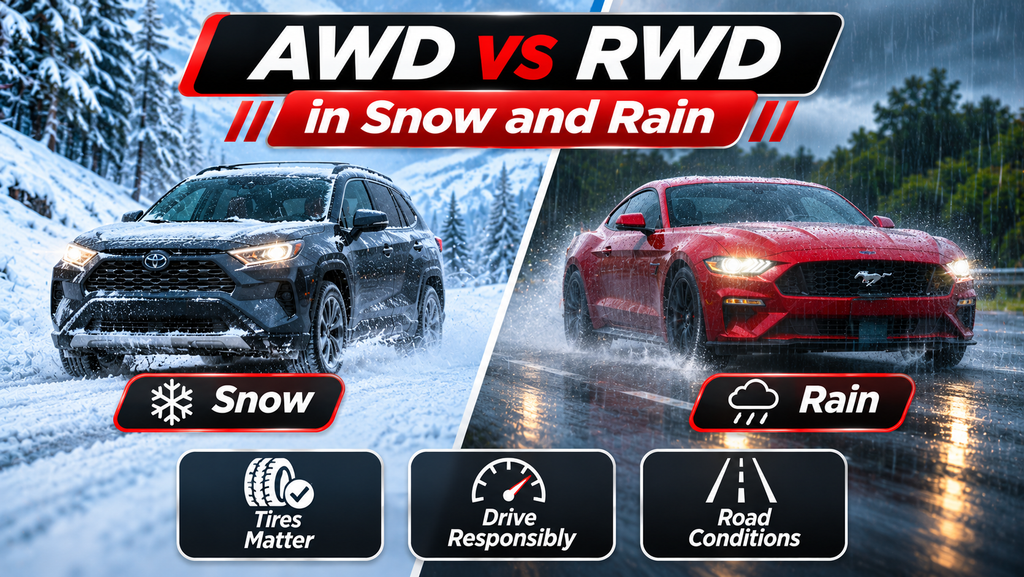
Bad-weather driving is often the deciding factor for shoppers. AWD can make an immediate difference when accelerating from a stop, especially on a snowy incline. But that benefit should never be confused with shorter stopping distances or unlimited cornering grip.
Which Is Better in Snow?
AWD generally has a traction advantage when getting moving because multiple driven wheels can share the task of pushing the vehicle forward. An RWD car equipped with quality winter tires, however, may accelerate, steer, and brake more predictably than an AWD car wearing unsuitable tires.
On ice or packed snow, grip can be limited regardless of how many wheels receive power. Slow down, increase following distance, brake smoothly, and avoid abrupt steering inputs. Winter tires may be necessary or strongly beneficial in consistently cold climates; follow local requirements and tire-maker guidance.
Which Is Better in Rain?
On wet pavement, AWD can reduce wheelspin when accelerating. For ordinary cruising and stopping, tire condition, tread depth, and speed are usually more important than the drivetrain layout. Neither AWD nor RWD prevents hydroplaning if the tires lose contact with the road surface.
Important safety distinction: AWD helps deliver driving power to the road. It does not create extra tire grip during braking. Every vehicle still depends on its tires, brakes, stability systems, and the available road friction.
AWD vs RWD for Performance and Handling
Acceleration and Launch Traction
When a powerful car accelerates hard, its tires must transfer substantial torque to the road. AWD can distribute that work across both axles, potentially reducing wheelspin and improving launches. But AWD systems add weight and may have added drivetrain losses, so an AWD badge does not automatically mean a quicker car.
RWD performance cars can also accelerate extremely well, especially with grippy tires, appropriate gearing, and good weight distribution. Compare measured results for the exact vehicles under consideration rather than assuming one drivetrain will always be faster.
Cornering and Driving Feel
Many enthusiasts enjoy RWD because the rear tires provide propulsion while the front wheels focus on steering. It can give a car an engaging response to throttle inputs. AWD can provide strong corner-exit traction, but does not make a vehicle immune to understeer, oversteer, or sliding.
Suspension tuning, tire choice, center of gravity, electronic stability control, and driver inputs often make more difference to real-world handling than the drivetrain label alone.
AWD vs RWD: Fuel Economy and Maintenance Costs
Does AWD Use More Fuel?
In otherwise similar gasoline vehicles, AWD often increases weight and rotating components, which can modestly increase fuel consumption. The exact difference depends on the drivetrain design, engine, transmission, vehicle weight, and driving cycle. Some modern systems disconnect components when full traction is not needed, and electric-vehicle comparisons follow different efficiency trade-offs.
When shopping, compare the official EPA fuel-economy ratings for the exact year, engine, trim, and drivetrain. Do not assume a fixed miles-per-gallon penalty for every AWD vehicle.
Which Drivetrain Costs More to Maintain?
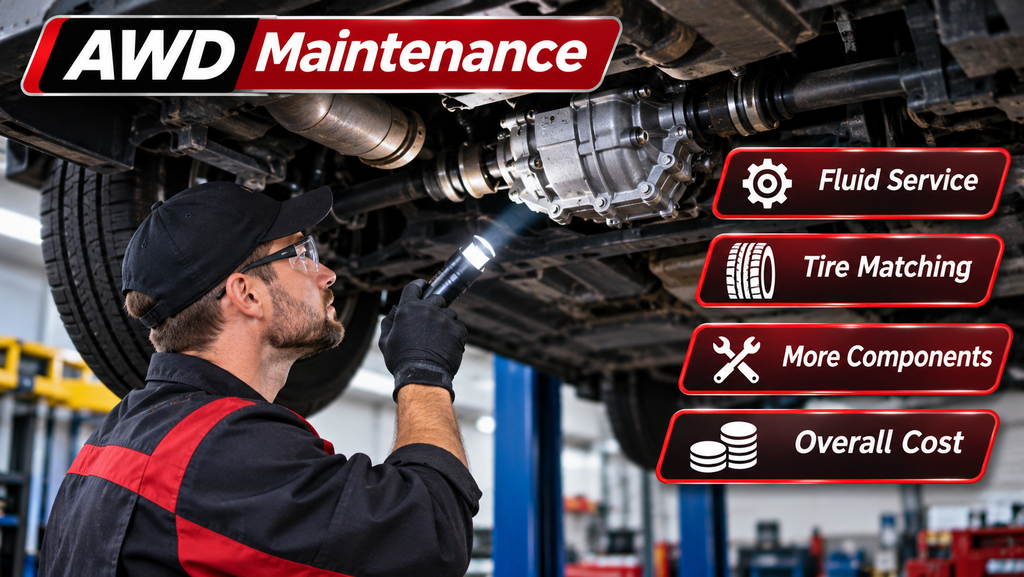
AWD can involve additional differentials, driveshafts, clutches, transfer units, or fluid services. That creates more possible repair points, but it does not mean every AWD car will be unreliable or expensive to own. RWD may be mechanically simpler than its AWD counterpart, yet the specific model’s design and condition matter more.
AWD owners may also have stricter requirements for matching tire size and tread wear. On some vehicles, uneven tires can stress the drivetrain. Check the owner’s manual before replacing one tire; some models require replacing tires in matched sets or keeping tread-depth differences within specified limits.
| Expense to compare | What to check before buying |
|---|---|
| Sticker price | Actual AWD option cost on the same model and trim |
| Fuel or energy | Official ratings for the exact drivetrain configuration |
| Fluid service | Manufacturer schedule for differentials and AWD units |
| Tires | Approved sizes, rotation schedule, and matching requirements |
| Used-car repairs | Service records, leaks, noises, warning lights, and inspection results |
Which Is Better for Daily Driving: AWD or RWD?
For most drivers, the better choice is the vehicle that fits their routes, climate, budget, and tire needs—not simply the one with more driven wheels.
Choose AWD if…
- You regularly start on snowy or slippery hills and want added acceleration traction.
- You frequently drive in changing weather and can afford suitable seasonal tires.
- Your preferred vehicle offers AWD features that justify the extra price and running costs.
Choose RWD if…
- You mostly drive on cleared roads in mild or dry weather.
- You favor traditional rear-drive handling or are considering a specific sports car.
- You want to avoid the cost of AWD hardware when its traction benefit is rarely needed.
Frequently Asked Questions About AWD vs RWD
Is AWD better than RWD?
AWD is often better for accelerating on slippery surfaces, while RWD may offer a simpler drivetrain and a driving feel some enthusiasts prefer. The better option depends on the exact vehicle, tires, road conditions, and your priorities.
Is AWD safer than rear-wheel drive?
Not automatically. AWD can improve traction while getting moving, but it does not inherently shorten stopping distances or prevent skids. Proper tires, speed management, stability control, and driver behavior remain critical.
Is AWD or RWD better in snow?
AWD often makes starting and climbing slippery hills easier. Winter tires, however, are essential to consider because they affect acceleration, steering, and braking on cold, snowy, and icy roads.
Is RWD faster than AWD?
Neither is always faster. AWD can improve launches when traction is limited, while RWD may weigh less. The actual result depends on the car’s power, weight, tires, gearing, and road conditions.
Does AWD use more gas than RWD?
It often uses somewhat more fuel in otherwise comparable gasoline models because of extra weight and drivetrain hardware, but exceptions exist. Compare the EPA ratings of the specific vehicles you are shopping for.
Is AWD more expensive to repair?
It can be, because there are often more drivetrain components and service points. Actual costs vary substantially by model, maintenance history, and the problem being repaired.
Can you drive a rear-wheel-drive car in winter?
Yes. Many RWD vehicles can be driven in winter with appropriate tires, functioning stability-control systems, and careful speed and distance management. Severe winter conditions can still make some routes impractical for any passenger car.
Do I need AWD for normal city driving?
Not necessarily. If roads are usually clear and conditions are mild, RWD may meet your needs. Prioritize tires, visibility, brakes, safety equipment, and vehicle condition before paying extra for AWD.