Every time you start your car, a carefully controlled process takes place inside the engine. Air and fuel are brought together, combustion releases energy, and moving components turn that energy into the power needed to move the vehicle.
This process is the foundation of an internal combustion engine. Although combustion engines come in several designs, two of the most important operating cycles are the 2 stroke engine and the 4 stroke engine.
Both use combustion to produce mechanical power, but they complete their operating cycles differently. These differences influence engine construction, fuel consumption, lubrication, emissions, and applications.
In this guide, you will learn how automobile combustion works, understand the individual engine strokes, and compare 2-stroke and 4-stroke engines through simple explanations and practical examples.
Quick Answer: An internal combustion engine converts the energy released by burning fuel into mechanical motion. A 2-stroke engine completes one operating cycle in two piston strokes and one crankshaft revolution. A 4-stroke engine completes one cycle in four piston strokes and two crankshaft revolutions.
What Is an Internal Combustion Engine?
An internal combustion engine (ICE) is a machine that produces mechanical power by releasing energy from fuel combustion inside the engine itself.
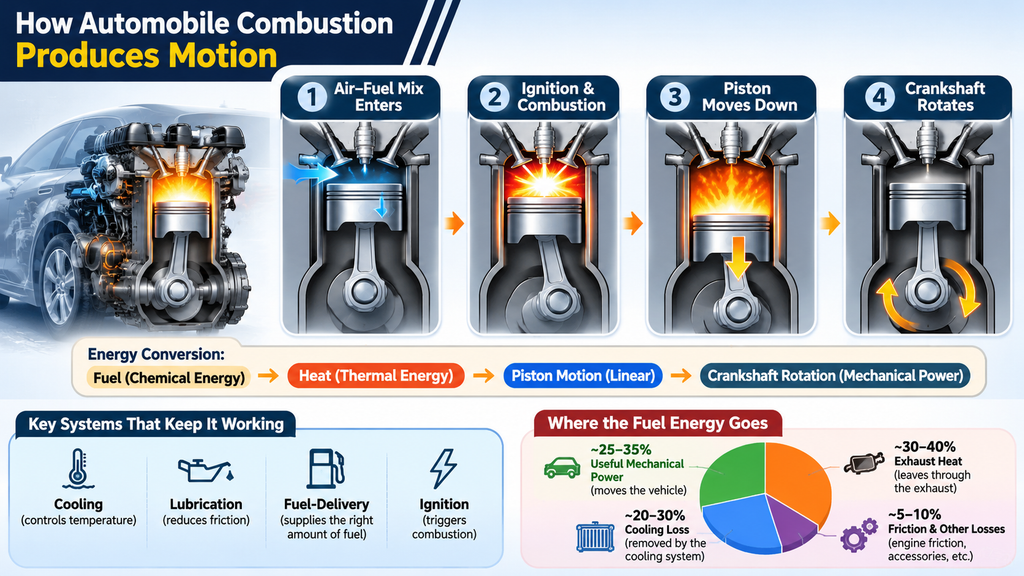
In a conventional gasoline car engine, air and fuel enter a cylinder. A piston compresses the mixture, and a spark plug ignites it. Combustion raises the pressure inside the cylinder, pushing the piston downward.
A connecting rod transfers this movement to the crankshaft, which converts the piston’s back-and-forth motion into rotation. That rotational power can then pass through the drivetrain to move the vehicle.
Internal combustion engines are used in passenger cars, motorcycles, trucks, generators, agricultural equipment, and many other machines.
Important distinction: Gasoline engines commonly use spark ignition, while conventional diesel engines use compression ignition. Both are types of internal combustion engines, but their fuel ignition processes differ.

How Does an Internal Combustion Engine Work?
The basic working principle of a reciprocating internal combustion engine is straightforward: fuel releases energy during combustion, pressure acts on a piston, and the crankshaft converts that piston movement into rotational motion.
In a typical four-stroke gasoline automobile engine, this process takes place through four stages.
- Intake: The engine draws an air-fuel mixture into the cylinder.
- Compression: The piston moves upward and compresses the mixture.
- Power: The spark plug ignites the mixture, and expanding combustion gases push the piston downward.
- Exhaust: The piston moves upward and helps expel combustion gases from the cylinder.
This sequence repeats continuously while the engine is running. Each cylinder contributes power according to the engine’s design and firing order.
How Automobile Combustion Produces Motion
Automobile combustion is more than simply setting gasoline on fire. The engine must carefully control how air and fuel mix, when ignition occurs, and how combustion pressure acts on the piston.
During combustion, chemical energy in the fuel is converted into thermal energy. Hot gases create pressure that moves the piston. The connecting rod and crankshaft then convert this linear movement into rotational motion.
The engine’s cooling, lubrication, fuel-delivery, and ignition systems all help this process operate reliably.
Not all fuel energy becomes useful mechanical power. Some energy leaves through the exhaust, while additional energy is lost through cooling and friction.
Main Components of an Internal Combustion Engine
Before comparing two-stroke and four-stroke engines, it helps to understand the mechanical components involved.
| Component | Main Function |
|---|---|
| Cylinder | Provides the chamber in which the piston moves. |
| Piston | Moves within the cylinder and transfers force from combustion. |
| Connecting Rod | Connects the piston to the crankshaft. |
| Crankshaft | Converts piston movement into rotational motion. |
| Spark Plug | Ignites the air-fuel mixture in a spark-ignition engine. |
| Intake and Exhaust Valves | Control gas flow in engines that use valves; many small two-stroke engines use ports instead. |
| Camshaft | Controls valve timing in engines with cam-operated valves. |
| Fuel Delivery System | Supplies the correct amount of fuel for combustion. |
The arrangement of these components varies between engine types. For example, many conventional small two-stroke engines use cylinder ports instead of the poppet-valve systems commonly found in four-stroke automobile engines.
What Is a 2-Stroke Engine?
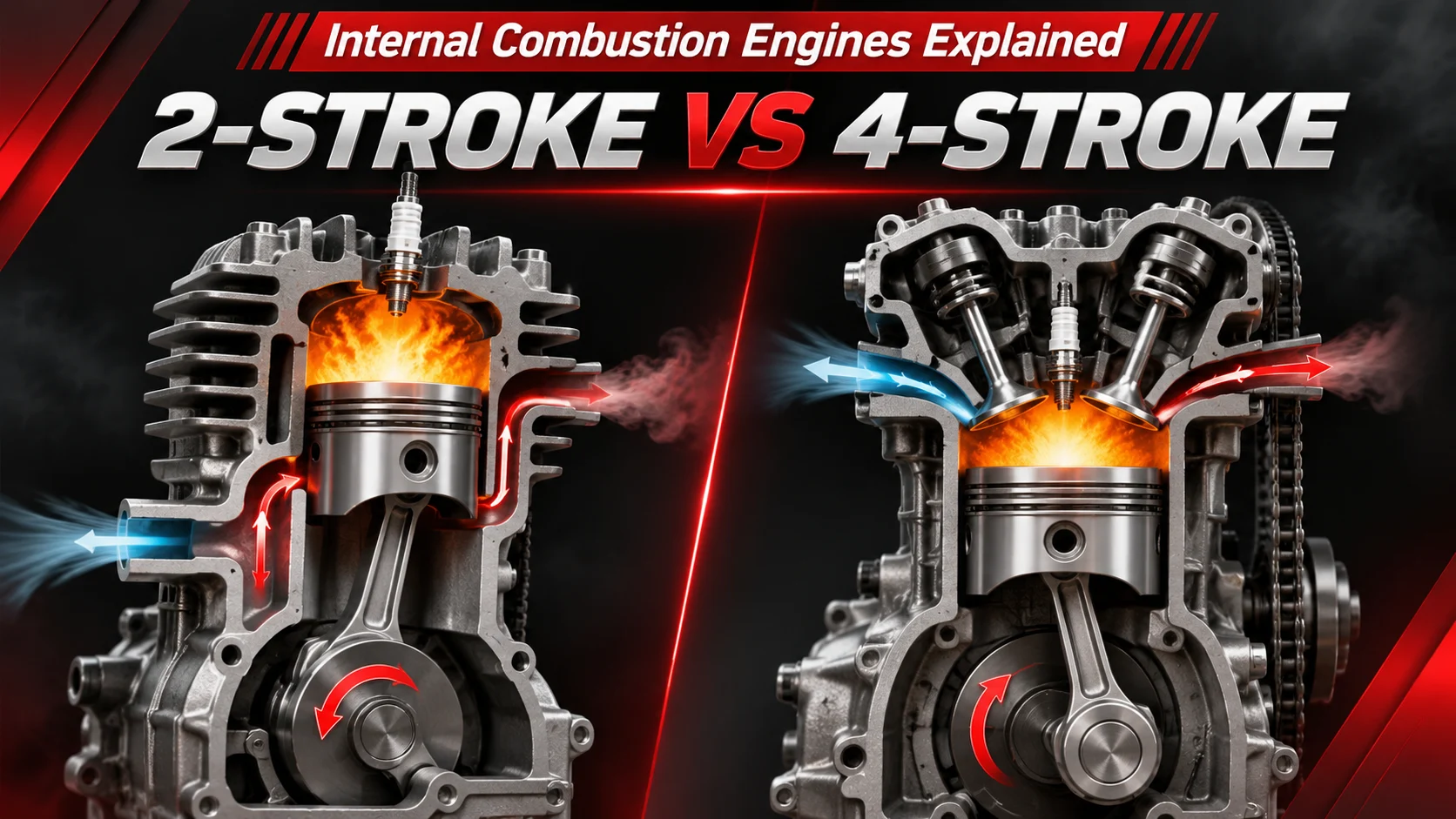
A 2 stroke engine is an internal combustion engine that completes one full operating cycle in two piston strokes: one upward stroke and one downward stroke.
Because these two strokes occur during one crankshaft revolution, a two-stroke engine can have one power-producing event per cylinder during every revolution.
Many small gasoline two-stroke engines use intake, transfer, and exhaust ports to control gas movement rather than a conventional four-stroke valve system.
The design can be mechanically simple and compact, making it useful where low weight and high power output relative to engine size are important.
How Does a 2-Stroke Engine Work?
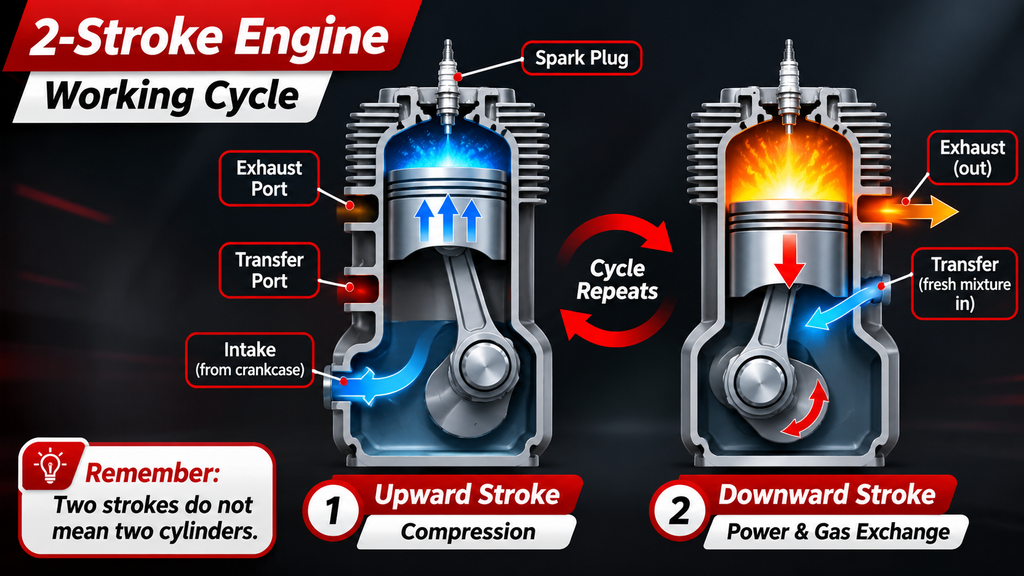
A conventional crankcase-scavenged gasoline two-stroke engine combines several processes during each piston movement.
1. Upward Stroke: Compression
As the piston moves upward, it compresses the fresh charge already inside the cylinder. At the same time, the movement can create lower pressure in the crankcase, allowing a fresh air-fuel mixture to enter through the intake system.
Near the top of the stroke, the spark plug ignites the compressed mixture.
2. Downward Stroke: Power and Gas Exchange
Combustion pressure pushes the piston downward, producing useful work.
As the piston descends, the exhaust port opens and burned gases begin leaving the cylinder. The transfer ports then allow fresh mixture from the crankcase to enter and help push remaining exhaust gases outward.
This gas-clearing process is called scavenging. Once the piston moves upward again, the cycle repeats.
Remember: Two strokes do not mean two cylinders. A stroke describes one movement of the piston from one end of its travel to the other.
Advantages of a 2-Stroke Engine
- Frequent power events: Each cylinder can produce a power event every crankshaft revolution.
- Compact construction: Many small two-stroke designs have fewer moving valve-train components.
- High power-to-weight potential: Their design makes them attractive for lightweight equipment.
- Simple mechanical layout: Conventional small two-stroke engines can be relatively straightforward mechanically.
Disadvantages of a 2-Stroke Engine
- Fuel losses: Some conventional designs can allow unburned fuel mixture to escape during scavenging.
- Emissions: Traditional small two-stroke gasoline engines can produce relatively high hydrocarbon and particulate emissions.
- Lubrication requirements: Many small two-stroke engines consume lubricating oil during operation.
- Wear and maintenance: Certain high-output designs may require more frequent servicing.
These disadvantages do not apply equally to every two-stroke engine. Modern fuel-injection systems, improved scavenging, and different lubrication designs can change performance substantially.
What Is a 4-Stroke Engine?
A 4 stroke engine completes one operating cycle in four piston strokes, requiring two full revolutions of the crankshaft.
This operating principle is widely used in modern passenger-car gasoline engines, motorcycles, trucks, generators, and industrial equipment.
Four-stroke engines separate intake, compression, power, and exhaust into distinct strokes. This separation gives engineers substantial control over airflow, combustion, and emissions.
The Four Stages of a 4-Stroke Engine
1. Intake Stroke
The piston travels downward while the intake valve is open. In a conventional port-injected gasoline engine, an air-fuel mixture enters the cylinder. In a direct-injection gasoline engine, fuel may be introduced separately.
2. Compression Stroke
The intake valve closes, and the piston moves upward. The trapped charge is compressed into a smaller space, preparing it for combustion.
3. Power Stroke
Near the end of compression, the spark plug ignites the mixture in a gasoline engine.
The resulting rise in pressure pushes the piston downward, transferring mechanical energy to the crankshaft.
4. Exhaust Stroke
The exhaust valve opens, and the piston moves upward to expel burned gases. Once this stroke is completed, the intake process begins again.

Advantages of a 4-Stroke Engine
- Efficient gas exchange: Intake and exhaust can be controlled separately through valve timing.
- Lower emissions potential: Modern four-stroke engines support precise fuel control and effective exhaust aftertreatment.
- Dedicated lubrication: Most automotive four-stroke engines circulate oil without intentionally burning it as part of normal operation.
- Broad operating range: Their designs are well suited to the varying speeds and loads experienced by road vehicles.
Disadvantages of a 4-Stroke Engine
- More mechanical components: Conventional designs include camshafts, valves, and timing mechanisms.
- Additional weight and complexity: Comparable four-stroke designs may require more components and space.
- Less frequent power events: Each cylinder completes one power stroke every two crankshaft revolutions.
- Valve-train servicing: Some designs require periodic valve clearance inspection or adjustment.
2-Stroke vs 4-Stroke Engine: Key Differences
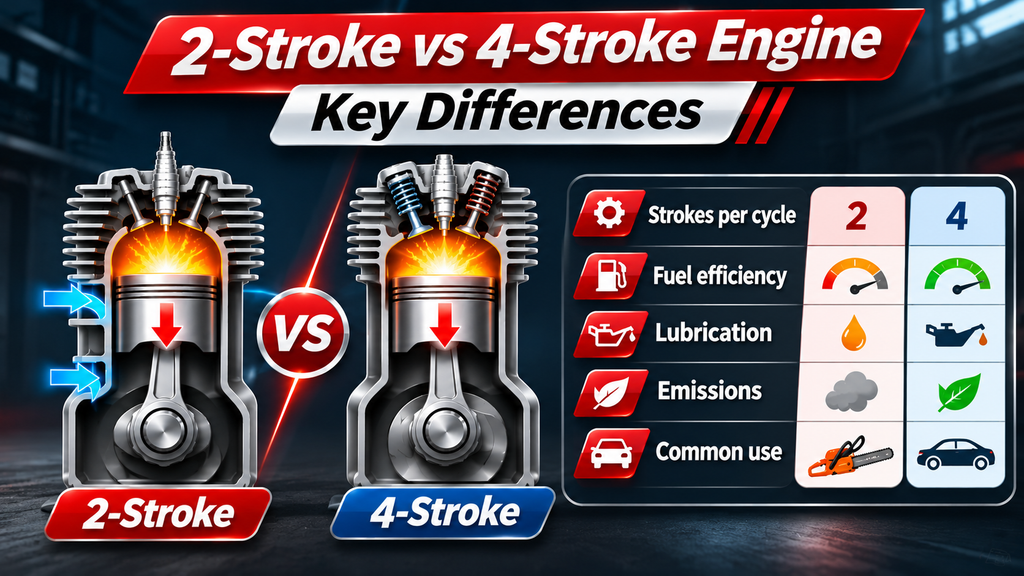
The main difference between a 2-stroke engine and a 4-stroke engine is the number of piston strokes needed to complete one combustion cycle.
However, the distinction also affects engine construction, lubrication, fuel efficiency, exhaust emissions, and typical applications.
| Feature | 2-Stroke Engine | 4-Stroke Engine |
|---|---|---|
| Strokes per cycle | 2 | 4 |
| Crankshaft revolutions per cycle | 1 | 2 |
| Power events per cylinder | One per revolution | One every two revolutions |
| Gas exchange | Often uses cylinder ports | Usually uses intake and exhaust valves |
| Fuel efficiency | Conventional small gasoline designs often consume more fuel | Typically better in comparable conventional gasoline applications |
| Lubrication | Many small versions use premix or oil injection | Usually uses a separate recirculating oil system |
| Emissions | Traditional small gasoline designs often have higher emissions | Generally easier to control in modern passenger-car applications |
| Construction | Often simpler in small gasoline engines | Typically includes more valve-train components |
| Common applications | Chainsaws, some motorcycles, marine engines | Passenger cars, trucks, most modern road motorcycles |
These comparisons describe common engine designs rather than universal limits. Actual performance depends on engine size, fuel system, operating speed, intended use, and engineering choices.
Which Engine Is More Fuel-Efficient?
In conventional small gasoline-engine applications, four-stroke engines are generally more fuel-efficient than traditional two-stroke engines.
One important reason is the way each design manages intake and exhaust gases.
In many traditional two-stroke gasoline engines, fresh mixture enters while the exhaust port is still open. Some of that mixture can escape before combustion, increasing fuel consumption and unburned hydrocarbon emissions.
Four-stroke engines use separate intake and exhaust strokes, allowing engineers to control gas exchange more precisely. Modern electronic fuel injection, ignition timing, and valve-control technologies can further improve efficiency.
However, it would be incorrect to claim that every four-stroke engine is more efficient than every two-stroke engine. Some large, slow-speed two-stroke diesel engines achieve exceptionally high thermal efficiency.
Practical takeaway: If you are comparing conventional small gasoline engines, a four-stroke model will often use less fuel for the same useful work. For other applications, efficiency must be evaluated using the actual engine design and operating conditions.
Which Engine Produces More Power?
A two-stroke engine has a theoretical advantage in power-event frequency because combustion can produce a power stroke during every crankshaft revolution.
This helps explain why two-stroke designs can deliver impressive power relative to their weight or displacement.
But more frequent power strokes do not automatically mean greater actual power. Cylinder filling, scavenging losses, operating speed, fuel delivery, cooling, and mechanical efficiency all influence output.
Modern four-stroke engines can produce very high power through technologies such as turbocharging, direct injection, and advanced valve control.
Where Are 2-Stroke and 4-Stroke Engines Used?
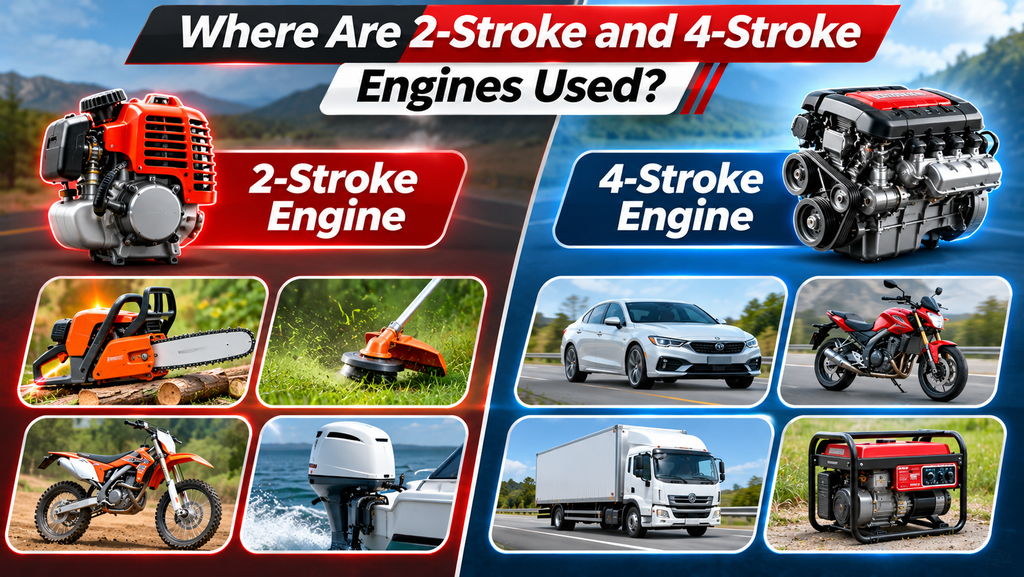
The choice of engine cycle depends on how a machine is expected to operate. Weight, fuel economy, emissions regulations, durability, and power requirements all matter.
Common Applications of 2-Stroke Engines
- Chainsaws: Many gasoline chainsaws use lightweight two-stroke engines that can operate in different orientations.
- Brush cutters and handheld equipment: Compact size and low weight make traditional two-stroke designs useful.
- Some motorcycles: Certain off-road and competition motorcycles continue to use two-stroke engines.
- Marine applications: Both specialized outboard engines and large marine diesel engines can use two-stroke cycles, although their designs differ substantially.
Common Applications of 4-Stroke Engines
- Passenger cars: Modern gasoline-powered cars overwhelmingly use four-stroke engines.
- Road motorcycles: Most modern street motorcycles use four-stroke designs.
- Commercial vehicles: Many trucks and buses use four-stroke diesel engines.
- Generators and equipment: Four-stroke engines are widely used for stationary and mobile power generation.
Why Do Most Modern Cars Use 4-Stroke Engines?
Passenger cars need engines that operate efficiently across many driving conditions, from idling in traffic to maintaining highway speeds.
Four-stroke gasoline engines are well suited to these requirements because they allow precise control of combustion, intake and exhaust flow, fuel delivery, and lubrication.
They also work effectively with modern emissions-control systems, including catalytic converters and sophisticated electronic engine management.
These advantages help explain why four-stroke designs dominate modern gasoline passenger vehicles, despite the compact construction and power-to-weight potential of two-stroke alternatives.
Common Myths About Internal Combustion Engines
Myth 1: A 2-Stroke Engine Always Produces More Power
Not necessarily. Two-stroke engines have more frequent power strokes, but actual power depends on displacement, engine speed, combustion quality, airflow, scavenging, and many other factors.
Myth 2: Every 2-Stroke Engine Needs Gasoline Mixed With Oil
Many small two-stroke engines use fuel-oil mixtures, while others have separate oil-injection systems. Larger two-stroke diesel engines may use entirely different lubrication arrangements.
Myth 3: 4-Stroke Engines Are Always Better
Four-stroke engines are excellent for many applications, especially modern road vehicles. However, two-stroke engines can be advantageous when compact size, low weight, or particular operating requirements matter most.
Myth 4: Internal Combustion Engines Only Run on Gasoline
Internal combustion engines can operate on gasoline, diesel, natural gas, ethanol blends, and other suitable fuels when designed and equipped for them.
Myth 5: A 4-Stroke Engine Has Four Cylinders
The number of strokes does not indicate the number of cylinders. A single-cylinder engine can operate on a four-stroke cycle, while a multi-cylinder engine can use the same cycle.
Frequently Asked Questions
What is the main purpose of an internal combustion engine?
Its purpose is to convert energy released by fuel combustion into mechanical power that can drive a vehicle or operate equipment.
What is the main difference between a 2-stroke and 4-stroke engine?
A two-stroke engine completes one operating cycle in two piston strokes and one crankshaft revolution. A four-stroke engine requires four strokes and two crankshaft revolutions.
Is a car engine 2-stroke or 4-stroke?
Most modern gasoline-powered passenger cars use four-stroke engines because these designs support efficient operation, controlled lubrication, and modern emissions systems.
Which engine is more powerful, 2-stroke or 4-stroke?
A two-stroke design can offer high power relative to its displacement or weight, but actual power output depends on engine design, speed, airflow, combustion, and other factors.
Which engine consumes less fuel?
Conventional four-stroke gasoline engines generally use less fuel than comparable traditional small two-stroke gasoline engines. However, efficiency varies with technology, application, and operating conditions.
Do 2-stroke engines need engine oil?
Yes. Two-stroke engines require lubrication, but the delivery method varies. Many small gasoline models use oil mixed with fuel or an oil-injection system, while other two-stroke designs have separate lubrication systems.
Are 2-stroke engines still used today?
Yes. They remain in use in certain handheld tools, off-road motorcycles, specialized marine applications, and large marine diesel engines.
What are the four strokes of a gasoline engine?
The four strokes are intake, compression, power, and exhaust. Together, they complete one operating cycle over two crankshaft revolutions.
Why do 2-stroke engines generally produce more emissions?
Traditional small two-stroke gasoline engines can release unburned fuel during scavenging and may burn lubricating oil. Modern designs can reduce these emissions through improved fuel delivery and combustion control.
Are diesel engines 2-stroke or 4-stroke?
Diesel engines can use either cycle. Four-stroke diesels are common in road vehicles, while large slow-speed two-stroke diesels are widely used for marine propulsion.
Final Thoughts: Understanding 2-Stroke and 4-Stroke Engines
Internal combustion engines have powered transportation and machinery for generations. Although engine technology has evolved, the central principle remains the same: fuel releases energy during combustion, and mechanical components convert that energy into useful motion.
The difference between a two-stroke and four-stroke engine comes down to how each design completes its operating cycle.
A two-stroke engine completes a cycle in one crankshaft revolution, offering frequent power events and the potential for compact construction. A four-stroke engine completes a cycle over two revolutions, with separate intake, compression, power, and exhaust strokes.
Neither design is universally superior. Modern passenger vehicles predominantly use four-stroke engines, while two-stroke technology continues to serve equipment and specialized industrial applications where its particular characteristics are valuable.