
If a mechanic told you that your driveshaft or prop shaft needs attention, you might be wondering — are these the same thing? The short answer: yes, in most cases they refer to the exact same component. The driveshaft (called a propshaft in the UK and Australia) is the rotating tube that transfers engine power from the transmission to the rear wheels. This guide breaks down everything you need to know about the driveshaft and propshaft — how they work, why the names differ, what goes wrong, and what repairs cost.
What Is a Driveshaft?
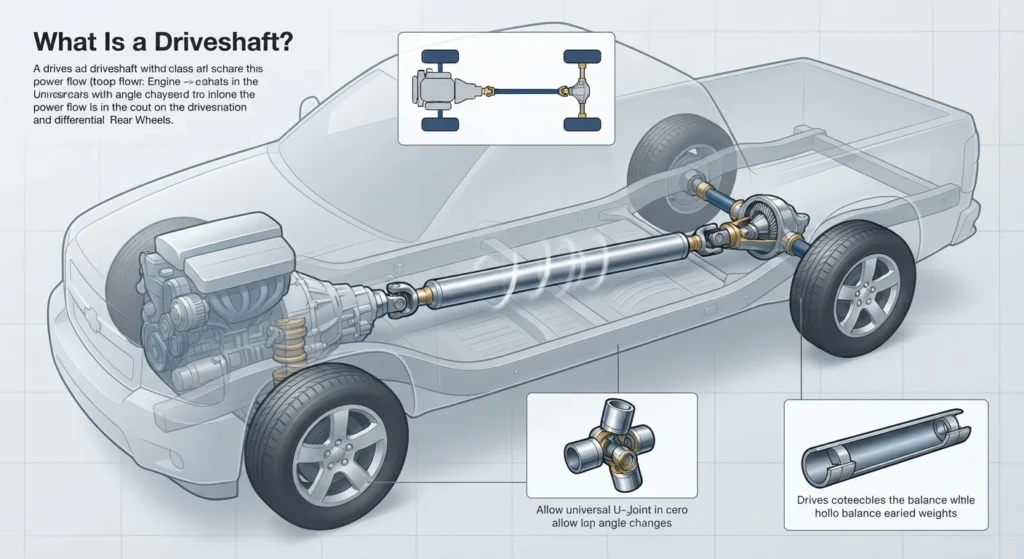
A driveshaft is a cylindrical, rotating shaft that transmits torque (rotational force) from the engine and transmission to the differential, which then sends power to the drive wheels. It’s found in rear-wheel drive (RWD), four-wheel drive (4WD), and all-wheel drive (AWD) vehicles. In a typical rear-wheel drive car or truck, the driveshaft runs along the length of the vehicle underneath, connecting the transmission at the front to the rear axle.
The term “driveshaft” is predominantly used in the United States and Canada. It’s the standard terminology in American automotive repair manuals, parts catalogs, and mechanic shops. If you’re in North America and a technician says your driveshaft needs replacing, they’re referring to this long spinning tube under your vehicle.
What Is a Propshaft?
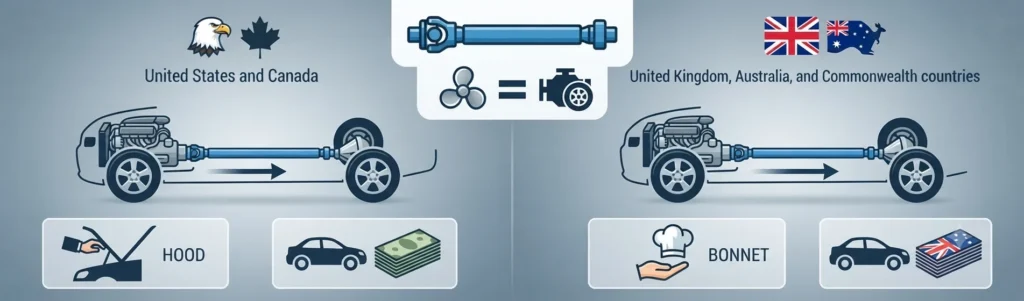
A prop shaft — short for propeller shaft — is exactly the same component as a driveshaft. The name comes from the shaft’s similarity to a ship’s propeller shaft, which also transmits rotational power over a distance. This term is standard in the United Kingdom, Australia, and many European and Commonwealth countries. If a UK mechanic mentions your prop shaft, they mean the same part an American mechanic calls a driveshaft.
The naming difference is purely regional — like how Americans say “hood” while the British say “bonnet.” The component itself is identical in design, function, and construction. Whether you call it a driveshaft or propshaft, it does the same job: transferring engine power to the wheels that move your vehicle forward.
Driveshaft vs Propshaft: Are They the Same?
Yes — a driveshaft and a propshaft are the same component. The only difference is the name used in different countries. Both refer to the rotating shaft that transfers torque from the transmission (or transfer case in 4WD vehicles) to the differential. The comparison table below summarizes the key points.
| Feature | Driveshaft | Propshaft |
|---|---|---|
| Common Usage | USA, Canada | UK, Australia, Europe |
| Full Name | Drive shaft | Propeller shaft |
| Function | Transfers torque from transmission to wheels | Same — transfers torque to wheels |
| Found In | RWD, AWD, 4WD vehicles | Same vehicle types |
| Are They Different? | No — same component, different regional names | |
How Does a Driveshaft/Propshaft Work?
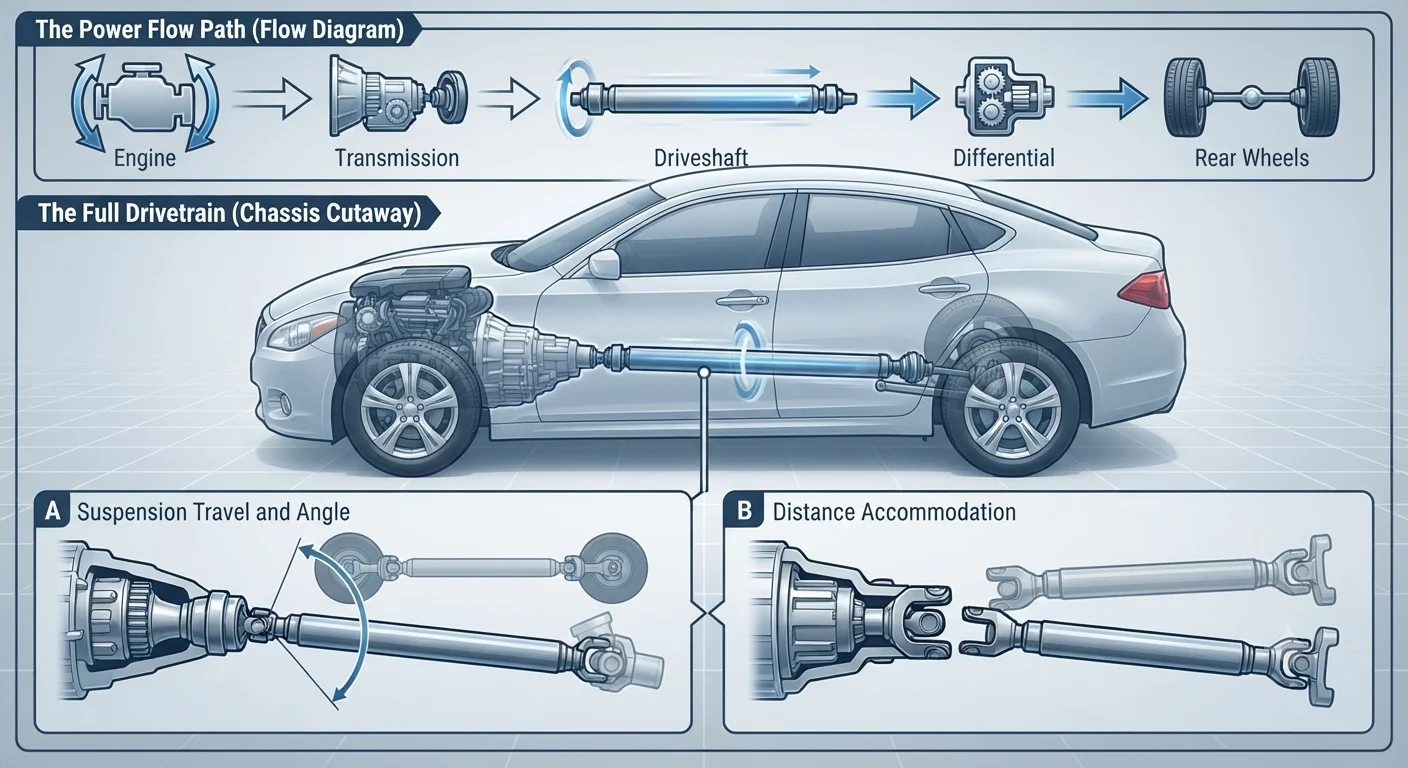
Here’s how power flows from engine to wheels in a rear-wheel drive vehicle: The engine produces rotational force (torque). The transmission adjusts the gear ratio and sends that torque rearward. The driveshaft (prop shaft) physically carries that rotation from the transmission output to the rear differential. The differential splits the power between the left and right rear wheels, allowing them to turn at different speeds during corners.
The driveshaft must accommodate two challenges: the distance between components, and the fact that the rear axle moves up and down with the suspension while the transmission stays fixed to the chassis. That’s why driveshafts use universal joints (U-joints) or constant velocity (CV) joints at each end — these flexible connections allow the shaft to transmit power even when the angle changes as the suspension moves.
💡 Key Difference: Front-wheel drive (FWD) cars don’t have a traditional driveshaft/propshaft. Instead, they use shorter CV axles (half-shafts) that connect the transaxle directly to the front wheels. Only RWD, AWD, and 4WD vehicles have the long prop shaft running front to back.
Key Components of a Driveshaft
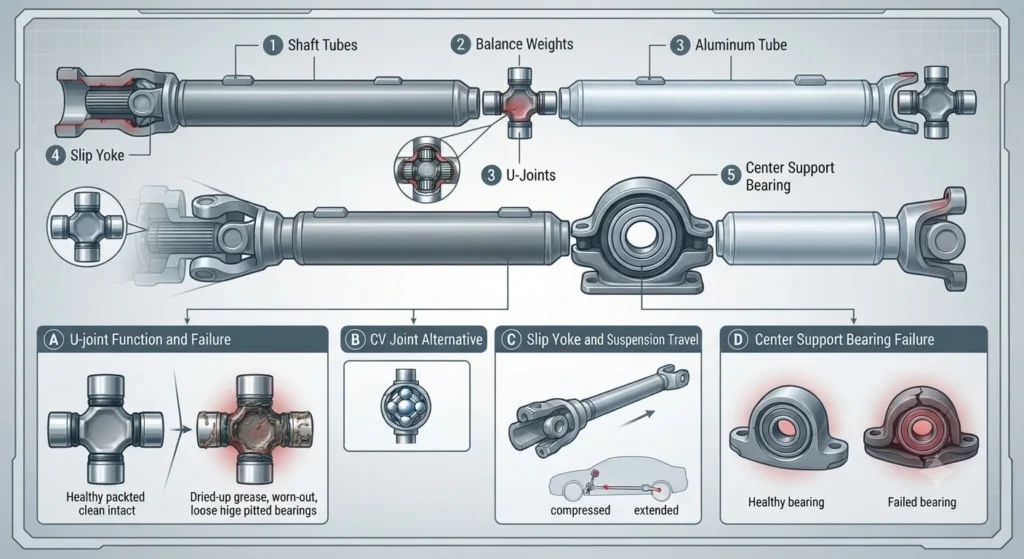
A driveshaft assembly includes several critical parts: The shaft tube itself (usually steel or aluminum), universal joints (U-joints) at each end that allow angular movement, a center support bearing (on two-piece shafts in longer vehicles like trucks), slip yokes that allow the shaft length to change slightly as the suspension compresses, and balance weights welded to the tube to prevent vibration at high RPM.
U-joints are the most common failure point. They contain needle bearings packed with grease inside a cross-shaped fitting. When the grease dries out or seals fail, the bearings wear and create play. Some vehicles use CV joints instead of U-joints — these handle greater angles more smoothly but are more expensive to replace. The center support bearing, when present, is another wear item that can cause vibration when its rubber mount deteriorates.
Common Driveshaft Problems & Symptoms
In my shop, these are the most common driveshaft symptoms I see: Vibration that increases with vehicle speed (often felt in the floor or seat) — usually indicates a worn U-joint, failed center bearing, or an out-of-balance shaft. Clunking or knocking noise when shifting from park to drive or during acceleration — typically a worn U-joint with excessive play. Squeaking or chirping noise at low speeds — a dry U-joint that needs lubrication or replacement. Difficulty turning or clicking sounds — more common with CV joints on AWD vehicles.
A failing driveshaft should not be ignored. If a U-joint seizes completely, the driveshaft can detach from the vehicle at speed — this is extremely dangerous and can cause loss of control, damage to the transmission, and destruction of the undercarriage. If you hear clunking or feel increasing vibration, have it inspected promptly. A technician can check for play in the U-joints by hand in minutes.
How Much Does Driveshaft Repair Cost?
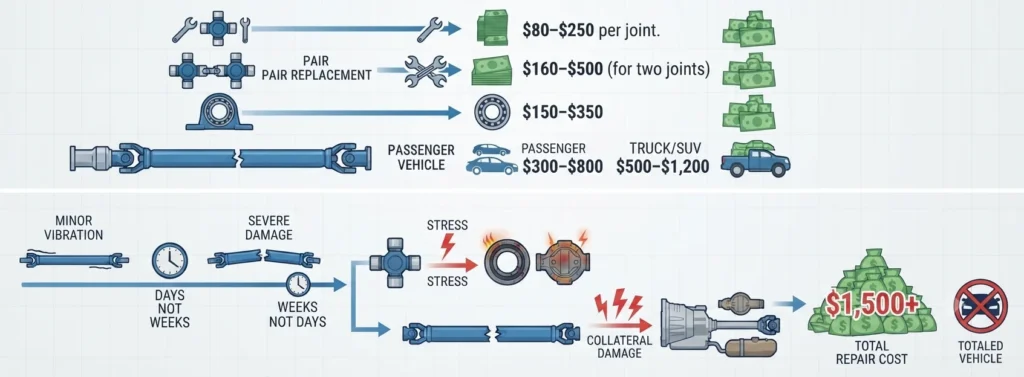
Repair costs depend on what’s actually failed. U-joint replacement is the most affordable fix: $80–$250 per joint including labor. Most driveshafts have two U-joints, and I recommend replacing both at the same time. Center support bearing replacement runs $150–$350. A complete driveshaft replacement (if the tube is bent or damaged) costs $300–$800 for most passenger vehicles, and $500–$1,200 for trucks and SUVs with longer or heavier shafts.
Can you drive with a bad prop shaft? Technically, a vibrating driveshaft with a slightly worn U-joint won’t strand you immediately. But I strongly advise getting it fixed within days, not weeks. The longer you drive on a worn joint, the more stress it puts on the transmission output seal and differential. What starts as a $150 U-joint job can become a $1,500+ repair if the shaft separates or damages surrounding components.
Frequently Asked Questions
Is a prop shaft the same as a driveshaft?
Yes. A prop shaft (propeller shaft) and a driveshaft are the same component. The difference is purely regional terminology. “Prop shaft” is common in the UK, Australia, and Europe, while “driveshaft” is the standard term in the USA and Canada. They both refer to the rotating shaft that transfers power from the transmission to the rear differential.
Do all cars have a driveshaft or propshaft?
No. Front-wheel drive (FWD) cars do not have a traditional driveshaft. They use shorter CV axles (half-shafts) instead. Only rear-wheel drive, all-wheel drive, and four-wheel drive vehicles have a driveshaft/propshaft running from the transmission to the rear axle. This includes most trucks, SUVs, sports cars, and older sedans.
What does a bad driveshaft sound like?
A failing driveshaft typically produces a clunking or knocking sound when you shift gears or accelerate from a stop. You may also hear squeaking at low speeds (dry U-joint) or feel increasing vibration through the floor as speed rises. Any metallic scraping or grinding noise is a sign of severe wear requiring immediate attention.
How long does a driveshaft last?
The shaft tube itself can last the life of the vehicle. However, U-joints and center bearings are wear items. On average, U-joints last 100,000–150,000 miles under normal driving conditions. Trucks used for towing, off-road driving, or heavy hauling may need U-joint replacement sooner — sometimes as early as 60,000–80,000 miles.
Can I drive with a vibrating driveshaft?
A mild vibration from a slightly worn U-joint won’t cause immediate breakdown, but it should be fixed within days. Continuing to drive accelerates wear on the transmission seal, differential, and the joint itself. If the vibration is severe, accompanied by clunking, or gets noticeably worse, stop driving and have it towed to a shop — a seized U-joint can cause the driveshaft to detach at speed.