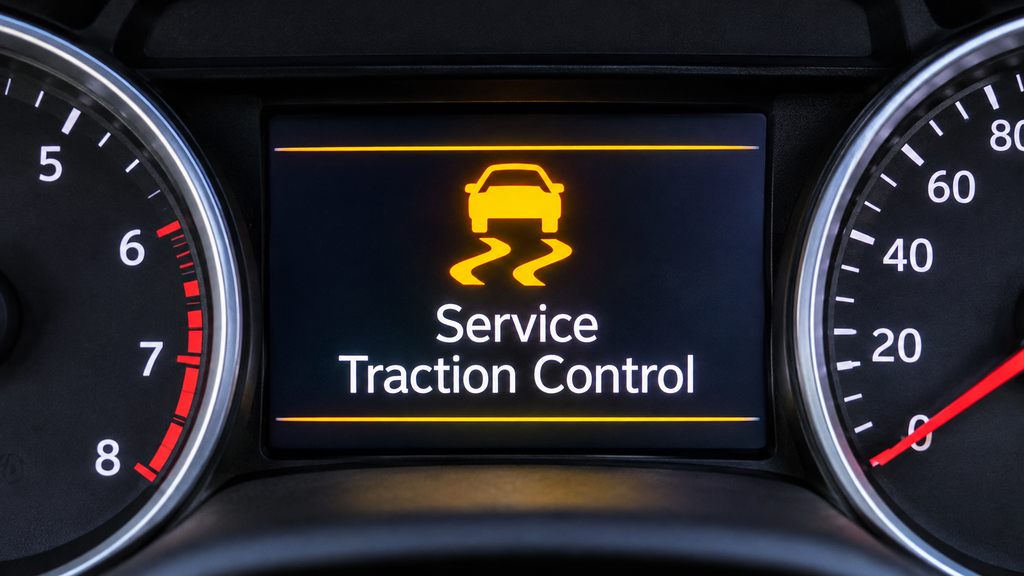
Seeing a Service Traction Control warning on your dashboard can be concerning, especially when your car still seems to drive normally. The message generally means the vehicle has detected a problem with its traction control system, which helps prevent excessive wheelspin when accelerating.
But what does the T/C light mean, why does it appear, and can you continue driving?
The answer depends on whether the light is flashing, staying on, or appearing alongside other warnings. This guide explains what traction control does, common causes of the warning, safe troubleshooting steps, and when professional diagnosis is necessary.
What Does Service Traction Control Mean?
Service Traction Control means your vehicle has detected a possible fault in its traction control system (TCS). The system may be unavailable or unable to reduce wheelspin as intended.
A steady warning or service message is different from a traction control light that briefly flashes while driving on a slippery surface.
What to do: Check for other dashboard warnings, confirm traction control has not been switched off, and arrange diagnosis if the service message remains. If braking or vehicle handling is abnormal, stop safely and seek professional assistance.
What Does T/C Mean in a Car?
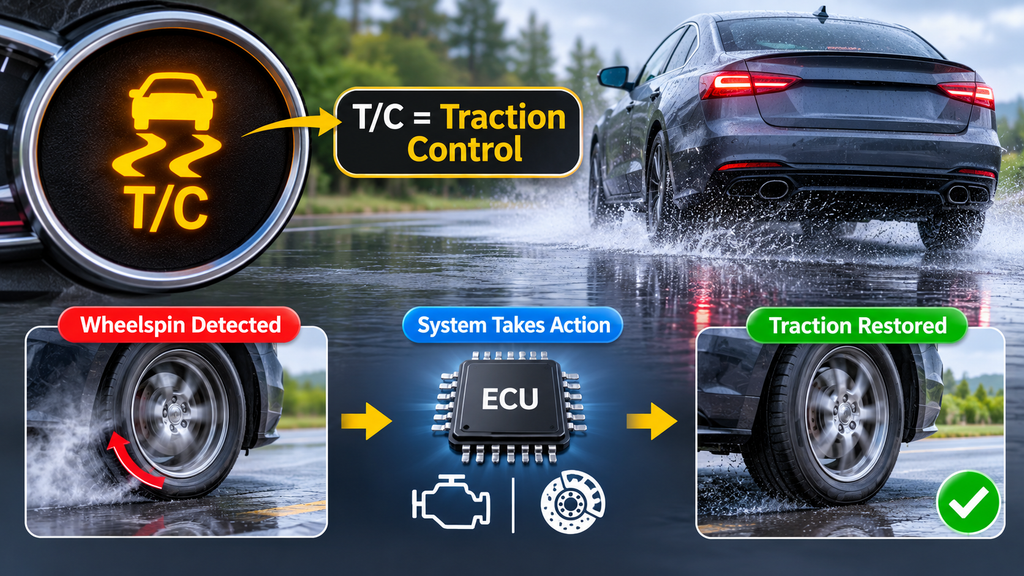
T/C stands for Traction Control. It is an electronic vehicle safety feature designed to limit excessive drive-wheel spinning during acceleration.
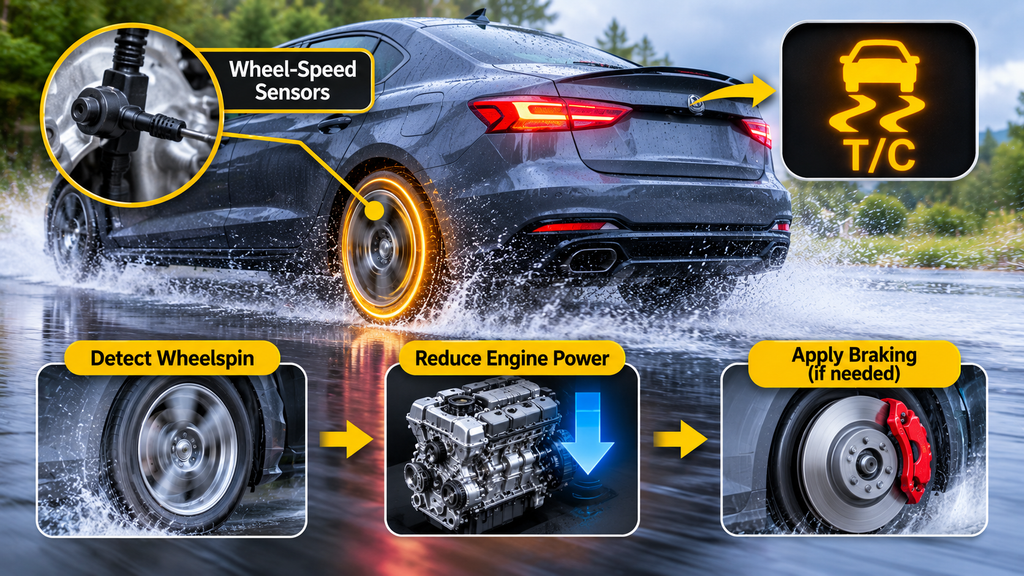
For example, when you accelerate on wet pavement, one wheel may begin spinning faster than the others because it has less grip. Traction control uses information from wheel-speed sensors to recognize the difference.
Depending on the vehicle, the system can reduce engine power, apply braking force to a spinning wheel, or use both methods to help restore traction.
What Does the Traction Control System Actually Do?
The system primarily helps with:
- Reducing wheelspin when accelerating.
- Improving traction on wet, snowy, icy, or loose surfaces.
- Helping the driver accelerate more smoothly when tire grip is limited.
- Working alongside other vehicle safety systems, including ABS and electronic stability control.
Traction control cannot create grip where none exists. Worn tires, excessive speed, and unsafe road conditions can still cause a loss of control.
How Does Traction Control Work?
Wheel-speed sensors monitor the rotation of individual wheels. When the control system detects excessive drive-wheel slip, it may request less engine torque or apply controlled braking to help the tire regain grip.
Once the wheelspin is reduced, the system allows normal operation to resume.
What Does the T/C Light on the Dash Mean?
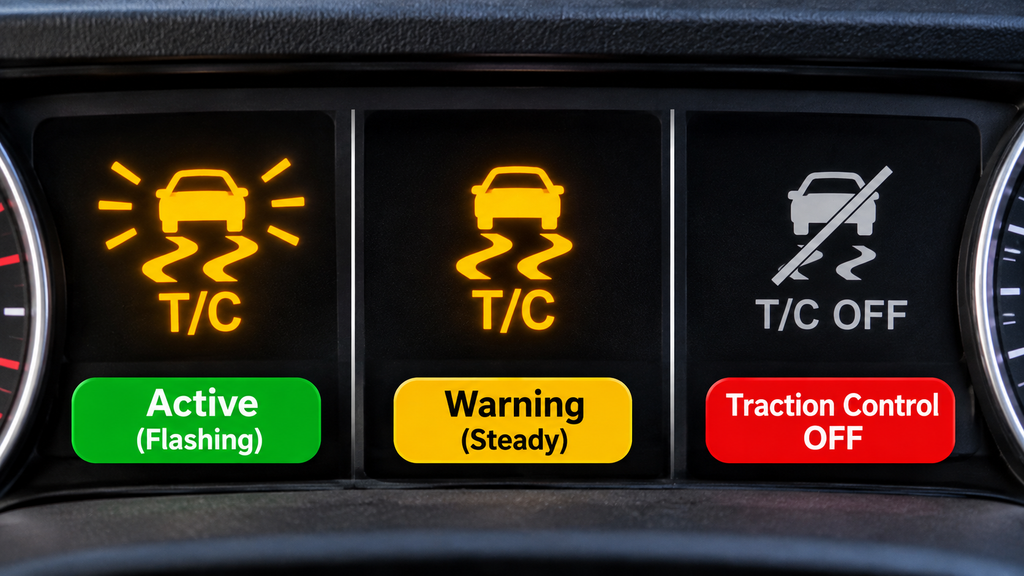
The meaning of the TC light on the dash depends on how the indicator behaves. A flashing symbol can be normal, while a persistent light may indicate that the system is disabled or experiencing a fault.
| Warning | Possible Meaning | Recommended Action |
|---|---|---|
| Flashing T/C light during wheelspin | Traction control is actively working | Accelerate gently and adjust driving to conditions |
| Steady T/C light | System may be disabled or malfunctioning | Check vehicle settings and service messages |
| T/C OFF light | Traction control has been switched off | Re-enable the system when appropriate |
| Service Traction Control message | Possible system fault | Arrange diagnosis if the message persists |
Flashing T/C Light
A traction control light flashing while accelerating on a slippery road generally means the system is trying to control wheelspin.
This is normally expected behavior. Reduce accelerator input and continue driving cautiously.
Steady T/C Light
If the traction control indicator stays illuminated, the system may be switched off or unable to operate normally.
Check the vehicle’s driver information display for related messages and consult the owner’s manual to identify the specific condition.
T/C OFF Warning Light
Many vehicles have a button or vehicle setting that allows traction control to be switched off. If the feature has been intentionally disabled, a separate OFF indicator may appear.
Is a T/C OFF Light the Same as a Service Warning?
No. A T/C OFF light may simply indicate a driver-selected setting. A Service Traction Control message usually points to a detected problem that may require inspection.
The exact symbols and messages differ among manufacturers.
What Causes the Service Traction Control Warning?
Several mechanical and electronic problems can trigger a traction control warning. Because traction control shares information with other safety systems, the cause is not always located in the traction control system itself.
1. Faulty Wheel-Speed Sensor
Wheel-speed sensors measure how quickly the wheels rotate. Traction control and ABS use these signals to recognize wheelspin and other wheel-speed conditions.
If a sensor becomes damaged or stops communicating properly, the control module may receive unreliable information and disable traction control assistance.
However, a traction warning alone does not prove that a wheel-speed sensor needs replacement.
2. Damaged Sensor Wiring or Connectors
Wheel-speed sensor wiring operates near suspension and wheel components, where exposure to moisture, road debris, movement, and corrosion can affect connections.
A loose connector, broken wire, or electrical fault may interrupt the sensor signal.
3. Wheel Bearing or Encoder Problems
On some vehicles, the wheel-speed sensor reads a magnetic encoder integrated with the wheel bearing or hub assembly.
Damage, contamination, or deterioration of the encoder may result in inaccurate wheel-speed readings, even when the sensor itself is functioning.
4. ABS Control Module Problems
The anti-lock braking system and traction control often share sensors, hydraulic components, and control electronics.
A problem with an ABS control module or associated circuitry may affect traction control operation and trigger multiple dashboard warnings.
5. Steering-Angle or Stability Sensor Issues
Vehicles equipped with electronic stability control may use steering-angle, yaw-rate, and other motion sensors to determine whether the vehicle is following the driver’s intended direction.
Problems involving these inputs can affect stability-control functions and may also produce related traction-control warnings.
6. Related Electrical or Engine-Control Faults
In some vehicles, low electrical voltage, communication problems, or certain engine-management faults may cause traction control to become unavailable.
If the check-engine light appears alongside the T/C warning, a technician should examine the relevant system codes rather than assuming two unrelated parts have failed.
How to Fix the Service Traction Control Warning
The correct repair depends on the cause. Start with basic checks, but avoid replacing sensors or clearing fault codes without understanding the problem.
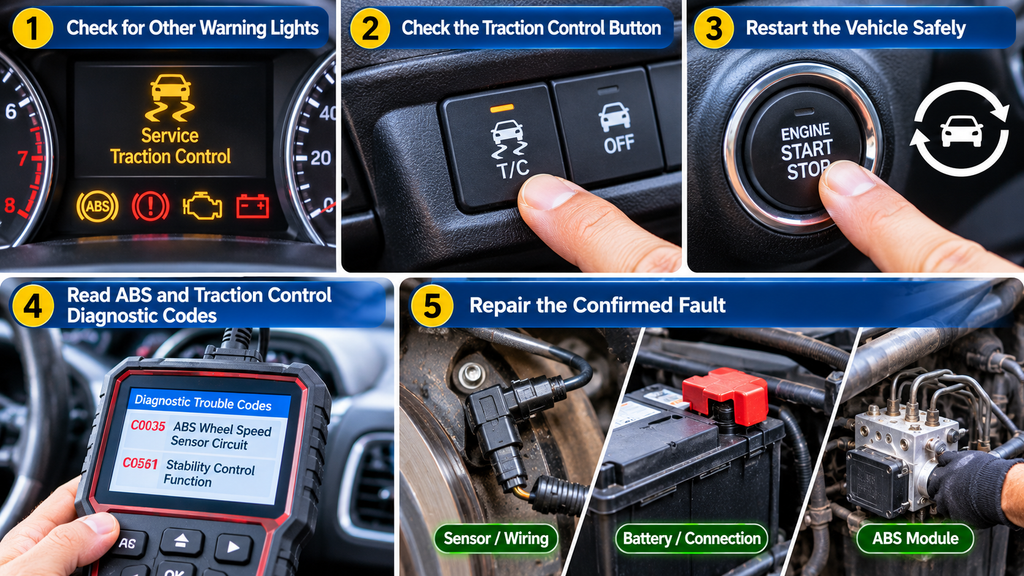
Step 1: Check for Other Warning Lights
Look for additional warnings such as:
- ABS warning light
- Red brake-system warning
- Check-engine light
- Service StabiliTrak or ESC message
- Other electrical or system warnings
Several simultaneous warnings may help a technician identify the affected system.
If a red brake warning appears with abnormal braking or handling, stop safely and arrange professional assistance rather than attempting to continue driving.
Step 2: Check the Traction Control Button
Look for a switch marked T/C, TCS, or a sliding-car symbol. Some vehicles have the setting in the infotainment system.
If traction control was unintentionally turned off, follow the owner’s manual to switch it back on.
If the dashboard specifically says Service Traction Control, pressing the button may not solve the problem.
Step 3: Restart the Vehicle Safely
When there are no urgent brake or handling symptoms, you can park safely, turn the engine off, and restart according to the owner’s manual.
Some temporary warnings may disappear after restarting, but a warning that goes away does not necessarily mean the underlying fault has been repaired.
Should You Disconnect the Battery to Reset the T/C Light?
Do not disconnect the battery merely to erase the warning. Doing so may clear diagnostic information or affect vehicle settings without fixing the cause.
It is better to identify the fault before attempting a reset.
Step 4: Read ABS and Traction Control Diagnostic Codes
If the warning returns or remains illuminated, a technician can use a compatible scan tool to check the ABS, stability-control, and related electronic modules.
Some basic OBD-II readers access only engine-related information. They may not retrieve the brake-system diagnostic codes needed to investigate traction control faults.
A proper diagnosis may involve:
- Reading current and stored diagnostic trouble codes.
- Checking individual wheel-speed readings through live data.
- Inspecting wheel-speed sensor wiring and connectors.
- Testing the related sensor or module circuits.
- Confirming whether other vehicle systems are contributing to the warning.
Step 5: Repair the Confirmed Fault
Once the technician has identified the problem, the repair may involve repairing damaged wiring, servicing a sensor connection, replacing a failed component, or performing a manufacturer-specified calibration.
After repairs, the technician should verify that the warning has cleared and the system operates normally.
Can You Drive With the Service Traction Control Light On?
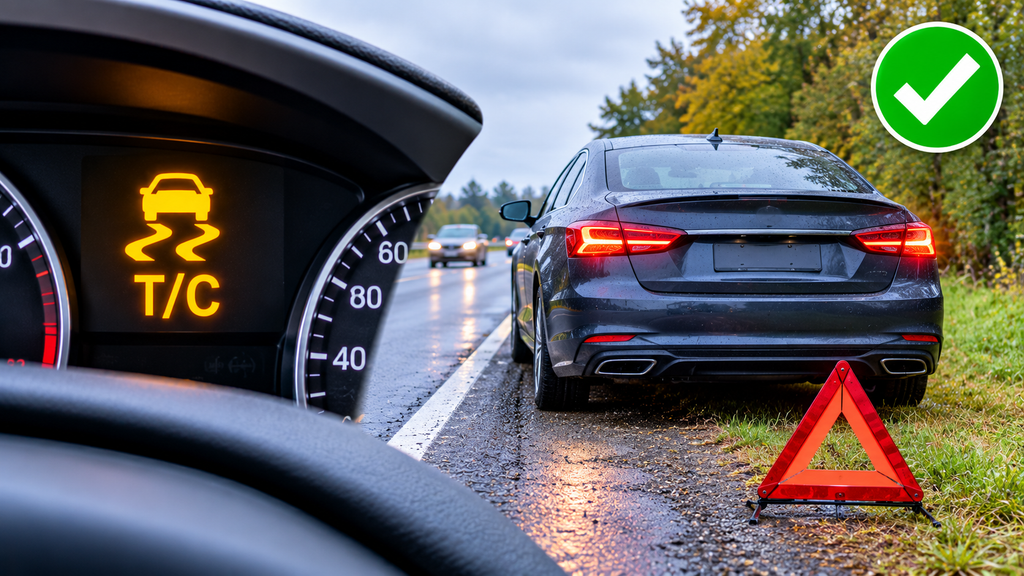
Some vehicles can still be driven with an isolated traction control fault, but safety depends on the other warnings, vehicle behavior, and road conditions.
Conventional braking may remain available, but traction and stability assistance could be reduced or unavailable.
When Limited Driving May Be Possible
If the warning is isolated, the brakes and steering feel normal, and your owner’s manual permits continued driving, you may be able to travel cautiously to a service facility.
Drive conservatively, avoid sudden acceleration, and allow extra distance for changing conditions. The absence of unusual symptoms does not guarantee the vehicle is safe.
When Should You Stop Driving?
Pull over safely and arrange assistance if you notice:
- A red brake warning or other urgent dashboard alert.
- A soft brake pedal, reduced braking response, or unusual brake behavior.
- Unexpected steering or handling changes.
- Severe vibration, grinding, or other signs of a mechanical fault.
- Loss of vehicle control or an inability to drive safely.
Traction control is especially useful on wet, snowy, and icy roads. A malfunction can increase the risk of wheelspin when accelerating under these conditions
Traction Control vs. ABS vs. Stability Control
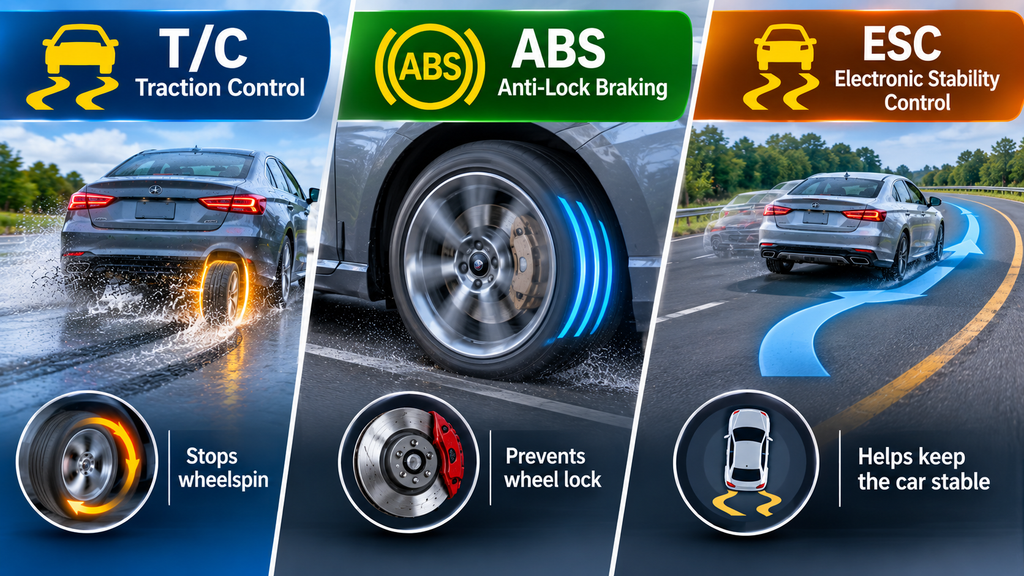
Traction control, anti-lock braking, and electronic stability control are related, but they perform different functions.
| System | Main Purpose | Typical Situation |
|---|---|---|
| Traction Control (TCS) | Helps reduce excessive drive-wheel spin | Accelerating on slippery pavement |
| ABS | Helps prevent wheel lock during braking | Hard braking or braking on slippery roads |
| ESC / StabiliTrak | Helps maintain directional stability | Skidding or losing directional control during a turn |
Why Can ABS and Traction Control Lights Appear Together?
These systems often share wheel-speed information and control hardware. A fault in a shared component may affect more than one function.
However, seeing both warnings does not prove that the ABS module has failed. A proper scan and electrical inspection are needed to locate the cause.
How Much Does Service Traction Control Repair Cost?
The cost depends on what caused the warning. There is no single repair price because the message can be triggered by several different faults.
For example, repairing a damaged wire may involve a different amount of labor than replacing a wheel hub assembly, diagnosing an electronic control module, or performing a vehicle-specific calibration.
What Affects the Repair Price?
- The vehicle’s make, model, and year.
- The diagnostic time required to identify the fault.
- The cost of replacement parts, if necessary.
- Whether wiring, sensors, bearings, or electronic modules are involved.
- Local labor rates and programming requirements.
How Can You Avoid Unnecessary Repair Costs?
Ask the repair shop for the actual diagnostic codes, a description of the failed test, and an itemized estimate.
Do not authorize expensive ABS or traction control component replacements simply because a dashboard warning appears.
Frequently Asked Questions
What does Service Traction Control mean?
It generally means your vehicle has detected a problem affecting the traction control system. The feature may be disabled or unable to provide its normal wheelspin assistance until the fault is resolved.
What does TC mean in a car?
TC stands for traction control when used as a dashboard safety-system abbreviation. It refers to the system that helps reduce excessive wheelspin during acceleration.
What does the T/C light on the dashboard mean?
A flashing T/C light may indicate the system is actively controlling wheelspin. A steady light can indicate the system is disabled or experiencing a malfunction. Check your owner’s manual for the exact meaning.
Why is my traction control light on when the car drives normally?
A malfunction may affect traction-control assistance without causing obvious engine or braking symptoms during ordinary driving. A persistent warning should still be diagnosed.
Can a bad wheel-speed sensor cause a traction control warning?
Yes. A faulty wheel-speed sensor can interfere with the information used by ABS and traction control. However, wiring, encoders, modules, and other problems may cause similar warnings.
Can low tire pressure cause a traction control warning?
Significantly incorrect tire pressure or mismatched tire sizes can affect wheel behavior and, in some vehicles, contribute to system issues. Check tire pressure and tire condition, but do not assume inflation alone will clear a service fault.
Will restarting my car fix Service Traction Control?
Restarting may clear a temporary warning, but it does not repair a failed sensor, damaged wiring, or another persistent fault. Have the system checked if the warning returns.
Can I drive with the traction control warning light on?
Some isolated traction-control faults may allow cautious driving, but traction assistance may be unavailable. Stop safely if braking, steering, or handling is abnormal or other urgent warnings appear.
Why are my ABS and T/C lights on at the same time?
ABS and traction control share components on many vehicles. A fault involving wheel-speed information, wiring, or control electronics can affect both systems.
How do I reset the traction control light?
First determine whether the system is manually switched off or reporting a fault. Re-enable it using the manufacturer’s instructions if necessary. A persistent service warning requires diagnosis and repair rather than simply clearing codes.
Final Takeaway
A Service Traction Control warning usually means your vehicle has detected a problem that may prevent the system from reducing wheelspin as designed.
A flashing T/C light during slippery-road acceleration is often normal system activity. However, a steady warning or service message should be investigated, especially when ABS, brake, or other warning lights appear.
Start with safety, then diagnose the cause. Check for urgent symptoms, review the vehicle’s settings and owner’s manual, and have persistent faults checked with a compatible diagnostic scanner.