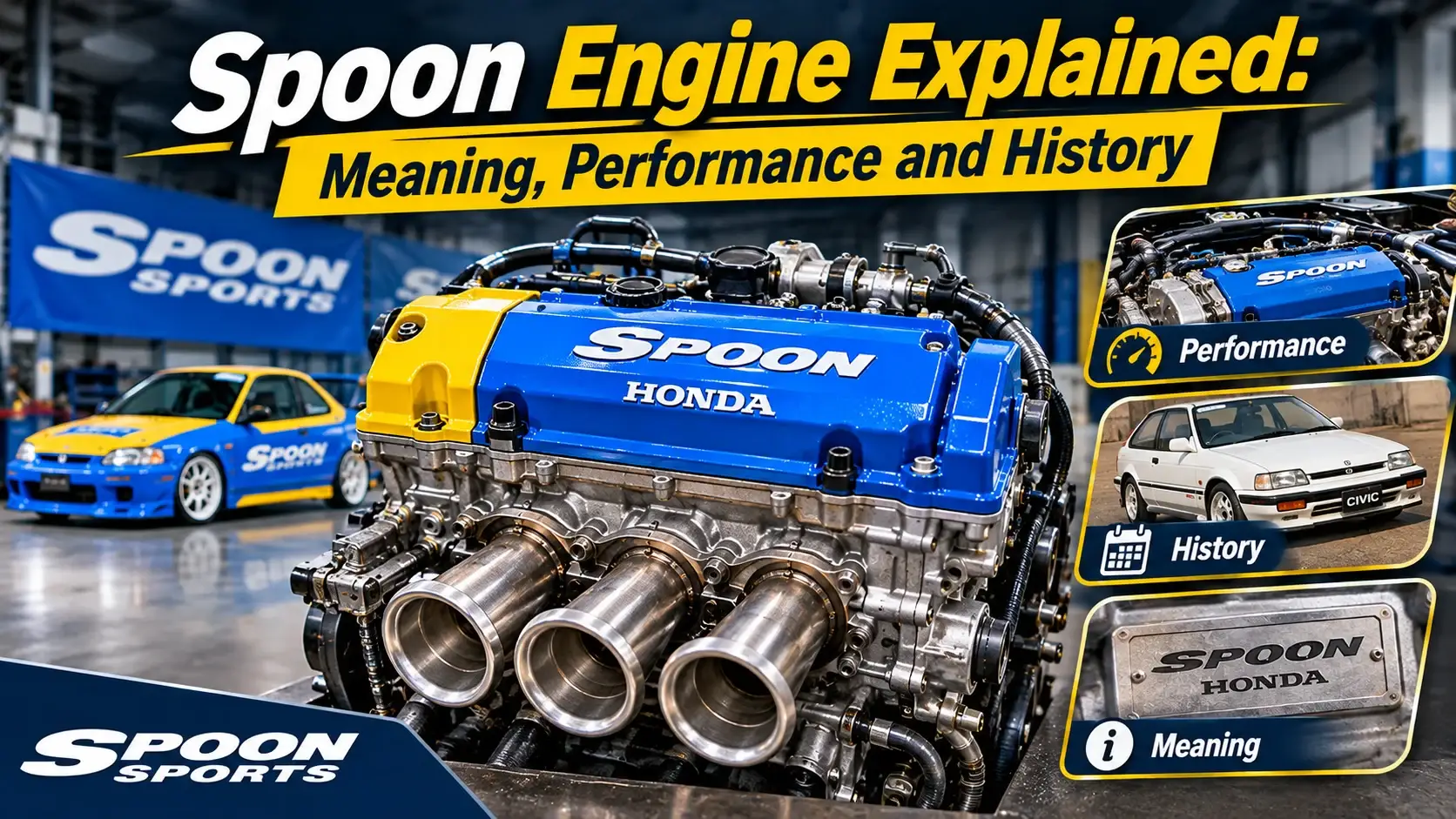
Ever heard someone mention a Spoon engine while talking about a Honda Civic, Integra, or S2000? The name comes up frequently in JDM car culture, Honda tuning communities, and conversations about The Fast and the Furious. But a Spoon motor is more than an unusual name or a brightly colored engine cover.
Spoon Sports is a Japanese company known for refining Honda vehicles and their components using engineering knowledge developed through motorsport. Its engines are associated with precise assembly, balanced internal parts, smooth power delivery, and a focus on performance that can be used consistently.
So, what is a Spoon engine, how much horsepower does it make, and what makes one different from a factory Honda engine?
This guide explains the meaning of Spoon engines, how they are developed, their performance characteristics, their history, and how to recognize a genuine Spoon-built motor.
What Is a Spoon Engine? Quick Answer
A Spoon engine is a Honda engine built, rebuilt, or specially prepared by Spoon Sports, a Japanese performance tuning company founded in 1988.
Spoon works with existing Honda engine platforms, using processes such as careful component selection, balancing, precision assembly, and application-specific tuning.
Important: A Honda fitted with a Spoon exhaust, yellow valve cover, or other Spoon-branded part is not automatically a complete Spoon-built engine.
What Is a Spoon Engine and What Does It Mean?
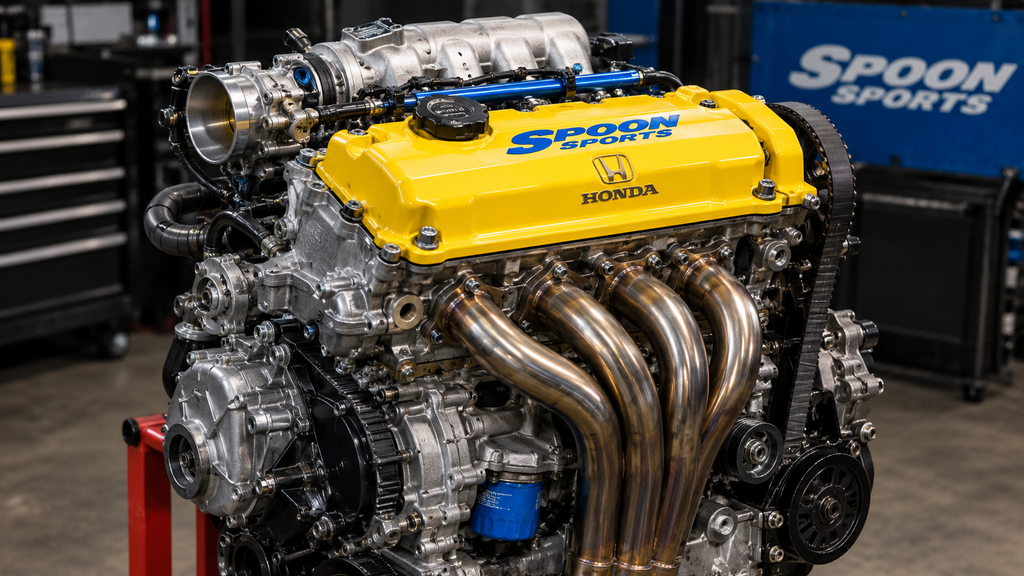
The term Spoon engine describes an engine associated with Spoon Sports, particularly one that has received the company’s specialized engine-building work.
Unlike Honda, Toyota, or Nissan, Spoon does not manufacture an independent range of vehicle engine blocks. Instead, it starts with Honda engine designs and refines selected components and assembly processes.
For instance, an authentic Spoon complete engine may use Honda-manufactured internal parts that have been individually inspected, prepared, weighed, and assembled to Spoon’s specifications.
Is a Spoon Motor the Same as a Spoon Engine?
Yes. In enthusiast conversations, Spoon motor and Spoon engine generally refer to the same thing.
Some people also search for “engine spoon,” although “Spoon engine” is the more natural term used in automotive discussions.
There is one important distinction: a complete engine built by Spoon is different from a standard Honda engine with a few Spoon aftermarket components installed.
Is Spoon an Engine Brand or a Tuning Company?
Spoon Sports is a Honda-focused tuning and performance-parts company. Its product range has included engine components, complete engine assemblies, suspension parts, brakes, exhaust components, and other performance upgrades.
The company’s identity comes from its engineering and development work, not from inventing a separate family of engines.
The History of Spoon Sports and Spoon Engines
Spoon’s origins are closely connected to Japanese motorsport and the development of Honda performance vehicles.
Who Founded Spoon Sports?
Tatsuru Ichishima founded Spoon Sports in January 1988. The company initially focused on racing preparation and performance tuning for Honda sports cars.
Its guiding idea was that a successful racing car depends on the balance of the complete vehicle rather than one impressive specification.
That approach influenced Spoon’s work on engines, chassis components, suspension systems, and braking performance.
How Spoon Developed Its Motorsport Reputation
Spoon tested its engineering ideas in competition and developed products from that experience.
Its official company history documents racing activities involving Honda Civics, the NSX, the Integra, and the S2000, including endurance racing in Japan and overseas.
In 1996, Spoon began selling tuned engine assemblies. Its historical records also identify the beginning of B-series engine assembly sales in 1998.
Important Spoon Sports Milestones
| Year | Milestone |
|---|---|
| 1988 | Spoon begins operating as a Honda-focused tuning and racing shop. |
| 1989 | Development work expands into racing ECUs and exhaust systems. |
| 1991 | A Spoon-prepared Civic records a class victory at the Snetterton 24-hour race. |
| 1996 | Sales of tuned engine assemblies begin. |
| 1998 | B-series engine assembly sales are documented. |
| 2001 | The Type One Honda specialty shop opens. |
These milestones help explain why Spoon engines are associated with an established Honda tuning tradition rather than a recent aftermarket trend.
Motorsport development helped establish Spoon’s reputation among Honda enthusiasts.

How Is a Spoon Engine Built?
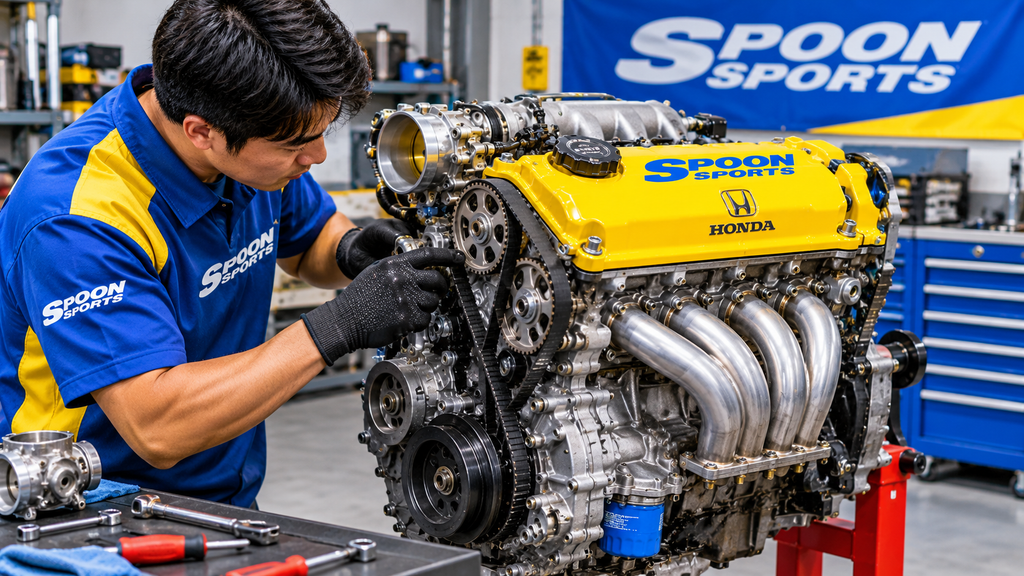
The defining feature of a Spoon engine is the attention given to individual components and the way they work together.
The exact procedures vary by engine model and product specification, so not every Spoon build receives the same modifications.
1. Careful Inspection and Component Preparation
Engine parts must fit and operate together within specified tolerances. Before assembly, a specialist may inspect the cylinder block, cylinder head, pistons, connecting rods, and other components for manufacturing variation or defects.
Spoon’s published description of its L15C complete engine specifically mentions removing metal burrs from the block and cylinder head before assembly.
This type of preparation can reduce the risk of loose material contaminating the engine and helps ensure careful assembly.
2. Precision Balancing
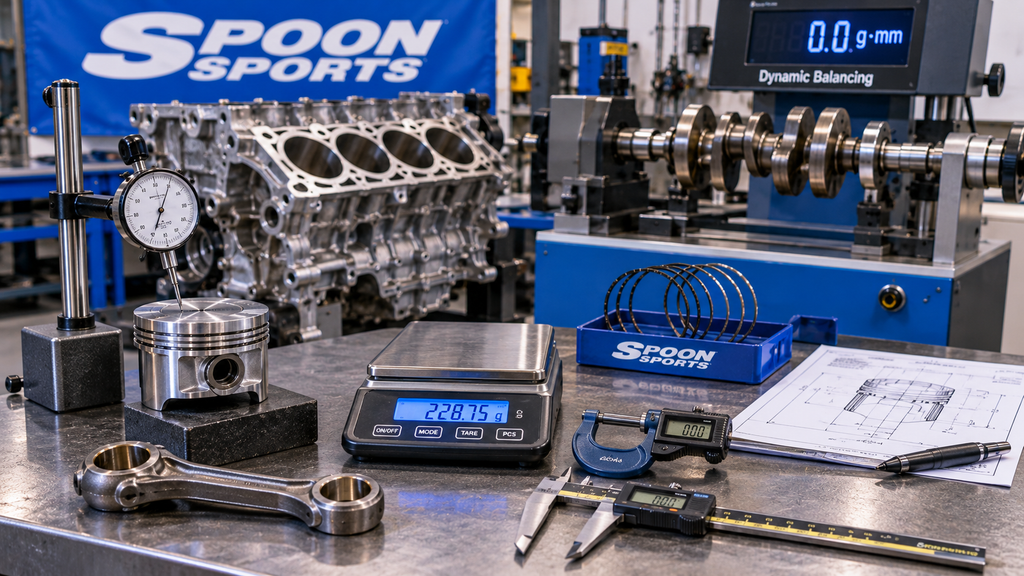
Balancing is one of the most frequently discussed elements of Spoon’s engine-building approach.
Small differences in the mass of pistons, pins, connecting-rod components, and other moving parts may contribute to vibration when an engine runs at high speed.
Carefully matching component weights helps control these differences.
A Real Example: Spoon’s L15C Complete Engine
Spoon USA’s published description of its L15C complete engine for the Honda Civic FK7 reports matching specified reciprocating-component weights to a tolerance of 0.02 grams per cylinder.
This is an example from one published product description, not a universal tolerance that should be attributed to every Spoon engine.
Such precision may improve smoothness and engine feel, but it does not automatically mean a dramatic increase in peak horsepower.
3. Blueprinting and Precision Assembly
Engine blueprinting means measuring selected components and clearances, then assembling the engine according to carefully controlled specifications.
Important measurements may include bearing clearances, piston-to-cylinder clearances, and other dimensions relevant to the engine design.
More precise assembly aims to make the finished engine consistent and suitable for its intended use. The target specifications must be appropriate for that particular engine and application.
4. Airflow and Engine Calibration
Depending on the build, performance development may also involve intake, exhaust, cylinder-head, or engine-control changes.
These changes need to work together. An exhaust upgrade or altered engine component does not guarantee a useful improvement without considering the complete setup.
Engine calibration is especially important when hardware modifications change airflow, fueling, or operating conditions.
5. Testing and Verification
After assembly, an engine should be inspected and tested according to the builder’s procedures.
Testing may include confirming fluid pressure, checking for leaks, monitoring operating behavior, and measuring performance where appropriate.
The exact test process should be verified with the builder rather than assumed from the Spoon name alone.
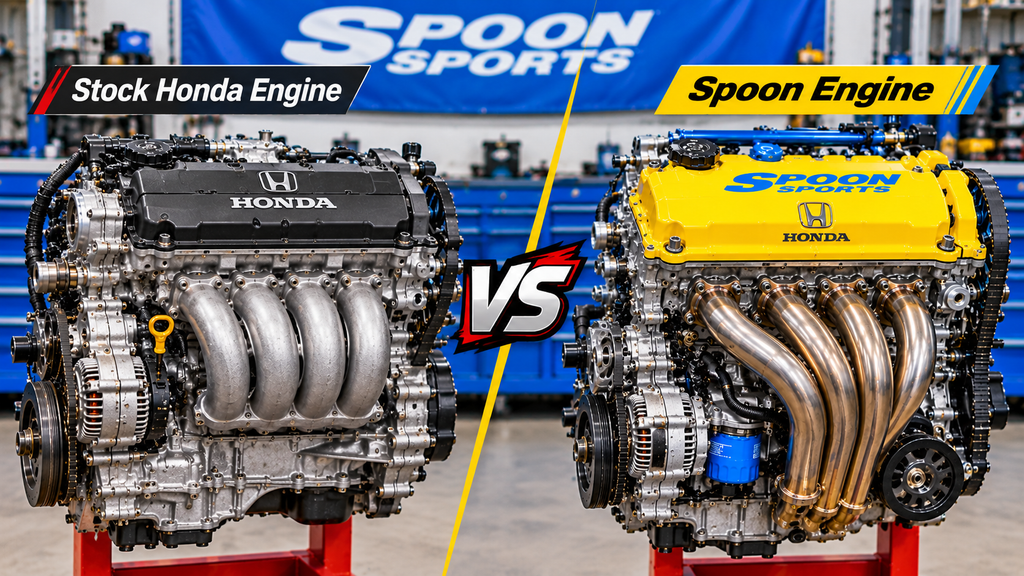
Spoon Engine vs. Stock Honda Engine: What’s Different?
A factory Honda engine is designed to satisfy a broad range of requirements, including performance, emissions, reliability, production efficiency, and maintenance expectations.
A Spoon-built engine may emphasize tighter component matching and specialized preparation for a particular performance goal.
| Feature | Stock Honda Engine | Spoon-Built Engine |
|---|---|---|
| Engine foundation | Factory Honda design | Honda design with Spoon preparation |
| Assembly | Honda production specifications | Product-specific precision assembly |
| Balancing | Factory manufacturing requirements | May use tighter matching specifications |
| Power output | Known factory rating for its model | Depends on the particular assembly and tune |
| Driving character | Broad everyday usability | May prioritize response and consistency |
| Cost | Depends on OEM or replacement-engine pricing | Usually requires a premium for specialist work |
The comparison describes general differences in priorities. It does not mean a Spoon engine is always more powerful, more reliable, or superior to every factory engine.
How Much Horsepower Does a Spoon Engine Make?
There is no single horsepower rating for all Spoon engines.
A Spoon-built engine based on a Honda Civic will not necessarily produce the same power as an assembly developed for an S2000 or another Honda platform.
The result depends on the original engine, the exact components, the assembly specification, the engine calibration, and the conditions under which output is measured.
Does Balancing an Engine Increase Horsepower?
Better component balance can reduce unwanted vibration and improve smoothness, but it should not be treated as a guaranteed horsepower modification.
Other engine changes may affect peak power, but those results need to be supported by data from the exact configuration.
A reliable before-and-after dynamometer test should identify the engine setup, testing method, and whether results represent engine horsepower or wheel horsepower.
Can All Spoon Motors Rev to 10,000 RPM?
No. Claims that every Spoon engine can safely operate at 10,000 RPM or higher are misleading.
The safe operating range depends on the engine’s mechanical design, valvetrain, rotating assembly, calibration, and other components.
Never increase an engine’s rev limit simply because it contains Spoon parts. Follow the builder’s documented specifications.
Why Do Enthusiasts Value Spoon Performance?
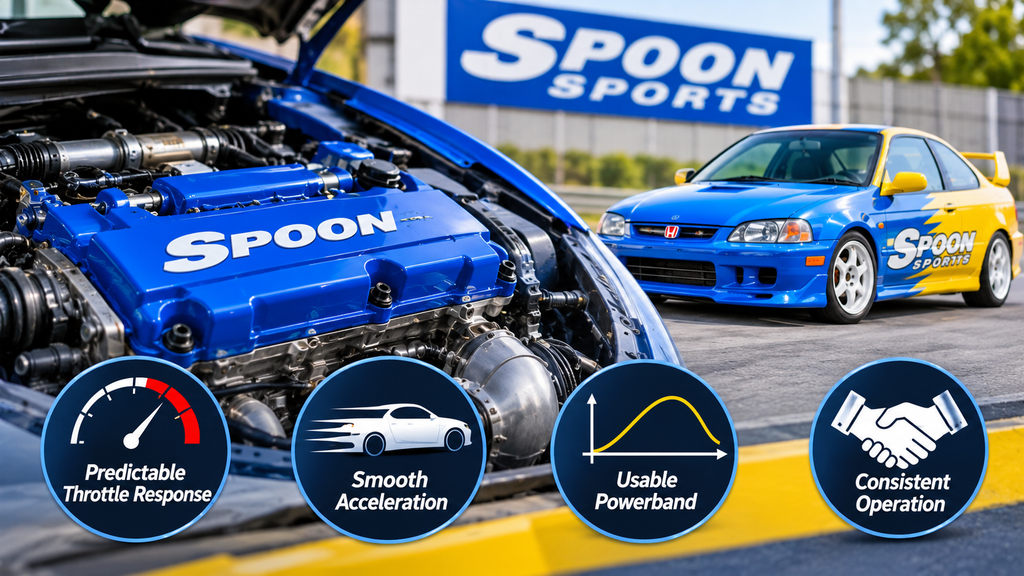
Peak horsepower is only one measure of engine performance. Drivers may also value predictable throttle response, smooth acceleration, a usable powerband, and consistent operation during demanding driving.
Spoon’s philosophy places considerable emphasis on those overall characteristics.
Which Honda Cars and Engines Are Associated With Spoon?
Spoon has worked with multiple generations of Honda performance vehicles. The company produces different parts and engine products for specific applications, so buyers should always confirm fitment.
Honda Civic
The Civic is one of the best-known vehicles in Spoon’s history.
Its tuning work has included older high-revving Civic models as well as more recent generations, including turbocharged Civic applications.
Engines and components differ substantially between Civic generations. A product for a B-series engine will not automatically fit a K-series or L-series engine.
Honda and Acura Integra
The Integra, particularly Type R models, has long appealed to enthusiasts interested in lightweight chassis and responsive Honda engines.
Spoon products have been associated with selected Integra platforms, including B-series and K-series applications.
Honda S2000
The Honda S2000 is famous for its high-revving, naturally aspirated four-cylinder engine.
Spoon’s historical motorsport activities include extensive S2000 development and racing, making the model an important part of the company’s reputation.
Honda NSX
Spoon has also worked with the Honda NSX, including racing and vehicle development projects.
These projects reflect the company’s broader Honda performance experience, although NSX-related products should not be confused with the more commonly discussed Civic engine builds.

Are Spoon Engines Reliable for Street and Track Use?
Spoon’s approach emphasizes careful assembly and balanced performance, but no engine is guaranteed to be trouble-free.
Reliability depends on the actual engine specification, how it is installed, its calibration, the quality of the supporting systems, and how the vehicle is used.
For Everyday Street Driving
A properly matched performance engine may be suitable for street use, but it is essential to check whether the complete setup meets the owner’s needs.
Consider fuel requirements, emissions compliance, cooling, service intervals, and the engine builder’s operating instructions.
For Track Driving
Track sessions expose an engine to sustained loads, high oil temperatures, and frequent high-rpm operation.
Even carefully assembled engines need appropriate cooling, lubrication, maintenance, and inspection.
Preparation should also account for brakes, tires, transmission condition, and driver safety equipment. A well-built engine alone does not make a car track-ready.
How Much Does a Spoon Motor Cost?
Spoon engine pricing depends heavily on the model, whether the product is a complete engine or individual parts, availability, and shipping or installation costs.
A complete Spoon-built engine can cost substantially more than a basic aftermarket upgrade because it includes the engine assembly and specialist preparation.
Official Spoon USA listings have included complete Honda engine assemblies priced in the five-figure U.S. dollar range. Prices can change, so use the current official listing rather than treating a historical figure as a guaranteed quote.
Additional Costs Buyers Should Consider
- Shipping and import-related charges where applicable.
- Installation labor and required supporting components.
- Engine-management calibration, if necessary.
- Compatible transmission and drivetrain components.
- Cooling, exhaust, or other installation requirements.
- Potential local emissions and registration requirements.
Is a Spoon Engine Worth Buying?
For a dedicated Honda enthusiast who values precision assembly, brand history, and a particular performance character, a genuine Spoon complete engine may be attractive.
However, a street car needing modest performance improvements may benefit more from maintenance, tires, suspension work, or carefully selected compatible upgrades.
The best choice depends on the car’s condition, intended use, budget, and the performance objective.
How to Identify a Genuine Spoon Engine
Authenticity matters because some sellers describe any Honda engine containing Spoon accessories as a “Spoon motor.”
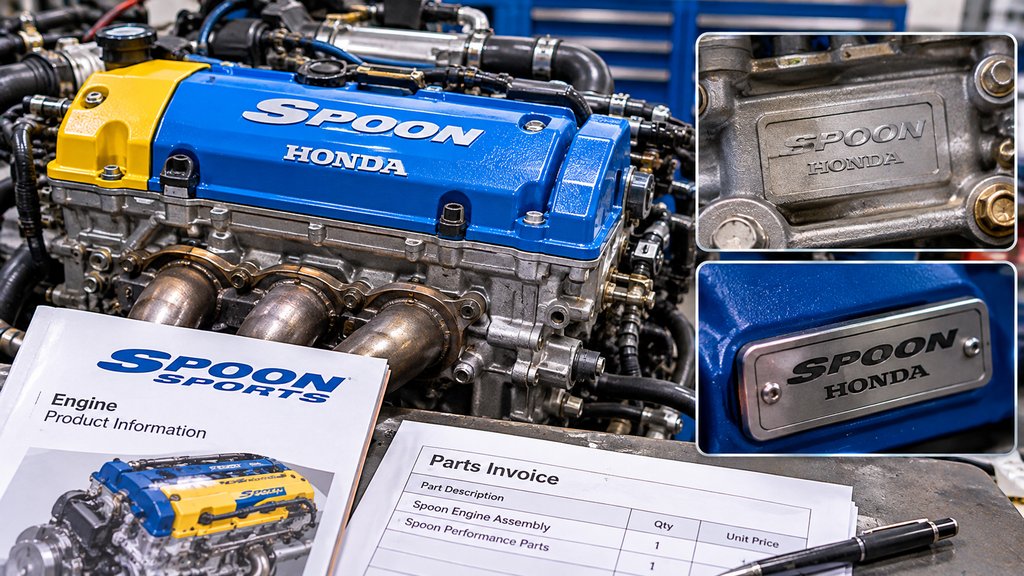
A painted engine cover, branded sticker, or aftermarket exhaust does not prove that the complete engine was assembled by Spoon Sports.
Check Documentation and Engine Provenance
For a claimed Spoon-built complete engine, ask the seller for evidence of where the engine originated and what work was performed.
Genuine Spoon Engine Buying Checklist
- Confirm the original Honda engine family and engine code.
- Request the Spoon product number where applicable.
- Ask for the original purchase invoice or builder documentation.
- Confirm the exact parts and engine work included.
- Check that the engine is compatible with the intended vehicle.
- Request compression or leak-down results where appropriate for a used engine.
- Review maintenance history and any previous repairs.
- Verify seller claims through an authorized distributor or Spoon contact.
Does a Yellow Valve Cover Prove an Engine Is Genuine?
No. Yellow engine covers are visually associated with Spoon, and Spoon sells painted head covers as individual products.
A standard Honda engine can have a Spoon head cover installed without receiving the company’s complete engine-building process.
Authenticity should be established through reliable product and purchase records, not appearance alone.
Spoon Engines and The Fast and the Furious
For many enthusiasts outside Japan, the term “Spoon engine” became familiar through the 2001 movie The Fast and the Furious.
During a conversation about competing race cars, the film refers to three Honda Civics fitted with Spoon engines.
The reference helped bring the name into broader car culture, particularly among viewers newly discovering Japanese performance tuning.
However, the film dialogue should not be treated as a technical specification. It does not establish that every Spoon engine has a particular turbocharger, power output, or engine configuration.
For accurate information about a real Spoon motor, refer to the exact product and engine build documentation.
Common Myths About Spoon Engines
| Common Myth | What You Should Know |
|---|---|
| Spoon manufactures its own unique Honda replacement engines. | Spoon builds and refines existing Honda engine platforms. |
| Every Spoon engine has the same horsepower. | Output depends on the engine and specific build. |
| All Spoon engines rev to 10,000 RPM. | Safe engine speed depends on the documented mechanical specification. |
| A yellow valve cover proves authenticity. | A separate cosmetic component does not prove a complete Spoon assembly. |
| A Spoon engine is guaranteed to be reliable. | Reliability still depends on installation, calibration, maintenance, and use. |
Frequently Asked Questions About Spoon Engines
What is a Spoon engine?
A Spoon engine is a Honda engine built or specially prepared by Spoon Sports, a Japanese tuning company. Its work may involve precise assembly, careful component matching, balancing, and other modifications depending on the engine model.
What is a Spoon motor?
Spoon motor is another term for a Spoon engine. The words are generally used interchangeably when discussing Honda engines associated with Spoon Sports.
Who makes Spoon engines?
Spoon Sports, the Japanese Honda tuning company, builds and prepares its complete engine products using Honda engine designs and components.
Who founded Spoon Sports?
Tatsuru Ichishima founded Spoon Sports in 1988. The company developed its reputation through Honda-focused tuning and motorsport participation.
How much horsepower does a Spoon engine have?
There is no universal horsepower rating. Power depends on the original Honda engine, the particular Spoon product or build, supporting modifications, and calibration.
Are Spoon engines better than stock Honda engines?
Spoon engines may offer particular advantages in precision assembly or performance characteristics, but the best choice depends on the vehicle, intended use, cost, and specific engine configuration.
Do all Spoon engines have VTEC?
No single engine feature applies to every Spoon product. Many Spoon-associated Honda platforms use VTEC, but the configuration depends on the underlying Honda engine. VTEC itself is Honda technology, not an invention unique to Spoon.
Are Spoon engines turbocharged?
Not necessarily. Spoon has worked with naturally aspirated and turbocharged Honda platforms. The presence of a turbocharger depends on the engine model and build specification.
Can I install Spoon parts on my Honda?
Yes, Spoon offers individual parts for compatible Honda vehicles. Check the product’s specific model, engine, model-year, and market fitment before purchasing or installing components.
How can I buy a genuine Spoon engine?
Start with Spoon Sports or an established authorized distributor. Confirm the exact engine product, compatibility, purchase documentation, included components, and installation requirements.
Final Verdict: What Makes a Spoon Engine Special?
A Spoon engine is not a completely different engine invented independently of Honda. It is a Honda-based engine prepared through Spoon Sports’ specialized performance-engineering approach.
Its appeal comes from careful component preparation, balancing, engine assembly, and the company’s motorsport heritage.
For Honda enthusiasts, the Spoon name represents a tuning philosophy focused on how the entire engine and vehicle perform together, rather than just achieving the highest possible horsepower figure.
If you are considering buying a Spoon motor, compare the documented specification with your goals, verify authenticity, and ensure it is suitable for the intended vehicle and use.