A practical guide to choosing a DeWalt reciprocating saw for demolition, metal cutting, plumbing repairs, pruning, and serious renovation work.
For all-round demolition, choose a full-size DeWalt 20V reciprocating saw with a brushless motor and a 5Ah-or-larger battery. Choose a compact or one-handed saw when access and overhead control matter more than maximum cut speed.
Whether you call it a DeWalt Sawzall, DeWalt recipro saw, recip saw, or reciprocating sawzall, the tool is built for cuts that are too rough, too close, or too inaccessible for a circular saw. It earns its place when removing nail-embedded framing, cutting cast iron or copper pipe, trimming roots, opening walls, or working overhead. The buying decision is less about the largest published number and more about matching saw size, stroke length, battery capacity, and blade type to the work you actually repeat.
Choose the DeWalt reciprocating saw shape before the spec sheet
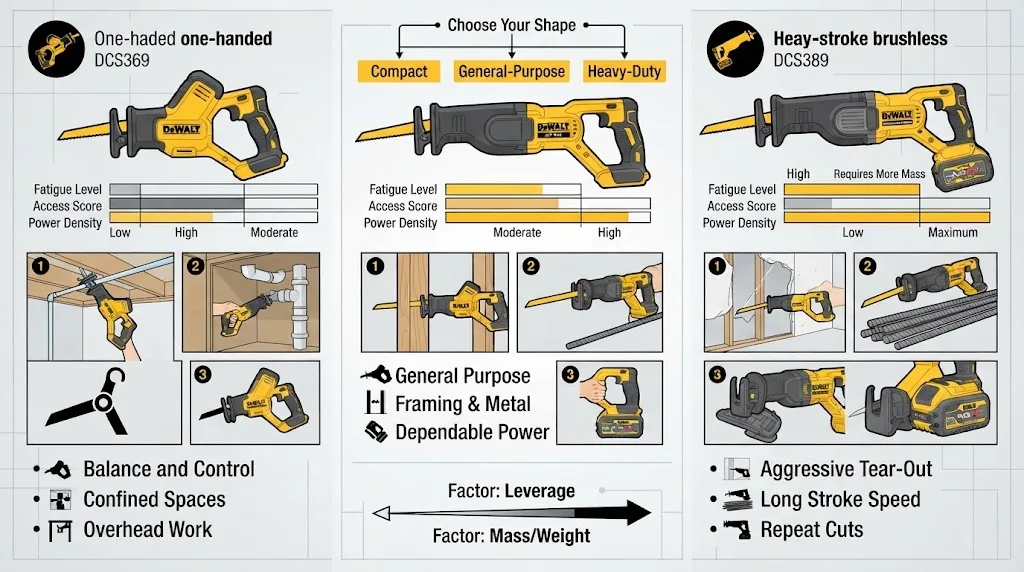
A compact DeWalt cordless reciprocating saw reduces fatigue and gets into joist bays, service cavities, and overhead positions. A full-size DeWalt 20V reciprocating saw carries more mass but generally gives better leverage and faster demolition performance. One-handed models are useful for controlled cuts in cramped work, but they are not substitutes for a two-handed saw when thick timber, structural fasteners, or repeated pipe cuts are on the schedule.
Compact / one-handed
Best for electrical and plumbing access, overhead trimming, and confined-service cuts. Prioritize balance and shoe control over raw speed.
Full-size 20V MAX
The dependable general-purpose DeWalt sawzall 20V format for framing demolition, nail-embedded lumber, metal, and daily remodel work.
Heavy demolition class
For aggressive tear-out and repeat cuts, favor a long-stroke brushless saw with a larger pack and a stable adjustable shoe.
A reciprocating saw can grab suddenly when a blade pinches or breaks through a hidden fastener. Keep two hands on full-size saws, brace your stance, secure loose material, and never place your free hand behind the expected blade path.
Stroke length, SPM, and control matter more than a single headline number
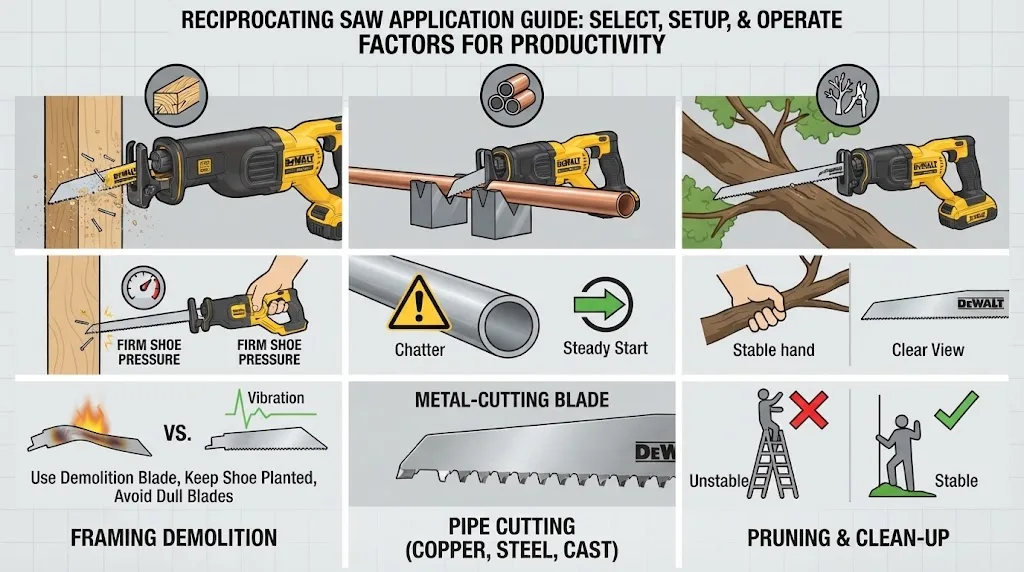
A longer stroke generally clears more material per pass in wood demolition, while high strokes per minute can help a sharp blade cut efficiently. In the field, however, shoe pressure, blade sharpness, battery condition, and access usually decide whether a DeWalt recip saw feels productive. Press the shoe firmly into the work whenever practical: it reduces chatter, prevents the blade from bouncing, and gives the motor a steadier cut.
| Common job | Best saw setup | Practical guidance |
|---|---|---|
| Nail-embedded framing | Full-size 20V reciprocating saw | Use a demolition wood blade and keep the shoe planted. Let the saw work; forcing a dull blade only increases vibration. |
| Copper, steel & cast pipe | Compact or full-size saw with metal blade | Support pipe on both sides of the cut. Start steadily so thin-wall material does not chatter or flatten. |
| Pruning & exterior clean-up | Compact saw and pruning blade | Use a clean wood blade only. Keep the branch stable and avoid working from an insecure ladder position. |
Published stroke and speed figures help compare similar classes of saw, but cutting performance changes dramatically with the blade, material thickness, battery temperature, and how well the shoe is controlled.
DeWalt reciprocating saw blades are the real cutting system
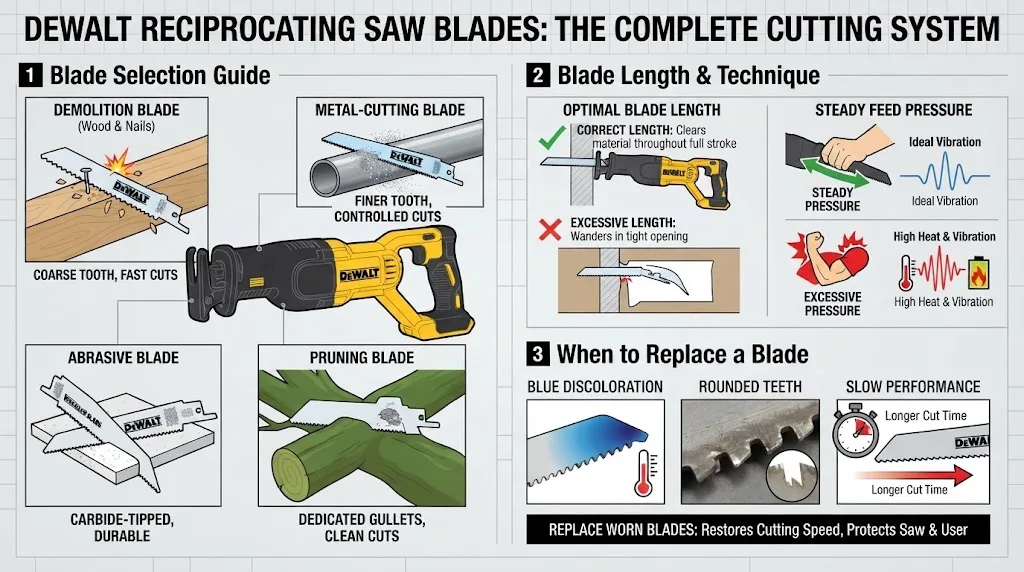
The fastest way to make a capable DeWalt reciprocating saw feel weak is to install the wrong blade. Use coarse-tooth demolition blades for wood and nail-embedded timber, finer bi-metal blades for metal, carbide-tipped blades for abrasive materials, and dedicated pruning blades for green wood. Blade length should clear the material throughout the full stroke without being excessively long; a long flexible blade wanders more easily in a tight opening.
If a blade is blue, rounded over, or taking far longer than the same cut did earlier in the day, replace it. Pushing harder rarely restores cutting speed; it transfers heat and vibration into the saw, battery, and your forearm.
Pair your DeWalt 20V sawzall battery with the pace of the work
Compact batteries make a DeWalt 20V reciprocating saw easier to manage for short service cuts and overhead work. For repeated demolition or cutting dense, dirty material, larger 20V MAX packs provide useful runtime and can help the tool sustain demanding cuts. A heavier pack is not automatically better: on a compact saw, it can make a tight-space task more tiring. Match the pack to the duration and orientation of the cut.
Protect the tool by respecting heat
If the pack, blade, or motor housing becomes unusually hot, stop and inspect the blade and cut setup. Let hot batteries cool before charging. Thermal protection is a safeguard, not an instruction to keep leaning on the trigger.
Use the lightest saw that can finish the task without fighting you
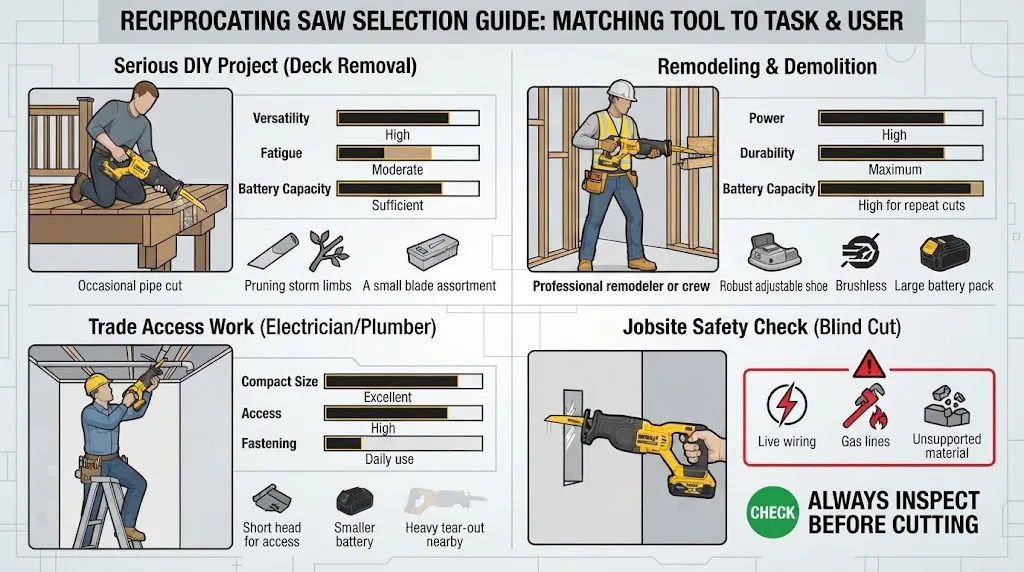
A serious DIYer removing a deck, cutting occasional pipe, or pruning storm-damaged limbs will often be best served by a versatile DeWalt 20V reciprocating saw and a small blade assortment. Remodelers and demolition crews should prioritize a full-size brushless body, a durable adjustable shoe, and enough battery capacity for repeat cuts. Electricians and plumbers may benefit most from a compact DeWalt saw zall for access, keeping a larger saw available for heavy tear-out. Before every blind cut, check for live wiring, gas lines, and unsupported material.
DeWalt reciprocating saw questions, answered
Is Sawzall the same as a DeWalt reciprocating saw?
Sawzall is commonly used as a general nickname for reciprocating saws, although it originated as a brand name. A DeWalt reciprocating saw performs the same basic push-pull blade function, but model size, battery platform, stroke, and vibration control differ by tool.
Can a DeWalt 20V reciprocating saw cut metal?
Yes, with the correct blade. Use a fine-tooth bi-metal blade for common metal pipe, conduit, angle iron, and embedded fasteners. Support the material, begin gently to prevent skipping, and replace blades as soon as they slow down or overheat.
What is the best DeWalt recip saw for demolition?
For frequent demolition, a full-size brushless DeWalt 20V reciprocating saw is generally the practical starting point. Look for a comfortable two-handed grip, an adjustable shoe, strong battery support, and a blade clamp that makes changes quick. The best choice is still the one that fits the material, access, and number of cuts you expect to make.