A drill gives you versatile hole-making and controlled screwdriving. An impact driver specializes in stubborn, long, and high-load fasteners. Here is how to choose the right one for the job.
The difference between an impact driver and a drill is how they deliver turning force. A drill/driver turns smoothly and uses a clutch for control. An impact driver adds rapid rotational impacts when resistance rises, helping it drive long screws and heavy fasteners with less wrist-twisting force. For most homes, a drill is the better first tool; an impact driver is the useful second tool.
Drill driver vs. impact driver: the practical difference
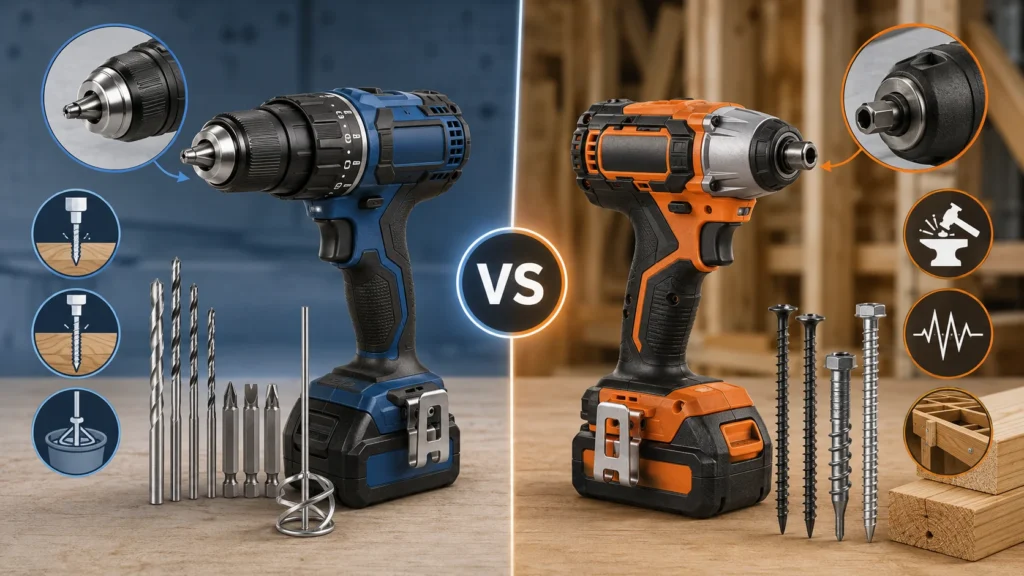
A cordless drill/driver normally has a three-jaw chuck that grips round-shank drill bits, driver bits, and many other accessories. Its adjustable clutch lets you limit torque, which is valuable when assembling flat-pack furniture, setting cabinet hardware, or driving screws into softer materials without burying them too deeply.
An impact driver normally has a ¼-inch quick-release hex collet. When the fastener resists, an internal hammer-and-anvil mechanism delivers short rotational blows. That is why an impact driver can feel compact but still drive long construction screws efficiently. It is not automatically better at every job: the extra force, noise, and lack of a typical clutch can make delicate work less forgiving.
Choose a drill/driver for versatility
Best for drilling holes, adjustable screwdriving, furniture assembly, pilot holes, mixing small batches, and accessories with round or hex shanks.
Choose an impact driver for demanding fasteners
Best for repeated long screws, ledger screws, lag screws with the proper bit, decking, framing, and jobs where a drill begins to stall or strain.
A drill/driver’s adjustable chuck accepts a wider range of common drilling and driving accessories than the fixed hex collet on an impact driver.
Impact drill vs. drill: side-by-side comparison
Retail listings sometimes say “impact drill,” but that phrase is imprecise. Before buying, check whether the listing means an impact driver for fasteners or a hammer drill for masonry. This table compares a standard drill/driver with an impact driver.
| Feature | Drill/driver | Impact driver |
|---|---|---|
| Primary purpose | Drilling holes and controlled screwdriving. | Driving demanding screws, bolts, and structural fasteners. |
| Bit holder | Adjustable three-jaw chuck; accepts many round and hex shanks. | ¼-inch hex collet; needs impact-rated hex-shank accessories. |
| Torque delivery | Smooth, continuous rotation with clutch adjustment. | Rotational impacts add usable driving force as resistance increases. |
| Drilling holes | Usually the better and more flexible choice. | Possible with impact-rated hex bits, but less versatile and less smooth. |
| Control and precision | Excellent for shallow screws, small hardware, and delicate materials. | Fast and capable, but easier to overdrive a screw without care. |
| Noise and vibration | Generally quieter and smoother under load. | Louder when impacting; hearing protection is sensible for repeated use. |
For long fasteners, start square to the workpiece and let the tool do the work rather than forcing it sideways.
Which tool is best for your project?
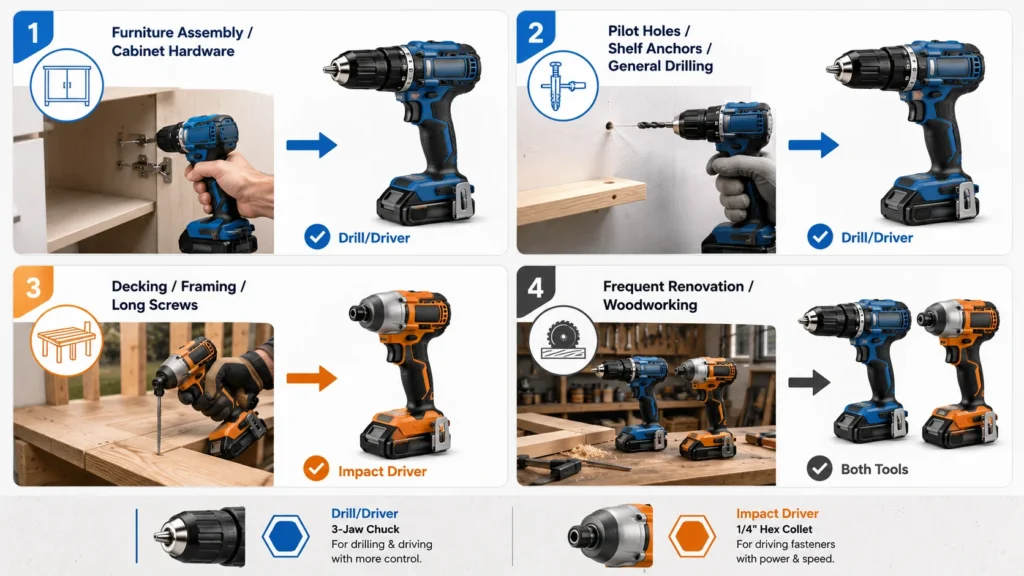
The best purchase depends less on the biggest torque number and more on the work you actually do. Published torque figures are measured differently across brands and are not always directly comparable.
- Furniture assembly and cabinet hardware: choose a drill/driver. Use a low clutch setting and finish delicate fittings by hand if needed.
- Pilot holes, shelf anchors, and general wood drilling: choose a drill/driver. Match the bit type to wood, metal, plastic, or masonry.
- Decking, framing, and repeated long screws: choose an impact driver with impact-rated bits and a compatible fastener system.
- Frequent renovation or woodworking: buy both. Keep a drill bit in the drill and a driver bit in the impact driver to avoid constant bit changes.
For a first cordless tool, a drill/driver is typically the most broadly useful option. A combination kit makes financial sense when you regularly drill pilot holes and then drive many screws, or when you want to stay within one battery platform.
Impact driver vs. hammer drill: do not confuse the mechanisms
An impact driver creates rotational impacts to help turn a fastener. A hammer drill creates a forward-and-back percussion action to help a masonry bit chip through brick, block, or concrete. The tools can look similar, but they solve different problems.
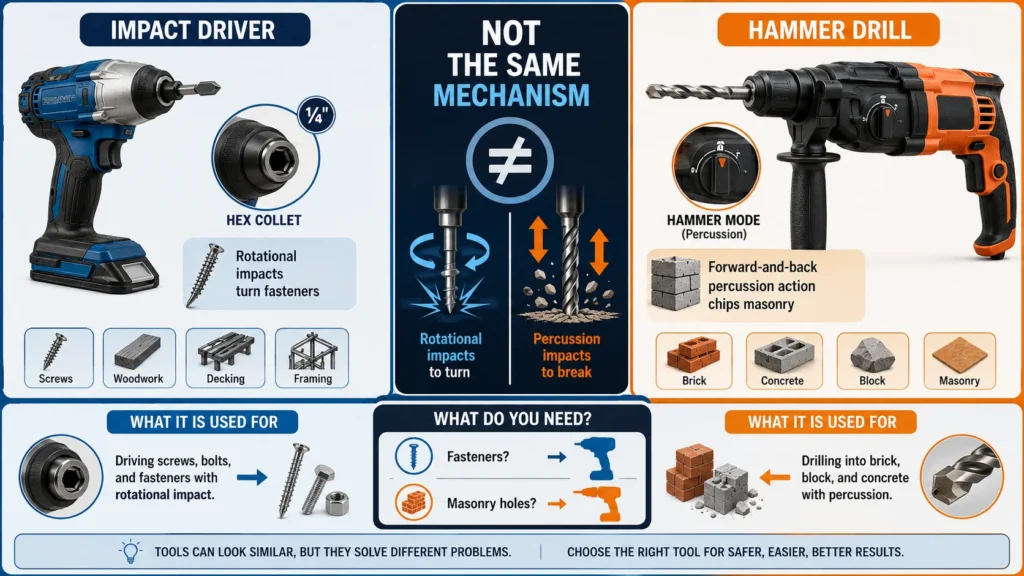
A drill/driver with a hammer setting can still perform normal drilling and screwdriving when that mode is switched off. For occasional small holes in masonry, it can be useful. For repeated concrete drilling, a rotary hammer is usually the more appropriate specialist tool.
What are impact drills?
“Impact drill” is often informal shorthand, not a precise category. Ask whether the tool has a ¼-inch hex collet and rotational impacts (impact driver) or a drill chuck with a hammer mode for masonry (hammer drill).
Use the right bits, fasteners, and protection
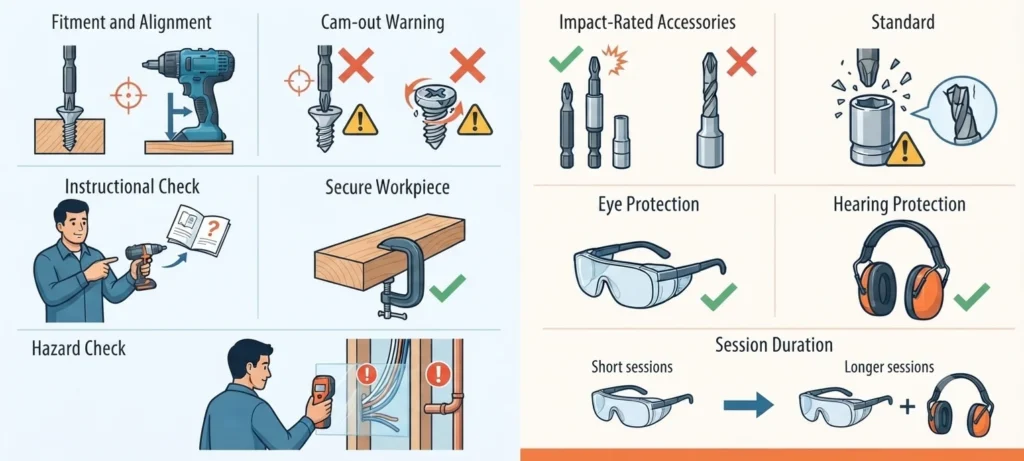
Use bits that fit the fastener cleanly, keep the tool aligned, and stop if a bit begins to cam out or a fastener binds. Read the tool and accessory manufacturer instructions before using specialty attachments. Secure workpieces when possible, and check behind walls for wiring, plumbing, and other hazards before drilling.
Impact-rated means something
Use impact-rated driver bits, bit holders, sockets, and adapters with an impact driver. Standard accessories can wear, crack, or fail under repeated impacts. Wear eye protection; for long or repeated impact-driving sessions, use hearing protection too.
Frequently asked questions
Can an impact driver be used as a drill?
Yes, for some holes. Use impact-rated ¼-inch hex-shank drill bits. However, a drill/driver is usually better for a wider range of bit sizes and types, smoother drilling, and more precise control. An impact driver is best treated as a fastener-driving specialist.
Can a drill drive long screws?
Yes. Use a suitable bit, pilot hole where appropriate, a fully charged battery, and a lower gear for more control. But a long screw in dense timber can make a drill work hard. An impact driver will generally complete repeated heavy driving jobs faster and with less reaction torque.
Do beginners need both tools?
Not usually. Start with a quality drill/driver if your projects are basic repairs, furniture, shelving, and occasional holes. Add an impact driver when you frequently build outdoor projects, drive long screws, or want a faster two-tool workflow.