
Learn what an impact driver is used for, when it beats a drill, and how to drive fasteners quickly without giving up control.
What is an impact driver used for? It is primarily used to drive screws, structural fasteners, and other resistant fasteners efficiently. Its internal impact mechanism adds rapid rotational blows when resistance rises, making it especially useful for long screws, decking, framing, repetitive fastening, and stubborn fasteners—provided the bit, fastener, and material are compatible.
What is an impact driver?
An impact driver is a compact power tool designed mainly for driving fasteners. Most models use a quick-release 1/4-inch hex collet rather than the adjustable chuck found on a drill/driver. That collet accepts compatible driver bits, hex-shank drill bits, and certain socket adapters.
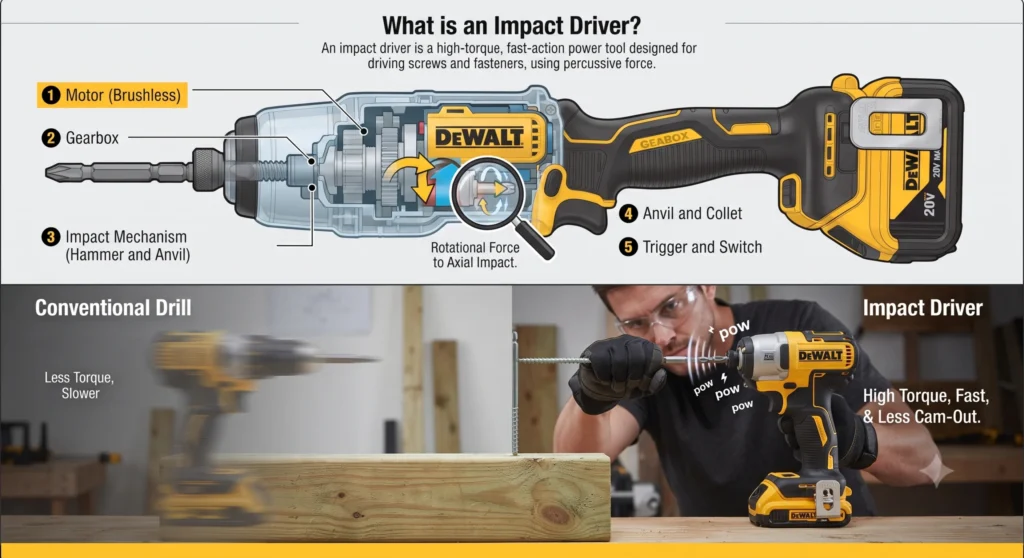
The defining difference is how it responds under load. A drill/driver delivers smooth rotational force. An impact driver delivers rotation too, but adds rapid rotational impacts when the fastener resists. That is why it can feel surprisingly capable for demanding fastening while transferring less steady twisting force to the user’s wrist.
Why an impact driver makes that hammering sound
When resistance increases, an internal hammer-and-anvil mechanism begins delivering rapid rotational blows. The sound is normal: it signals that the tool is applying impacts rather than relying only on smooth motor rotation.
- Torque is rotational force applied to turn the fastener.
- Impacts are rapid rotational blows that help overcome fastening resistance.
- More power is not automatically better—bit fit, alignment, trigger control, and the fastener specification still determine the result.
What is an impact driver used for on the job?
Impact drivers are most valuable where fastening resistance and repetition make a standard drill/driver slower or more tiring. Always follow the tool, fastener, and accessory manufacturer guidance for the specific job.
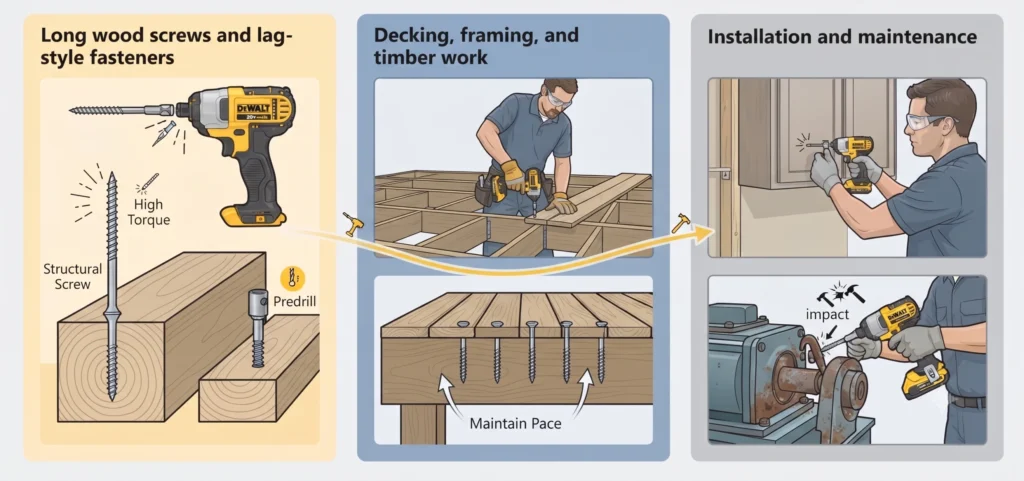
Long wood screws and lag-style fasteners
Drive long wood screws, structural screws, and compatible lag screws with an appropriate bit or rated socket adapter. Predrilling may still be needed to prevent splitting or meet the fastener manufacturer’s requirements.
Decking, framing, and timber work
For repetitive deck screws, framing hardware, fencing, and outdoor structures, an impact driver helps maintain pace through dense timber. Ease off the trigger as each screw approaches its final depth.
Installation and maintenance
The tool is useful for cabinet installation, fixtures, metal fastening with suitable screws, and removing stubborn fasteners. For large nuts and bolts, use an impact wrench instead of overloading a driver and adapter.
Impact driver vs drill vs impact wrench
A drill/driver remains the more versatile choice for controlled drilling and delicate screwdriving. An impact driver excels at resistant fasteners. An impact wrench normally has a square drive and is intended for higher-torque socket work such as larger nuts and bolts.
| Task | Impact driver | Drill/driver | Impact wrench |
|---|---|---|---|
| Long screws and deck screws | Excellent | Good | Usually unnecessary |
| General drilling | Limited; bit-dependent | Excellent | No |
| Small precision screws | Less ideal | Better control | No |
| Large nuts and bolts | Limited | Limited | Excellent |
Use impact-rated bits and compatible accessories
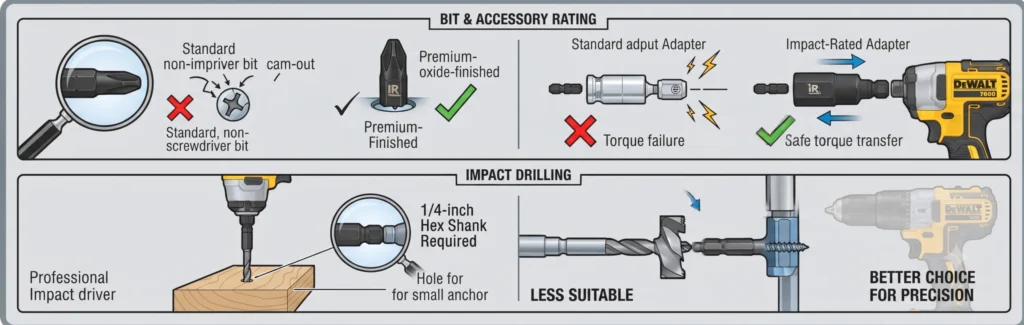
Use bits that match the screw recess precisely and are rated for impact use when driving repeatedly or under high load. Worn, loose, or non-matching bits are a common cause of cam-out, stripped screw heads, and broken accessories. For socket work, use an impact-rated adapter and stay within the ratings of the tool and accessory.
Can you drill with an impact driver? Yes, with 1/4-inch hex-shank drill bits designed for the task. It is useful for occasional small holes, but a drill/driver is usually the better choice for precision drilling, larger holes, and bits that need a conventional chuck.
How to use an impact driver step by step
- Choose the correct fastener and bit
Confirm the screw or fastener is suitable for the material and application. Select the exact matching impact-rated bit; a bit that rocks in the recess is the wrong fit. - Insert the bit into the hex collet
Pull the quick-release collet forward if your model requires it, insert the 1/4-inch hex accessory fully, and check that it locks securely before use. - Set direction, speed, or assist mode
Use forward for driving and reverse for removal. If your driver has speed or assist modes, start with the lower or more controlled setting when working near finished surfaces or smaller fasteners. - Hold the driver square to the fastener
Plant the bit fully in the screw head and keep the tool in line with the fastener. Apply firm, straight pressure so the bit cannot climb out of the recess. - Start slowly and establish the bite
Use the variable-speed trigger gently for the first turns. This is where alignment matters most, especially with self-drilling screws or a screw started in a pilot hole. - Let the impact mechanism work
As resistance rises, keep the tool square and resist the urge to lean or twist. If the fastener stalls, stop and check the bit, pilot hole, material, and fastener specification instead of forcing it. - Reduce speed at final seating
Feather the trigger as the fastener reaches the surface. Stop at the required depth; do not hold full trigger pressure after the head seats unless the application specifically calls for it.
How professionals avoid stripped screws and overdriving
High torque is useful only when the operator controls it. The fastest way to damage a screw, bit, or finished face is to start at full speed with poor alignment and continue after the fastener is seated.
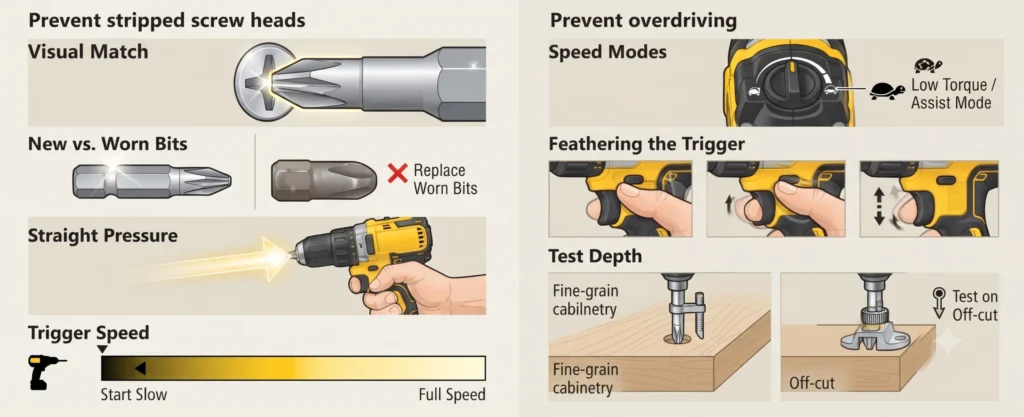
Prevent stripped screw heads
Match the recess exactly, replace worn bits early, keep straight pressure behind the bit, and start at a low trigger speed. If a screw repeatedly cams out, reassess bit size, screw quality, pilot-hole requirements, and alignment.
Prevent overdriving
Use a lower speed or assist mode where available, then feather the trigger at the final few turns. On decking, cabinetry, and finish-sensitive work, test depth on offcuts before committing to the visible surface.
When an impact driver is not the best choice
Choose a drill/driver for precision drilling, very small screws, fine furniture hardware, soft plastics, or jobs needing delicate clutch control. Choose an impact wrench for large socket work. An impact driver is also not a torque-measuring tool: applications that require an exact final torque need the specified torque tool and procedure.
Impact driver FAQs
Can an impact driver replace a drill?
Not completely. An impact driver can drill some holes using compatible 1/4-inch hex-shank bits, but a drill/driver is generally better for precise holes, larger bits, and controlled work with a clutch and adjustable chuck.
Can I use regular screwdriver bits in an impact driver?
A standard 1/4-inch hex bit may fit, but impact-rated bits are the better choice for impact driving because they are designed to handle repeated shock loads. Replace any bit showing wear, twisting, cracking, or poor engagement.
Why does an impact driver stop or struggle with a screw?
The fastener may be unsuitable, the bit may be worn or incorrect, the material may need a pilot hole, or the tool may be at its practical limit for that application. Stop rather than forcing it, then check manufacturer guidance for the fastener, accessory, and tool.