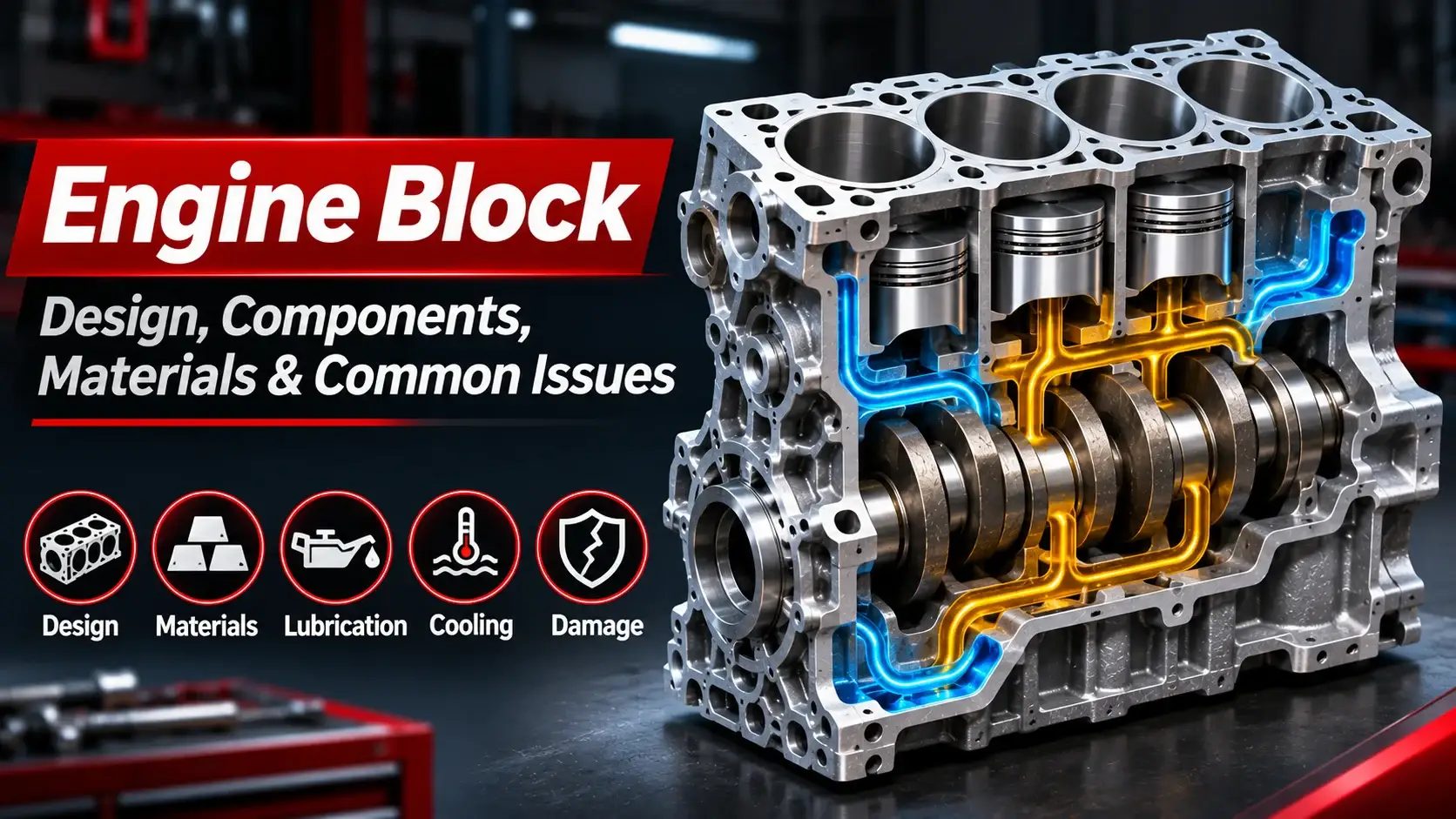
The engine block is the structural foundation of an internal combustion engine. It houses the cylinders, supports the crankshaft, contains internal coolant and lubrication passages, and maintains the precise alignment of components operating under extreme mechanical and thermal loads.
Although it may appear to be a single metal casting, the engine block is a carefully engineered structure designed to withstand combustion pressure, repeated heating and cooling, vibration, and thousands of operating cycles per minute.
Understanding its construction is essential for mechanical engineering students, automotive technicians, and DIY enthusiasts who want to understand how engines work, why they fail, and how damaged components are inspected.
This guide explains the functions, internal components, configurations, and materials of an engine block, along with practical inspection techniques used during engine rebuilding.
What Is an Engine Block?
An engine block, also called a cylinder block, is the main structural casting of a conventional piston-type internal combustion engine. It contains the cylinder bores where pistons move and provides mounting structures for the cylinder head, crankshaft, and other assemblies.
Depending on engine design, the block also incorporates the upper crankcase, coolant passages, lubrication galleries, and mounting points for supporting equipments.
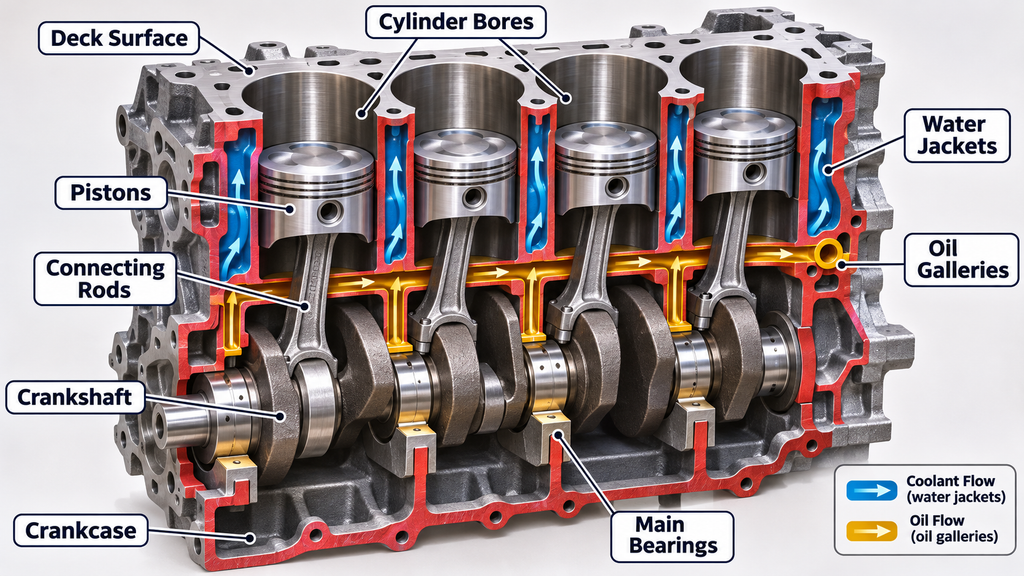
n most automotive engines, the cylinder head bolts to the upper surface of the block, while the crankshaft rotates in main bearings supported by the lower structure.
The block does not usually form the entire combustion chamber. The cylinder head, piston crown, cylinder walls, valves, and sealing components collectively define the combustion space.
Why Is the Engine Block Important?
During combustion, expanding gases push the piston downward. The connecting rod transfers this force to the crankshaft, converting reciprocating movement into rotational output.
The block must maintain accurate alignment between these moving components while resisting combustion pressure, inertia, and vibration.
Small changes in cylinder geometry or bearing alignment can increase friction, accelerate wear, reduce oil-film reliability, or compromise sealing.
For more information about the parts supported by the block, see our guide to car engine components and their functions.
Core Functions of an Engine Block
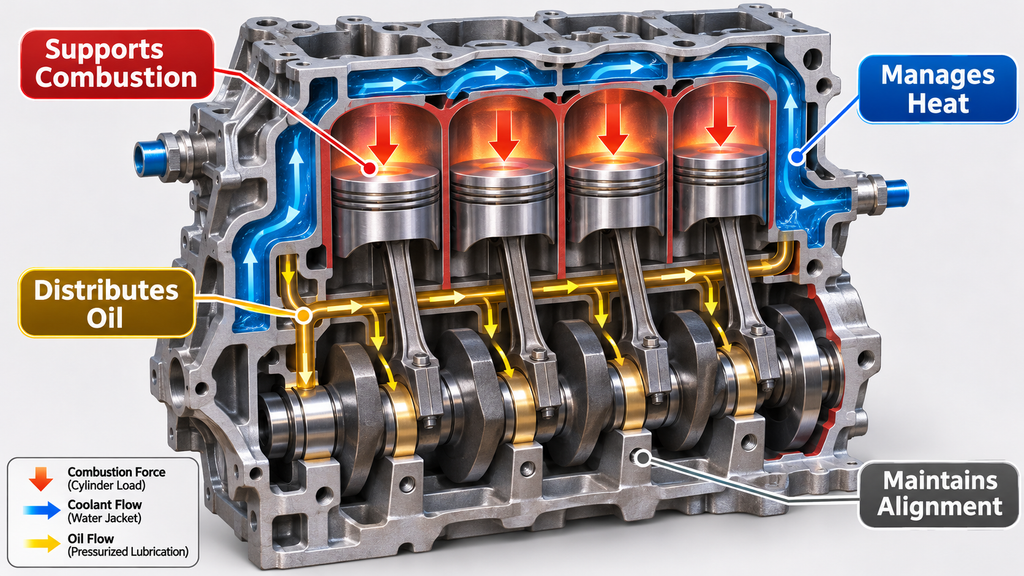
An engine block performs four essential mechanical functions: supporting combustion loads, managing temperature, distributing lubrication, and maintaining mechanical alignment.
These functions work together to keep the engine structurally stable while its internal components operate under high pressure, temperature, and speed.
1. Supporting Combustion
Cylinder walls, head fasteners, and crankshaft supports transfer combustion forces through the engine. High-pressure applications demand especially robust structures.
2. Managing Heat
Water jackets carry coolant around hot cylinder regions. Balanced coolant distribution reduces local hot spots and excessive thermal distortion.
3. Distributing Lubrication
Internal oil galleries route pressurized lubricant to bearings and other moving components. Reliable oil flow maintains protective films between loaded metal surfaces.
4. Maintaining Alignment
Accurate cylinder and bearing alignment minimizes friction, abnormal mechanical loading, and vibration during engine operation.
To understand how combustion generates these loads, read our explanation of two-stroke and four-stroke internal combustion engines.
Anatomy and Key Components of an Engine Block
Each major feature of an engine block serves a distinct mechanical purpose. Understanding these features helps technicians interpret machining measurements, diagnose failures, and plan repairs.
1. Cylinder Bores and Sleeves/Liners
Cylinder bores are precisely machined openings where pistons travel. Their dimensions and surface finish influence compression sealing, piston clearance, oil consumption, and friction.
Some blocks use separate liners to create a durable running surface, while others use parent bores or specialized coatings.
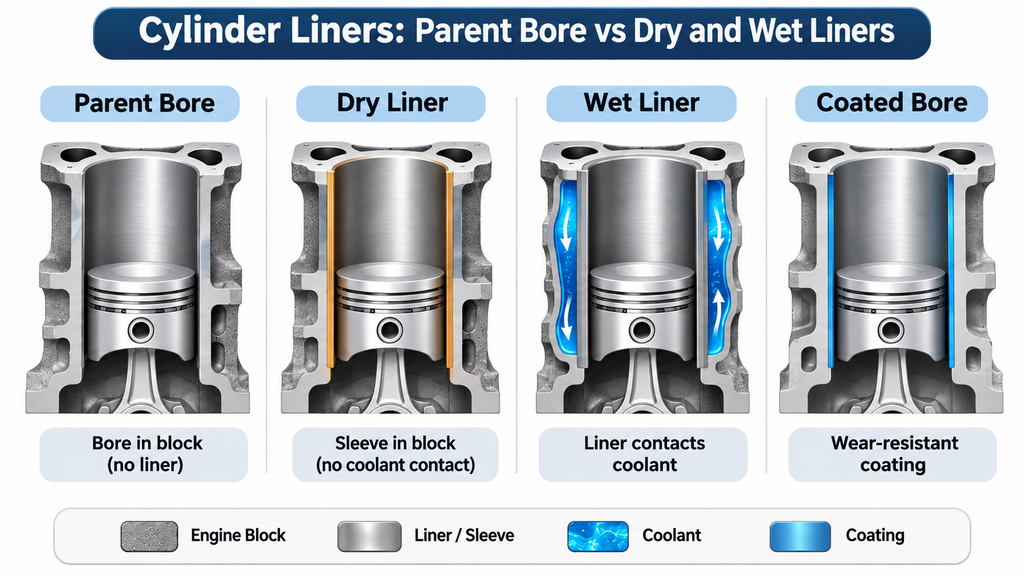
Cylinder liner construction influences wear resistance, cooling, and serviceability.
| Type | Construction | Characteristic |
|---|---|---|
| Parent Bore | Running surface in block material | No separate conventional liner |
| Dry Liner | Sleeve supported by surrounding block | No direct coolant contact |
| Wet Liner | Liner contacts engine coolant | Common in heavy-duty diesels |
Many aluminum blocks use cast-in iron liners, specialized high-silicon cylinder surfaces, or engineered coatings. Plasma-transferred wire arc (PTWA) coatings provide a thin iron-based running surface without requiring a thick conventional liner.
Workshop Inspection Tip
Use a dial bore gauge referenced to a calibrated micrometer or setting master. Measure each bore at several heights and in perpendicular directions to identify taper and out-of-roundness.
Learn how piston rings interact with cylinder walls in our guide to piston functions, components, and common problems.
2. Deck Surface
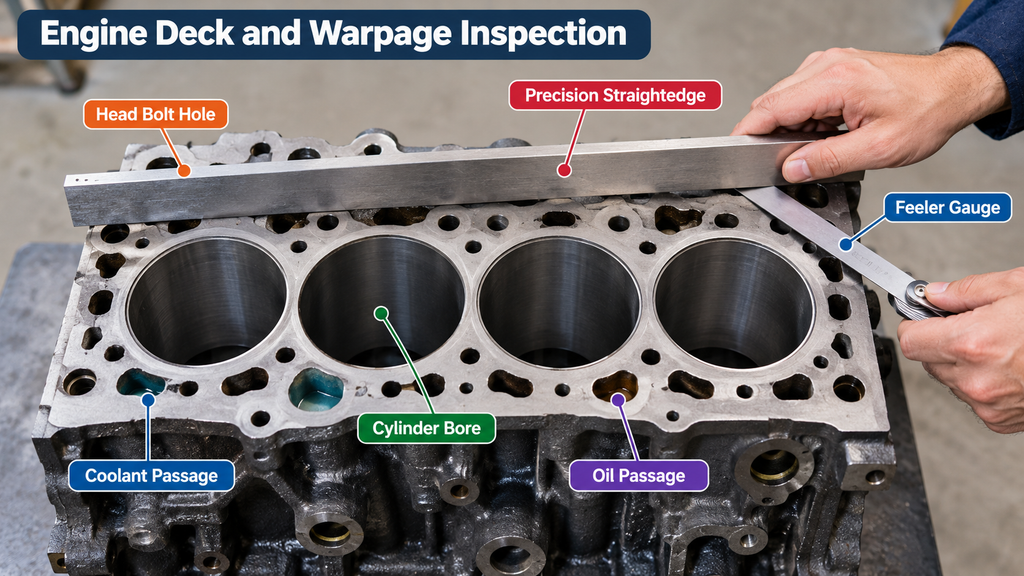
The deck surface is the machined upper face of the block that supports the cylinder head gasket and cylinder head.
It contains openings for cylinders, coolant passages, oil passages, and head fasteners. Correct flatness and surface finish are essential for reliable sealing.
Understanding Deck Height
Deck height is the design distance between the crankshaft centerline and the block deck surface. It affects piston position near top dead center and the relationship between crankshaft, connecting rod, and piston geometry.
Excessive deck resurfacing may alter piston-to-deck clearance, compression ratio, and timing-related dimensions.
Workshop Inspection Tip
Use a precision straightedge and feeler gauges across prescribed longitudinal, transverse, and diagonal positions. Compare measurements with manufacturer specifications.
3. Water Jackets and Freeze (Core) Plugs
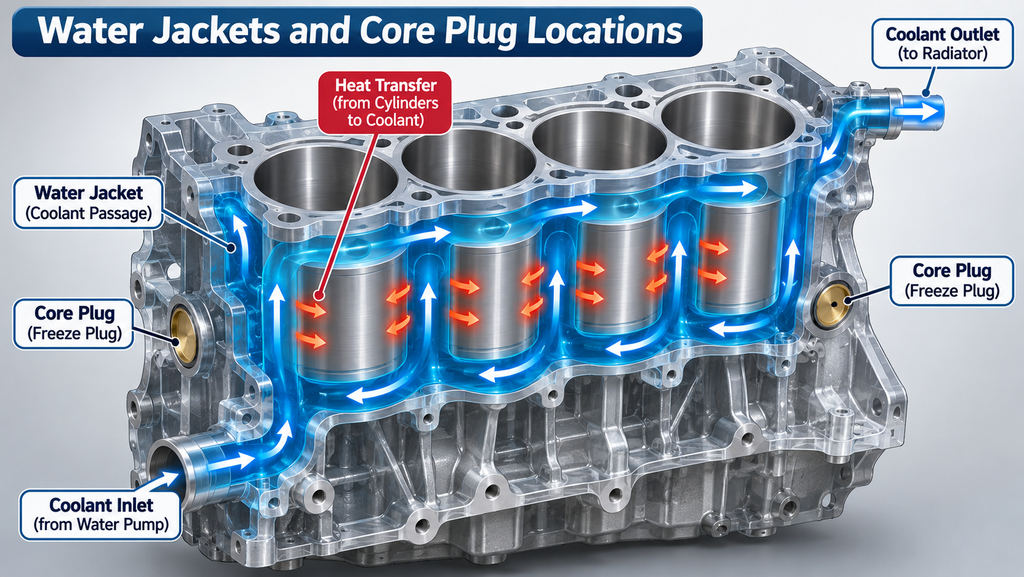
Water jackets are internal coolant passages within the cylinder block. They remove heat from cylinder walls and other thermally loaded regions.
Coolant routing must balance heat transfer and temperature uniformity without unnecessarily weakening the casting structure.
What Are Freeze Plugs?
Core plugs, often called freeze plugs, seal openings used during the block casting process, including openings involved in removing sand cores.
Although freezing coolant may occasionally displace a plug, these plugs are not reliable freeze-damage protection devices. Coolant expansion can still crack an engine block.
Corrosion can also create leaks around plugs, particularly when coolant maintenance has been neglected.
Workshop Inspection Tip
Before replacing a leaking core plug, inspect the surrounding casting and plug seating surface for corrosion and cracks.
Learn more about coolant-related failures in our guide to antifreeze leaks and engine overheating diagnosis.
4. Oil Galleries and Filter Mounts
Oil galleries are internal passages distributing pressurized lubricant through the engine block.
Depending on engine architecture, they supply crankshaft main bearings, camshaft bearings, lifters, and other components. Connecting rod bearings commonly receive oil through crankshaft drillings.
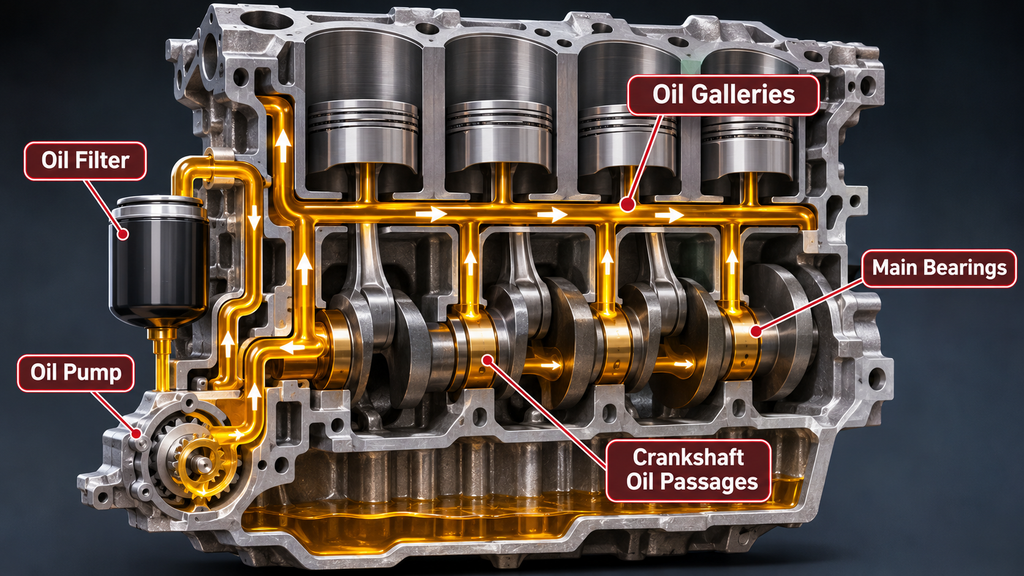
The block may also include an oil filter mounting pad, oil cooler connections, oil pressure sensor ports, and other lubrication-related openings.
Machining debris, abrasive particles, and contamination can become trapped inside oil galleries. If these contaminants remain after assembly, they may damage newly installed bearings.
Workshop Inspection Tip
Clean accessible oil galleries thoroughly after machining. Remove serviceable gallery plugs where required and confirm passages are free from debris before reassembly.
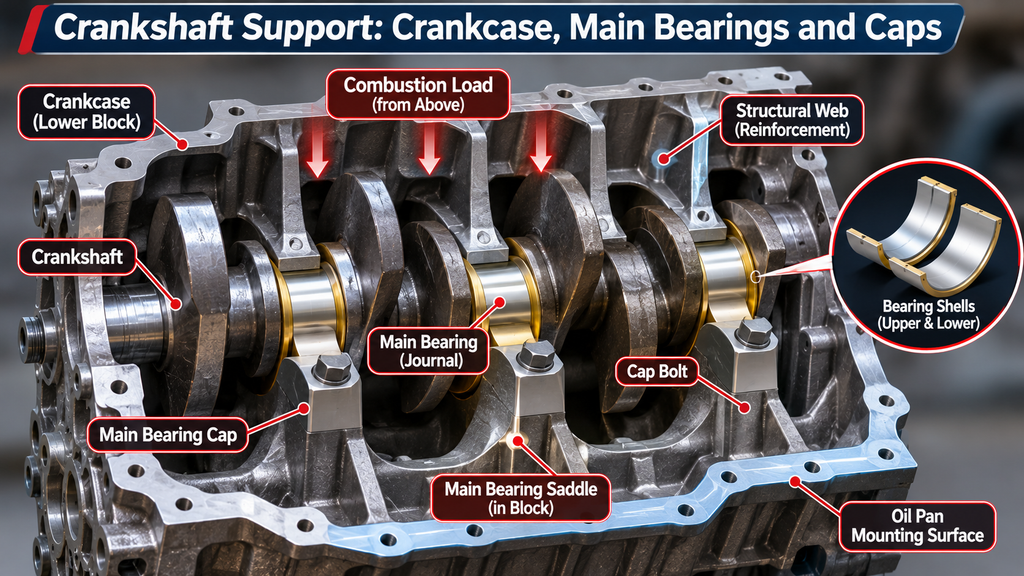
5. Crankcase and Main Bearing Webs/Caps
The crankcase is the lower engine region surrounding the crankshaft. In many engines, the upper crankcase is integrated into the block.
Main bearing webs reinforce the crankshaft support structure, while main bearing caps retain the crankshaft within precisely machined bearing housings.
What Is a Spun Main Bearing?
A spun main bearing occurs when a bearing shell rotates inside its housing rather than remaining securely retained.
Possible contributing factors include poor lubrication, overheating, incorrect assembly, inadequate bearing crush, and excessive mechanical loads.
A spun bearing can damage the housing saddle, cap, and crankshaft journal, sometimes requiring specialist machining or block replacement.
Workshop Inspection Tip
Measure main bearing housing bores with the correct matched caps or bedplate installed and tightened as specified. Distorted bores may require approved line honing or line boring.
Read our guide explaining crankshaft operation and common failure symptoms for more details on crankshaft support and bearing loads.
6. Bellhousing Flange and Engine Mount Bosses
The bellhousing flange is the mounting interface between the engine block and transmission bellhousing or transaxle housing. Its machined surfaces and locating dowels maintain drivetrain alignment.
Engine mount bosses are reinforced mounting locations that transfer engine weight and operating forces into the vehicle’s mounting system.
Cracks around mounting bosses or damaged flange surfaces can compromise structural support and component alignment. These areas require careful inspection before rebuilding.
Engine Block Configurations: Inline, V-Type and Boxer
Engine block configuration describes how cylinders are arranged relative to the crankshaft. The arrangement affects overall dimensions, vibration characteristics, manufacturing complexity, and vehicle packaging.
Three important configurations are inline, V-type, and horizontally opposed boxer or flat engines.
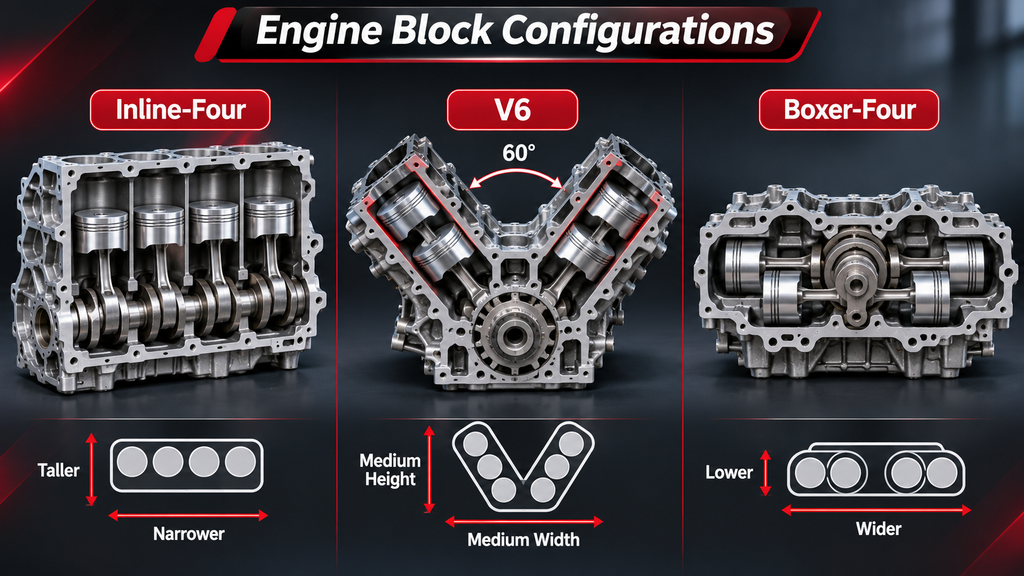
| Type | Arrangement | Advantage | Limitation |
|---|---|---|---|
| Inline | Single cylinder bank | Narrow, relatively simple | Longer with more cylinders |
| V-Type | Two angled banks | Shorter length at higher cylinder counts | Wider and more complex |
| Boxer/Flat | Horizontal opposing banks | Low engine profile | Greater width |
Inline Engines
Inline engines place all cylinders in one bank. Inline-four engines are widely used for practical packaging and relatively straightforward manufacturing.
Inline-six engines can provide excellent inherent primary and secondary reciprocating-force balance, although their longer construction requires more installation space.
V-Type Engines
V-type engines have two angled cylinder banks around a common crankshaft. This arrangement allows more cylinders within a shorter engine length, but generally introduces additional cooling, exhaust, and cylinder head complexity.
Boxer or Flat Engines
Boxer engines have horizontally opposed cylinders. Their low profile can help vehicle designers lower the engine’s center of gravity, although their width can complicate service access.
Not every flat engine uses true boxer crankshaft geometry; some flat engines employ different crankpin arrangements.
Engine Block Materials Compared: Cast Iron vs Aluminum vs CGI
The material chosen for an engine block affects weight, strength, stiffness, heat transfer, vibration damping, machining requirements, and manufacturing cost.
The three important materials considered here are gray cast iron, aluminum alloys, and compacted graphite iron (CGI).
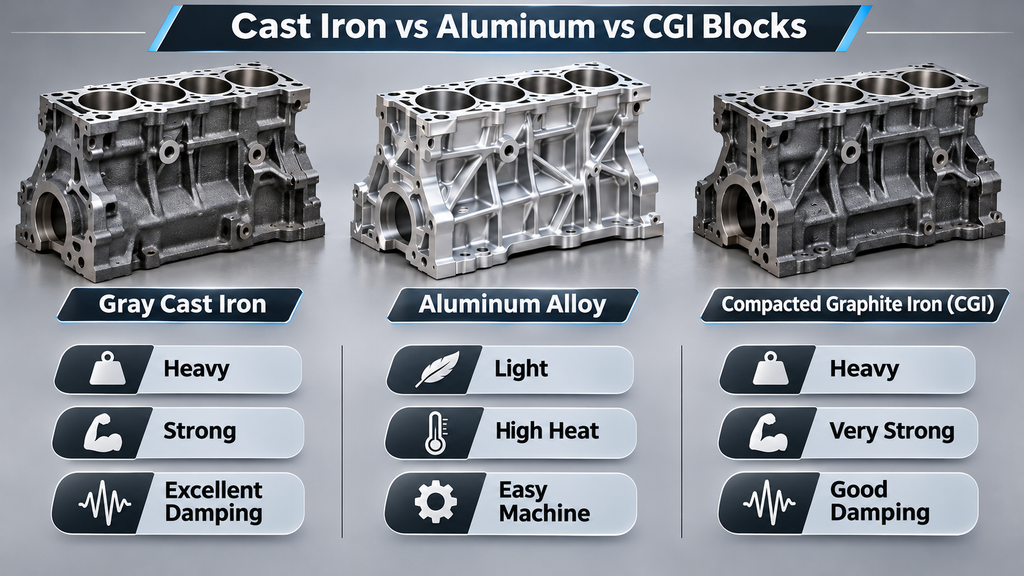
| Property | Gray Cast Iron | Aluminum A356-T6 | CGI |
|---|---|---|---|
| Density | 7.1–7.3 g/cm³ | About 2.7 g/cm³ | 7.0–7.2 g/cm³ |
| Tensile Strength | 200–350 MPa | 230–300 MPa | 300–500 MPa |
| Thermal Conductivity | 45–60 W/m·K | 140–160 W/m·K | 32–45 W/m·K |
| Weight | Heavy | Low-density | Heavy; potential thinner sections |
| Stiffness | Good | Lower modulus | High |
| NVH Damping | Excellent | Lower intrinsic damping | Good |
| Machinability | Generally favorable | Generally favorable | More demanding |
| Relative Cost | Low | Moderate to high | Higher |
| Applications | Traditional passenger and industrial engines | Modern passenger and performance engines | High-load diesel and selected performance engines |
Property values are representative ranges, not universal specifications. Actual results depend on grade, microstructure, manufacturing process, heat treatment, and temperature. Finished engine block mass also depends on design geometry.
1. Gray Cast Iron: Durability and Vibration Damping
Gray cast iron has long been used in engine blocks because it combines good castability, economical manufacturing, favorable machinability, and effective vibration damping.
Its microstructure contains graphite flakes in an iron-based matrix. These graphite flakes improve damping but act as local stress concentrators that reduce ductility and tensile strength.
Mechanical Advantages
- Good dimensional stability under normal operation.
- Generally favorable machining properties.
- Excellent material vibration damping.
- Useful cylinder bore wear resistance.
- Relatively economical casting production.
The primary limitations are high density and relatively brittle behavior under tensile or severe thermal stresses.
2. Aluminum Alloy: Lightweight Construction and Heat Transfer
Aluminum engine blocks are common in modern passenger vehicles because aluminum has low density and relatively high thermal conductivity.
A356-T6 is an example of a heat-treated aluminum-silicon-magnesium casting alloy. Its T6 treatment improves mechanical properties when correctly processed.
Aluminum is approximately one-third as dense as cast iron, providing opportunities to reduce engine mass. High thermal conductivity helps transfer heat toward coolant passages, although cooling performance also depends on flow and geometry.
Ordinary aluminum casting alloys generally require engineered cylinder running surfaces such as iron liners, specialized high-silicon surfaces, or wear-resistant coatings.
Aluminum’s lower elastic modulus and higher thermal expansion require careful structural reinforcement, bearing support design, fastening, and cooling.
3. Compacted Graphite Iron: Strength for High-Load Engines
Compacted graphite iron (CGI) has compacted graphite particles rather than the elongated graphite flakes found in gray iron.
It provides higher strength and stiffness than many gray iron grades, making it suitable for demanding applications with elevated cylinder pressures.
CGI may allow thinner sections while maintaining adequate structural performance. However, it can increase machining forces, tool wear, and casting process complexity.
Its thermal conductivity is also generally lower than gray iron at room temperature, requiring appropriate cooling-system design.
Which Engine Block Material Is Best?
Gray cast iron: Suitable when cost, vibration damping, and established manufacturing processes matter.
Aluminum alloy: Suitable when reducing mass and transferring heat are important design priorities.
CGI: Useful for high-load engines where additional strength and stiffness justify increased manufacturing complexity.
Material selection should be based on the complete engine design, including combustion pressure, temperature, stiffness targets, manufacturing costs, and long-term durability.
Important Engineering Factors Beyond Material Choice
An engine block’s durability depends on more than its material. Structural geometry, cylinder support, wall thickness, bore spacing, and crankshaft reinforcement influence its ability to operate reliably under load.
One important engineering decision is how much structural material supports the upper cylinder walls while allowing coolant to flow around them.
Open-Deck vs Closed-Deck Construction
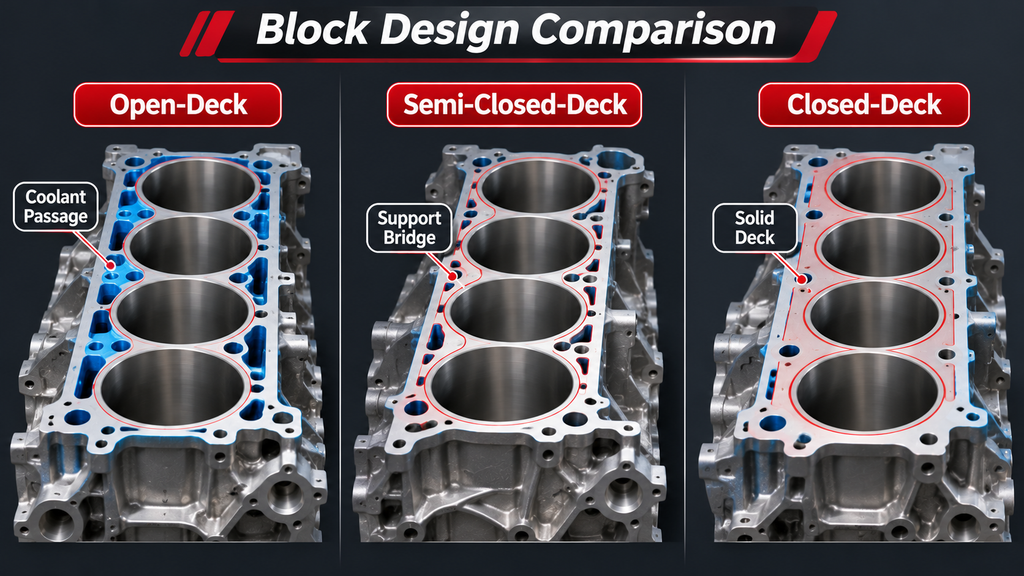
An open-deck block has relatively large coolant openings around the upper cylinder walls. This arrangement provides flexibility in coolant routing and casting design.
A closed-deck block provides greater structural support around the tops of the cylinders, with smaller coolant openings.
A semi-closed deck provides an intermediate solution. The best design depends on required bore stiffness, cylinder pressure, cooling performance, and manufacturing constraints.
Bore Spacing and Cylinder Wall Thickness
Bore spacing is the center-to-center distance between adjacent cylinders. Greater spacing can provide room for thicker walls and additional coolant passages, but it increases engine length.
Thin walls reduce mass and allow compact packaging but must remain sufficiently rigid to control distortion and preserve piston-ring sealing.
Structural Reinforcement and Bedplates
Some engines use a bedplate, an integrated lower structural assembly supporting multiple main bearing positions.
This construction can improve structural continuity and crankshaft support stiffness compared with separate caps when appropriately designed.
Common Engine Block Issues and Practical Inspection Tips
Engine blocks may suffer damage from overheating, poor lubrication, corrosion, freezing coolant, excessive loads, or manufacturing defects.
A reliable diagnosis requires identifying the affected component and measuring its condition rather than replacing parts based on symptoms alone.
1. Overheating and Deck Warpage
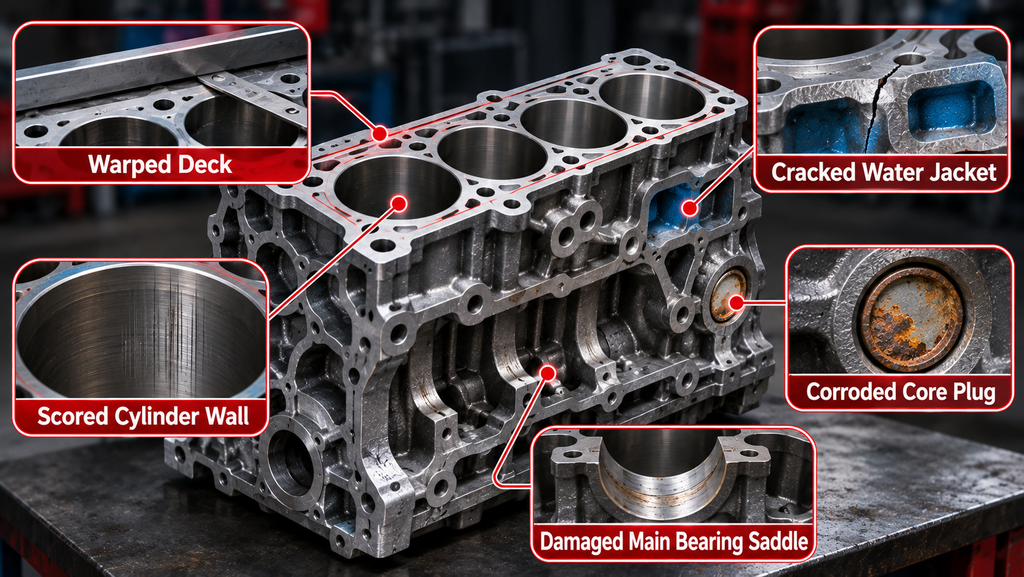
Severe overheating can create uneven thermal expansion and permanent distortion of the block deck.
A warped deck may compromise the seal between the cylinder head, gasket, and block, causing compression leakage or coolant-related problems.
Deck Flatness Inspection Procedure
- Remove the cylinder head using the manufacturer’s service procedure.
- Clean the deck carefully without damaging the sealing surface.
- Remove raised burrs or deposits using approved methods.
- Position a precision straightedge across the prescribed locations.
- Use feeler gauges to measure any gaps beneath the straightedge.
- Compare measurements with manufacturer-specified flatness limits.
Resurfacing may be possible if the block remains within the manufacturer’s machining limits and the required deck surface finish can be achieved.
2. Hairline Cracks in the Casting
Cracks may form in cylinder walls, water jacket boundaries, main bearing webs, head bolt holes, or mounting bosses.
Some defects can be identified visually, while others require specialized nondestructive inspection methods.
| Inspection Method | What It Detects |
|---|---|
| Magnetic Particle Inspection | Suitable surface and near-surface defects in ferromagnetic materials |
| Dye Penetrant Inspection | Surface-breaking discontinuities in suitable nonporous materials |
| Pressure Testing | Leakage through coolant jackets or associated damaged regions |
Cracks affecting heavily loaded structural regions are particularly serious. Repair feasibility should be established by a qualified machine shop before proceeding.
3. Cylinder Wall Scoring and Excessive Wear
Cylinder wall scoring consists of scratches or grooves along the piston running surface. It may result from poor lubrication, piston seizure, abrasive contamination, broken rings, or incorrect clearance.
A technician should inspect the surface and measure bore diameter, taper, and out-of-roundness using calibrated equipment.
Conventional iron bores may be recoverable through approved honing or oversize boring. Coated aluminum bores may require specialized restoration because ordinary boring can remove the engineered wear surface.
Before disassembly, an engine compression test can provide useful evidence of a possible cylinder sealing problem, although it cannot identify the exact defect by itself.
4. Main Bearing Housing Distortion
Main bearing housing distortion can develop after severe overheating, excessive mechanical loading, incorrect assembly, or bearing failure.
Distorted housings can lead to uneven bearing contact, incorrect oil clearance, and recurring bearing problems.
Machine shops measure housing bore size, roundness, and alignment before deciding whether line honing, line boring, or block replacement is appropriate.
5. Cracked Water Jackets and Coolant Leakage
Freezing, corrosion, or severe thermal stress can damage internal coolant passages.
Possible symptoms include unexplained coolant loss, overheating, oil contamination, or abnormal cooling-system pressure.
These symptoms may also indicate a damaged cylinder head, head gasket, or another cooling-system fault. Pressure testing and appropriate inspection are required to isolate the cause.
6. Corroded Core Plugs
Core plugs can corrode when cooling-system maintenance is neglected. Minor seepage may gradually develop into significant coolant leakage.
Replacement requires inspection of the plug seat and surrounding casting to confirm that corrosion or cracking will not compromise the repair.
Important Safety Note
Do not continue operating an engine that is severely overheating, has lost oil pressure, or shows evidence of coolant entering the lubricating oil. Continued operation can cause extensive mechanical damage.
Engine Block Inspection Checklist Before Rebuilding
Before an engine rebuild, technicians should evaluate the block as a complete structural component rather than inspecting only the visibly damaged cylinder or bearing.
Measurements should be recorded and compared with the engine manufacturer’s service specifications before machining decisions are made.
| Inspection Area | Method | What It Reveals |
|---|---|---|
| Cylinder Bores | Dial bore gauge | Wear, taper, out-of-roundness |
| Deck Surface | Straightedge, feeler gauges, surface inspection | Warpage and sealing condition |
| Main Bearing Housings | Calibrated bore measurement | Diameter, roundness, alignment |
| Water Jackets | Visual and pressure testing | Corrosion, leakage, cracks |
| Casting Surfaces | Appropriate nondestructive testing | Cracks and discontinuities |
| Oil Galleries | Cleaning and passage inspection | Debris and restrictions |
| Threaded Holes | Thread and visual inspection | Damaged threads, cracked bosses |
| Core Plugs | Visual and leak inspection | Corrosion and seal failure |
| Mounting Faces | Visual and dimensional inspection | Damage and misalignment |
Practical Workshop Inspection Sequence
STEP 01
Identify the block. Confirm casting identification, engine variant, and service specifications.
STEP 02
Disassemble and clean. Remove components and serviceable plugs as required.
STEP 03
Inspect visible damage. Look for cracks, corrosion, overheating, and broken bosses.
STEP 04
Check for cracks. Perform appropriate leak and casting inspections.
STEP 05
Measure cylinders. Record bore diameter, taper, and out-of-roundness.
STEP 06
Inspect the deck. Check flatness, surface condition, and machining limits.
STEP 07
Check bearing housings. Verify size, roundness, and alignment.
STEP 08
Decide repair feasibility. Determine whether to reuse, machine, sleeve, repair, or replace.
A block that can technically be repaired may not be economical to rebuild. Machining costs, replacement availability, structural integrity, and expected durability should all be considered.
Frequently Asked Questions About Engine Blocks
Is an Engine Block the Same as an Engine?
No. The engine block is the main structural component. A complete engine also contains pistons, connecting rods, crankshaft, cylinder head, valvetrain, lubrication system, and additional components.
Can a Cracked Engine Block Be Repaired?
Some cracks can be repaired using specialized techniques. Repair feasibility depends on crack location, material, structural loads, and manufacturer restrictions. Severe structural damage may require replacement.
Is an Aluminum Engine Block Better Than Cast Iron?
Aluminum offers lower density and higher thermal conductivity. Gray cast iron generally provides excellent damping and economical production. The better choice depends on the complete engine design.
Why Do Aluminum Engine Blocks Have Iron Liners?
Many aluminum blocks use iron liners because ordinary aluminum casting alloys do not provide suitable untreated piston-ring running surfaces. Other engines use specialized silicon-rich surfaces or thin wear-resistant coatings.
What Happens if an Engine Block Warps?
Warping may disturb cylinder geometry, head gasket sealing, or bearing alignment. Its severity is determined through measurements compared with manufacturer specifications.
Can You Drive With a Damaged Engine Block?
Driving with a suspected cracked or severely damaged engine block can lead to coolant loss, oil starvation, overheating, or major engine failure. Stop safely if serious symptoms appear and arrange professional diagnosis.
What Is the Difference Between Open-Deck and Closed-Deck Blocks?
An open-deck block has relatively open coolant spaces around cylinder tops. A closed-deck block provides additional structural material around the upper cylinder walls, often improving support under demanding loads.
How Long Does an Engine Block Last?
A properly maintained engine block may last for the vehicle’s service life and potentially through multiple rebuilds. Longevity depends on lubrication, cooling, corrosion, operating loads, and dimensional condition.
Conclusion
The engine block is much more than a housing for pistons and cylinders. It forms the structural foundation that supports combustion forces, maintains mechanical alignment, and carries the coolant and oil passages essential for reliable engine operation.
Gray cast iron offers proven vibration damping, wear characteristics, and cost efficiency. Aluminum provides opportunities for lower engine mass and efficient heat transfer, while compacted graphite iron offers increased strength and stiffness in demanding applications.
Modern block engineering continues to balance mass reduction with structural rigidity, thermal stability, durability, and manufacturing efficiency.
For students and engine rebuilders, the essential lesson is that engine block condition cannot be judged by appearance alone. Accurate measurements, appropriate inspection methods, and manufacturer specifications determine whether a block can remain in service.
Key Takeaway: Engine block reliability depends on the combination of material properties, structural design, cooling, lubrication, and accurate component alignment. Diagnosis and measurements should always guide repair decisions.