

A practical guide to understanding your traction control warning, what causes it, whether it’s safe to drive, and how to fix it.
You’re driving along when suddenly a warning message appears on your dashboard: “Service Traction Control.” Your heart rate spikes. Is something seriously wrong? Is it safe to keep driving? Don’t worry — in most cases, this warning doesn’t mean your car is about to break down. But it does mean something needs attention.
In this guide, we’ll explain exactly what “Service Traction Control” means, walk through the most common causes, help you decide whether it’s safe to continue driving, and show you how to diagnose and fix the problem. We’ll also cover expected repair costs so you know what to expect at the shop.
What Does Service Traction Control Mean?
When your vehicle displays “Service Traction Control” (or the TC warning light illuminates), it means the vehicle’s computer has detected a fault in the traction control system. The traction control system is no longer functioning normally, and the vehicle may not be able to prevent wheel spin during acceleration.
Service Traction Control” is your vehicle’s way of saying: the system that prevents your wheels from spinning has detected a problem and needs inspection.
This message is common on GM vehicles (Chevrolet, GMC, Buick, Cadillac) where it often appears alongside “Service StabiliTrak.” However, all modern vehicles have traction control systems, and similar warnings appear across Toyota, Ford, Honda, Hyundai, and other manufacturers — sometimes as a dashboard light rather than a text message.
What Does the Traction Control System Do?
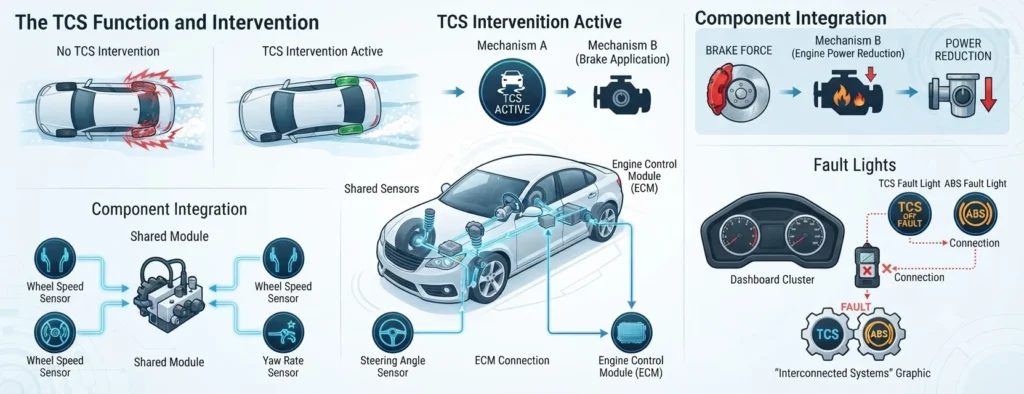
Your traction control system (TCS) monitors wheel speed using sensors mounted at each wheel. When it detects that one or more wheels are spinning faster than the others — meaning they’ve lost grip — it intervenes automatically. It may reduce engine power, apply the brake to the spinning wheel, or both.
The system relies on several components working together: wheel speed sensors (one at each wheel), the ABS (Anti-lock Braking System) module, the Engine Control Module (ECM), the steering angle sensor, and the yaw rate sensor. Traction control shares most of its hardware with the ABS system — they use the same wheel speed sensors and hydraulic module.
This is why a traction control fault often triggers the ABS light as well. The two systems are deeply interconnected, and a failure in one commonly affects the other.
Signs of a Traction Control Problem
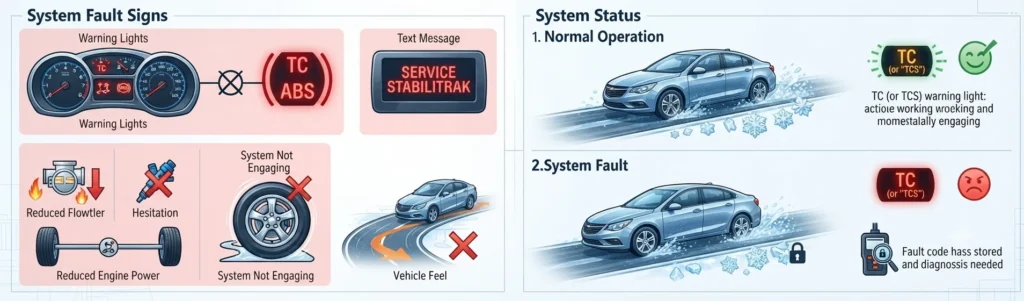
Common symptoms that accompany the Service Traction Control warning include: the TC or TCS warning light illuminated on the dashboard, the ABS light turning on simultaneously, a “Service StabiliTrak” message (GM vehicles), reduced engine power or limp mode, poor acceleration or hesitation, the vehicle feeling unstable during turns or on slippery surfaces, and the traction control system not engaging when wheels spin.
If you notice the warning light flashing briefly during acceleration on wet or icy roads, that’s actually normal — it means the system is actively working. A steady light or a text message, however, indicates a system fault that needs diagnosis.
Common Causes of the Service Traction Control Warning
Based on real-world repair data and common diagnostic trouble codes (DTCs), here are the most frequent causes mechanics encounter:
1. Faulty wheel speed sensor — The most common cause. These sensors get dirty, corroded, or damaged. Codes: C0035–C0050.
2. Damaged ABS module — The hydraulic control unit or its electronic controller fails.
3. Steering angle sensor malfunction — Needs recalibration after alignment or battery disconnect.
4. Low battery voltage — A weak battery can cause erratic signals to electronic modules.
5. Corroded wiring or connectors — Road salt, water intrusion, and age degrade connections.
6. Worn wheel bearing with damaged encoder ring — The magnetic ring that the speed sensor reads can crack or shift.
7. Faulty brake light switch — Some vehicles use this input for traction control logic.
8. Bad yaw rate sensor — Measures vehicle rotation; failure disables stability control.
9. Blown fuse — A simple but sometimes overlooked cause.
Can You Drive With the Service Traction Control Light On?
The short answer: it depends on the conditions. When the traction control warning is on, the system is disabled — your vehicle will still drive, but you won’t have electronic traction assistance. Your brakes, steering, and engine still work normally in most cases.
Generally safe to drive cautiously: dry roads, good visibility, slow city speeds, and no ABS warning light. You can drive to a shop for diagnosis. However, avoid driving in these conditions: rain, snow, or ice (no traction assistance available), if the ABS light is also on (braking performance may be compromised), if you notice reduced engine power or unusual braking behavior, or on highways at high speed.
Important: If the ABS light is also illuminated, your anti-lock braking may not function. This significantly increases stopping distance on wet or slippery surfaces. In this case, drive very cautiously and get the vehicle inspected as soon as possible.
How to Diagnose the Problem
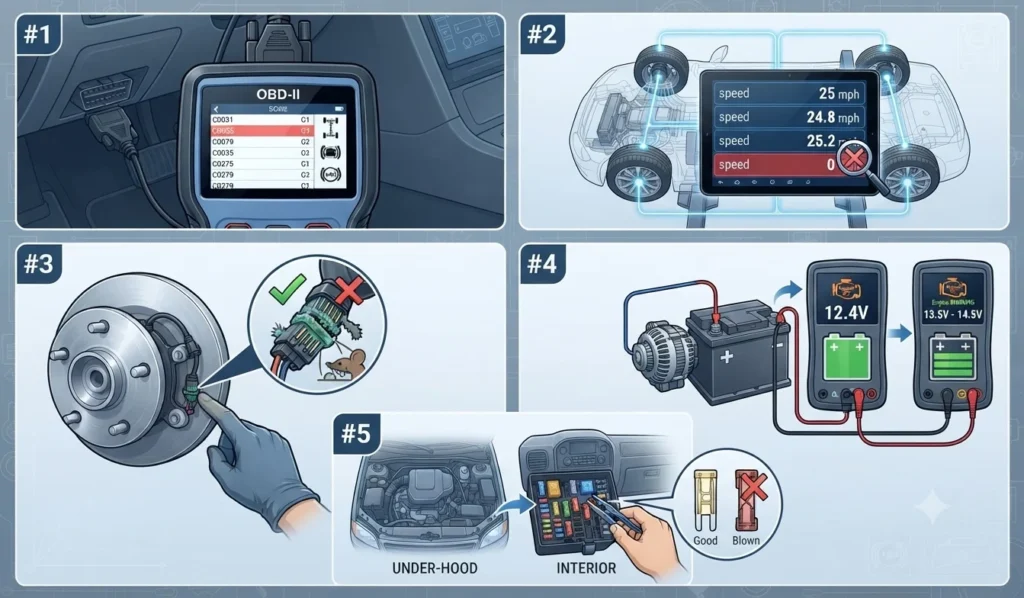
Step 1:
Scan for codes using an OBD-II scanner that reads ABS/chassis codes (not just engine codes). Common scanners like BlueDriver, Foxwell NT301, or any shop-level scan tool will work. Look for codes in the C0xxx range.
Step 2:
Check wheel speed sensor readings — with the vehicle on a lift, compare live data from all four sensors. A sensor reading 0 mph while others show speed confirms the faulty corner.
Step 3:
Visually inspect wiring at each wheel speed sensor for damage, corrosion, or rodent chewing.
Step 4:
Test battery voltage — should be 12.4V+ with engine off, 13.5–14.5V running.
Step 5:
Check fuses related to ABS/TCS in both the under-hood and interior fuse boxes.
If you’re not comfortable with these steps, any qualified mechanic can diagnose the issue quickly. Most shops charge $50–$100 for a diagnostic scan and inspection.
How to Fix Service Traction Control
The fix depends entirely on the root cause identified during diagnosis. Here are the most common repairs:
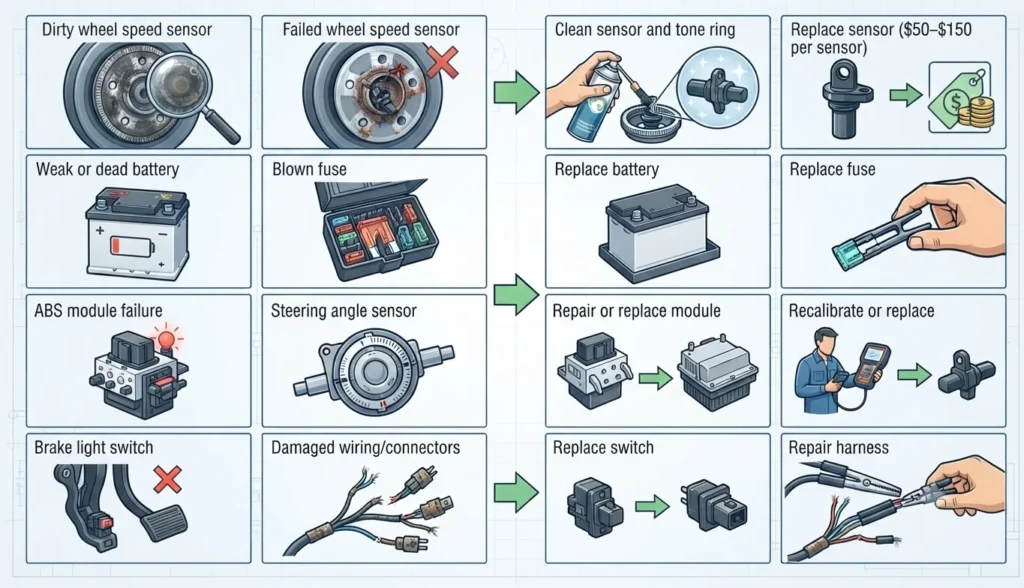
| Problem | Typical Fix |
|---|---|
| Dirty wheel speed sensor | Clean sensor and tone ring |
| Failed wheel speed sensor | Replace sensor ($50–$150 per sensor) |
| Weak or dead battery | Replace battery |
| Blown fuse | Replace fuse |
| ABS module failure | Repair or replace module |
| Steering angle sensor | Recalibrate or replace |
| Brake light switch | Replace switch |
| Damaged wiring/connectors | Repair harness |
Expected Repair Costs
Repair costs vary by vehicle make, model, and location. Here are typical ranges based on common repair shop pricing (parts + labor):
| Repair | Estimated Cost (USD) |
|---|---|
| Wheel speed sensor replacement | $100–$300 |
| ABS module repair | $300–$800 |
| ABS module replacement | $600–$1,500 |
| Battery replacement | $100–$300 |
| Wiring repair | $100–$400 |
| Steering angle sensor | $150–$500 |
| Brake light switch | $50–$150 |
How to Reset the Traction Control Light
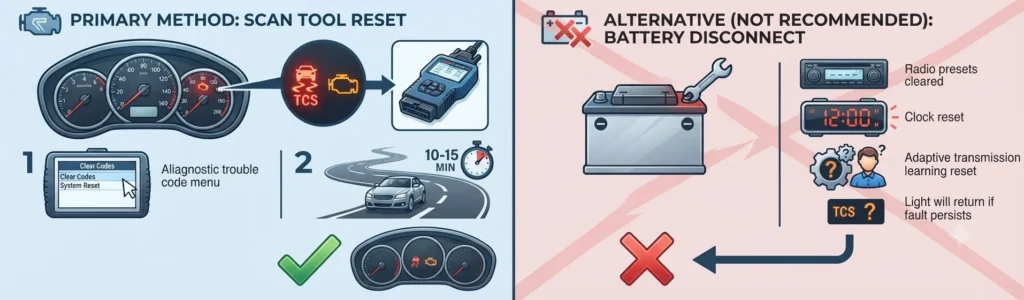
Important: Simply resetting the light without fixing the underlying problem will only cause it to return — usually within minutes or the next drive cycle. Always fix the root cause first. Once the repair is complete: 1. Clear the diagnostic codes using an OBD-II scanner. 2. Drive the vehicle through a complete drive cycle (typically 10–15 minutes of mixed city/highway driving). 3. The light should remain off if the repair was successful.
Some people suggest disconnecting the battery for 15 minutes to reset the light. While this can clear codes temporarily, it will also reset other vehicle systems (radio presets, clock, adaptive transmission learning) and the light will return if the fault still exists. It’s better to use a scan tool.
How to Prevent Future Traction Control Problems
Regular maintenance goes a long way in preventing traction control issues: Schedule brake inspections every 12 months or 12,000 miles. Replace your battery every 4–5 years (or when load testing shows weakness). Have wheel bearings checked during brake service. Inspect suspension components for wear that could affect sensor alignment. Avoid pressure-washing directly at wheel speed sensors and ABS connectors.
If you live in a region with heavy road salt use, consider applying dielectric grease to electrical connectors during routine maintenance. This prevents corrosion — one of the leading causes of sensor and wiring failures in the traction control system.
Frequently Asked Questions
Can a low battery cause the Service Traction Control warning?
Yes. A weak battery causes voltage drops that confuse electronic modules, including the ABS/TCS controller. Low voltage can generate false wheel speed readings or communication errors between modules. Replacing an aging battery often resolves intermittent traction control warnings.
Will traction control reset itself?
Sometimes. If the fault was intermittent (like a loose connection that re-seated itself), the light may turn off after a few drive cycles. However, if the light stays on for more than 2–3 drive cycles, the problem is persistent and needs diagnosis.
Is traction control the same as ABS?
No, but they share hardware. ABS prevents wheel lock-up during braking. Traction control prevents wheel spin during acceleration. Both use the same wheel speed sensors and hydraulic module, which is why they often fail together.
Does traction control affect the transmission?
The traction control system doesn’t directly control the transmission, but on some vehicles, a TCS fault can trigger reduced engine power or limp mode, which limits the transmission to certain gears. Fixing the traction control issue restores normal transmission operation.
Can bad tires trigger the traction control warning?
Mismatched tire sizes (different wear levels or mixing tire brands with different diameters) can cause wheel speed differences that confuse the traction control system. Always keep tires at the same wear level and replace in pairs (front or rear) at minimum.
Can I disable traction control permanently?
While the TC button lets you temporarily disable traction control (useful in deep snow or sand), permanently disabling it is not recommended for daily driving. It’s a critical safety system. If the warning light is bothering you, fix the underlying fault rather than ignoring it.
Conclusion
The “Service Traction Control” warning usually indicates a fault in the traction control or ABS system — most commonly a wheel speed sensor issue. It’s rarely a catastrophic failure, but it does mean your vehicle has lost an important safety feature that helps maintain grip during acceleration.
Diagnose the issue promptly using an OBD-II scanner, address sensor or electrical problems early, and you’ll restore safe handling and traction assistance. Most repairs are straightforward and affordable. When in doubt, a qualified mechanic can have you back on the road safely within a day.