
Seeing “FCW System Failed” on your dashboard? This guide explains what it means, whether you can keep driving, common causes, how to fix it, and what repairs cost.
Your FCW system failed warning just appeared — and you’re wondering if it’s safe to keep driving. You’re not alone. This is one of the most common dashboard alerts on modern Honda, Acura, Toyota, and Hyundai vehicles.
In this comprehensive guide, we explain exactly what the Forward Collision Warning (FCW) system does, why the “FCW system failed” message appears, the most common causes from dirty sensors to software glitches, step-by-step troubleshooting you can do at home, and when you need a professional diagnosis. No forum speculation — just clear, technically accurate information.
What Is Forward Collision Warning (FCW)?
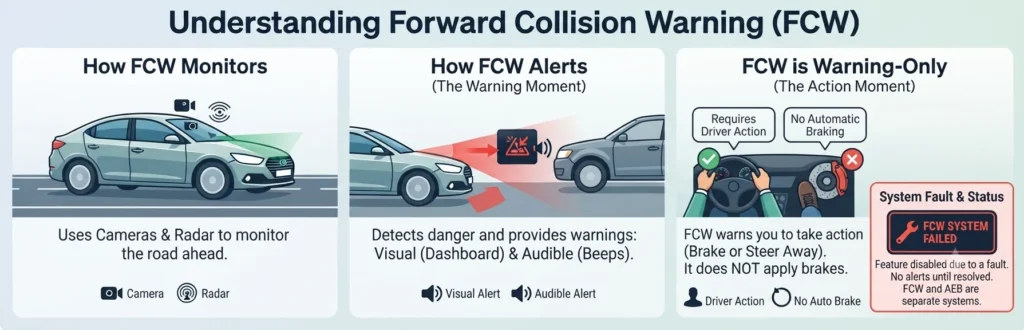
Forward Collision Warning (FCW) is an active safety system that monitors the road ahead using cameras, radar sensors, or both. When the system detects that you’re approaching another vehicle or obstacle too quickly and a collision is likely, it alerts you with visual warnings on the dashboard, audible beeps, or both — giving you time to brake or steer away.
FCW is a warning-only system — it does not apply the brakes for you. That’s the job of Automatic Emergency Braking (AEB), which is a separate (though often paired) system. When your dashboard says “FCW system failed,” it means the forward collision warning feature has been disabled due to a detected fault, and it will not alert you to potential collisions until the issue is resolved.
How Does the FCW System Work?
The FCW system relies on a front-facing camera (usually mounted behind the windshield near the rearview mirror) and/or a radar sensor (typically located behind the front grille or bumper emblem). These sensors continuously scan the road ahead, measuring the distance and closing speed between your vehicle and objects in your path.
The system’s computer processes this data in real time. If closing speed exceeds a safe threshold and you haven’t started braking, the system triggers a collision warning. On Honda and Acura vehicles, this appears as an amber or red “BRAKE” alert on the instrument panel. The system must have a clear, unobstructed view of the road to function — which is why sensor blockages are the most common cause of failure.
Is It Safe to Drive With FCW System Failed?
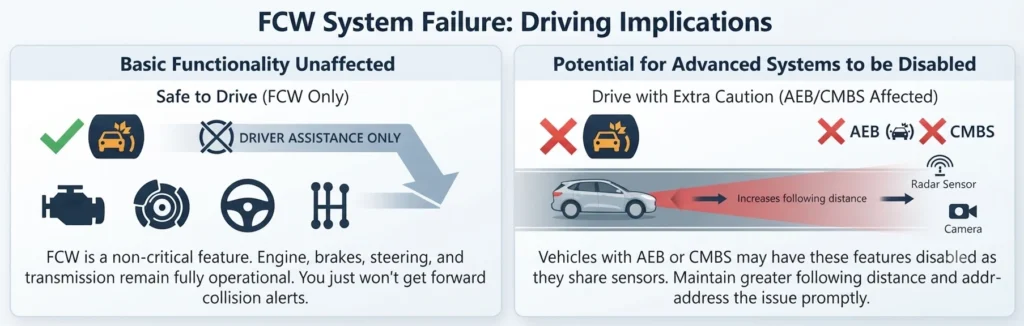
Yes — your vehicle is still safe to drive when the FCW system failed warning appears. The FCW system is a driver-assistance feature, not a critical mechanical system. Your engine, brakes, steering, and transmission are unaffected. You simply won’t receive forward collision alerts until the system is restored.
However, if your vehicle also has Automatic Emergency Braking (AEB) or Collision Mitigation Braking (CMBS), these may be disabled along with FCW since they share the same sensors. Drive with extra caution, maintain greater following distances, and plan to address the issue promptly — especially if the warning persists after restarting the vehicle.
Common Causes of FCW System Failed
Dirty or blocked sensors. This is the #1 cause. The front camera behind your windshield can be obscured by dirt, condensation, ice, heavy rain, or snow. The radar sensor behind the front bumper or grille can be blocked by mud, road salt, snow buildup, or even a front license plate that has shifted. A simple cleaning often resolves the warning immediately.
Extreme weather conditions. Heavy rain, dense fog, blinding snow, or direct sun glare can temporarily overwhelm the camera or radar. The system disables itself because it cannot reliably detect objects. Once conditions improve, the warning typically clears on its own after driving for a few minutes.
Windshield issues. A cracked, chipped, or recently replaced windshield can trigger FCW failure. The front camera requires a specific windshield transparency and mounting angle. Aftermarket windshields without the correct optical properties, or improperly installed replacements that shift the camera’s alignment, are common culprits — especially on Honda and Subaru models.
Electrical and software faults. A weak or dying 12V battery can cause voltage drops that reset the FCW module. Software bugs may trigger false failures, particularly after a battery disconnect or jump start. In rarer cases, the radar sensor unit or camera module itself may be physically damaged or have a wiring fault that requires professional diagnosis.
How to Fix FCW System Failed
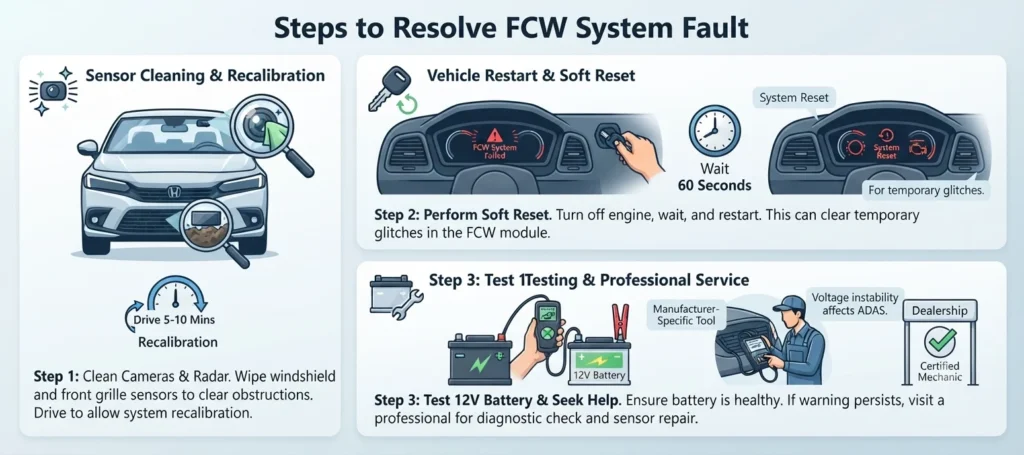
Clean the sensors:
Wipe the windshield area around the rearview mirror (where the front camera sits) with a clean microfiber cloth. Then check the front bumper grille area for the radar sensor — clean off any mud, ice, salt, or debris. After cleaning, drive for 5–10 minutes at normal speeds to let the system recalibrate.
Restart the vehicle:
Turn off the engine completely, wait 60 seconds, then restart. This performs a soft reset of the FCW computer module. For many temporary glitches (especially after battery changes or jump starts), this clears the warning. On some Honda/Acura models, you may need to drive for a few miles before the system re-enables.
Check your battery and seek professional help:
If the warning remains after cleaning the sensors and restarting the vehicle, test the 12V battery. A weak battery can affect the FCW system. If the battery is fine and the warning persists, have a qualified mechanic diagnose the camera, radar, or wiring using professional diagnostic tools.
FCW Repair Cost Estimates
Costs vary depending on the root cause. Here’s what to expect in 2026 based on common scenarios across US dealerships and independent shops.
Sensor Cleaning / Reset
$0 – $50
Camera Recalibration
$150 – $400
Sensor / Camera Replacement
$500 – $1,500+
How to Prevent FCW System Failures
Keep sensors clean. Make it a habit to wipe the windshield camera area and front grille radar zone during regular car washes. In winter, clear snow and ice from the front bumper before driving — salt buildup is a leading cause of radar blockage.
Use OEM-spec windshield replacements. If you need a new windshield, insist on one that meets manufacturer specifications for your vehicle’s ADAS camera. After installation, ask the shop to perform a camera recalibration — many aftermarket windshield installers skip this step, causing persistent FCW failures.
Maintain your battery. A healthy 12V battery prevents voltage-related ADAS glitches. Have your battery tested annually, especially if it’s over 3 years old. Avoid disconnecting the battery without understanding that ADAS systems may need reinitialization afterward.
FCW System Failed: Honda & Acura Specifics
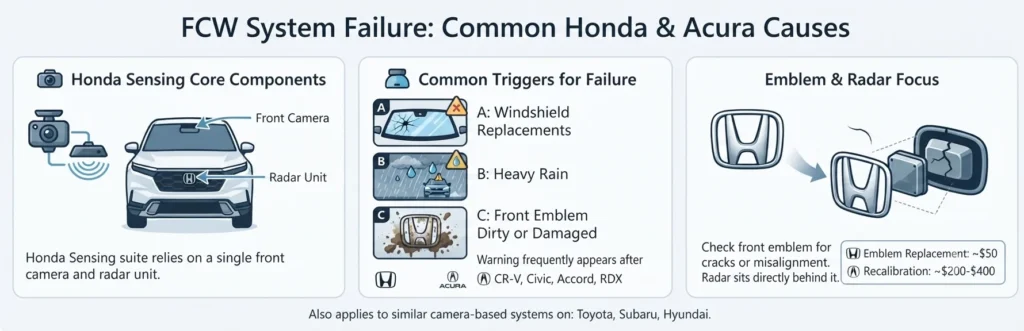
Honda and Acura vehicles are among the most common models to display the “FCW System Failed” message because their Honda Sensing suite relies heavily on a single front camera and radar unit. On CR-V, Civic, Accord, and RDX models, the warning frequently appears after windshield replacements, in heavy rain, or when the front emblem (which houses the radar) gets dirty or damaged.
For Honda/Acura owners: check whether your front emblem is cracked or misaligned — the millimeter-wave radar sits directly behind it. A $50 emblem replacement and $200–$400 recalibration often resolves persistent failures. Toyota, Subaru, and Hyundai models use similar camera-based systems and share many of the same troubleshooting steps outlined above.
Frequently Asked Questions
What does FCW system failed mean?
It means your vehicle’s Forward Collision Warning system has detected a fault and disabled itself. You won’t receive alerts about potential front-end collisions until the issue is resolved. The vehicle remains safe to drive, but you lose this safety warning feature.
Can I drive with FCW system failed?
Yes. FCW is an assistive feature, not a critical driving system. Your brakes, steering, and engine are unaffected. However, drive with extra caution since you won’t get collision warnings, and related systems like AEB may also be disabled.
How do I reset my FCW system?
Clean the front camera area (windshield near rearview mirror) and radar sensor (front grille/bumper). Then turn off the vehicle, wait 60 seconds, and restart. Drive for 5–10 minutes at normal speeds. If the warning persists, the system may need professional diagnosis and recalibration.
Why does my FCW keep failing in rain or snow?
Heavy rain, snow, fog, and road spray can obscure the camera and radar sensors. The system disables itself because it can’t reliably detect objects. This is a temporary condition — once the weather clears and sensors dry off, the system usually re-enables automatically after a few minutes of driving.
FCW system failed after windshield replacement — what now?
The front camera likely needs recalibration after a windshield replacement. Return to the installer and request an ADAS camera recalibration (costs $150–$400). If an aftermarket windshield was used without proper optical specifications, you may need an OEM-spec replacement.
How much does it cost to fix FCW system failed?
It depends on the cause. Sensor cleaning is free (DIY). Camera recalibration runs $150–$400 at a dealer. Radar sensor or camera module replacement costs $500–$1,500+ including parts and labor. Start with cleaning and a restart before assuming expensive repairs are needed.
What is the difference between FCW and AEB?
FCW (Forward Collision Warning) only warns you — it provides visual and audible alerts but does not intervene. AEB (Automatic Emergency Braking) actively applies the brakes if you don’t respond to the FCW alert. They use the same sensors, so when FCW fails, AEB is often disabled too.
Can a weak car battery cause FCW system failed?
Yes. A weak or failing 12V battery causes voltage fluctuations that can reset or disable ADAS modules including FCW. If your battery is over 3–4 years old and you’re getting intermittent FCW failures, have the battery tested. Replacement often resolves the issue.
Where could you find FCW in the past?
Forward Collision Warning technology was originally exclusive to luxury and commercial vehicles in the early 2000s — brands like Mercedes-Benz, Volvo, and heavy trucks offered it as a premium option. Today, FCW is standard on most new vehicles across all price ranges thanks to safety regulations and widespread adoption of camera-based ADAS systems.
Will FCW system failed clear on its own?
Sometimes. If the cause is temporary (dirty sensor, bad weather, minor glitch), the warning often clears after cleaning the sensors and restarting the vehicle. If it persists for more than a day despite clean sensors and clear weather, a professional diagnosis is recommended — there may be a hardware or calibration issue.