
Seeing the ESP BAS light on your dashboard? This complete guide explains what the ESP and BAS warning means, common causes, whether it’s safe to drive, and step-by-step fixes to resolve it.
When the ESP BAS light appears on your dashboard, it means your vehicle’s Electronic Stability Program and Brake Assist System have detected a fault — and your safety systems may not be functioning at full capacity.
Don’t panic. In many cases the BAS ESP light is triggered by a minor sensor issue or electrical glitch rather than a catastrophic brake failure. This guide walks you through exactly what ESP and BAS do, why the warning appears, whether you can still drive safely, and the most common fixes — from simple DIY checks to when you need a professional mechanic.
What Does ESP BAS Mean on a Car?
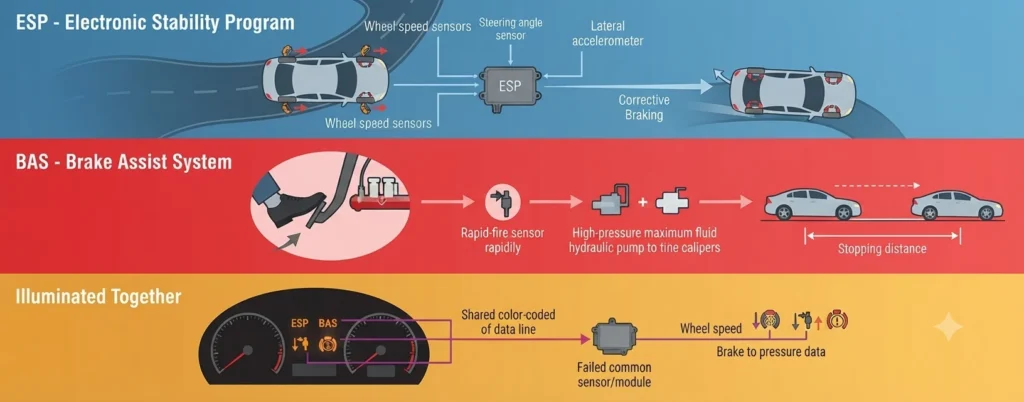
ESP (Electronic Stability Program) is your vehicle’s traction and stability control system. It monitors wheel speed sensors, steering angle, and lateral acceleration to detect when your car begins to skid or lose traction — then automatically applies individual brakes to bring the vehicle back under control.
BAS (Brake Assist System) detects emergency braking situations by monitoring how quickly you press the brake pedal. When it senses a panic stop, it instantly applies maximum braking force to help you stop in the shortest distance possible.
When the ESP and BAS lights illuminate together, it typically means the two systems share a sensor or module that has failed. Since BAS relies on some of the same wheel speed and brake pressure data as ESP, a single fault can trigger both warnings simultaneously.
Common Causes of the ESP BAS Light
The BAS ESP light can be triggered by several issues, ranging from a $15 brake light switch to a more complex ABS module failure. Here are the most frequent culprits.
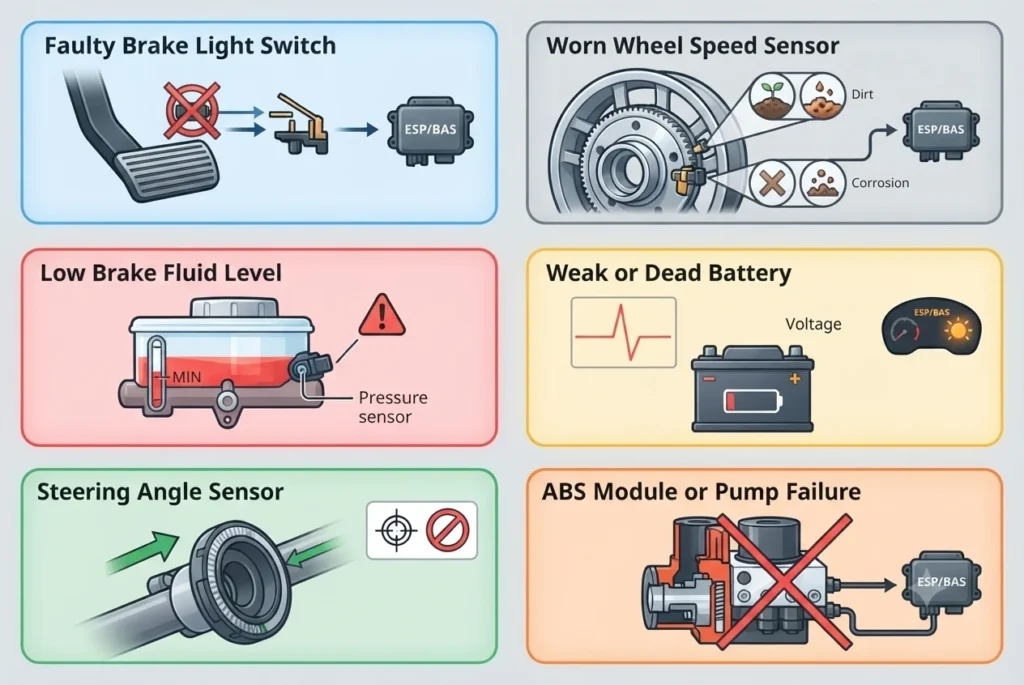
Faulty Brake Light Switch
The most common cause. This small switch behind the brake pedal tells the BAS system when you’re braking. When it fails, the system can’t detect braking input, triggering both the ESP and BAS warnings.
Worn Wheel Speed Sensor
Each wheel has a speed sensor that feeds data to the ESP module. Dirt, corrosion, or a damaged sensor ring can cause incorrect readings — making the system think a wheel is locking up or spinning freely.
Low Brake Fluid Level
When brake fluid drops below the minimum level, the pressure sensor alerts the ESP/BAS system. This can indicate worn brake pads (normal) or a leak in the brake lines (urgent).
Weak or Dead Battery
A battery with low voltage can cause voltage spikes or drops that confuse electronic modules. Many owners see the ESP BAS light appear right after a jump-start or battery replacement.
Steering Angle Sensor
The steering angle sensor tells ESP which direction you intend to go. If it loses calibration (common after a wheel alignment or tire change), the ESP system may throw a warning.
ABS Module or Pump Failure
The ABS hydraulic unit is shared by ESP and BAS. Internal pump wear or corroded electrical connections can disable all three systems at once. This is the most expensive potential cause.
Is It Safe to Drive With the ESP BAS Light On?
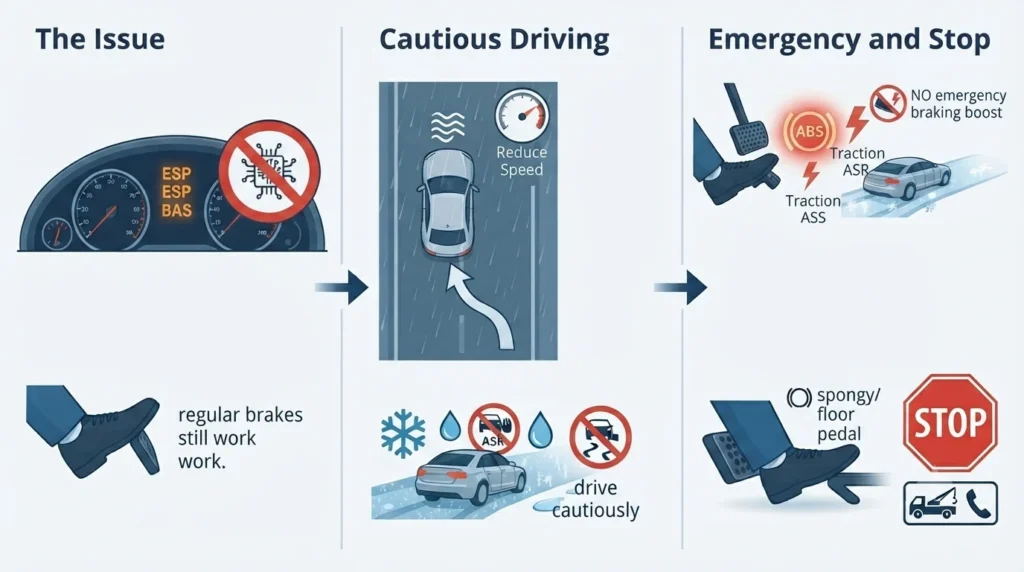
Your regular brakes still work — the ESP BAS light means the electronic safety assists are disabled, not that your brakes have failed. However, you lose emergency braking boost and skid protection. Drive cautiously, avoid sudden maneuvers, reduce speed in wet or icy conditions, and get the issue diagnosed as soon as possible. If the brake pedal feels spongy or goes to the floor, stop driving immediately and call for roadside assistance.
How to Fix the ESP BAS Light (Step by Step)
Work through these steps from simplest to most complex. Many owners resolve the BAS ESP light without visiting a dealership.
Check & Replace the Brake Light Switch
Located above the brake pedal arm. If your brake lights don’t illuminate when you press the pedal, the switch is likely failed. Replacement costs $15–$40 for the part and takes about 15 minutes.
Inspect Wheel Speed Sensors
Look for damaged wiring or heavy corrosion around each wheel hub sensor. Clean the sensor tip and tone ring with brake cleaner. If a sensor is cracked or its connector is corroded, replace it ($30–$80 per sensor).
Check Brake Fluid Level & Battery Voltage
Open the hood and check the brake fluid reservoir — top up with DOT 4 if low. Test your battery voltage with a multimeter: it should read 12.4V+ with engine off. A weak battery (under 12V) is a very common hidden cause.
Reset the Steering Angle Sensor
Turn the steering wheel fully left, then fully right, then back to center. Turn the ignition off and on. On many vehicles this recalibrates the sensor. If the light persists, a scan tool can perform a forced calibration.
Run an OBD2 Diagnostic Scan
A diagnostic scanner that reads ABS/ESP codes (not just engine codes) will pinpoint exactly which sensor or module triggered the fault. Clear the code after repair — if it doesn’t return, the fix worked. If it does, deeper diagnosis is needed.
ESP BAS Repair Cost Estimates
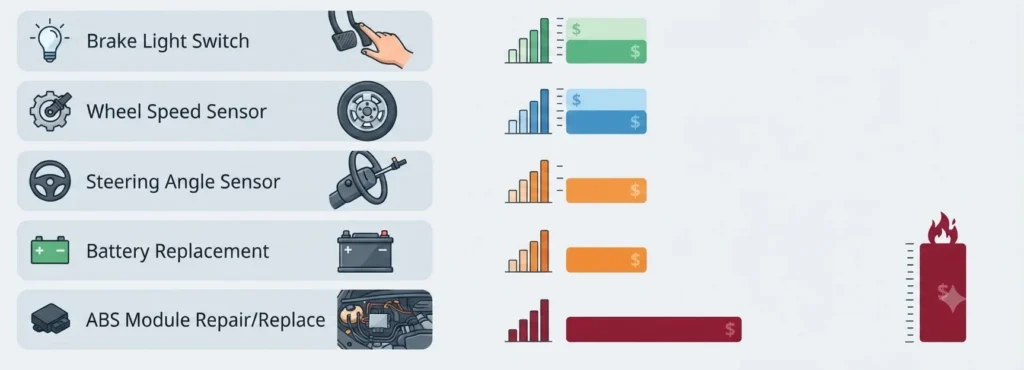
| Repair | Estimated Cost (USD) |
|---|---|
| Brake Light Switch | $15 – $80 (DIY) / $80 – $150 (shop) |
| Wheel Speed Sensor | $30 – $80 (part) / $150 – $300 (shop) |
| Steering Angle Sensor | $100 – $250 (part + calibration) |
| Battery Replacement | $100 – $300 (depending on vehicle) |
| ABS Module Repair/Replace | $500 – $1,500+ (most expensive fix) |
Frequently Asked Questions About the ESP BAS Light
What does the ESP BAS light mean?
The ESP BAS light indicates a fault in your vehicle’s Electronic Stability Program (ESP) and Brake Assist System (BAS). These are active safety systems that help prevent skidding and boost braking force in emergencies. When the light is on, these assists are disabled.
Can I still drive with the ESP BAS warning on?
Yes, your normal brakes still function. However, you lose electronic stability control and emergency brake assist. Drive carefully, avoid aggressive maneuvers, and get the vehicle inspected soon. If the brake pedal feels abnormal, do not drive.
What is the most common fix for the BAS ESP light?
Replacing the brake light switch is the single most common fix, especially on Mercedes-Benz, Chrysler, and Dodge vehicles. It’s a $15–$40 part that takes about 15 minutes to replace behind the brake pedal.
Can a bad battery cause the ESP BAS light?
Absolutely. A weak battery or voltage irregularities can confuse electronic modules and trigger false warnings. Many owners report the ESP BAS light appearing after a jump-start. Testing battery voltage and replacing an aging battery often resolves it.
How do I reset the ESP BAS light?
First fix the underlying cause. Then you can clear the code with an OBD2 scanner that reads ABS modules, or try disconnecting the battery for 15 minutes. On some vehicles, cycling the steering lock-to-lock and restarting the engine resets the steering angle sensor. The light should stay off if the repair was successful.
Does the ESP BAS light affect my ABS brakes?
Often yes — ESP, BAS, and ABS share the same hydraulic unit and wheel speed sensors. When one system faults, the others may also be disabled. You may see ABS, ESP, and BAS warnings illuminate simultaneously.
Is the ESP BAS light the same on all car brands?
The terminology varies. Mercedes-Benz uses ESP/BAS specifically. Chrysler and Dodge models show similar ESP/BAS warnings. Other manufacturers may label it ESC (Electronic Stability Control) or VSA (Vehicle Stability Assist), but the underlying systems are functionally identical.
Should I take my car to the dealer for an ESP BAS warning?
Not necessarily. Many independent shops can diagnose and repair ESP/BAS faults at lower cost. However, if the issue involves ABS module reprogramming or advanced calibration, a dealer with manufacturer-specific tools may be required. Start with a diagnostic scan to identify the specific fault code.