

Your tire tread is the only thing connecting your vehicle to the road. Those grooves and channels carved into the rubber are engineered to grip pavement, channel water away from the contact patch, and give you control during braking and cornering. As tread wears down, your tires lose their ability to perform these critical functions — especially on wet roads.
In this guide, we explain exactly what tire tread depth means, provide a clear tire tread depth chart you can reference, walk you through how to use a tread depth gauge for tires, and share practical safety tips backed by stopping-distance research. Whether you’re preparing for a road trip or just noticed your tires look worn, this article will help you make a confident decision.
What Is Tire Tread and Why Does It Matter?
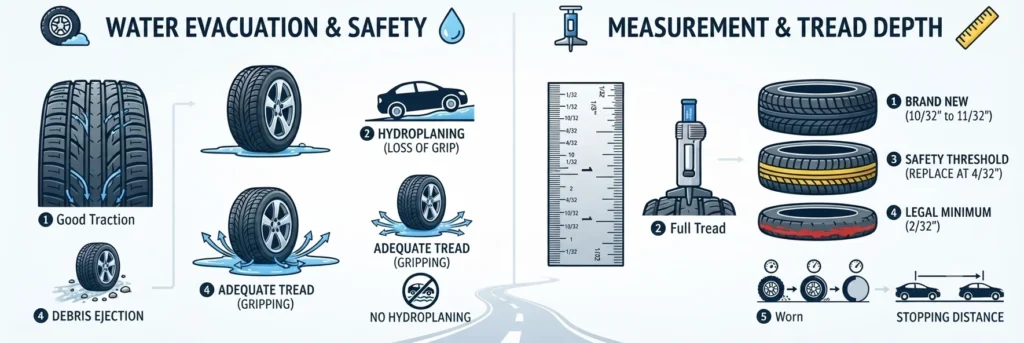
Tire tread refers to the patterned rubber on the outer surface of your tire that makes direct contact with the road. The grooves, sipes, and channels in the tread are designed to evacuate water, slush, and debris from beneath the tire. Without adequate tread, water cannot escape — causing hydroplaning, where your tire rides on top of a thin film of water instead of gripping the road.
Tire tread depth is measured in 32nds of an inch in the United States. A brand-new passenger tire typically has 10/32″ to 11/32″ of tread. As you drive, this rubber gradually wears away. The legal minimum in most states is 2/32″, but safety experts and tire manufacturers recommend replacement well before that point — generally at 4/32″ — because wet stopping performance degrades significantly once tread drops below that threshold.
Tire Tread Depth Chart: When to Replace Your Tires
Use this tire tread depth chart to quickly assess your tire condition. The chart shows tread depth in 32nds of an inch alongside the general condition and recommended action for each range:
| Tread Depth | Condition | Recommended Action |
|---|---|---|
| 10/32–11/32″ | New tire (full tread) | Continue regular checks |
| 6/32″ | Moderate tread remaining | Monitor closely, especially for winter |
| 4/32″ | Wet traction reduced | Plan replacement soon |
| 2/32″ | Legally bald / unsafe | Replace immediately |
Note: Discount Tire recommends replacement at 4/32″ because wet stopping distances increase substantially before reaching the 2/32″ legal minimum. NHTSA research confirms that crash risk rises as tread depth decreases.
How to Measure Tire Tread Depth
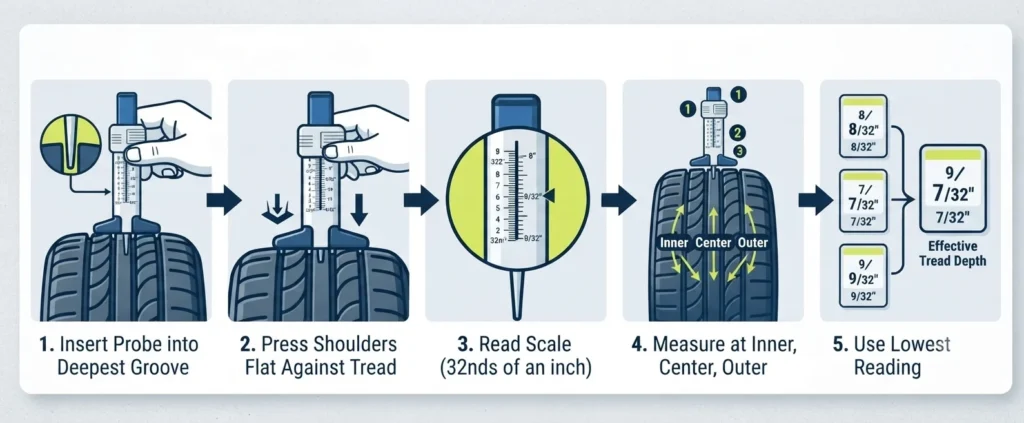
The most accurate way to check tire tread depth is with a dedicated tread depth gauge for tires. These inexpensive tools (typically $5–$15) give you a precise numerical reading in 32nds of an inch. While the penny test provides a rough pass/fail check, a gauge tells you exactly how much tread remains so you can track wear over time.
Step-by-Step: Using a Tread Depth Gauge
- Insert the gauge probe into the deepest groove of the tire.
- Press the shoulders flat against the tread surface.
- Read the measurement in 32nds of an inch on the scale.
- Repeat in at least three spots: inner, center, and outer tread.
- Use the lowest reading as your tire’s effective tread depth.
The Penny Test (Quick Alternative)
Insert a penny into the tread groove with Lincoln’s head facing down. If the top of his head is visible, your tread is at or below 2/32″ — replace immediately. While simple, this test only tells you whether you’ve reached the legal minimum. It cannot distinguish between 4/32″ and 6/32″, which is why a tread depth gauge for tires is the better tool for proactive maintenance.
How Tire Tread Depth Affects Stopping Distance
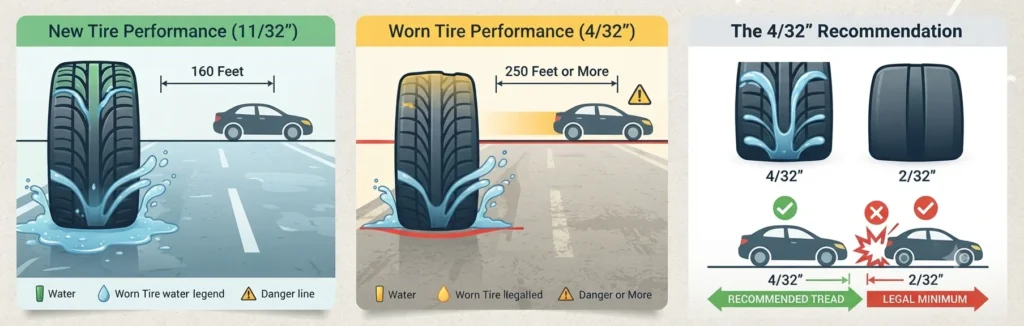
Tire tread depth has a direct, measurable impact on how quickly your vehicle can stop — particularly on wet pavement. Research from Discount Tire shows that at highway speeds on a wet surface, a tire with full tread (11/32″) can stop in approximately 160 feet. As tread wears to 4/32″, that distance increases noticeably. At the legal minimum of 2/32″, stopping distance can reach 250 feet or more — nearly 60% longer than a new tire.
This is why safety organizations recommend replacing tires at 4/32″ rather than waiting for 2/32″. That extra tread depth gives your tires the groove volume needed to channel water away from the contact patch and maintain grip. In heavy rain, the difference between 4/32″ and 2/32″ of tire tread could be the difference between stopping safely and a collision.
Tire Tread Safety Tips and Maintenance Checklist
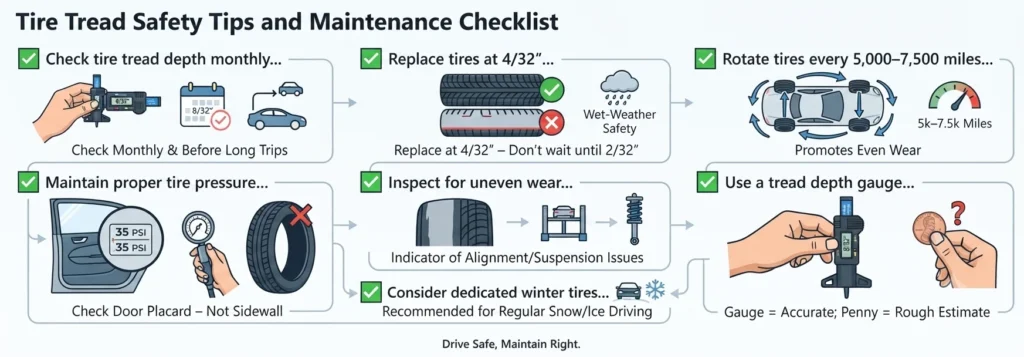
- ✅ Check tire tread depth monthly and before long trips.
- ✅ Replace tires at 4/32″ for wet-weather safety — don’t wait until 2/32″.
- ✅ Rotate tires every 5,000–7,500 miles to promote even wear.
- ✅ Maintain proper tire pressure (check the door placard, not the sidewall).
- ✅ Inspect for uneven wear — it can indicate alignment or suspension issues.
- ✅ Use a tread depth gauge for accurate readings; the penny test is a rough estimate only.
- ✅ Consider dedicated winter tires if you regularly drive in snow or ice.
Frequently Asked Questions About Tire Tread
What is a safe tire tread depth?
Most safety experts recommend maintaining at least 4/32″ of tire tread depth for adequate wet-road performance. While 2/32″ is the legal minimum in most U.S. states, wet stopping distances increase significantly between 4/32″ and 2/32″. For winter driving, 6/32″ or more is recommended.
How often should I check my tire tread depth?
Check your tire tread at least once a month and before any long road trip. Also inspect your tires whenever you notice changes in handling, longer braking distances, or visible wear indicators. Regular checks help you catch uneven wear early.
Is a tread depth gauge better than the penny test?
Yes. A tread depth gauge for tires provides a precise numerical measurement (e.g., 5/32″), while the penny test only tells you if you’re at or below 2/32″. The gauge lets you track gradual wear over time and determine exactly when you’re approaching the recommended 4/32″ replacement threshold.
Why do my tires have different tread readings in different spots?
Uneven tire tread wear can indicate alignment issues, improper tire pressure, worn suspension components, or a need for tire rotation. Measure the inner, center, and outer grooves — if readings differ significantly, have your alignment and inflation checked by a professional.
What does 4/32 tire tread mean?
A reading of 4/32″ means your tire tread grooves are 4/32 of an inch deep (approximately 3.2 mm). At this depth, wet-road traction is noticeably reduced compared to a new tire. Most tire safety experts recommend planning replacement at this point rather than waiting for the 2/32″ legal minimum.
Should I replace tires before they reach 2/32″?
Yes. While 2/32″ is the legal minimum, research shows that wet stopping distances increase