
The Toyota FJ Cruiser remains one of the most distinctive used 4x4s on the market. Here is what its tough hardware gets right, what age and condition can hide, and how to buy one with clear eyes.
A rugged, characterful Toyota — if you buy condition, not just the badge.
A well-maintained Toyota FJ Cruiser can still be an excellent trail-ready SUV with a proven V6, strong resale appeal and real off-road ability. But it is thirsty, compromised for rear passengers, and old enough that frame corrosion, accident repair, neglected servicing and poor modifications matter more than the odometer alone.
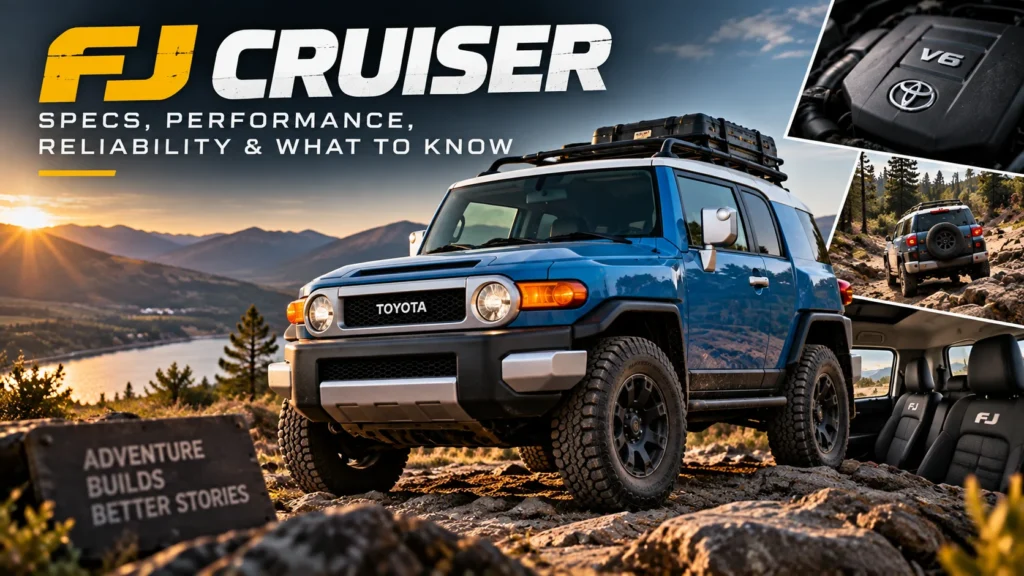
The Toyota FJ Cruiser was sold in North America for model years 2007 through 2014, with availability continuing longer in some overseas markets. It shares much of its tough body-on-frame foundation with the contemporary Toyota 4Runner, but packages it in a shorter, more playful-looking two-row body. That combination has created lasting demand: enthusiasts value its 4.0-litre V6, selectable four-wheel drive, trail ability and unusually strong identity. The trade-off is that every FJ Cruiser is now a used vehicle, and its individual history is more important than its reputation.
FJ Cruiser history: one generation, many markets and a final send-off
Toyota introduced the FJ Cruiser as a retro-styled, two-door-looking four-wheel-drive SUV for the 2007 model year. It was inspired by the original FJ40 Land Cruiser, but used modern Toyota truck architecture and a practical five-door body with rear-hinged access doors. The model was developed around a single generation rather than a succession of redesigns: updates were mainly equipment, trim, safety and market-specific changes. Production for the US market ended after 2014, while the model continued in selected international markets for longer.

The original brief
Built as an accessible, characterful alternative to larger Land Cruisers, the FJ paired a 4.0-litre V6 with body-on-frame construction, short overhangs and available trail hardware. Its unusual styling was deliberate: a white roof, wraparound windscreen treatment and rear-hinged rear doors echoed Toyota’s classic off-road heritage.
Beyond North America
The FJ Cruiser was sold in markets including Japan, Australia and the Middle East, with specifications and availability varying by country. Japan received right-hand-drive versions, while some overseas markets continued to offer the model after North American sales ended. Always verify the exact engine, drivetrain, equipment and recall information for the country where the vehicle was sold.
2025 Final Edition
Toyota announced a limited FJ Cruiser Final Edition for the Middle East, marking the end of the model’s long production run. The special version used heritage-focused exterior details, dark trim, 17-inch alloy wheels, Final Edition badging and a four-seat interior treatment, with availability limited to the region. It is a market-specific farewell model, not a new generation or a global replacement.
Toyota FJ Cruiser specs: the essentials buyers should know
Most US-market FJ Cruiser cars use Toyota’s 4.0-litre 1GR-FE V6. Output changed slightly over the run, but later examples are commonly rated at 260 horsepower and 271 lb-ft of torque. A five-speed automatic was widely available, while a six-speed manual was offered on some 4WD models. Two-wheel-drive versions exist in some markets, but a 4WD FJ Cruiser is the version most buyers seek because it brings the low-range transfer case and stronger off-road brief.
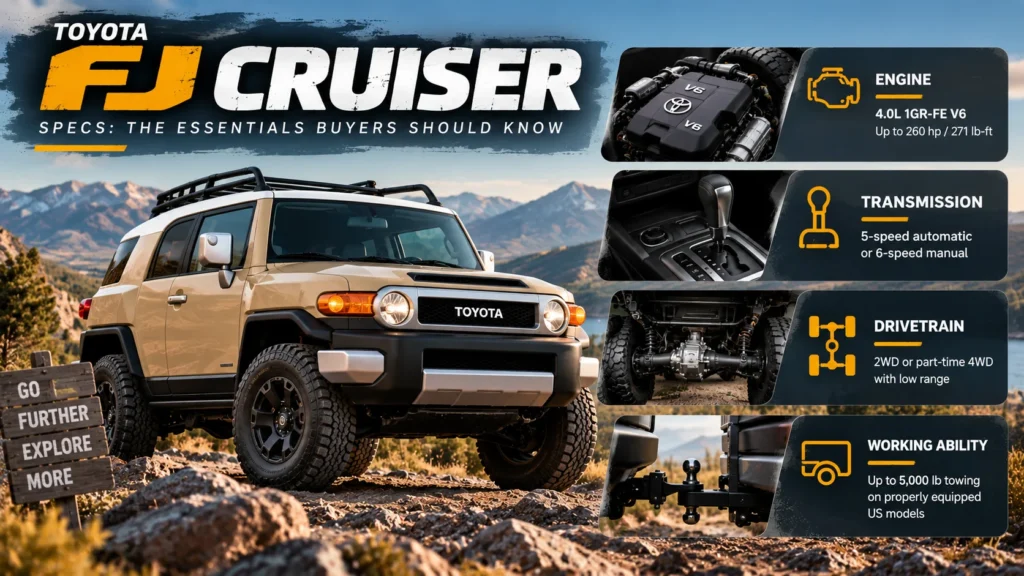
| Engine 4.0L 1GR-FE V6; up to 260 hp / 271 lb-ft | Transmission 5-speed automatic or limited-availability 6-speed manual |
| Drivetrain 2WD or part-time 4WD with low range | Working ability Up to 5,000 lb towing on properly equipped US models |
Performance: more trail tool than polished commuter
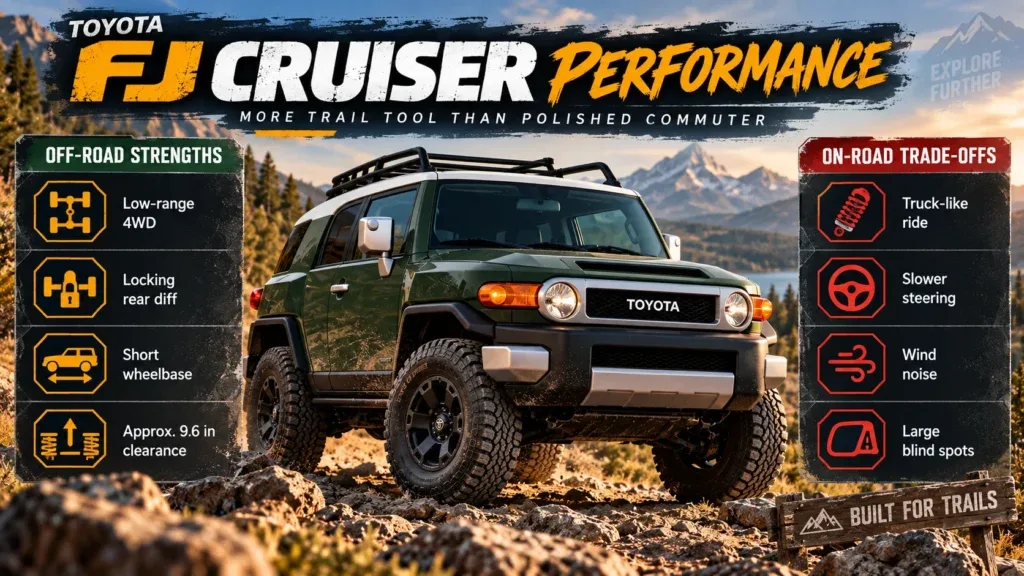
The FJ Cruiser earns its reputation off pavement. Its body-on-frame construction, short wheelbase, high seating position, low-range gearing and useful approach and departure angles help it work through ruts, loose climbs and rocky tracks. Four-wheel-drive models typically offer an electronically locking rear differential, while active traction control can brake a spinning wheel and move torque across an axle. Ground clearance is commonly quoted around 9.6 inches on standard US specifications, but suspension condition, tyre size, skid plates and added weight all affect real-world clearance.
What is an FJ Cruiser like on the road?
The V6 is generally strong enough for highway merging, towing within rating and loaded travel, but the FJ Cruiser feels like an older truck-based SUV rather than a modern crossover. Its steering is slower, body motion is more noticeable and wind noise is more apparent at speed. The large blind spots created by the thick pillars and rear-hinged rear doors are genuine daily-use compromises. A careful test drive should include parking, highway speed, uneven pavement and full-lock manoeuvres—not only a quick loop around a dealership.
Cabin, practicality, fuel economy and everyday ownership
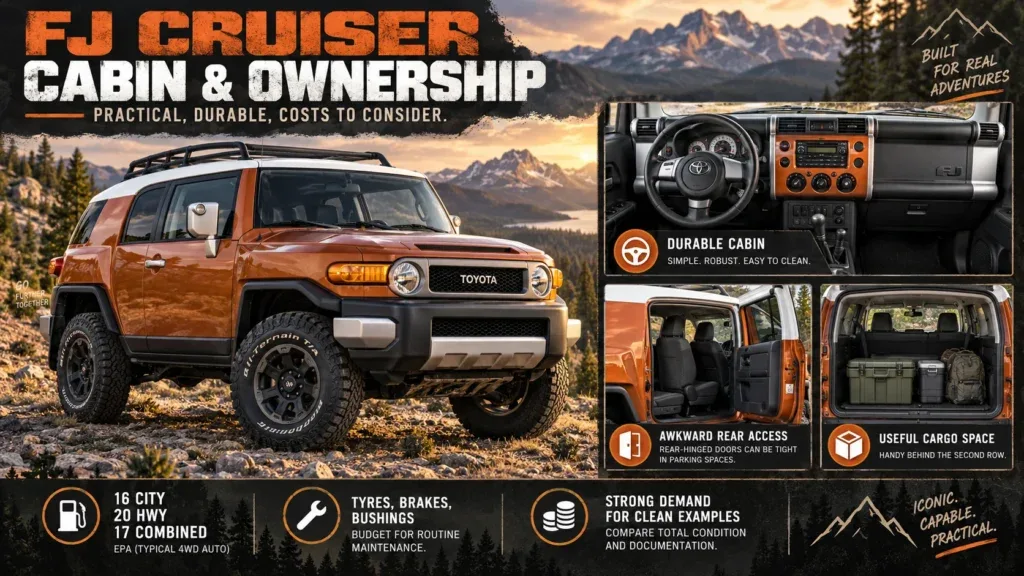
Inside, the FJ is durable rather than luxurious. Its washable surfaces and robust-looking dashboard suit outdoor use, but rear-seat access through the small rear-hinged doors can be awkward, especially in tight parking spaces. Cargo space is useful behind the second row, though the tall load floor and side-hinged tailgate deserve a hands-on check for your own equipment. Visibility forward is commanding; visibility behind the thick rear pillars is not. Families should try child seats, passenger entry and daily luggage before assuming the FJ’s compact exterior makes it easy to live with.
Fuel use is one of the clearest ownership costs. EPA ratings for a typical 4WD automatic are around 16 mpg city, 20 mpg highway and 17 mpg combined, although tyre choice, lifts, roof accessories and short trips can make real consumption worse. Budget for tyres, suspension bushings, brakes, fluid services and potentially rust repair. Clean, unmodified FJ Cruisers often command a premium because demand remains high, so compare total condition and documentation rather than choosing only on advertised mileage.
Reliability: strong fundamentals, but inspect the individual truck
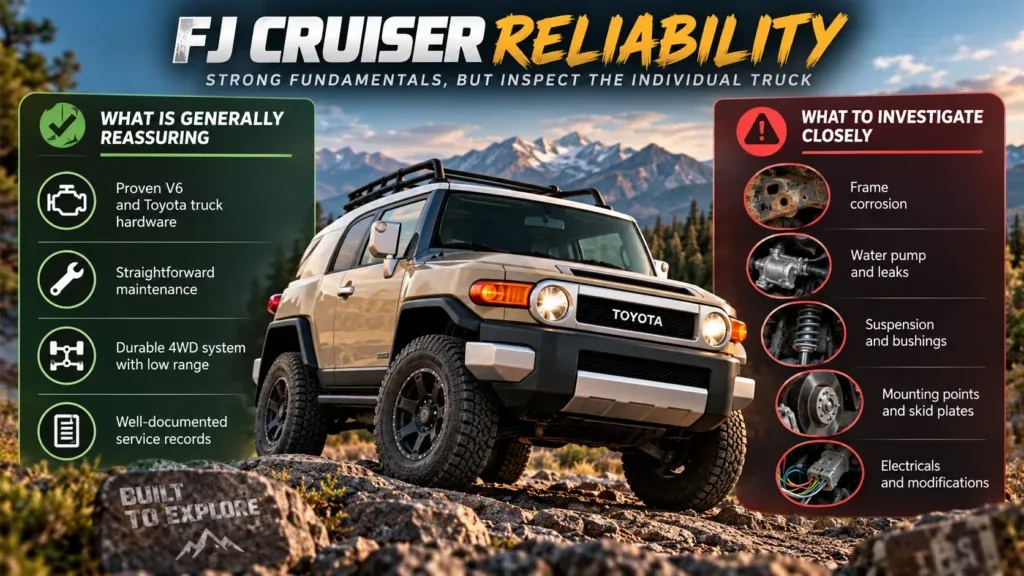
The FJ Cruiser’s 1GR-FE V6 and related Toyota truck hardware have a strong reputation when serviced properly. Many examples accumulate high mileage, but that should not be confused with a promise that every high-mile vehicle is safe to buy. Age affects rubber components, seals, wheel bearings, suspension joints, batteries, hoses and electronics. Off-road use can also leave bent skid plates, damaged mounting points, leaks and concealed chassis corrosion. A vehicle with complete service records and a clean underbody inspection is normally a better bet than a cheaper, lower-mileage example with an unclear story.
What is generally reassuring
The V6, automatic transmission and core 4WD system are widely familiar Toyota truck components. Routine maintenance, clean fluids, a smooth transmission and working low range are positive signs. A documented owner who has addressed wear items is worth more than a vague claim that the SUV is “Toyota reliable.”
What to investigate closely
Frame corrosion is the priority inspection item in salt-belt and coastal vehicles. Also check for old water-pump seepage, timing-cover oil leaks, worn suspension, driveshaft service neglect, differential leaks, cracked exhaust parts and poorly installed lights, lockers or stereo wiring. Confirm open recalls and service campaigns by VIN.
Before purchase, arrange an independent pre-purchase inspection on a lift. Ask the technician to inspect the complete frame, body mounts, lower control-arm mounting areas, skid plates, brake and fuel lines, differential housings, shock mounts and evidence of water ingress. Test 4HI, 4LO, the rear differential lock where fitted, air conditioning, all windows, rear door operation and warning lights. Modified FJ Cruiser cars are not automatically bad buys, but receipts and competent installation matter; poorly chosen lifts can compromise alignment, CV joints, braking and handling.
FJ Cruiser vs rivals: buy the use case, not the cult status
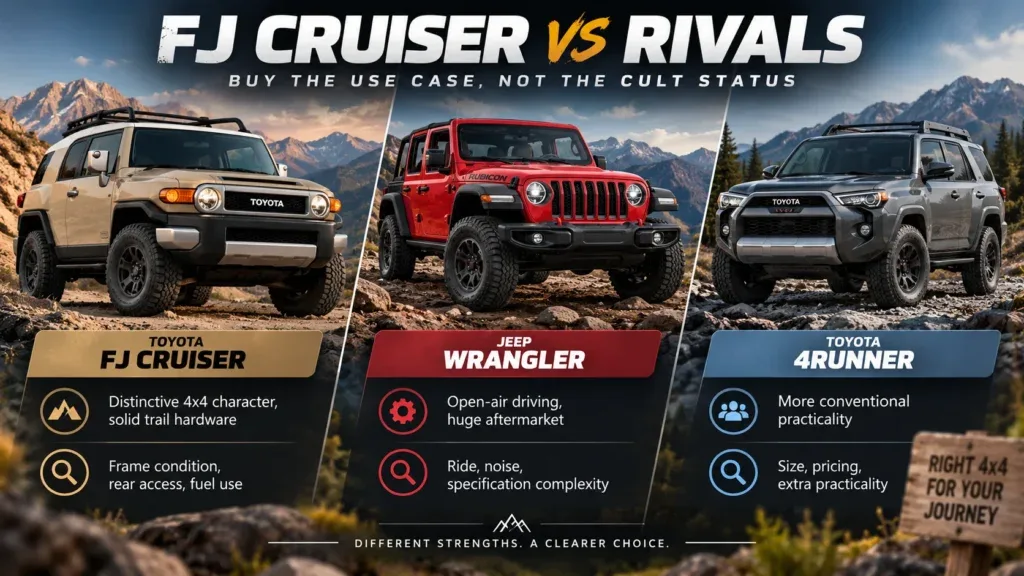
The FJ Cruiser sits between classic Toyota truck dependability and enthusiast-focused trail character. A Jeep Wrangler typically gives buyers more aftermarket choice, removable-top fun and more extreme trail variants, but has a different road-manners and ownership equation. A Toyota 4Runner generally brings easier rear-seat access, more cargo flexibility and a broader used-market selection while sharing some mechanical philosophy. The FJ remains compelling for buyers who specifically value its compact, distinctive shape and are willing to accept its visibility and practicality compromises.
| Vehicle | Strongest case | Question to investigate |
|---|---|---|
| Toyota FJ Cruiser | Distinctive Toyota 4×4 character, solid trail hardware and resale appeal | Frame condition, rear access, fuel use and modification quality |
| Jeep Wrangler | Open-air driving, huge aftermarket and dedicated trail variants | Ride, noise, specification complexity and individual maintenance history |
| Toyota 4Runner | More conventional practicality with related Toyota truck credentials | Size, pricing and whether its extra practicality suits your needs |
Should you buy an FJ Cruiser?
Buy it if…
You want a durable-feeling, factory-capable Toyota 4×4 with real personality; you can accept fuel use and awkward rear access; and you have found a well-documented, rust-free or properly protected example with a clean inspection.
Skip it if…
You need easy rear-seat access, strong fuel economy, a quiet daily commute, modern driver-assistance features or a bargain-priced used SUV. Do not buy a neglected, heavily modified or rusty FJ simply because clean examples are scarce.
The FJ Cruiser is still special because it does not feel like a generic SUV. Its styling and off-road credibility have aged well, but so have the vehicles themselves. The smartest purchase is not necessarily the lowest-mile or most aggressively modified example: it is the one with clear records, a sound frame, sensible maintenance and a specification that genuinely fits how you will drive it.
Frequently asked questions
Is the Toyota FJ Cruiser reliable?
The FJ Cruiser has strong mechanical fundamentals and the 4.0-litre V6 is widely respected, but reliability at this age depends heavily on servicing, corrosion exposure, previous off-road use and repair quality. A pre-purchase inspection is essential.
Which FJ Cruiser model year is best?
There is no universal best year because condition is more important than small year-to-year changes. Later examples may appeal for newer age and equipment, while a well-maintained early FJ can be a smarter purchase than a neglected later one. Check the exact drivetrain, service history and recall status.
How many miles is too many on an FJ Cruiser?
Mileage alone cannot answer that question. A high-mile FJ with documented fluid changes, sound compression, a clean frame and recently addressed wear items can be safer than a lower-mile example that has sat unused, been driven in road salt or poorly modified. Let inspection results guide the decision.
What should I check before buying an FJ Cruiser?
Inspect the full frame and underbody for corrosion or off-road damage, verify the 4WD system and rear locker where fitted, check for leaks and suspension wear, review service records, scan for fault codes, inspect aftermarket wiring and confirm recalls by VIN. A lift inspection by an independent Toyota or 4×4 specialist is money well spent.