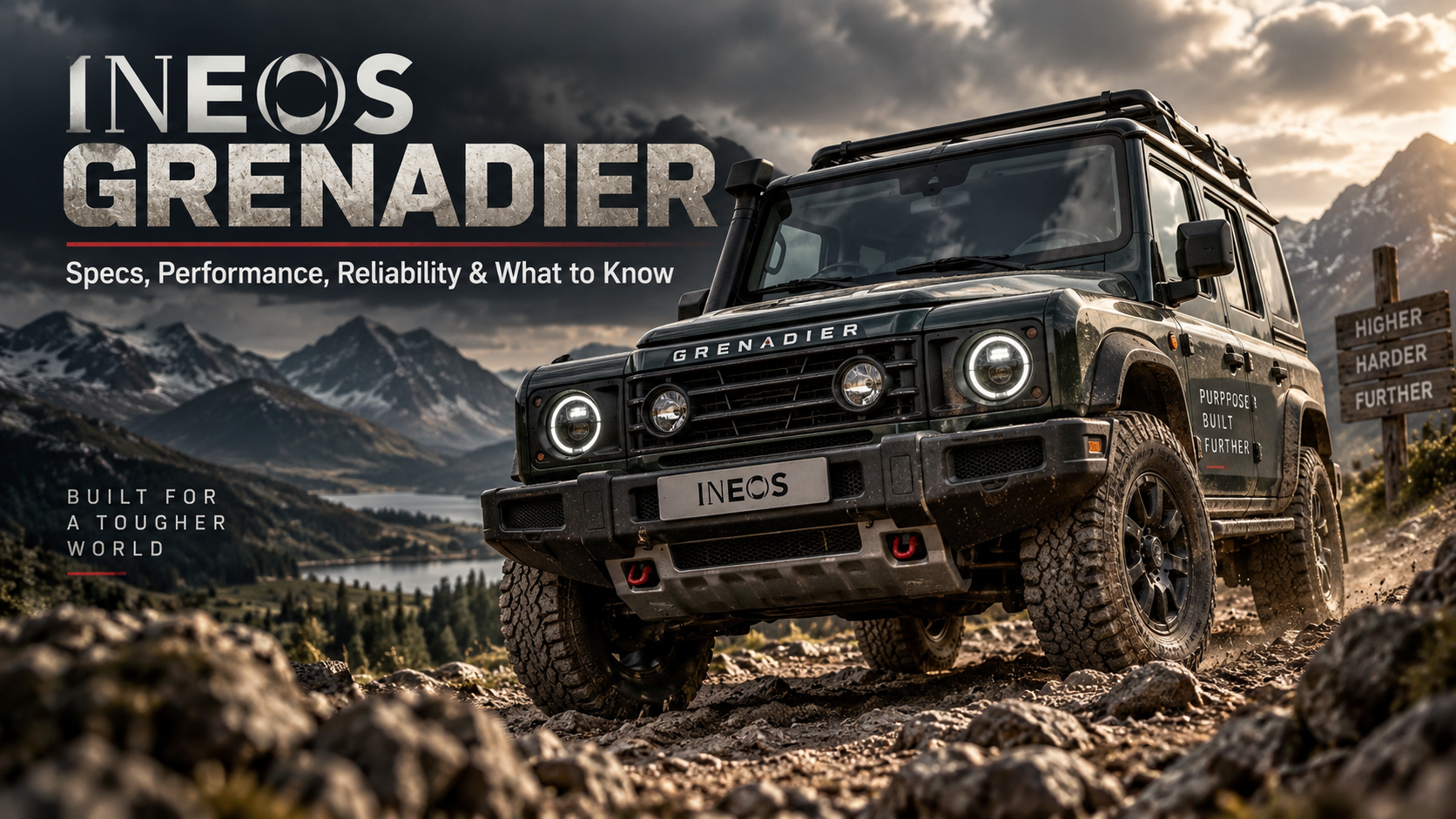

A practical, evidence-led look at the Grenadier SUV: what its old-school hardware does brilliantly, where a new brand asks for patience, and who should consider it over more established 4x4s.
A rare purpose-built 4×4 — with a new-brand ownership question mark.
The INEOS Grenadier is compelling if you value mechanical off-road capability, towing confidence and tough touring credentials more than fuel thrift or sophisticated road manners. Its long-term record is still emerging, so local service access and warranty terms deserve as much scrutiny as the spec sheet.
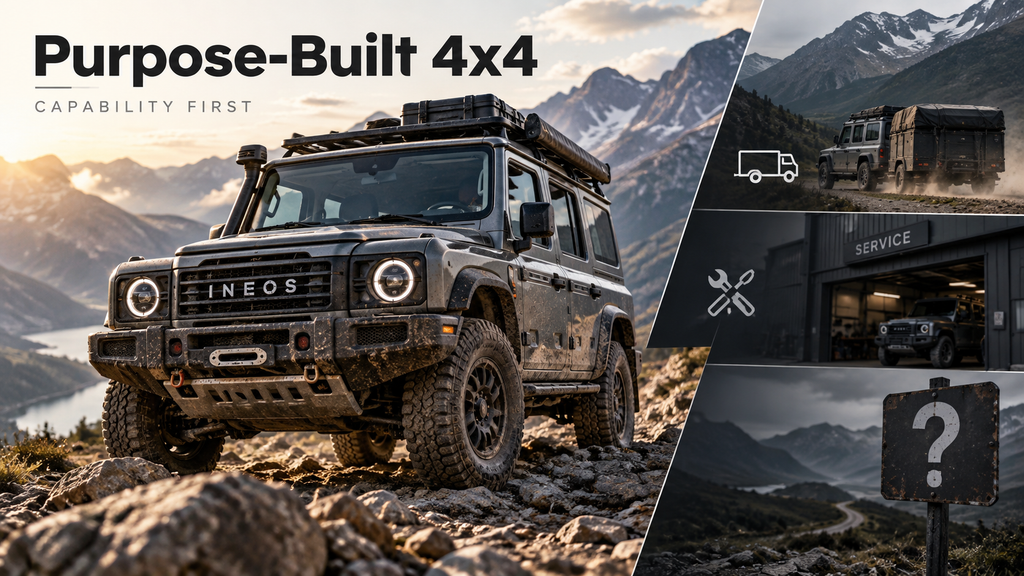
The Grenadier is deliberately different from most modern luxury SUVs. INEOS built it around a separate ladder frame, permanent four-wheel drive, a two-speed transfer case and solid axles — the ingredients buyers expect from a serious work-and-expedition vehicle. That formula gives the Grenadier genuine credibility away from paved roads. It also explains why it can feel heavier, thirstier and less polished than a car-based SUV on the daily commute.
Core Grenadier specs: designed around proven hardware
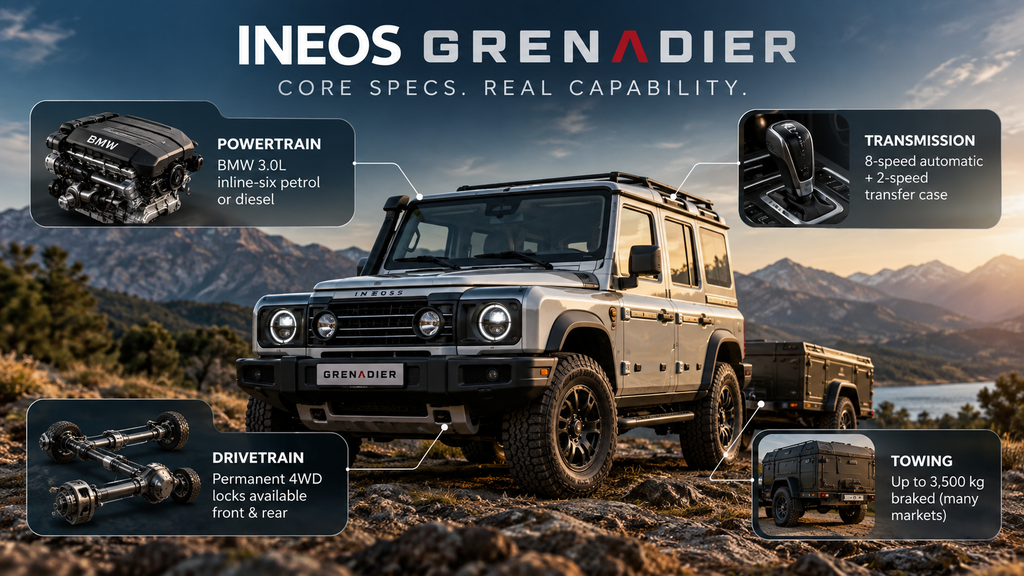
Most Grenadier Station Wagon markets use BMW-supplied 3.0-litre inline-six petrol or diesel engines, paired with an eight-speed automatic transmission. The permanent 4WD system combines a centre differential with low range; optional front and rear locking differentials are a key distinction for buyers who will use the vehicle in difficult terrain. Exact output, availability and certification differ by market, so treat the figures below as a familiar reference point rather than a purchase-order specification.
| Powertrains BMW 3.0L inline-six petrol or diesel | Transmission 8-speed automatic + 2-speed transfer case |
| Drivetrain Permanent 4WD; locks available front & rear | Working ability Up to 3,500 kg braked towing in many markets |
Performance: exceptionally capable off-road, intentionally uncompromised
The Grenadier SUV’s off-road case rests on hardware, not simply drive modes. Its robust frame, beam axles, low-range gearing and available differential locks give it the articulation and traction tools needed for rutted climbs, loose surfaces and slow technical work. Published Grenadier figures commonly cite 264 mm of ground clearance, approach and departure angles around 35.5° and 36.1°, and an 800 mm wading depth — numbers that place it firmly among serious factory 4x4s. Tyres, accessories and load can materially change real clearance and angles.
What is it like on the road?
On pavement, the Grenadier’s mass and live-axle layout are noticeable. It is stable and direct enough for long-distance touring, while the BMW six-cylinder engines provide useful pulling power. But it is not a soft, luxury-first crossover: road noise, fuel consumption, parking bulk and ride reactions over broken surfaces are likely to matter to daily commuters. A proper back-to-back test drive with a Defender or Land Cruiser is more revealing than a short urban loop.
Cabin, practicality and everyday ownership
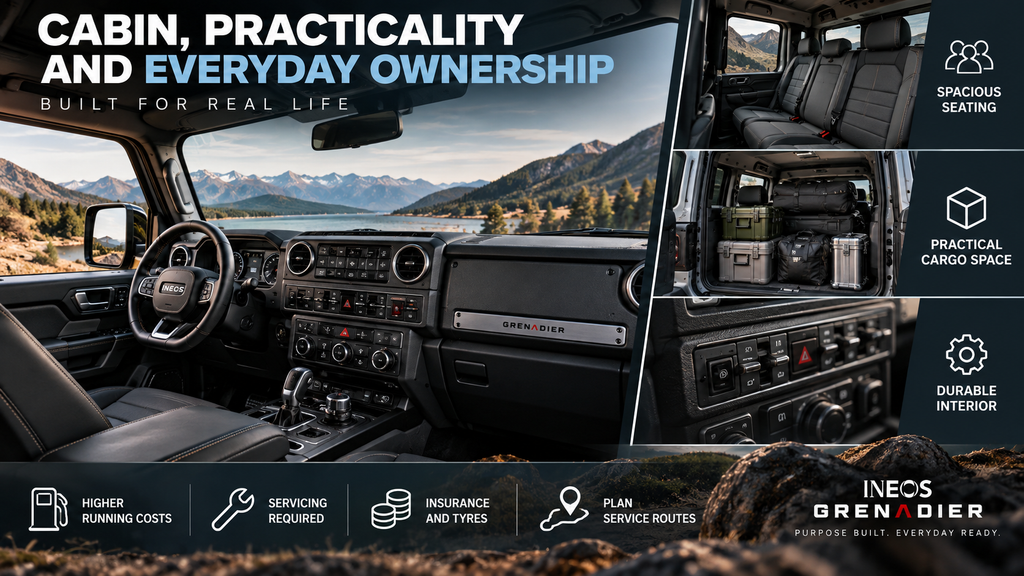
Inside, the Grenadier favours durable-looking materials, physical controls and a broad dashboard over the screen-heavy minimalism found in many premium SUVs. The five-seat Station Wagon is the mainstream choice; the commercial-oriented Quartermaster pickup and Utility Wagon may suit work-led buyers better where offered. For families, inspect rear access, child-seat fit, luggage volume with your exact seating arrangement and roof-load needs. The upright shape is useful, but it does not automatically make the Grenadier the roomiest vehicle in every comparison.
Running-cost expectations should be realistic. A heavy, permanent-4WD petrol or diesel 4×4 will not match hybrid SUVs for fuel use, while insurance, tyres, servicing and accessory fitment can be meaningful costs. Ask a local retailer for written service intervals, labour pricing, parts lead-time policy and roadside-assistance details. Remote-tour buyers should also map authorised service points along the routes they genuinely intend to drive.
Reliability: promising ingredients, not yet a decades-long record
The honest answer is that the INEOS Grenadier is too new to have the long, high-mileage reliability evidence available for a Toyota Land Cruiser or established Jeep platform. Its use of major supplier components — including BMW engines and a ZF automatic transmission — may reassure some buyers, but a vehicle’s long-term dependability also depends on calibration, electronics, seals, wiring, supplier logistics and dealer repair quality. Early owner stories are useful signals, not statistical proof.
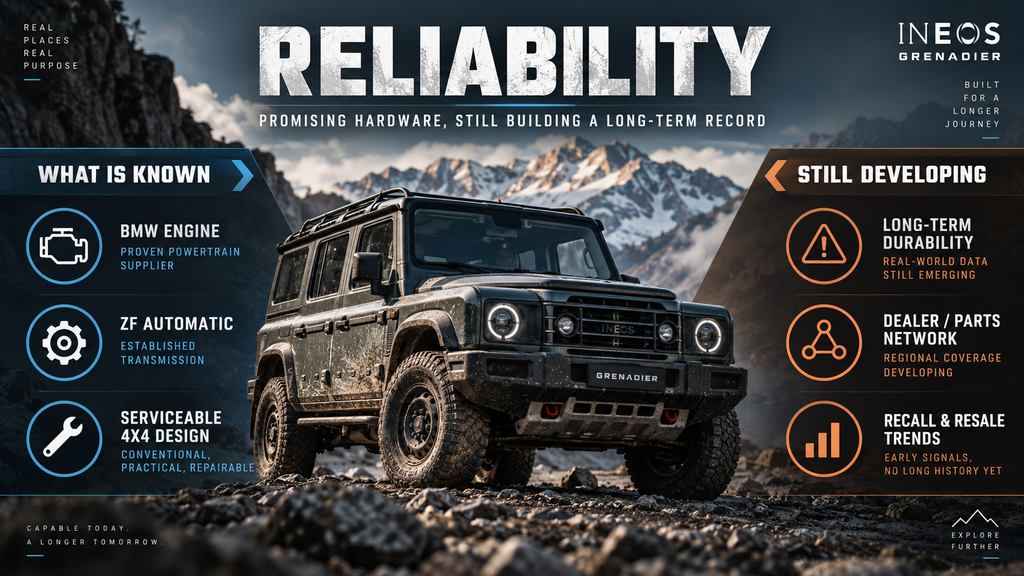
What is known
The Grenadier uses conventional, serviceable 4×4 architecture and well-known powertrain suppliers. This can be an advantage for repair familiarity, but it does not eliminate the need for model-specific diagnostics and parts.
What is still developing
Fleet-scale durability data, resale patterns and the maturity of regional parts and service networks remain developing. Check recall status by VIN and ask how technical campaigns are handled locally.
Before signing, verify warranty coverage and exclusions in writing, identify your nearest authorised workshop, and ask what happens if a vehicle becomes immobilised far from that workshop. Those answers are especially important for owners in remote areas or markets with a smaller retail footprint.
Grenadier vs rivals: choose the mission, not the mythology
The closest alternatives depend on your priority. The Land Rover Defender usually offers more comfort, technology and dealer familiarity in many regions, while the Grenadier leans harder into simple mechanical 4×4 hardware. The Toyota Land Cruiser is the benchmark for global reputation and likely resale confidence, though availability and specification vary dramatically by market. A Jeep Wrangler remains a highly configurable trail tool, but it has a different towing, refinement and cargo-use case.
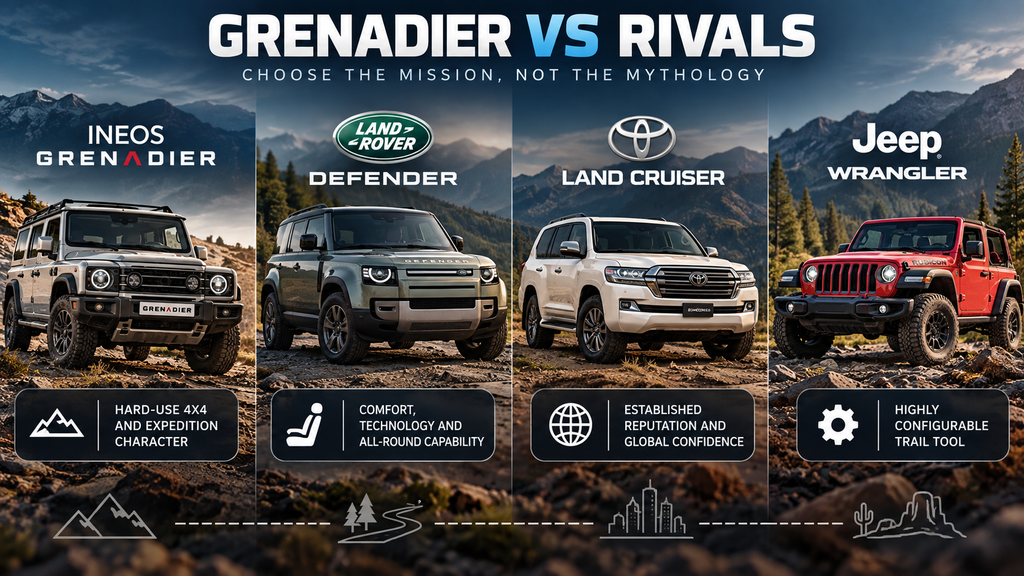
| Vehicle | Strongest case | Question to investigate |
|---|---|---|
| INEOS Grenadier | Hard-use 4×4 hardware, towing and expedition character | Local service reach, fuel costs and long-term data |
| Land Rover Defender | Comfort, technology and broad all-round capability | Option cost, complexity and model-specific reliability record |
| Toyota Land Cruiser | Established reputation and global touring confidence | Price, supply and equipment vary widely by country |
Should you buy the Grenadier?
Buy it if…
You want a distinctive, factory-built 4×4 with genuine low-range ability, useful towing credentials and a practical platform for touring, work or off-grid travel — and you have convenient access to a capable authorised service centre.
Skip it if…
Your priority is maximum fuel efficiency, the softest urban ride, dense dealer coverage, established depreciation data or the reassurance of a long-running model with decades of reliability evidence.
The Grenadier is not trying to be every kind of SUV. That is its strength — and its limitation. If its mission matches yours, it is one of the most interesting new rugged 4x4s available. Just make the purchase decision with a clear-eyed view of local support, total ownership cost and the fact that a young brand’s long-term story is still being written.
Frequently asked questions
Is the INEOS Grenadier genuinely capable off-road?
Yes. Its ladder frame, permanent four-wheel drive, low-range transfer case, solid axles and available differential locks give it serious trail hardware. Real-world ability still depends on tyres, payload, driver technique and route conditions.
How reliable is the Grenadier?
The long-term record is still developing because the Grenadier is a young model. BMW engines and a ZF automatic may reassure buyers, but local diagnostics, parts supply, warranty support and authorised workshop quality deserve careful checking.
Is the Grenadier comfortable enough for daily driving?
It is usable for everyday travel and long-distance touring, but its weight, live-axle layout, road noise, fuel consumption and parking size are more noticeable than in a comfort-first crossover. A back-to-back test drive is essential.
What should I check before buying one?
Confirm the exact market specification, warranty exclusions, service intervals, towing and payload limits, recall status, nearest authorised workshop and expected parts lead times. Also price insurance, tyres, fuel and recovery equipment for your intended use.