A dead battery can feel urgent, but the safest way to jumpstart a car is slow, deliberate and methodical. Follow this cable order, know when to stop, and get back on the road with more confidence.
The cable order
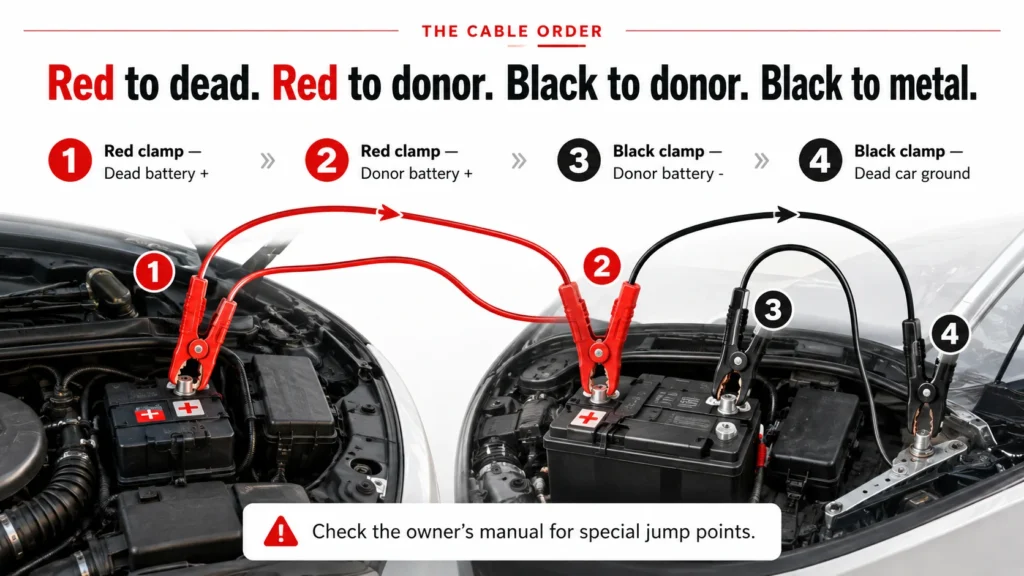
Red to dead. Red to donor. Black to donor. Black to metal.
This is the standard sequence for conventional 12-volt systems. Your owner’s manual takes priority if your vehicle specifies a different jump point or procedure.
| 1 · Red clamp Dead battery + | 2 · Red clamp Donor battery + |
| 3 · Black clamp Donor battery − | 4 · Black clamp Dead car ground |
Knowing how to jumpstart a car can save a long wait for roadside assistance, but it is not a job to rush. A spark near a battery can be dangerous, and connecting the clamps in the wrong order can damage electrical components. Before you touch a cable, take a minute to confirm that the battery is a sensible and safe suspect.
A weak battery often causes a slow crank, clicking noise, dim interior lights or a dashboard that lights up without the engine turning over. If you have a hybrid, EV, vehicle with a remote battery terminal, or a newer model with a specific under-hood jump post, check the owner’s manual first. The procedure below is intended for typical 12-volt passenger vehicles.
Stop before you start
Safety checks before you jump a car battery
Park the donor vehicle close enough for the cables to reach, but never let the vehicles touch. Shift both into Park or Neutral, set both parking brakes, switch off lights and accessories, and remove loose clothing or jewelry. Identify the positive terminal first: it is usually marked with a plus sign and may have a red cover. The negative terminal is marked with a minus sign.
Do not attempt a jump if the battery looks unsafe
Do not jumpstart a battery that is cracked, leaking, swollen, severely corroded, giving off a strong sulfur smell, or frozen. Move away from the vehicle and contact roadside assistance or a qualified technician. Also stop if you are unsure whether the vehicle uses a standard 12-volt battery system.
Prepare your setup
What you need to jumpstart a car
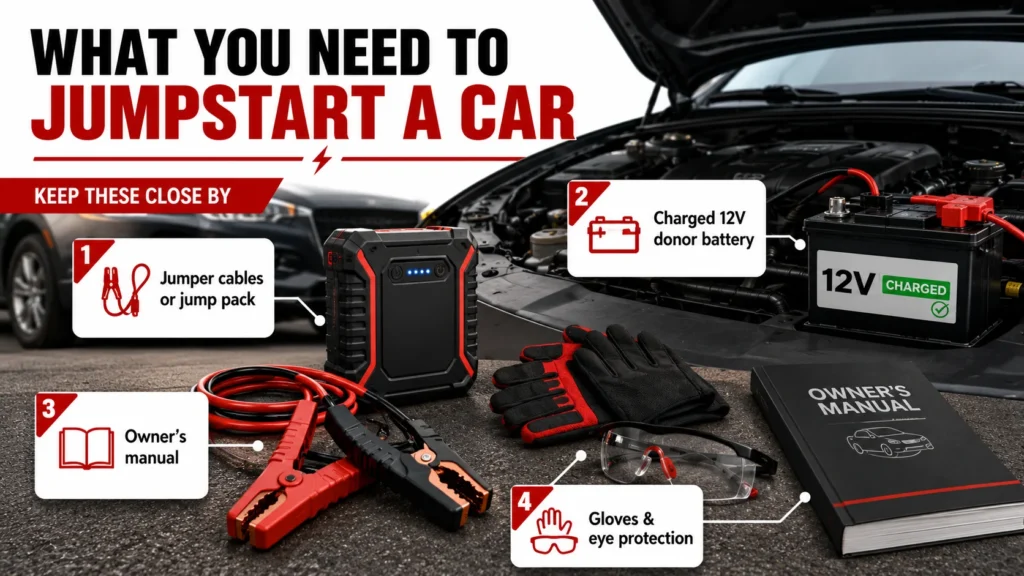
You need a compatible donor vehicle with a charged 12-volt battery, or a properly charged portable jump starter. Use good-condition jumper cables with insulated clamps. Avoid cables with exposed wire, loose clamp jaws or damaged insulation.
Keep these close by
- Jumper cables or a jump pack rated for your vehicle’s battery system.
- Your vehicle owner’s manual, especially for remote jump terminals.
- Protective gloves and eye protection if available, particularly around corrosion.
The safe sequence
How to jump start a car, step by step
Keep the cable clamps from touching one another once they are connected. Attach one clamp at a time and make sure each clamp has a firm grip on clean metal.
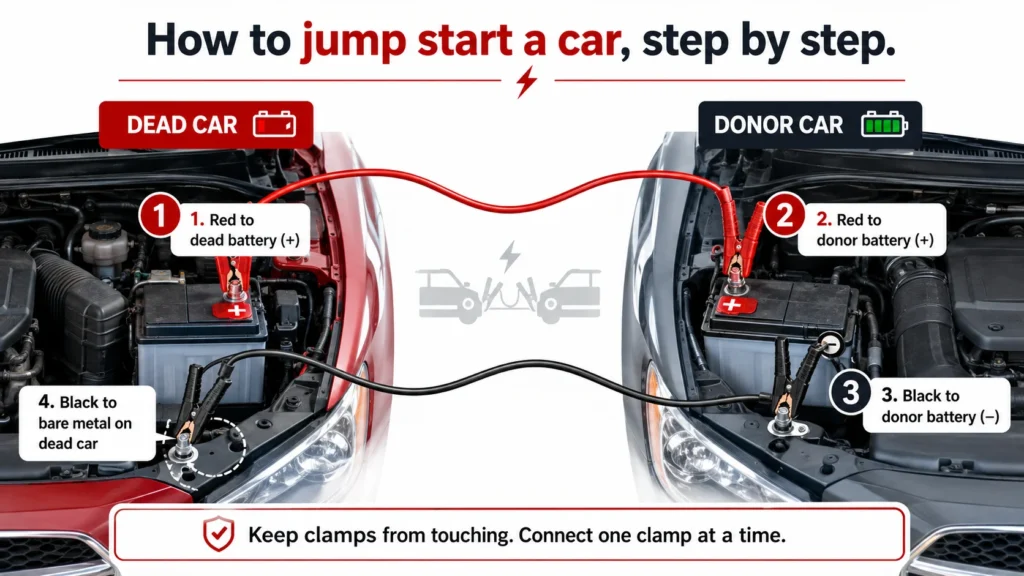
Red to the dead battery
With both engines off, connect one red positive clamp to the positive (+) terminal on the dead battery.
Red to the donor battery
Connect the other red positive clamp to the positive (+) terminal on the donor vehicle’s battery.
Black to the donor battery
Connect one black negative clamp to the negative (−) terminal on the donor battery.
Black to bare metal on the dead car
Connect the final black clamp to an unpainted metal engine bracket or designated grounding point on the dead car, away from the battery and moving parts.
Start the donor, then the dead vehicle
Start the donor vehicle and let it idle for a few minutes. Then try to start the vehicle with the dead battery. Do not crank for more than about five seconds at a time. If it does not start, wait a minute before trying again. If it still will not start after a few attempts, stop rather than repeatedly cranking the engine.
Once the engine is running
Remove the cables in reverse order
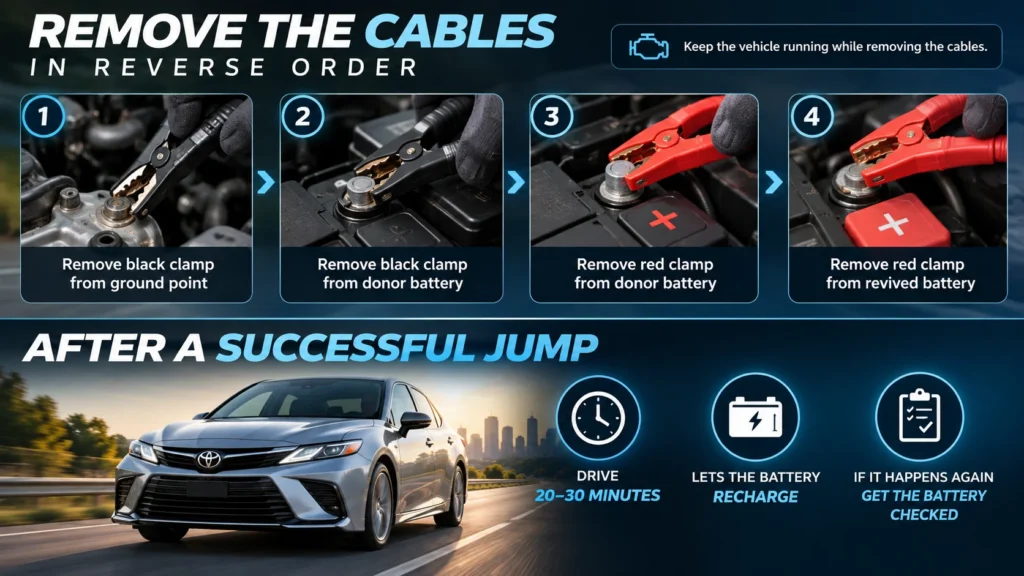
Leave the revived vehicle running. Remove the clamps carefully in the reverse order of connection, keeping clamps away from belts, fans and each other.
Removal order: ground, donor negative, donor positive, dead positive
First remove the black clamp from the grounded metal point on the revived car. Next remove the black clamp from the donor battery, then the red clamp from the donor battery, and finally the red clamp from the revived battery.
What to do after a successful jump
Drive the car for at least 20 to 30 minutes if it is safe to do so, limiting high electrical loads where practical. A jump gets the engine started; it does not prove the battery is healthy. If the vehicle needs another jump soon, have the battery and charging system tested. A weak battery, failing alternator, loose connection or parasitic drain may be the real cause.
Automatic or manual
Check your transmission before you try
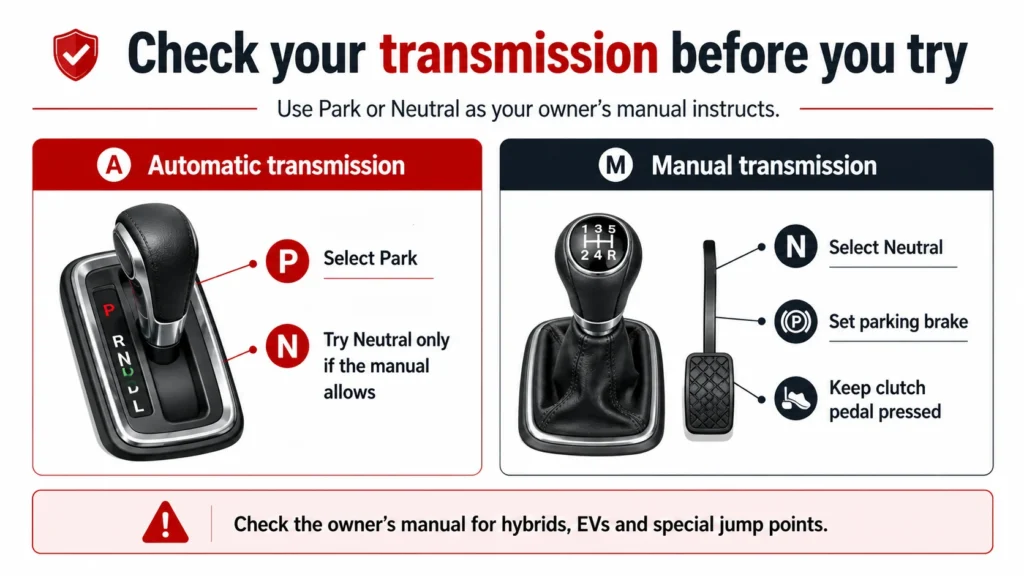
Most modern vehicles should be jumpstarted in Park or Neutral with the parking brake set. Follow the owner’s manual whenever its instructions differ, especially for hybrids, EVs and vehicles with special jump points.
Automatic transmission
Select Park. If the engine does not crank, try Neutral only if the manual permits it, and keep your foot on the brake.
Manual transmission
Select Neutral, set the parking brake firmly, and keep the clutch pedal depressed while starting. Do not push-start a modern vehicle unless the manual specifically allows it.
A cable-free option
Using a portable jump starter
Choose a jump pack with enough peak current for your engine size and a battery that is fully charged. Switch the pack off before connecting its clamps, attach positive to positive and negative to the vehicle’s designated ground, then switch it on and start the car.
Keep the pack away from water and moving parts. Never allow the clamps to touch, and disconnect it as soon as the vehicle is running according to the manufacturer’s instructions.
Avoid the next flat battery
Small habits that protect your battery
Turn off lights, climate controls and accessories before switching the engine off. Keep terminals clean and tight, inspect for corrosion, and avoid leaving the car parked for long periods without a suitable maintainer. If the battery is several years old, have its capacity and the charging system tested before winter or a long trip.
If it still will not start
A jump start cannot solve every no-start problem
If the dash lights are bright but the engine will not crank, the issue may be a starter, ignition, neutral-safety switch or another electrical fault. If the engine cranks normally but does not run, fuel, spark or engine-management issues may be involved. Repeated clicking, a burning smell, smoke, or warning messages are all reasons to stop.
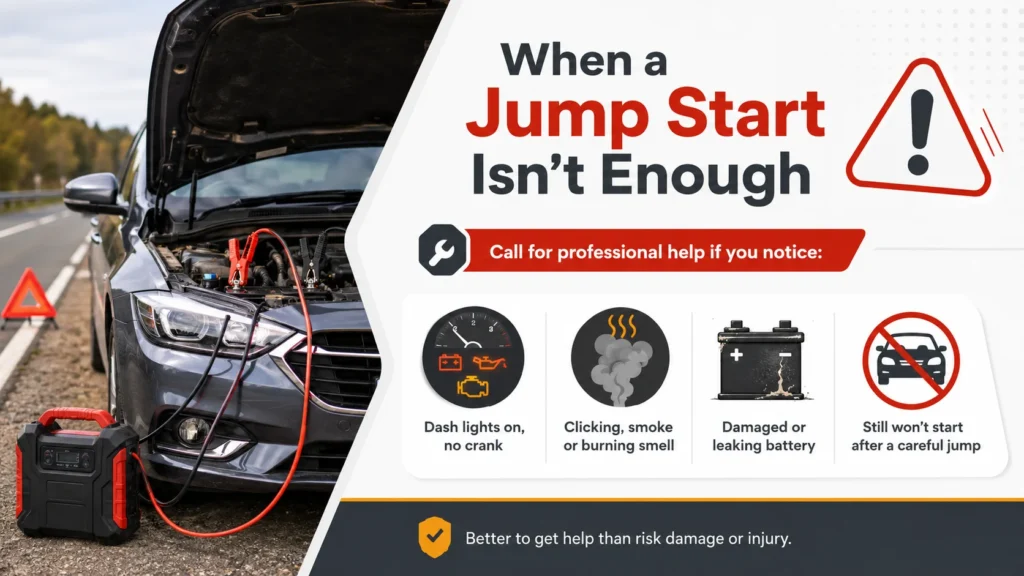
When to call for professional help
Call roadside assistance or a qualified technician if the battery is visibly damaged, the vehicle will not start after a careful jump attempt, you are unsure where to attach the final ground clamp, or your manual gives a special hybrid, EV or remote-terminal procedure. It is better to get help than risk damage to the vehicle or injury to yourself.
Roadside reminder
The last black clamp goes to metal — not the dead battery.
Using a clean, unpainted grounding point away from the battery helps reduce the chance that a normal connection spark occurs near battery gases.
Common questions
Jumpstarting a car FAQs
Use these practical answers as a final check before connecting the cables.
How long should I let a car run before trying to jump it?
Start the donor vehicle and let it idle for a few minutes before trying the dead car. Extremely weak batteries may need more time, but do not keep attempting to crank the dead vehicle repeatedly.
Can I jumpstart a car with a portable jump starter?
Yes, if the jump starter is charged and rated for your engine size and battery type. Follow the jump pack manufacturer’s instructions, especially its clamp order and indicator lights.
Why should the final negative clamp go to metal?
The final connection can create a small spark. Attaching it to a grounding point away from the dead battery reduces the chance of igniting flammable gases that can be present around a battery.
Will driving recharge a completely dead battery?
Driving may restore some charge, but a deeply discharged or aging battery may not recover fully. A proper battery test and charger are more reliable ways to assess its condition.