
A practical BMW maintenance guide covering Condition Based Service, mileage intervals, fluid services, run-flat tires, common costs and the repair reserve that matters after warranty coverage ends.
A BMW can be rewarding to own, but it needs a maintenance plan that is specific to its engine, mileage, use and service history.

For a well-kept, non-M BMW outside included maintenance coverage, many U.S. owners may plan roughly $1,000–$2,000 per year for routine service and normal wear. Older, high-mileage, xDrive, plug-in hybrid and M models can require materially more.
BMW maintenance costs are easy to oversimplify. One owner may report a quiet year with only an oil service and filters, while another is facing tires, brakes, a battery and age-related repairs at the same time. Both experiences can be real. The useful question is not whether every BMW is expensive to maintain, but what your exact BMW is likely to need, when it is likely to need it, and how much financial room you should keep for the unexpected.
01 / The ownership question
Are BMWs expensive to maintain?

Compared with many mainstream vehicles, BMWs can cost more to maintain because they use premium parts, sophisticated electronics, turbocharged engines, performance-oriented brakes and tires, and labor procedures that benefit from BMW-specific diagnostic knowledge. xDrive hardware, adaptive suspension, plug-in hybrid systems and M-car components can add further complexity where fitted.
That does not mean every BMW is automatically costly or unreliable. A newer 3 Series with a complete service history can be more predictable than a neglected luxury SUV, while an older 7 Series with deferred maintenance may be expensive regardless of purchase price. Model year, engine family, local labor rates, driving style and prior care all shape the real ownership cost.
Maintenance is not the same as repairs
Scheduled maintenance includes planned work such as oil, filters, brake fluid, spark plugs, inspections, tires and brake wear items. Repairs cover failures or faults: cooling-system leaks, sensors, water pumps, suspension wear, electronics, oil leaks or drivetrain issues. Online cost estimates often blend these categories together, which is why annual figures can look contradictory.
02 / Service timing
BMW maintenance schedule: the practical checklist
BMW uses Condition Based Service (CBS) on many modern vehicles. The car monitors time, mileage, driving conditions and—in some cases—component condition to estimate when service is due. The dashboard reminder is useful, but it does not replace the model-specific owner’s manual, warranty booklet or service information for your VIN.
What BMW Condition Based Service means

CBS can display remaining mileage or time for oil service, brake fluid, vehicle inspection, front or rear brakes, filters and other items. Treat it as a planning tool—not permission to ignore warning lights, leaks, unusual noises or a service item your vehicle documentation calls for earlier.
Intervals vary by engine, model year and market. Use the following as a planning checklist rather than a universal BMW maintenance plan. Severe heat, dust, short trips, heavy traffic, towing, track driving and long periods of storage can justify more frequent inspection or service.
| Planning interval | Service or inspection | Why it matters |
|---|---|---|
| Every month / fuel fill | Check tire pressures, warning lights, fluid leaks, exterior lights and tire tread. | Low tire pressure and uneven wear can quickly raise tire, fuel and suspension costs. |
| CBS reminder or vehicle schedule | Engine oil and filter service; inspect brakes, tires and underbody. | Short trips, hard use and stop-start driving can be tougher than highway miles. |
| About every 2 years on many models | Brake fluid replacement and battery-condition assessment. | Brake fluid is time-sensitive; AGM battery replacement often needs registration. |
| Scheduled / inspection based | Cabin microfilter, engine air filter and spark plugs as applicable. | Engine family and operating conditions affect the exact timing. |
| Mileage and model specific | Review transmission, transfer-case, differential and coolant requirements. | Do not assume every fluid has the same interval or applies to every drivetrain. |
Always verify the exact service requirements through your BMW’s onboard menu, owner’s manual and VIN-specific maintenance documentation. A qualified BMW workshop can also identify open recalls, software campaigns and model-specific service actions.
03 / Typical workshop work
Common BMW maintenance services and costs

Typical U.S. service pricing checked September 2026. These broad ranges include parts and labor context, but local dealer pricing, independent-shop rates, engine layout, wheel size and fitted options can change the final invoice substantially.
| Service item | When it may be due | Typical U.S. range |
|---|---|---|
| Oil and filter service | CBS reminder / vehicle-specific schedule | About $150–$350; more for M and larger-engine models |
| Pads and rotors | Wear-based; front and rear vary | Roughly $700–$2,000+ per axle depending on model |
| Spark plugs | Engine and model-year specific | Often $300–$900+; labor access matters |
| Cabin and engine filters | Scheduled or inspection-based | Approximately $100–$350 combined |
| Battery registration and replacement | Condition- and age-based | About $300–$700+ depending on battery type |
04 / Beyond oil changes
Coolant, transmission and differential fluid service

Oil service is only one part of long-term BMW care. As a vehicle ages, fluid condition, seepage, cooling-system health and the service history of its transmission and all-wheel-drive components become increasingly important. The correct approach is model-specific rather than a blanket interval for every BMW.
Cooling-system checks
Check coolant level only as directed by the owner’s manual and investigate any recurring low level, visible leak, sweet smell, overheating warning or dried residue around hoses and components. Water pumps, thermostats, expansion tanks, hoses and seals are repair items that can become relevant with age, depending on the engine family.
Transmission, transfer-case and differential fluids
Service needs differ among rear-wheel-drive, xDrive, automatic, manual and M models. Some owners and specialists choose preventative driveline-fluid service as mileage rises, particularly where towing, stop-start driving or performance use is involved. Confirm approved fluid specifications and the interval for the exact gearbox and drivetrain before authorizing work.
05 / The high-wear items
Run-flat tires, alignment and brake wear

Tires are one of the biggest variables in BMW ownership. Wide wheels, staggered fitments, performance compounds and run-flat tires can make a replacement set far more expensive than a standard family-car tire. Check pressures when cold, inspect inner tread wear and have alignment checked after pothole impacts, suspension work or uneven wear.
Run-flat tires can allow limited travel after a pressure loss, but they still need careful inspection after a puncture or low-pressure warning. Do not assume a run-flat can always be repaired, and do not exceed the vehicle’s stated reduced-speed and reduced-distance guidance. Brake sensors, pad wear, rotor condition and driving style should also guide brake planning—not mileage alone.
06 / The badge is not the whole story
BMW maintenance cost by model family
A model family offers a useful starting point, but a specific powertrain and option list still matter. A rear-wheel-drive four-cylinder sedan and a twin-turbo V8 luxury model may share the BMW roundel while having very different tire, brake, cooling and diagnostic exposure.

BMW 3 Series maintenance cost
The 3 Series is often one of the more approachable ways into BMW ownership, especially in a well-maintained four-cylinder configuration. Costs rise with xDrive, larger wheels, performance trims, older turbocharged engines and neglected history. Budget for brakes, tires and scheduled engine work rather than focusing only on oil changes.
BMW 5 Series maintenance cost
A 5 Series typically adds size, equipment and luxury features, which can raise service and repair exposure compared with an equivalent 3 Series. Six-cylinder, plug-in hybrid and V8 versions deserve especially careful model-specific research. A documented history is more valuable than a bargain purchase price on a complex executive sedan.
BMW X3 and X5 maintenance costs
BMW SUVs may bring xDrive, heavier curb weight, larger wheels and more expensive tire and brake packages. An X5 can also have more expensive suspension, cooling and luxury-equipment exposure than a smaller X3. Towing, rough roads and frequent short trips can accelerate wear, so the vehicle’s actual use should inform the budget.
BMW M car maintenance costs
M models generally require a larger maintenance and repair reserve. High-output engines, performance cooling, specialized fluids, large brakes, wide tires and track use can all increase costs. Buy based on the exact car’s records, modifications and inspection results—not on a standard BMW ownership estimate.
07 / Protect the ownership budget
How to reduce BMW maintenance costs without cutting corners
The lowest invoice is not always the lowest ownership cost. Preventative inspections, accurate diagnostics and quality parts can help avoid repeat visits and consequential damage. The goal is informed spending, not delaying every recommendation.
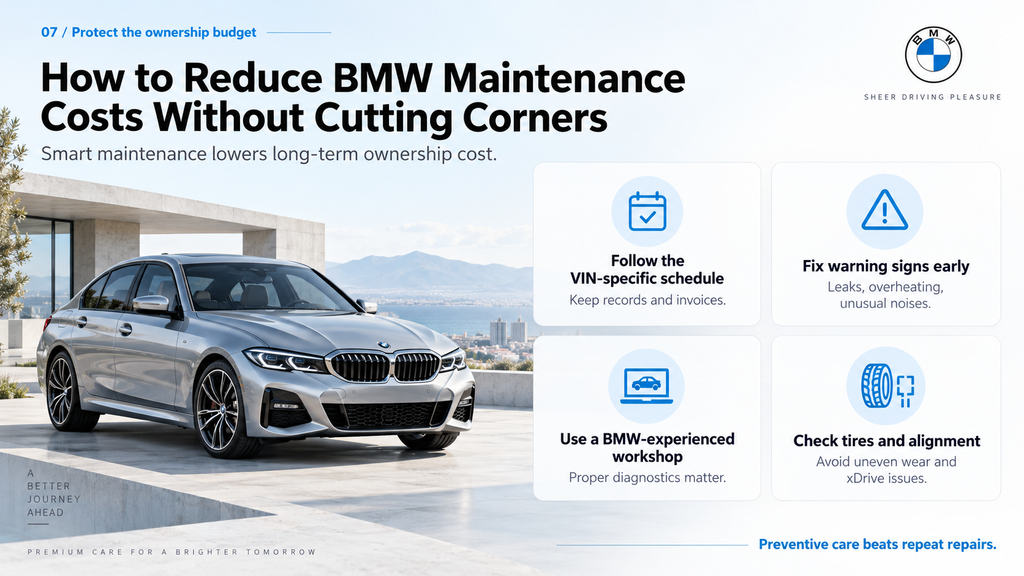
- Follow the VIN-specific service schedule and keep every invoice. Clear records improve resale confidence and make future diagnosis easier.
- Address warning lights, leaks, overheating concerns and unusual driveline noises early, before a small issue becomes a larger repair.
- Use a BMW-experienced workshop with the right diagnostics, especially for electrical faults, programming, xDrive and complex drivetrain work.
- Check tires regularly, keep alignment in specification and avoid mixing incompatible tire types or significantly mismatched tread depth on xDrive vehicles.
08 / Before you buy
Used BMW maintenance: what to check before buying
A used BMW is not automatically risky, but it should be purchased with more evidence than a clean exterior and a low advertised price. A pre-purchase inspection from a BMW-qualified technician can reveal deferred service and faults that are not obvious during a brief test drive.
- Review invoices for oil service, brake fluid, filters, spark plugs, tires, brakes and any drivetrain-fluid work applicable to that model.
- Confirm open recalls, software campaigns, warning lights and a diagnostic scan for stored faults before committing.
- Inspect cooling-system condition, leaks, battery health, suspension wear, steering feel, tire age and uneven tread wear.
- Ask about tuning, track use, accident repairs, water damage and modifications. Documentation matters because modifications can affect reliability, warranty and insurance.
A practical ownership reserve
How much should you budget each year for BMW maintenance?

Separate predictable scheduled work from a repair reserve. The figures below are planning ranges rather than promises, and exclude insurance, fuel, depreciation, registration and finance costs.
| Ownership profile | Routine annual planning | Repair reserve to consider |
|---|---|---|
| Newer BMW with coverage | Plan for tires, brakes and non-covered consumables; scheduled service may be partially included. | Keep a modest contingency because coverage terms and wear-item exclusions vary. |
| Out-of-warranty daily driver | Many owners plan roughly $1,000–$2,000 yearly for scheduled work and normal wear. | Add meaningful flexibility for age-related repairs, especially with incomplete records. |
| M, V8, luxury or complex SUV | Budget above the standard-car range for fluids, brakes, tires and specialist labor. | Maintain a larger reserve; a single major component can exceed a routine-service year. |
Frequently asked questions
BMW maintenance cost FAQs
How much does BMW maintenance cost per year?
There is no universal figure. For many out-of-warranty BMWs, $1,000–$2,000 can be a reasonable routine-service and wear-item planning range, but repairs, tires, mileage and model choice can push a real ownership year well above it.
Does BMW Condition Based Service replace inspections?
No. CBS is valuable for tracking scheduled needs, but it cannot replace attention to warning lights, tire damage, fluid leaks, accident damage, unusual sounds or changes in how the vehicle drives.
Should I service my BMW at a dealer?
Dealer service can be valuable for warranty work, factory campaigns and software. For out-of-warranty maintenance, a reputable independent BMW specialist may offer strong expertise at a lower labor rate. Choose based on capability, documentation and the exact job.