A practical guide to brake-pad lifespan, warning signs, pad thickness, and when a professional brake inspection is the safer next step.
Many brake pads last about 25,000–65,000 miles, but there is no universal replacement mileage.
How many miles do brake pads last depends on the vehicle, pad material, road conditions, load, and braking habits. Remaining pad thickness and a proper inspection are more useful than mileage alone when deciding whether brake pad replacement is due.
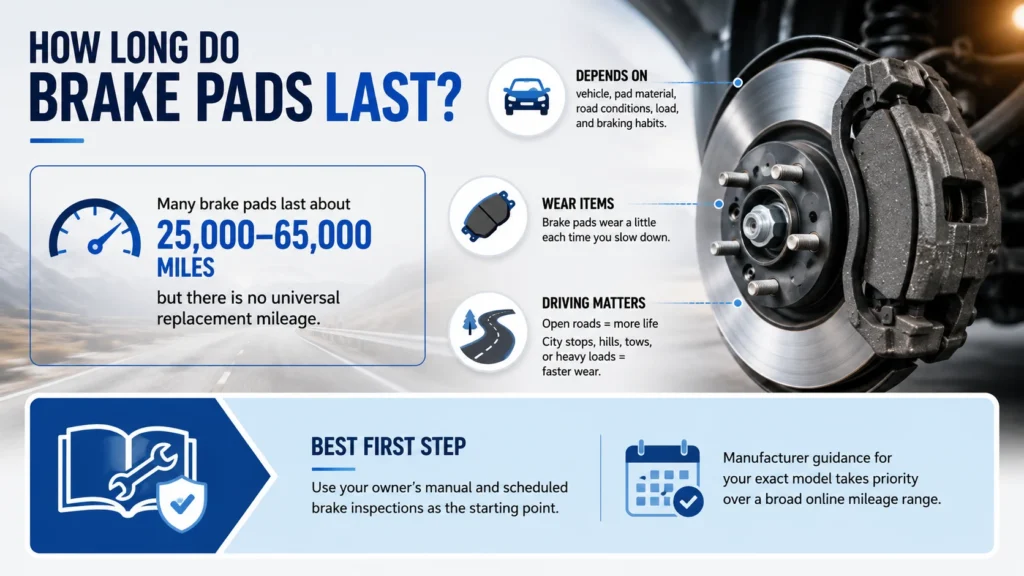
Brake pads are wear items: each time you slow down, their friction material presses against the brake rotor. That material gradually becomes thinner, but it does not wear at the same speed on every vehicle. A driver who mostly uses open roads may get much more life from a set than someone who makes frequent city stops, drives through hills, tows, or carries heavy loads.
Best first step
Use your owner’s manual and scheduled brake inspections as the starting point. Manufacturer guidance for your exact model takes priority over a broad online mileage range.
How many miles do brake pads last?
A commonly quoted brake pad lifespan is roughly 25,000–65,000 miles (40,000–105,000 km). Many drivers may see around 30,000–50,000 miles from front pads, but that is only a general range, not a promise or a replacement interval. Brake systems, pad compounds, driving patterns, and vehicle weight all change the result.
Steady road driving
Longer, smoother journeys with fewer hard stops can reduce pad wear compared with stop-start driving.
City traffic and hills
Frequent braking, steep descents, and short trips can shorten brake pad lifespan significantly.
Loads and towing
Carrying passengers, cargo, or towing can require more braking force and increase wear.
Inspection reminder
Rather than waiting for a fixed number, have the brake system inspected during routine service. Ford guidance, for example, advises a thorough brake inspection at 15,000-mile / 24,000-km intervals.
Signs of worn brake pads
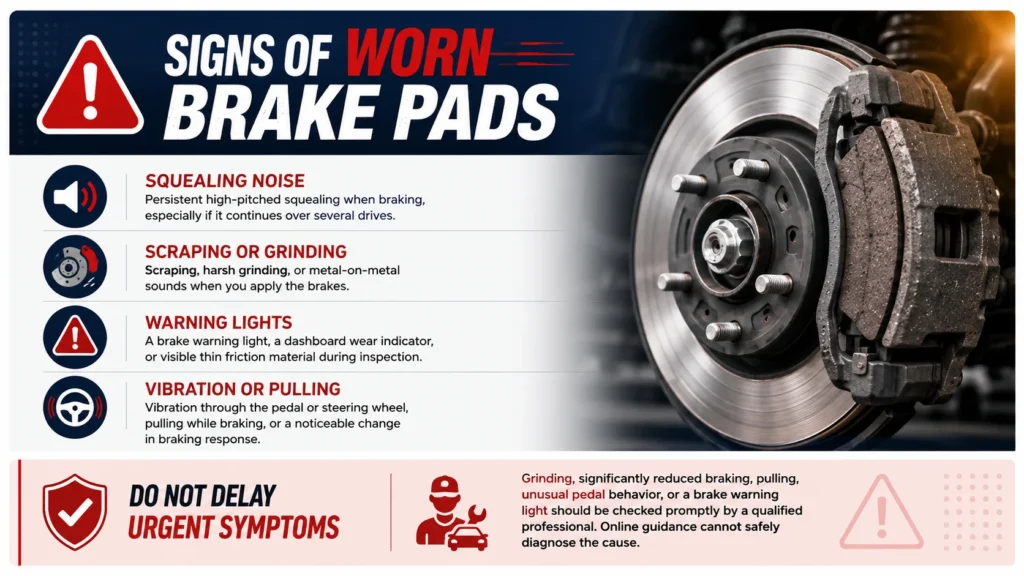
Noise alone does not diagnose every brake issue, but these symptoms are good reasons to arrange a brake-pad inspection. A technician can distinguish normal surface noise from wear indicators, damaged parts, or other brake-system concerns.
- Persistent high-pitched squealing when braking, especially if it continues over several drives.
- Scraping, harsh grinding, or metal-on-metal sounds when you apply the brakes.
- A brake warning light, a dashboard wear indicator, or visible thin friction material during an inspection.
- Vibration through the pedal or steering wheel, pulling while braking, or a noticeable change in braking response.
Do not delay urgent symptoms
Grinding, significantly reduced braking, pulling, unusual pedal behavior, or a brake warning light should be checked promptly by a qualified professional. Online guidance cannot safely diagnose the cause.
Why brake pad thickness matters more than mileage
A brake inspection measures the remaining friction material, checks for uneven wear, and assesses the rotor and hardware. Around 3–4 mm of friction material is commonly treated as a point to plan replacement, while exact limits vary by vehicle. As an example of model-specific limits, Toyota documentation lists 1 mm as a wear limit for the 2026 Land Cruiser.
What a proper brake inspection should check
- Measure the inner and outer brake pad material, because pads can wear unevenly.
- Inspect brake rotors for scoring, corrosion, heat damage, and thickness within the manufacturer specification.
- Check calipers, slides, hoses, brake fluid condition, and related hardware for faults that can accelerate wear.
Practical tip
Looking through a wheel may show the outer pad, but it may not reveal the inner pad or the condition of the rest of the brake system. Avoid relying on a quick visual glance as a complete inspection.
Do front and rear brake pads wear at the same rate?
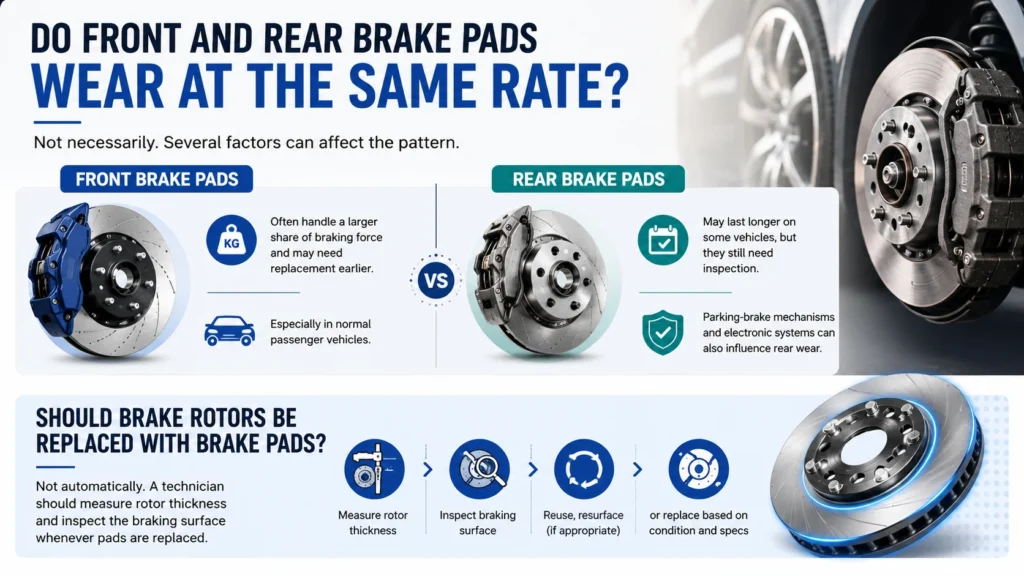
Not necessarily. On many vehicles, front brake pads wear faster because weight transfers toward the front during braking. However, electronic brake-force distribution, rear brake design, vehicle loading, and driving conditions can all affect the pattern.
Front brake pads
Often handle a larger share of braking force and may need replacement earlier, particularly in normal passenger vehicles.
Rear brake pads
May last longer on some vehicles, but they still need inspection. Parking-brake mechanisms and electronic systems can also influence rear wear.
Should brake rotors be replaced with brake pads?
Not automatically. A technician should measure rotor thickness and inspect the braking surface whenever pads are replaced. Depending on the condition and the manufacturer specification, rotors may be reused, resurfaced where appropriate, or replaced. Replacing pads without addressing a damaged or out-of-spec rotor can affect braking feel and pad life.
Brake pad lifespan FAQ
Does squeaking always mean I need new brake pads?
No. Moisture, dust, pad material, or light surface corrosion can cause noise. Persistent squealing, especially when braking, is still a valid reason to schedule an inspection because some pads use wear indicators designed to make noise.
What does grinding when braking mean?
Grinding can indicate severely worn brake pads or another brake-system issue. Continued driving may damage rotors and reduce safe braking performance, so seek prompt professional inspection.
Can driving habits make brake pads wear faster?
Yes. Frequent hard braking, dense traffic, hills, towing, heavy loads, and carrying excess weight can all increase brake-pad wear. Smooth anticipation and maintaining a safe following distance may reduce unnecessary braking.
How often should I have my brakes inspected?
Follow your vehicle manufacturer’s maintenance schedule and have brakes inspected whenever you notice noise, warning lights, vibration, pulling, or a braking change. A scheduled inspection is safer than waiting for pads to fail.