A full guide to knowing when your engine air filter actually needs replacement, based on your manual, your driving conditions, and the filter’s condition.
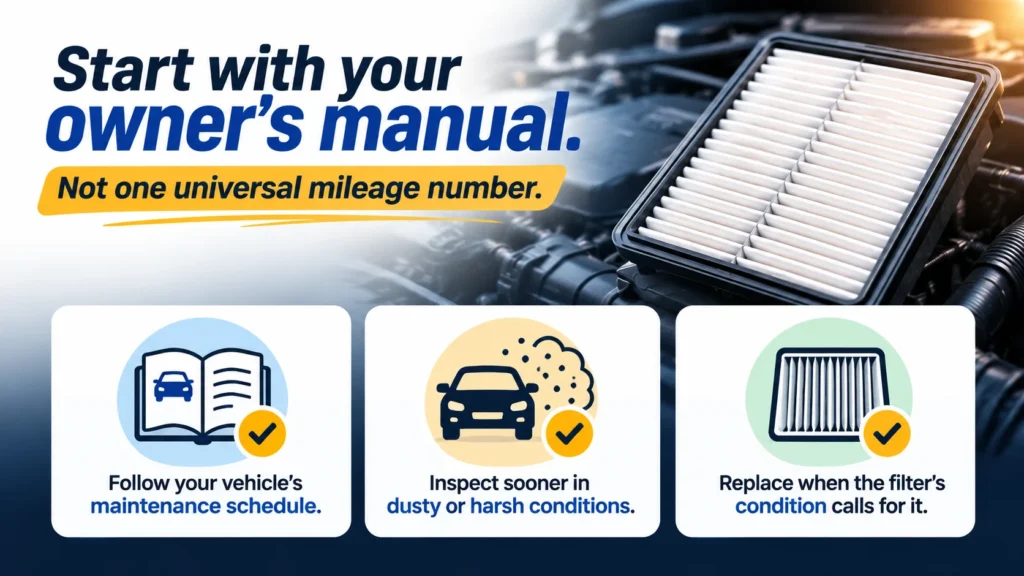
Start with your owner’s manual, not one universal mileage number.
Many vehicles list an engine air-filter service interval around 15,000–30,000 miles (24,000–48,000 km), but the correct schedule is vehicle-specific. Inspect sooner when you drive in dust, sand, smoke, heavy traffic, or construction areas, and replace the filter when your manufacturer calls for it or its condition warrants it.
Your engine air filter keeps dust and debris out of the air entering the engine. It is an inexpensive maintenance item, but it should not be replaced solely because a generic sticker or service pitch says it is due. The most trustworthy starting point is your vehicle’s maintenance schedule, followed by a visual inspection and an honest look at where you drive.
Best first step
Look under “maintenance,” “air cleaner,” or “engine air filter” in your owner’s manual. Follow that vehicle-specific interval or maintenance reminder before relying on a generic recommendation.
How often should you change an engine air filter?
There is no single replacement interval that fits every car, SUV, or light truck. A 15,000–30,000-mile range is common in general guidance, but manufacturer schedules can vary and some vehicles use maintenance-monitor systems rather than a fixed mileage rule. Treat broad mileage advice as a reason to inspect, not an automatic instruction to buy a filter.
Normal driving
Use the maintenance schedule in your manual and inspect the filter during routine service.
Mileage is a guide
A common broad range is 15,000–30,000 miles, but it does not override your vehicle maker’s guidance.
Dirty conditions
Dust, sand, unpaved roads, construction, and smoke can shorten filter life substantially.
Dusty-road reminder
If you regularly drive on dusty or sandy roads, check the filter at every oil service. Honda owner information, for example, identifies a 15,000-mile replacement interval in dusty conditions for applicable vehicles. Your own manual remains the deciding reference.
Signs your engine air filter may need attention
A dirty-looking filter is not always proof that it has failed, and a drivability symptom can have many causes. Still, these signs are good reasons to inspect the filter and compare it with the service schedule.
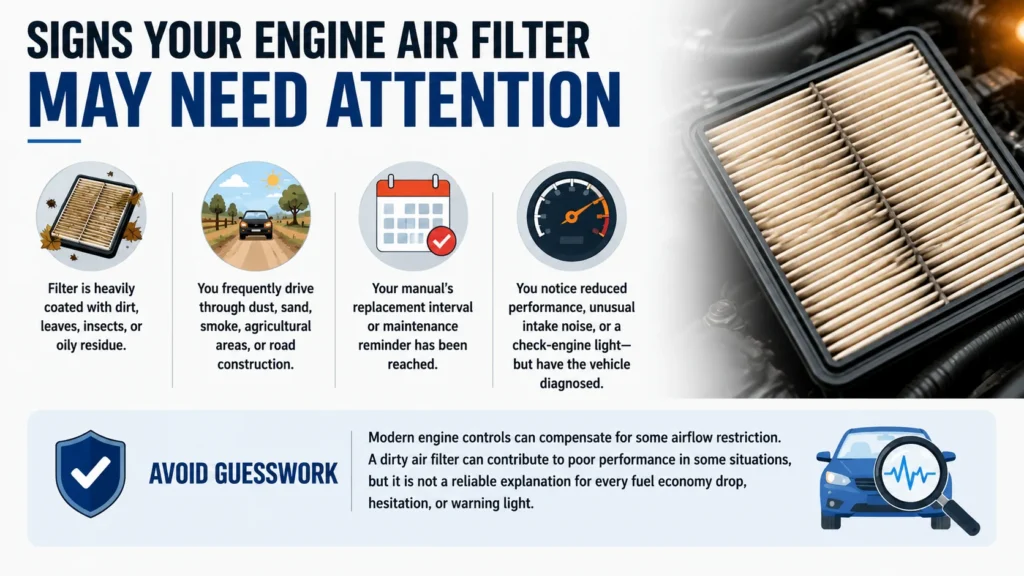
- The filter media is heavily coated with dirt, leaves, insects, or oily residue when you inspect it.
- You frequently drive through dust, sand, smoke, agricultural areas, or road construction.
- Your manual’s replacement interval or maintenance reminder has been reached.
- You notice reduced performance, unusual intake noise, or a check-engine light—but have the vehicle diagnosed instead of assuming the filter is the cause.
Avoid guesswork
Modern engine controls can compensate for some airflow restriction. A dirty air filter can contribute to poor performance in some situations, but it is not a reliable explanation for every fuel-economy drop, hesitation, or warning light.
Can you inspect the air filter yourself?
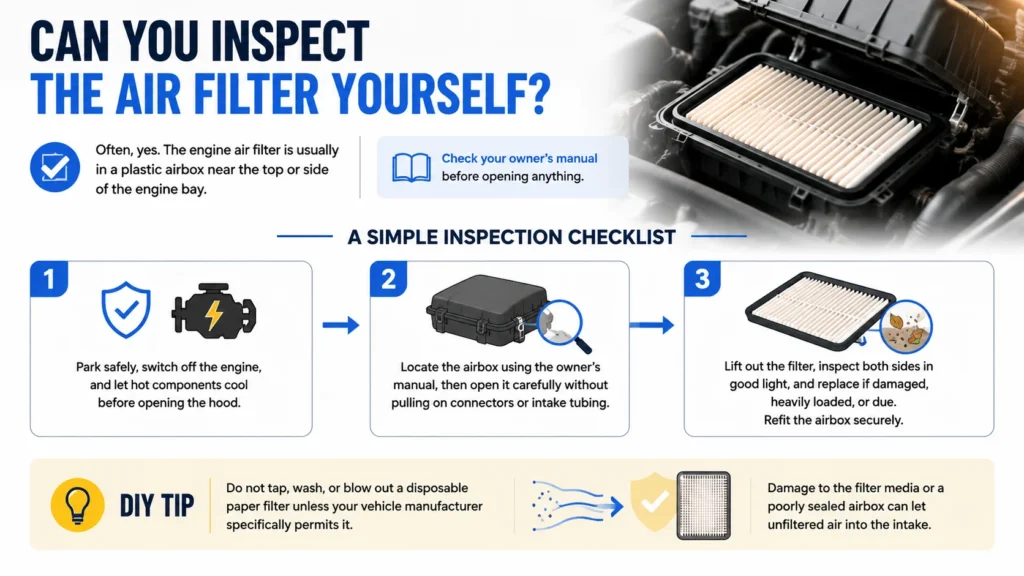
Often, yes. On many vehicles, the engine air filter sits inside a plastic airbox near the top or side of the engine bay. Check your owner’s manual before opening anything: some housings use clips, while others use screws or have nearby sensors and ducts that should not be forced.
A simple inspection checklist
- Park safely, switch off the engine, and let hot components cool before opening the bonnet or hood.
- Locate the airbox using the owner’s manual, then open it carefully without pulling on electrical connectors or intake tubing.
- Lift out the filter, inspect both sides in good light, and replace it if it is damaged, heavily loaded, or due under the manufacturer schedule. Refit the airbox securely.
DIY tip
Do not tap, wash, or blow out a disposable paper filter unless your vehicle manufacturer specifically permits it. Damage to the filter media or a poorly sealed airbox can let unfiltered air into the intake.
Engine air filter vs. cabin air filter
The phrase “car air filter” can mean two different parts. They have different jobs, locations, service intervals, and symptoms, so be sure a service recommendation is referring to the filter you actually mean.
Engine air filter
Filters outside air before it enters the engine. This guide focuses on this filter. It is usually found in an under-bonnet airbox.
Cabin air filter
Filters air entering the passenger compartment through the heating and air-conditioning system. It may affect airflow or odours inside the car, not engine intake.
Should you replace it early just to be safe?
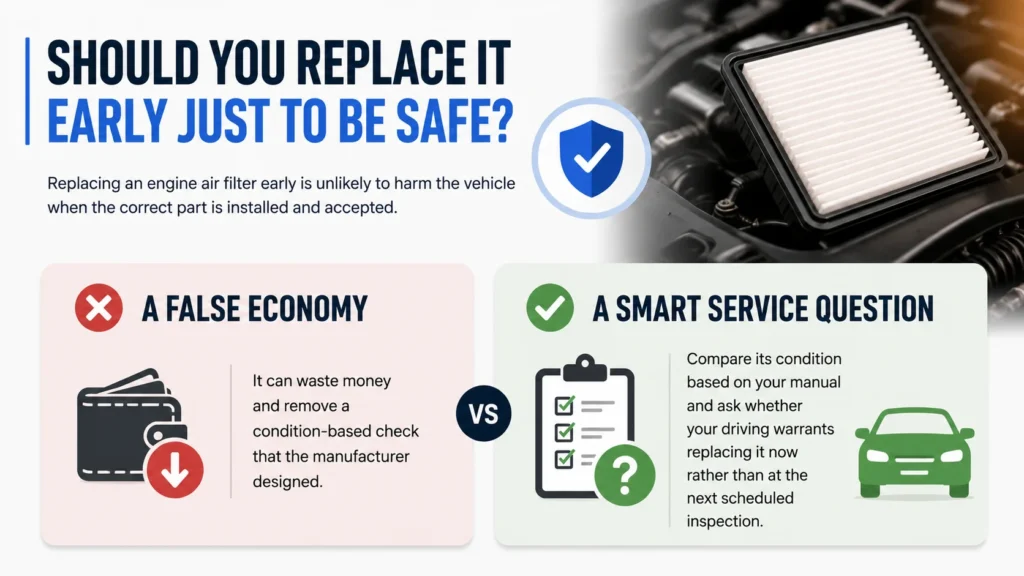
Replacing an engine air filter early is unlikely to harm the vehicle when the correct part is installed properly, but it can waste money and materials. A condition-based check paired with the manufacturer schedule is more useful than treating every routine service visit as an automatic replacement event.
A fair service question
If a shop recommends a filter, ask to see it. Compare its condition with your manual’s interval and ask whether your driving conditions justify replacing it now rather than at the next scheduled inspection.
Engine air filter FAQ
How often should I change my engine air filter?
Follow your owner’s manual first. Many vehicles fall somewhere around 15,000–30,000 miles (24,000–48,000 km) in normal use, but the correct interval varies by manufacturer, engine, and operating conditions.
Do dusty roads mean I should replace it more often?
Usually, yes. Dusty, sandy, smoky, or construction-heavy driving can load a filter more quickly. Inspect it more frequently and use the severe-service guidance in your owner’s manual.
Can a dirty engine air filter reduce fuel economy?
It can contribute in some cases, especially if restriction is severe, but fuel economy is affected by many factors. Do not assume the filter is the only cause of reduced mileage or performance.
Is the engine air filter the same as the cabin air filter?
No. The engine air filter protects the engine’s intake air, while the cabin filter cleans air delivered to the passenger compartment through the HVAC system. Each has its own maintenance schedule.