Match the right Makita impact tool to framing screws, automotive fasteners and cramped engine-bay work, without confusing a 1/4-inch impact driver with a high-torque impact wrench.
Reach for the tool that matches the fastener, not the biggest torque number.
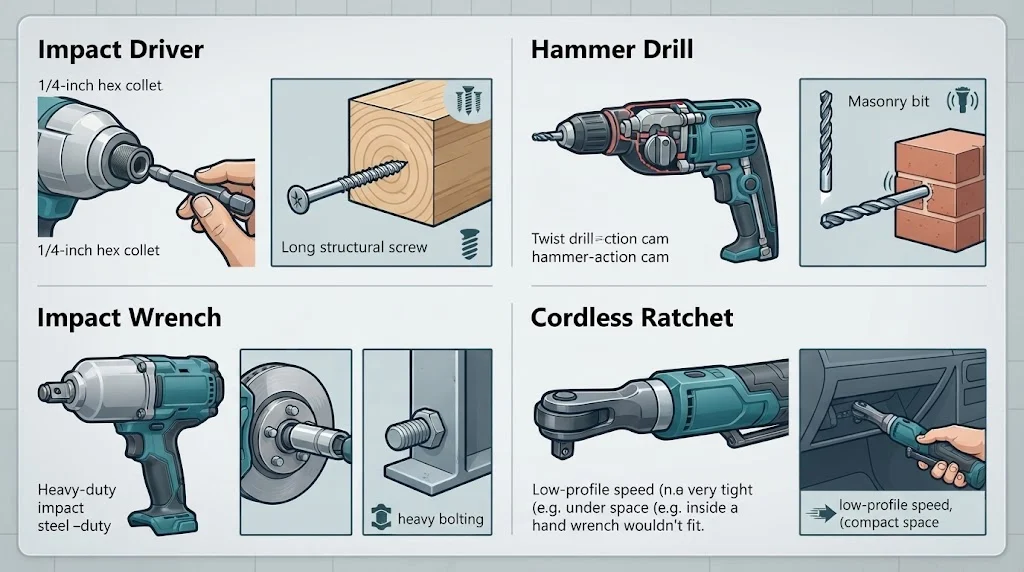
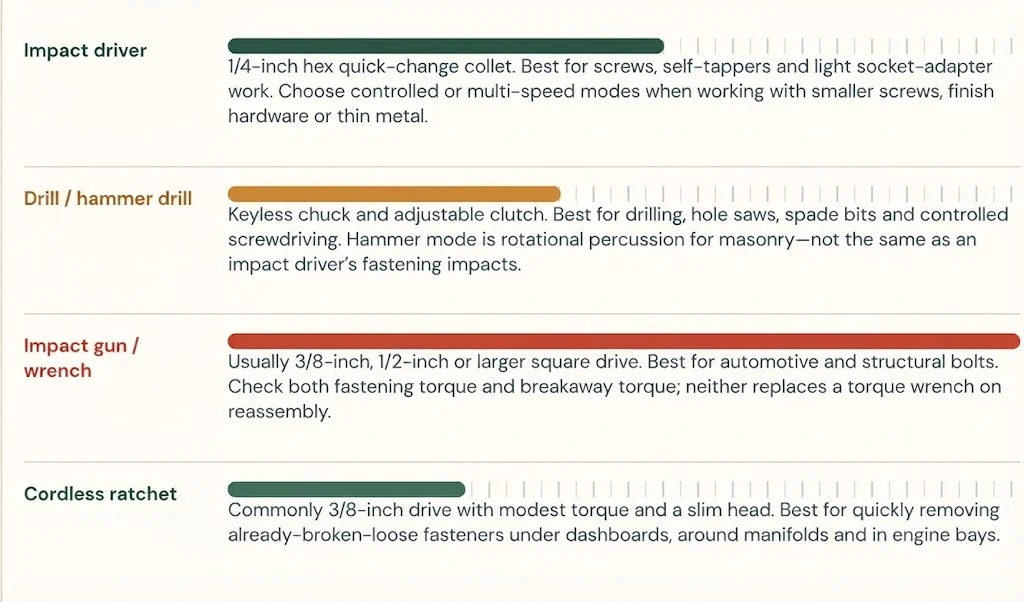
Impact driver
1/4-inch hex bits for long screws, structural screws and repetitive fastening.
Hammer drill
Drills holes and can add hammer action for light-to-medium masonry work.
Impact wrench
Square-drive sockets for lug nuts, suspension hardware and heavy bolting.
Cordless ratchet
Low-profile speed for run-down work where a wrench will not physically fit.
What is the difference between an impact driver, impact wrench and cordless ratchet?
An impact driver uses a compact hammer-and-anvil mechanism behind a 1/4-inch hex collet. It delivers short rotational blows that help drive large screws with less wrist twist than a drill/driver. It is the everyday fastening tool for deck screws, ledger screws, cabinet installs and timber framing hardware.
An impact wrench is built around a square-drive anvil and sockets, with much higher fastening and breakaway capability. A cordless ratchet is the opposite: it prioritizes access and controlled run-down in tight places, then you finish critical fasteners to specification by hand with a torque wrench.
Makita impact tool comparison: the right first grab
Tool labels can blur together at the store. The drive interface and the type of impact mechanism tell you much more about the intended work than marketing phrases such as “high power” or “compact.”
Makita impact drivers and drills: construction speed with control
For most contractors, a brushless 18V LXT impact driver is the first Makita impact to buy. Brushless motors generally run cooler and use battery energy more efficiently under repeated driving. A drill/driver or hammer drill complements it rather than replacing it.
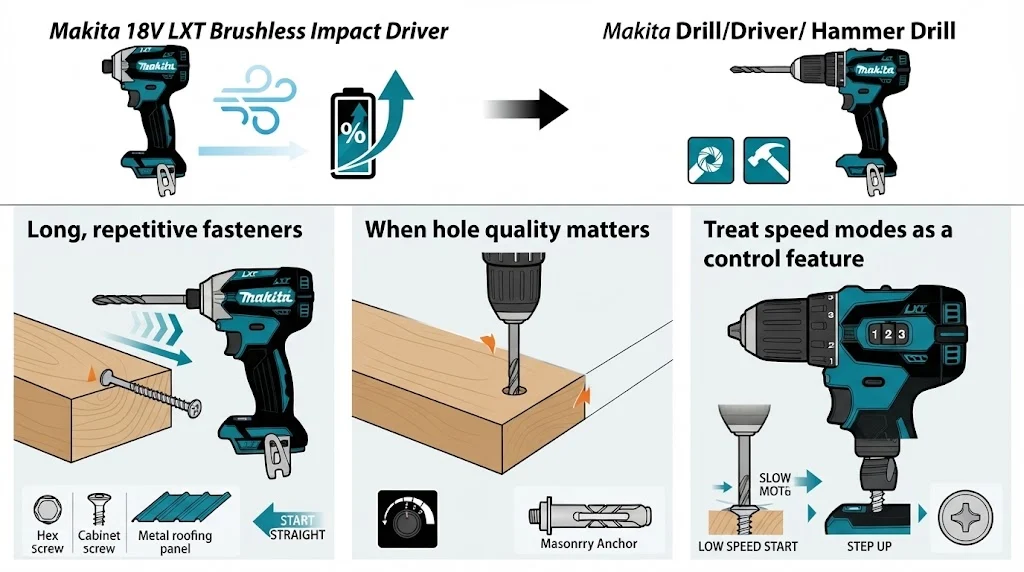
Use the impact driver for long, repetitive fasteners
A 1/4-inch hex impact driver shines on structural screws, cabinet screws, decking and metal roofing fasteners. Start straight, support the tool inline with the screw and let the bit fully seat before pulling the trigger.
Use the drill when hole quality matters
Drills accept round-shank and specialty bits securely in a chuck, offer clutch adjustment and give more predictable drilling control. For masonry anchors, select hammer mode only when the bit and substrate call for it.
Treat speed modes as a control feature
Multiple speed or assist modes can reduce cam-out, stripped heads and snapped small fasteners. Use low speed to start delicate work, then step up only when the bit remains stable and the fastener needs more drive.
How much impact-driver torque do you need?
For framing and decking, bit quality, screw design, battery condition and trigger control often matter as much as a headline torque figure. A compact driver is easier overhead; a higher-output model earns its place when long structural screws and repeated heavy fastening fill the day.
18V LXT and 40V XGT battery planning
Stay within the battery platform specified for the tool. Smaller compatible 18V LXT packs reduce wrist fatigue but have less runtime and thermal headroom during continuous driving. Larger packs improve endurance but change balance in tight or overhead work.
Makita impact guns: when sockets and serious torque are required
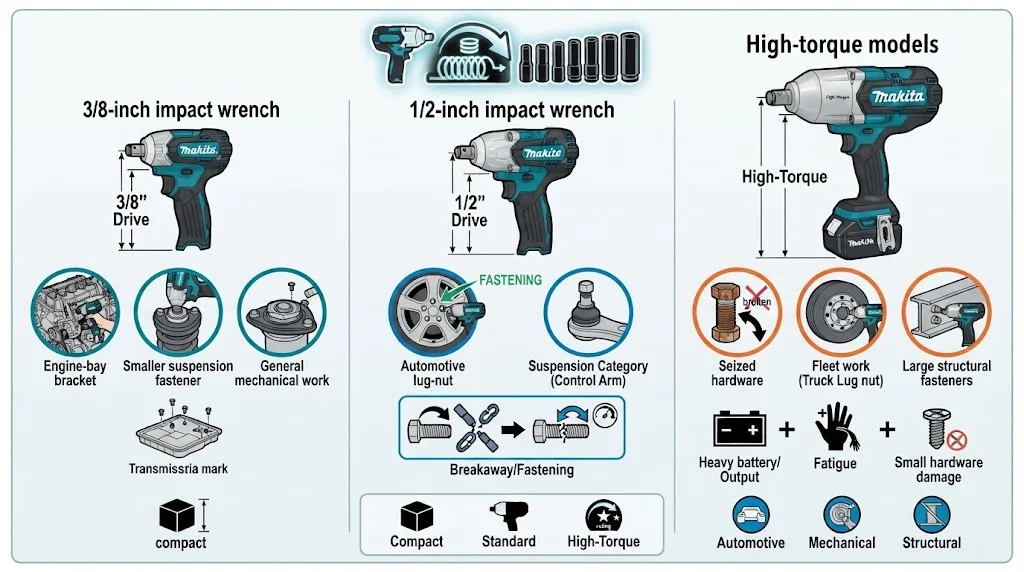
Impact guns Makita users choose for automotive and structural work should be selected by drive size, access, rated output and the actual fasteners in front of you. A compact 3/8-inch model and a high-torque 1/2-inch model solve very different problems.
3/8-inch impact wrench
A practical compact choice for engine-bay brackets, smaller suspension fasteners and general mechanical work where socket access matters as much as output.
1/2-inch impact wrench
The common automotive lug-nut and suspension category. Verify the model’s documented fastening and breakaway ratings, but plan to final-torque every wheel fastener manually.
High-torque models
Useful for seized hardware, fleet work and larger structural fasteners, but heavier batteries and high output can fatigue the wrist and make small hardware easier to damage.
Makita ratchet gun guidance: speed in spaces an impact wrench cannot reach
A cordless ratchet is not a miniature impact wrench. It is a time-saving tool for spinning nuts and bolts after they have been loosened, especially where there is barely enough room to swing a hand ratchet.
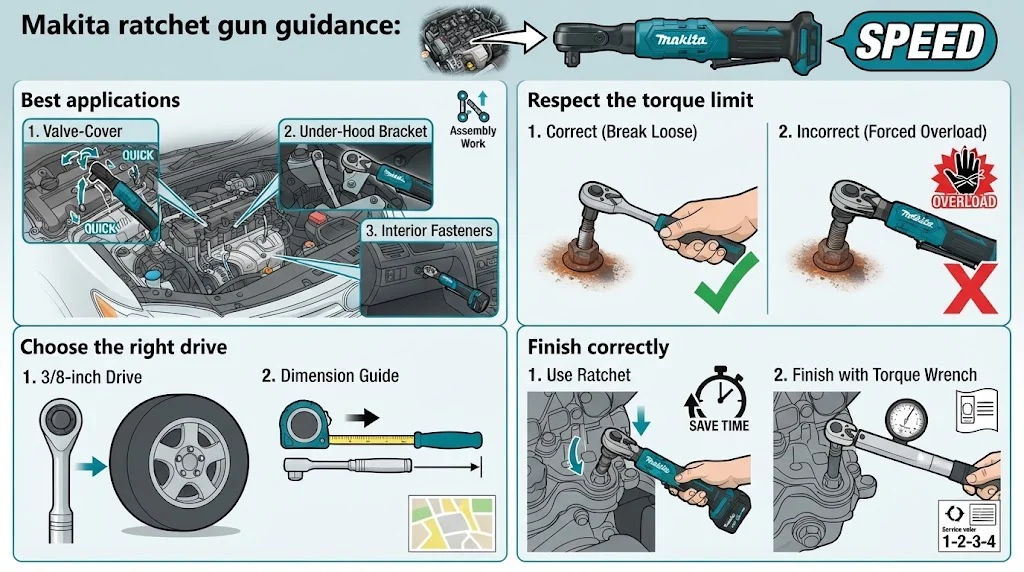
Best applications
Valve-cover hardware, under-hood brackets, interior fasteners and assembly work where many fasteners need quick, consistent run-down.
Respect the torque limit
Break stubborn bolts loose by hand first. Forcing a cordless ratchet against seized hardware can overload the tool, damage the fastener or twist your wrist.
Choose the right drive
A 3/8-inch drive is broadly useful for automotive sockets. Choose the head profile and handle length around the access constraints of your actual workspace.
Finish correctly
Use the ratchet to save time, then finish by hand or with a torque wrench whenever a service manual specifies a torque value or tightening sequence.
Makita impact tool FAQs
Are Makita impact guns powerful enough for automotive lug nuts?
Many 1/2-inch cordless impact wrenches have ample capability for common passenger-vehicle lug nuts, but results depend on corrosion, prior over-torque, battery charge and the specific model. Use the wrench for removal; install and final-torque lug nuts with the vehicle maker’s specified pattern and torque value.
Is a brushless Makita impact worth the extra cost?
For frequent job-site or workshop use, brushless models are often worthwhile for efficiency, heat management and sustained performance. Occasional users may get more value by prioritizing the right drive type, batteries and high-quality bits or impact sockets before chasing the highest specification.
Should I buy a kit or bare tool?
Buy bare tools when you already own healthy batteries and a charger on the same platform. Choose a kit when it adds the battery capacity you actually need, especially for high-demand impacts. Compare usable battery amp-hour capacity, warranty terms and included charger speed, not only the sticker price.