
Makita is a Japanese tool company, but its tools are manufactured across several countries. Here is what that means when you are comparing a specific drill, saw, battery, or kit.
Makita is Japanese
The Makita tool company began in Japan and remains headquartered there. Japanese ownership and a Japanese origin do not mean every current Makita tool is made in Japan.
Production is global
Official Makita materials describe manufacturing operations in Japan and multiple overseas locations. The final country of origin depends on the exact product, not simply the brand name.
Check the actual tool
For an accurate answer, inspect the data plate, packaging, or official manual for the specific model you plan to buy. Listings and photos can be outdated.
Where are Makita tools made?
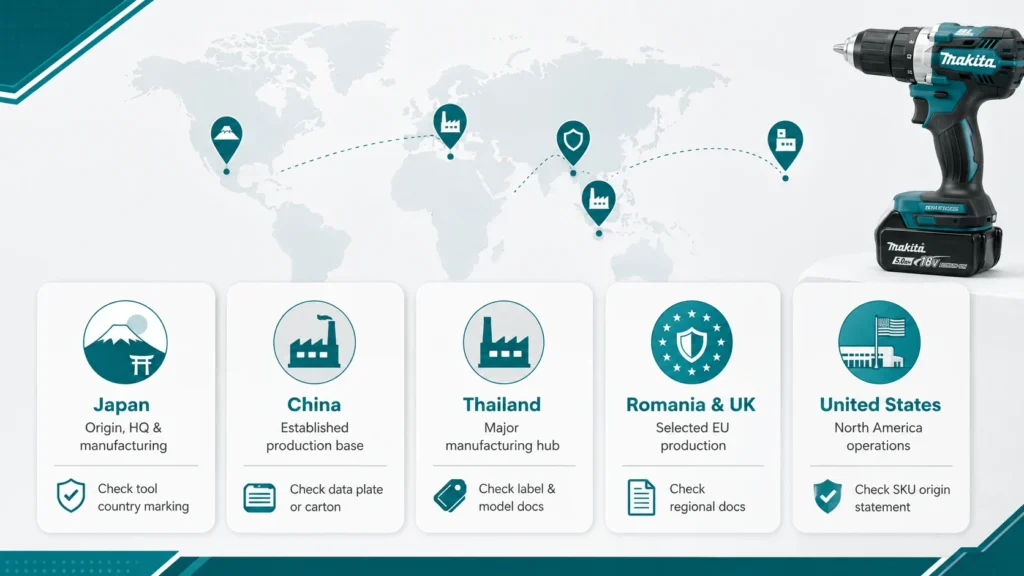
Makita manufactures and assembles products across a global network. This table is a practical orientation, not a promise that every product category is made in every listed location.
| Location | What the location indicates | What it does not prove | Best verification |
|---|---|---|---|
| Japan | Company origin, headquarters, design and manufacturing operations. | That every Makita tool sold worldwide is Japanese-made. | Country marking on the specific tool. |
| China | One of Makita’s established overseas production locations. | A lower quality tier by default. | Data plate, carton, official regional product page. |
| Thailand | A significant manufacturing base in Makita’s global network. | That a similar-looking model has the same origin. | Tool label and current model documentation. |
| Romania & UK | European manufacturing operations for selected products and markets. | That all European-stock Makita tools are locally made. | Regional documentation and origin marking. |
| United States | Operations supporting North American manufacturing and distribution. | That all tools sold in the US are made there. | The country-of-origin statement for that SKU. |
What each manufacturing location means
A manufacturing country is useful information, but it is only one part of the product story. Tool design, components, process controls, inspection, and the intended product tier also matter.
Makita’s home country and corporate base
Makita was founded in Japan in 1915 and is a Japanese public company. Japan remains central to its corporate identity and manufacturing footprint. Some tools and components carry a Made in Japan marking, but availability changes by product family, market, and production run. Treat the label on the exact unit—not an old forum post or a generic brand claim—as the reliable answer.
Chinese-made Makita tools are part of the official global supply chain
A Made in China marking on a genuine Makita tool is not unusual. It identifies final manufacturing or assembly according to the applicable country-of-origin rules; it does not, by itself, reveal the design standard, component source, inspection requirements, or expected tool life. Compare the model specification, warranty coverage, seller reputation, and condition before using country alone as a quality shortcut.
Thailand is another key Makita production location
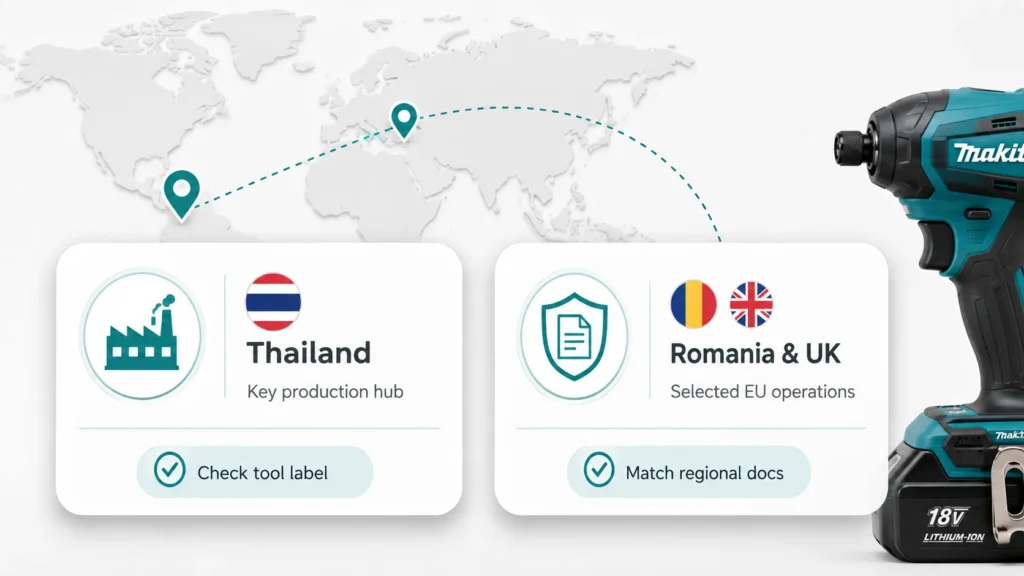
Thailand appears in Makita’s published global manufacturing information and is commonly encountered on genuine product labels. As with every other location, different models can be assigned to different factories over time. A Thailand marking should be read as a traceable origin detail, not as evidence that the product is better or worse than a similar item made elsewhere.
European operations support selected product lines and markets
Makita has described manufacturing operations in Romania and the United Kingdom as part of its overseas manufacturing structure. The exact output of a facility can change, and a tool sold in Europe may still come from a factory outside Europe. If origin matters for procurement or collection purposes, ask for a current photo of the label and match the model number against official regional information.
US operations do not make every North American Makita tool American-made
Makita maintains an important North American presence, including US operations. However, country of sale and country of manufacture are separate questions. A tool purchased in the United States can be made in Japan, China, Thailand, Romania, the UK, or another listed manufacturing country depending on the model and batch. Review the origin statement on the physical product or packaging before making a purchase decision.
We separate company origin from product origin
This guide prioritizes Makita corporate information, regional Makita product documentation, manuals, labels, and official company materials over marketplace copy or anonymous discussion threads. We use careful wording because designed in Japan, manufactured in Japan, assembled elsewhere, and made with globally sourced components are not interchangeable claims.
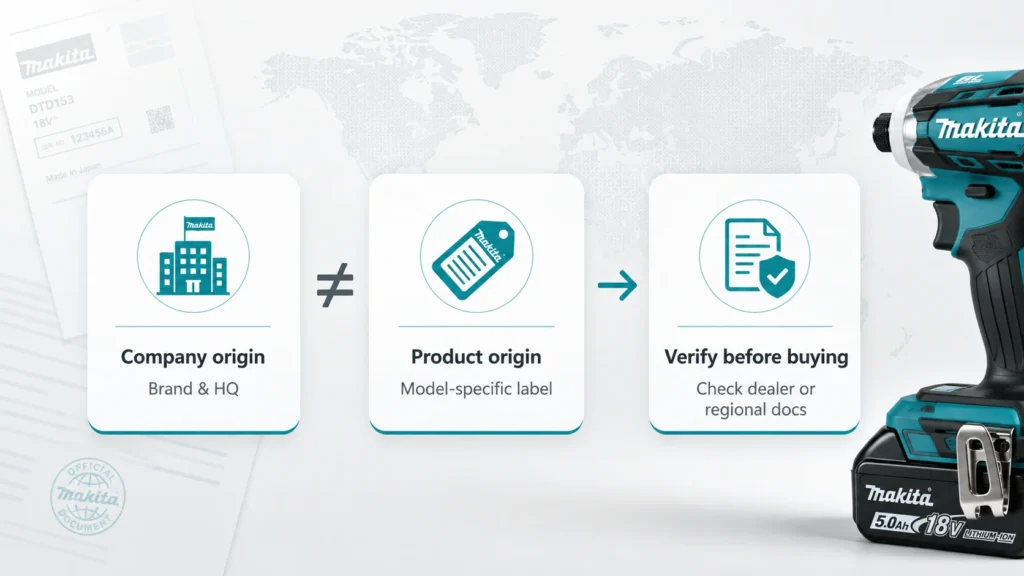
Manufacturing assignments can change. Before placing a large order, verify the origin of the specific model and batch with an authorized dealer or Makita regional support team.
Country alone is not a reliable quality score
Start with the model
A tool’s platform, motor type, dust control, battery compatibility, duty rating, and warranty tell you more about fit for work than the country printed on its housing.
Verify genuine supply
The bigger risk is often an unclear or unauthorized seller. Genuine tools have consistent model and serial details, proper labeling, regional compliance marks, and warranty support through approved channels.
Use origin as context
Collectors or procurement teams may have valid origin requirements. For most buyers, use country of origin as one comparison point alongside price, local service, features, and a trusted seller.
How to find where your Makita tool was made
The most useful evidence is normally on the tool itself. Check before use if a marketplace listing provides only stock photos, or ask an authorized seller for a current image of the item you will receive.
- Look for a country-of-origin statement on the rating plate, molded housing, or serial label.
- Match the model number, voltage version, and serial information to the box and official documentation.
- Be cautious of missing labels, unusually low prices, spelling errors, or sellers unable to explain warranty support.
Mister Worker Editorial Team
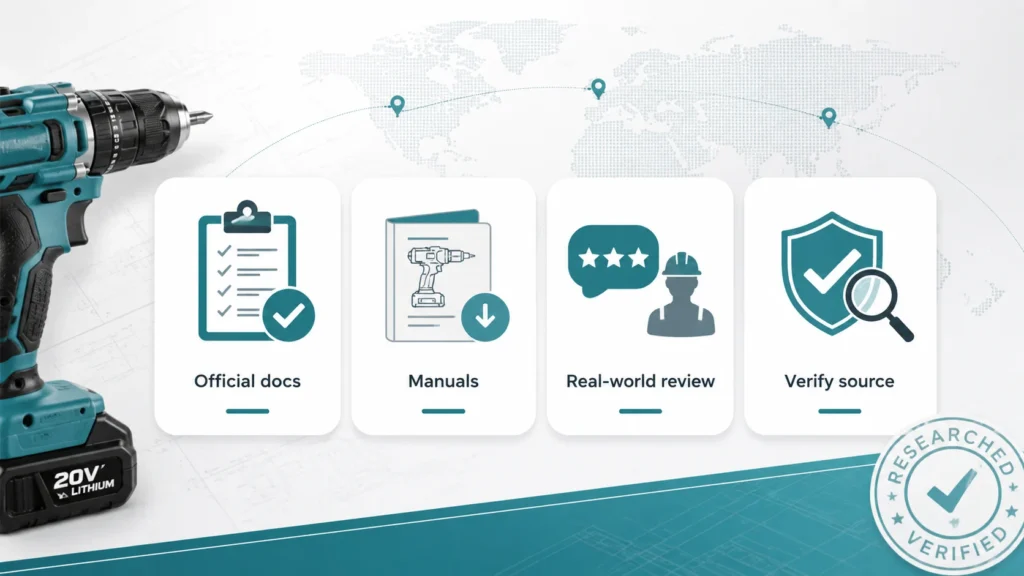
Our editorial team researches professional tools through manufacturer documentation, product manuals, real-world use considerations, and the questions tradespeople ask before committing to a platform.
Editorial note: Manufacturing information can change without notice. We do not use country of origin as a stand-alone rating of a tool’s quality, and we recommend confirming details with official sources before purchase.
Makita manufacturing FAQs
Is Makita a Japanese company?
Yes. Makita originated in Japan and remains a Japanese company. That corporate origin is separate from the country where any particular tool is made or assembled.
Are all Makita tools made in Japan?
No. Makita has a global manufacturing network. Some products may be marked Made in Japan, while others are manufactured or assembled in other countries. Check the exact tool, model, batch, and regional version.
Are Japanese-made Makita tools better?
There is no responsible basis for assuming that country alone determines quality. Compare the exact model, specification, intended duty, warranty, condition, and authenticity. A genuine tool from Makita’s global production network should be judged by the product itself.
Who owns Makita?
Makita Corporation is a Japanese publicly listed company. It operates under the Makita corporate group rather than being owned by another global tool-brand parent company.