
A practical guide to choosing a DeWalt battery charger that matches your packs, workload, workspace, and safety expectations.
A 20V MAX charger is generally for DeWalt 20V MAX and FLEXVOLT lithium-ion packs, not older 18V stem-style batteries or 12V MAX slide packs. Match the battery platform first, then select charge speed and port count for how you actually work.
For a one-battery homeowner, the charger in a combo kit may be all that is needed. For a contractor rotating drills, impact drivers, saws, lights, and radios, charging becomes a production issue. The right DeWalt charger helps keep packs in rotation while protecting the lithium-ion cells that power the job. This guide separates marketing shorthand from the checks that matter before you buy.
Start with battery compatibility, not the fastest charger
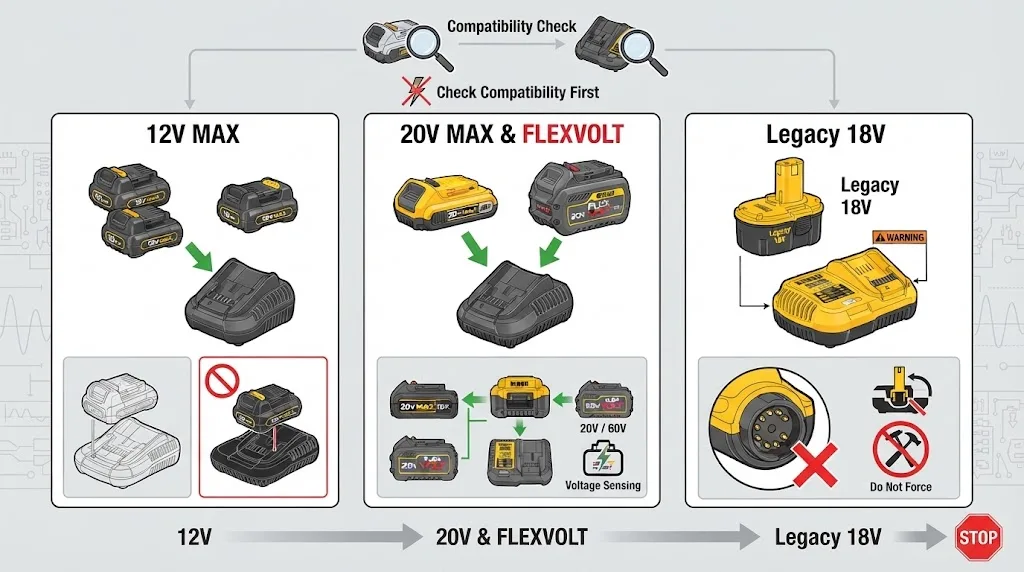
The phrase “20 volt” appears often in search results, but a charger is not universal just because the brand matches. DeWalt’s 12V MAX packs, current 20V MAX packs, FLEXVOLT packs, and legacy 18V NiCd/NiMH packs use different physical formats and charging electronics. Read the model label on both the battery and charger, then verify compatibility in the manufacturer documentation before connecting them.
12V MAX
Compact slide packs need a compatible 12V MAX charger. Their smaller footprint does not make them interchangeable with 20V MAX equipment.
20V MAX & FLEXVOLT
Many 20V MAX chargers accept 20V MAX and FLEXVOLT lithium-ion packs. Confirm the specific charger model if you rely on high-capacity packs.
Legacy 18V
Older 18V stem-style packs generally need their original compatible charger. Do not force them into a modern 20V MAX charger.
Charge speed: think in amps, pack capacity, and heat
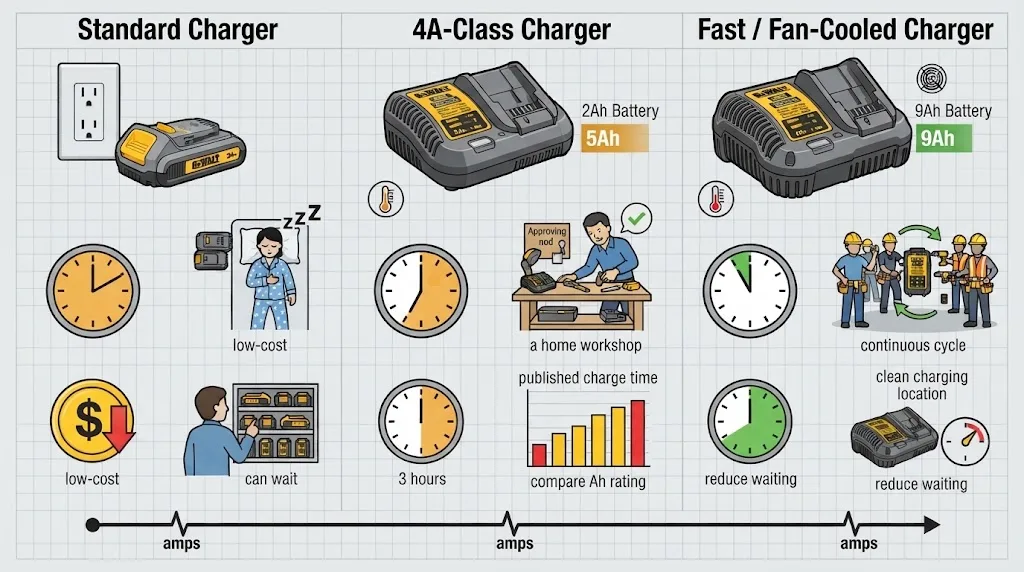
A charger’s output current is one practical clue to its speed. A compact 2Ah battery reaches full charge faster than a 5Ah or 9Ah pack on the same unit, while a higher-output or fan-cooled fast charger can reduce downtime for crews that cycle batteries continuously. The indicator lights are equally important: they tell you when a pack is charging, complete, or paused because it is too hot or too cold.
| Charger category | Best fit | What to expect |
|---|---|---|
| Standard charger | Occasional DIY use and overnight replenishing | Lower-cost, steady charging; adequate when you own spare packs and can wait. |
| 4A-class charger | Active home workshop or one-person trade kit | A balanced option for regular use; compare published charge time for your exact Ah rating. |
| Fast / fan-cooled charger | High-demand jobsite rotations and larger packs | Designed to reduce waiting; ventilation and a clean charging location matter more under heavy use. |
Build a charging station around access and airflow
A DeWalt charging station can be as simple as a wall-mounted shelf with one outlet per charger. Keep chargers on a hard, non-flammable surface where status lights are visible, cables are not trip hazards, and sawdust cannot accumulate around vents. A multi-battery charger may simplify the bench, but check whether it charges packs simultaneously or sequentially—those are very different productivity gains.
Wall-mounting can keep cords out of harm’s way, but leave enough space to remove packs without twisting or pulling on the charger.
Car, USB, and mobile charging: useful, but purpose-built
A DeWalt car charger can make sense for vehicle-based crews, remote repairs, and long travel between jobs. Use a unit designed for the vehicle power system and place it where it will not overheat or interfere with driving. A DeWalt USB charger or USB power source is typically intended to draw power from a tool battery for phones and small devices; it is not a substitute for charging a tool battery unless the product specifically says it is.
Why genuine chargers and a visual inspection matter
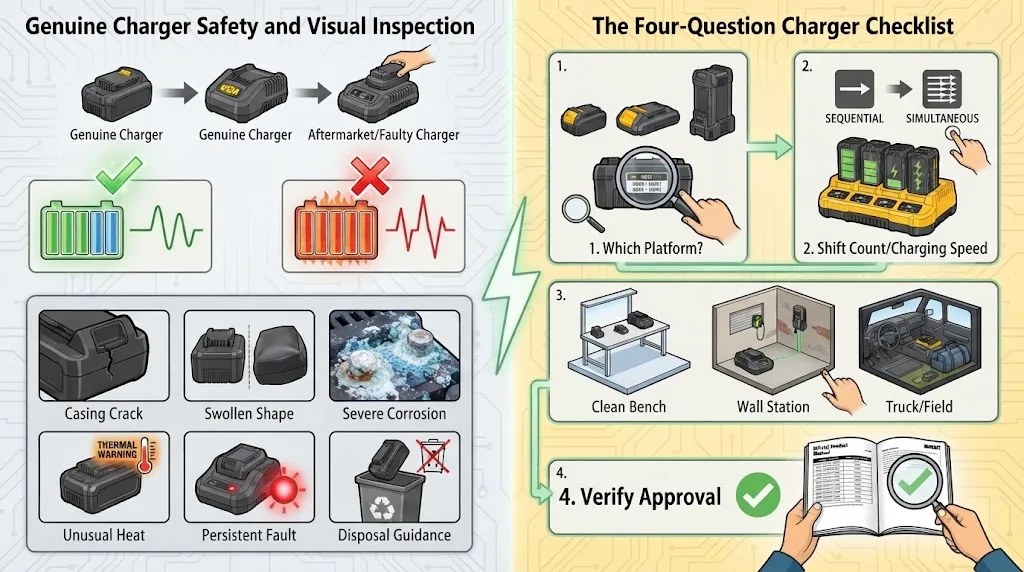
Modern lithium-ion systems use electronics to monitor charging conditions and help prevent overcharging. That protection depends on compatible equipment that can correctly communicate with the pack. Before charging, inspect the casing, terminals, and release latch. If a battery has a cracked housing, swollen shape, severe corrosion, unusual heat, or a persistent fault indication, remove it from service and follow the manufacturer’s disposal guidance.
The four-question charger checklist
- Which exact battery platform and model numbers do I already own?
- How many packs are used during a normal shift, and do I need sequential or simultaneous charging?
- Will the charger live on a clean bench, a wall station, a truck, or travel between jobs?
- Can I verify the charger is approved for my packs through official product documentation?
DeWalt charger questions, answered
Can a 20V MAX charger charge an 18V DeWalt battery?
Generally, no. Legacy 18V stem-style batteries use a different physical format and charging system. Use the charger specified for that battery platform rather than relying on voltage numbers alone.
Is a fast charger better for every battery?
Not necessarily. A fast charger can reduce downtime, but the exact pack capacity, temperature, charger model, ventilation, and your work pattern all matter. Choose the output and capacity that fit your rotation.
What should I do if a battery gets hot while charging?
Stop using it if the heat seems unusual, let it cool in a dry shaded place, and inspect the pack for damage. Follow the manufacturer’s instructions if the problem persists or a fault indicator appears.