
Check your tire tread in minutes with a penny, quarter, tread-depth gauge and wear bars, then use the chart below to understand whether your tires need closer inspection or replacement.
How do I check tire tread?
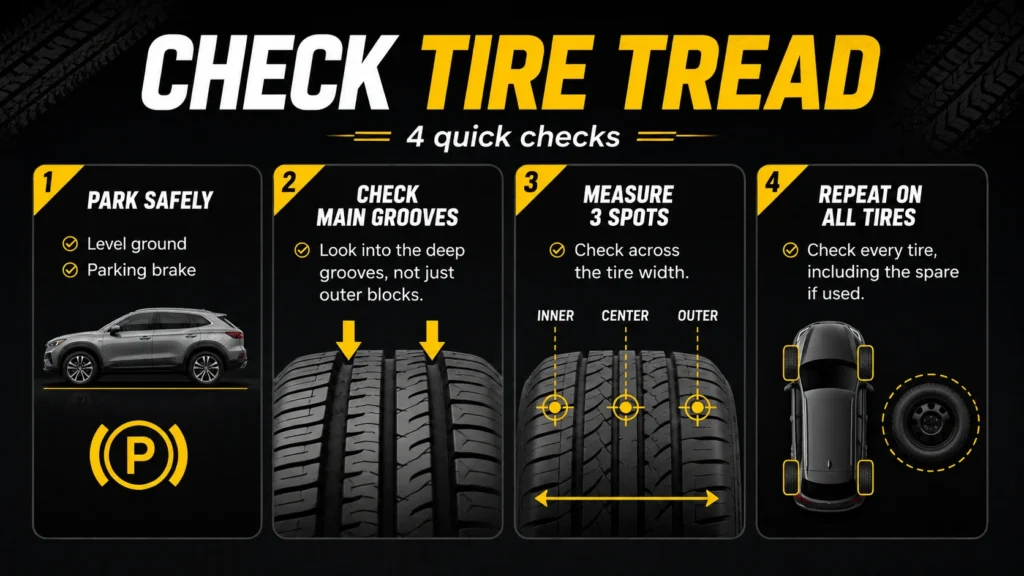
Park on level ground, set the parking brake and turn the front wheels slightly if that gives you a clearer view. Look into the main grooves, the deep channels that run around the tire, not just the outer tread blocks.
Check every tire in at least three places across its width: the inner shoulder, center and outer shoulder. One measurement can miss uneven wear. Repeat the same process on all four tires, including the spare if it is part of your driving plan.
How to measure tire tread depth with a gauge
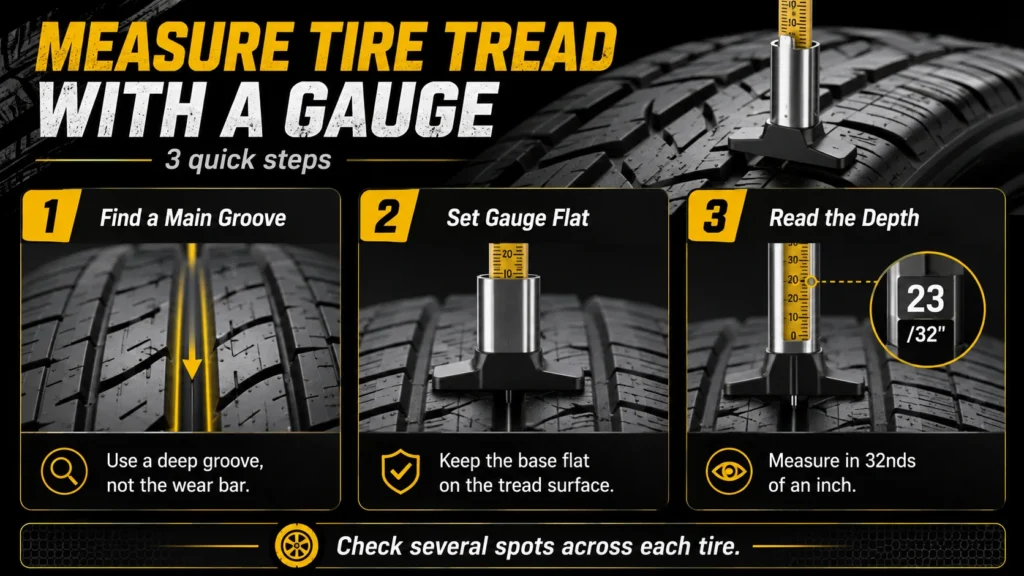
A tread-depth gauge is the most accurate at-home method because it gives you a number. Most gauges measure in 32nds of an inch, the common unit used for tire tread in the United States.
Park safely and find a main groove
Use a deep circumferential groove. Avoid measuring directly on a wear bar because it is intentionally raised.
Set the gauge base flat on the tread
Push the gauge probe down to the bottom of the groove while keeping the gauge shoulders resting squarely on the tread surface.
Set the gauge base flat on the tread
Push the gauge probe down to the bottom of the groove while keeping the gauge shoulders resting squarely on the tread surface.
Why a gauge is the best tread test
A simple pencil-style gauge is inexpensive and avoids guessing. It also makes it easier to compare one shoulder with the other, which can reveal alignment, inflation or suspension-related wear patterns.
What does the number mean?
The fraction is tread depth in 32nds of an inch. For example, 6/32 means six thirty-seconds of an inch remain. New tire tread depth varies by model and intended use, so do not assume every new tire starts at the same depth.
Penny test, quarter test and tire wear bars
Penny tire test
Insert a U.S. penny into a main groove with Lincoln’s head pointing down into the groove. If the top of Lincoln’s head is fully visible, the tire is around 2/32 or less and is at the wear-bar replacement threshold.
Quarter tire tread test
Place a quarter into the groove with Washington’s head down. If the top of his head is visible, tread may be below about 4/32. Treat this as an early warning to measure precisely and plan ahead.
Wear bars on tires
Wear indicators are small raised bars molded across the main grooves. When surrounding tread is level with those bars, the tire is at approximately 2/32 and needs replacement.
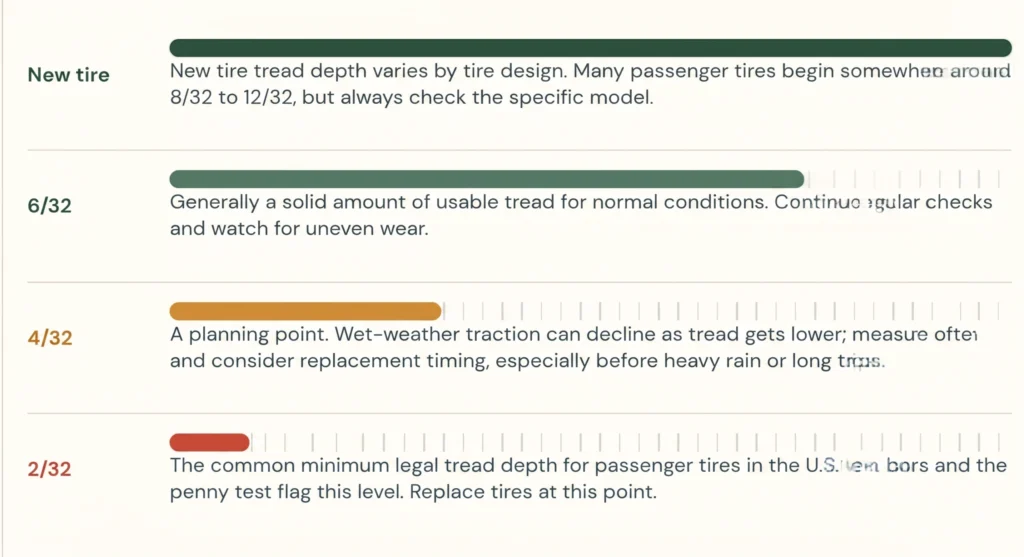
Tire tread depth chart: what 6/32, 4/32 and 2/32 mean
These ranges are practical guidance for passenger tires. Traction needs change with road conditions, tire type and vehicle manufacturer guidance, so use the chart alongside your owner’s manual and a professional inspection when needed.
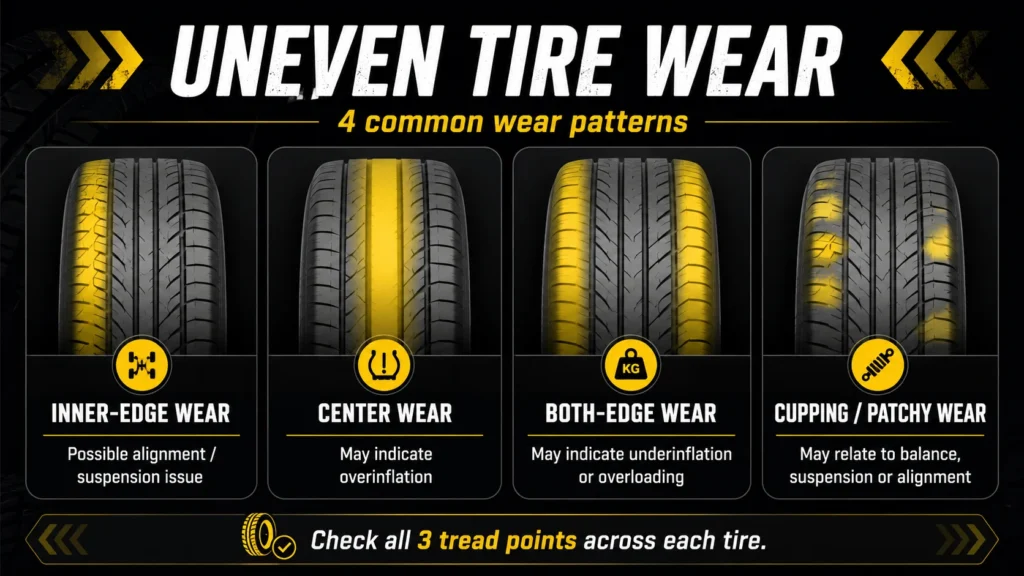
What uneven tire wear can tell you
Compare all three measurement points across each tire. Uneven tread can change handling and may point to a problem worth correcting before installing new tires.
Inner-edge wear
The inside shoulder is lower than the center or outer edge. Have alignment and suspension components checked.
Center wear
The middle groove wears faster than both shoulders. Overinflation may be a factor; verify pressure using the vehicle door-jamb label.
Both-edge wear
Both shoulders are worn more than the center. Underinflation or sustained overloading may contribute; check recommended pressure and load practices.
Cupping or patchy wear
Scalloped, choppy or isolated worn patches can relate to balance, worn suspension parts or alignment. Arrange professional diagnosis.
Tire tread check FAQs
Is the penny tire test accurate?
It is accurate as a quick test for tread around the 2/32 wear-bar threshold when performed correctly. It does not tell you the exact remaining depth, identify uneven wear reliably, or prove that a tire is otherwise safe. A tread-depth gauge is more informative.
Is 6/32 good tire tread?
For many passenger tires, 6/32 indicates meaningful tread remains. Conditions still matter: inspect all grooves, look for damage and follow your vehicle and tire manufacturer guidance. Continue checking regularly as the tread wears.
When should I replace tires?
Replace tires when tread reaches the wear bars or about 2/32, and seek inspection sooner for cracks, bulges, exposed cords, punctures, severe irregular wear or other damage. Consider earlier replacement if low tread no longer suits your expected wet or winter driving conditions.