A jigsaw is a handheld power saw with a narrow blade that moves rapidly up and down. It is useful for straight, curved, and internal cuts in wood, plastic, laminate, and, with the right blade, metal.
What is a jigsaw used for?
A jigsaw is designed for versatility rather than maximum speed. Its slim reciprocating blade lets you follow a marked curve, cut a sink opening inside a countertop, trim a panel, or make a short straight cut. The shoe stays flat on the work while the blade does the cutting. For long, perfectly straight sheet cuts, another saw may be a better fit.
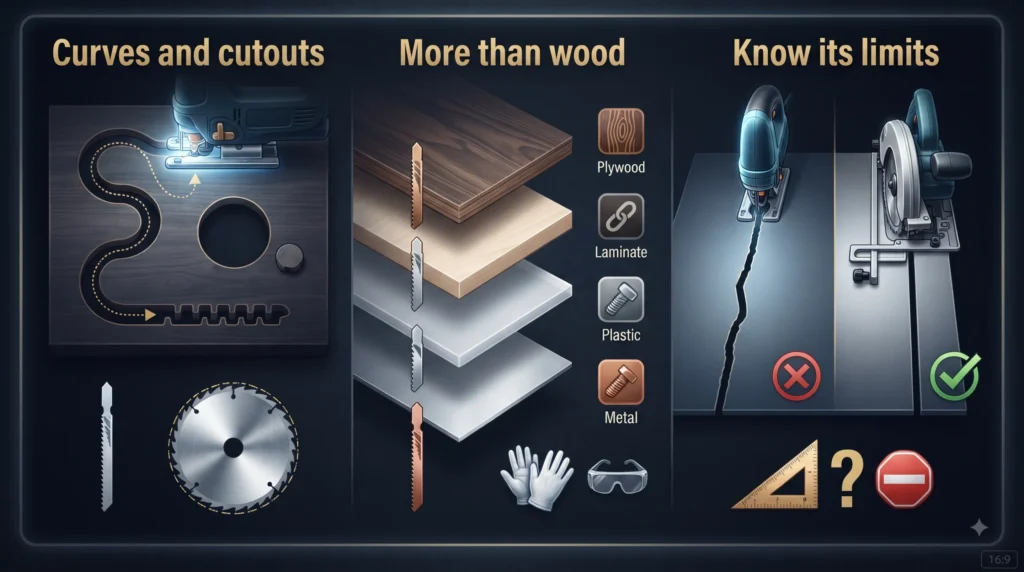
Curves and cutouts
Cut arcs, circles, notches, and internal openings that are difficult with wider-blade saws.
More than wood
Blade choice determines whether the saw can handle plywood, laminate, plastic, or thin metal safely and cleanly.
Know its limits
A jigsaw can cut straight, but it is less efficient and less naturally accurate than a guided circular saw for long rip cuts.
Choose the blade before you choose the speed
The blade has more influence on cut quality than most beginners expect. Check that it is straight, sharp, fully seated, and made for your material. Most modern jigsaws accept T-shank blades, but verify your model before buying replacements.
Fine teeth cut cleaner; larger teeth cut faster
Wood blades with fewer, larger teeth remove material quickly but may leave a rougher edge. Fine-tooth blades are slower but can reduce splintering in plywood and laminate. Metal-cutting blades use smaller teeth and should be run more slowly to reduce heat and blade damage.
Disconnect power before blade changes. Let a recently used blade cool before touching it, and inspect the shank for damage before installation.
| Material | Blade to look for | Starting approach | Useful tip |
|---|---|---|---|
| Softwood / plywood | General wood blade | Medium speed; low orbital action for cleaner work | Support the offcut so it cannot tear away near the end. |
| Laminate / veneered board | Fine-tooth clean-cut blade | Slower feed; orbital action off or low | Use painter’s tape over the cut line to help reduce surface chipping. |
| Plastic | Fine-tooth plastic or metal blade | Moderate speed and steady feed | Pause if the plastic starts melting; excessive heat can close the cut. |
| Thin metal | Fine-tooth metal-cutting blade | Low speed; orbital action off | Use cutting lubricant where appropriate and follow blade maker guidance. |
How to use a jigsaw: a safe first-cut sequence
Practice on scrap material before cutting the final piece. The goal is control, not speed: keep the shoe flat, start the blade before it enters the material, and guide the saw without forcing it.
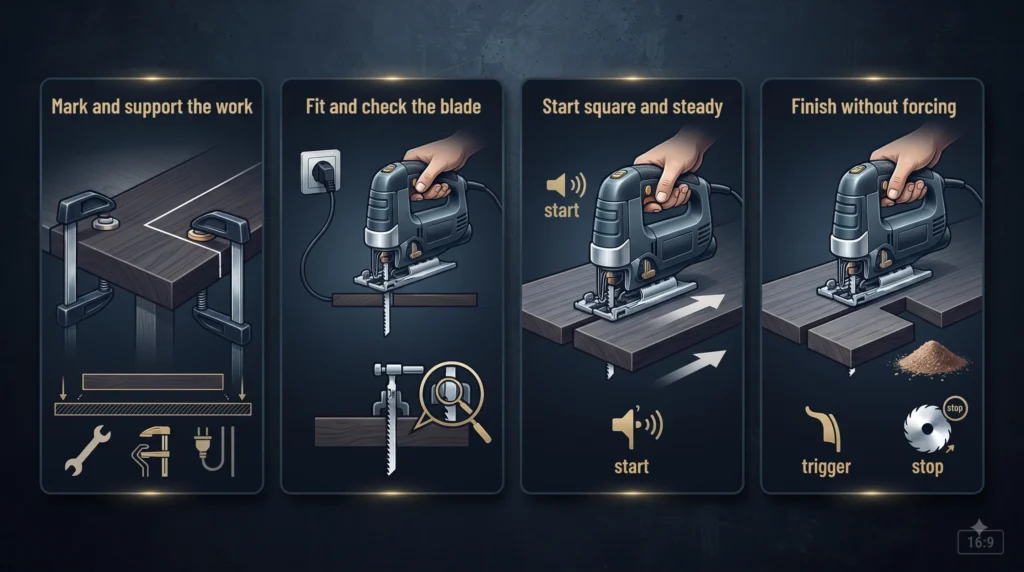
Mark and support the work
Draw a clear cut line. Clamp the board so it cannot shift, and make sure the blade will not strike the bench, clamp, wiring, or anything below.
Fit and check the blade
With power disconnected, install the correct blade according to your tool manual. Confirm it locks firmly and does not touch the workpiece before starting.
Start square and steady
Rest the front of the shoe flat on the work, keep the blade clear, then start the motor. Let it reach speed before gently moving into the cut line.
Finish without forcing
Keep the shoe against the work and follow the line with gentle pressure. Release the trigger after the blade clears the cut, then wait for it to stop before setting the tool down.
How to keep cuts straighter and curves smoother
Blade wandering usually comes from pushing too quickly, turning too sharply, using a dull blade, or choosing a blade that is too narrow for the material thickness. For the cleanest result, slow down and let the blade steer itself along the line.
Use a guide for straight cuts; make relief cuts for tight curves
Clamp a straightedge when accuracy matters on a straight line. For a tight curve, make a series of short relief cuts from the waste side toward the line. These give the offcut somewhere to go and reduce the urge to twist the blade.
- Do not twist or side-load the blade to force a turn.
- For inside cutouts, drill a starter hole large enough for the blade first.
- Keep orbital action low for tight curves and cleaner finished faces.
Jigsaw safety: the habits that prevent most mistakes
A jigsaw is often approachable for beginners, but it is not risk-free. Prioritize secure workholding and clear hand placement. Never reach beneath the workpiece while cutting, and never assume the area below a cut is empty.
Wear appropriate PPE
Wear safety glasses as a minimum. Add hearing protection for extended work and a suitable dust mask or respirator when cutting materials that create fine dust. Avoid loose sleeves, jewelry, and gloves that can reduce grip or snag.
Jigsaw vs circular saw: which should you use?
A jigsaw and circular saw overlap on some jobs, but they excel at different ones. Pick the tool based on the cut you need, not simply the material you are cutting.
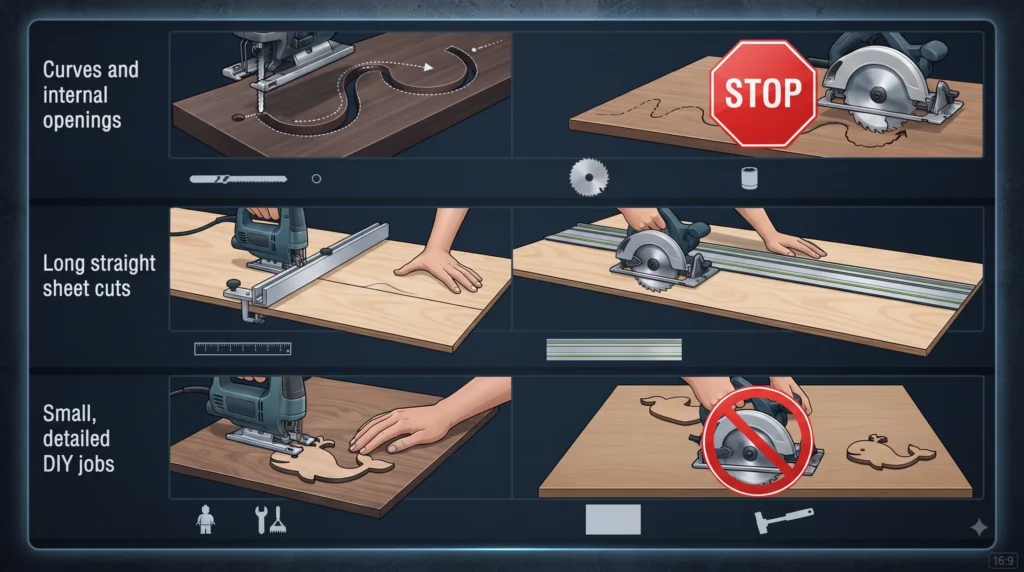
| Task | Jigsaw | Circular saw |
|---|---|---|
| Curves and internal openings | Best choice. Narrow blade can turn and start from a drilled hole. | Poor fit. The round blade cannot make tight curves or internal cutouts. |
| Long straight sheet cuts | Possible with a guide, but slower and more prone to blade drift. | Usually better, especially with a guide rail or straightedge. |
| Small, detailed DIY jobs | Very versatile and often the more approachable first saw. | Useful for breaking down boards, but less suited to detail work. |
Jigsaw FAQs
Can a jigsaw cut straight lines?
Yes. For short straight cuts, follow a clear pencil line at a controlled pace. For a longer or more precise cut, clamp a straightedge as a guide and use a blade suited to the board thickness. Do not force the saw sideways to get back on line; stop, back out safely, and restart if needed.
What is orbital action on a jigsaw?
Orbital action adds a slight forward movement to the blade as it travels up and down. It can speed up rough cuts in wood, but it may leave a rougher edge and is not generally used for metal, laminate, or tight curves. Follow your manufacturer’s instructions for the setting on your model.
Why is my jigsaw cut splintering?
Splintering is commonly caused by a coarse or dull blade, excessive orbital action, feeding too fast, or cutting delicate veneered material without support. Try a fine-tooth clean-cut blade, slow the feed, use a splinter guard if your model supports one, and apply painter’s tape along the cut line.