
A practical guide to choosing the best laser level for cabinets, tile, framing, electrical layouts, ceilings, and outdoor alignment—focused on accuracy, visibility, mounting, battery systems, and honest specification checks.
For most professional interior work, a green-beam 360-degree laser with a reliable magnetic bracket, pendulum lock, replaceable battery system, and detector mode is the strongest all-round format. For exterior grading and long-distance work, choose a detector-compatible rotary laser instead. Do not buy on beam color or maximum range alone.
Best laser level categories for real trade work
There is no one laser level that is best for every trade. The strongest purchase is the format that matches your working distance, layout requirements, mounting points, and service expectations. Confirm the exact model number, included accessories, warranty terms, and regional kit contents before ordering.
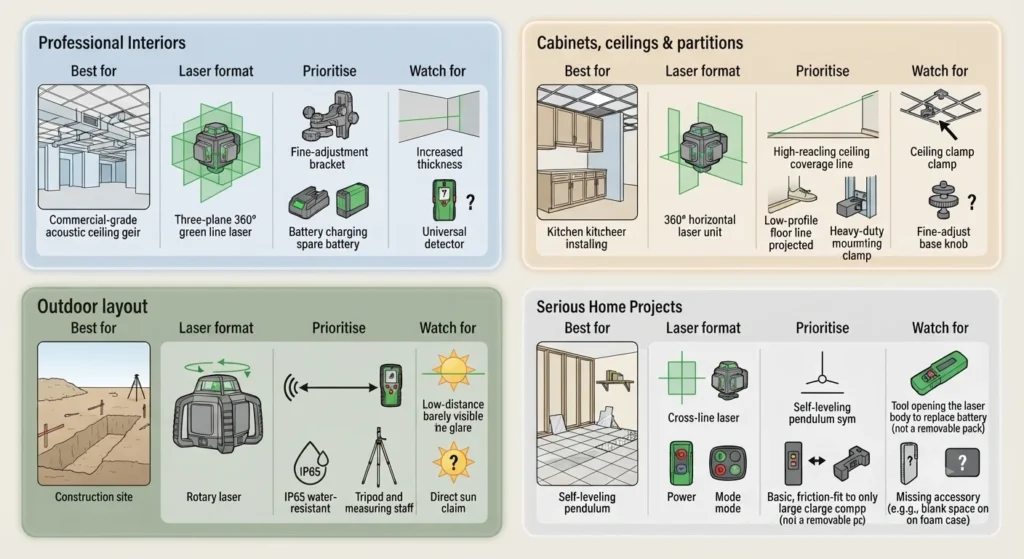
| Best for | Laser format | Prioritise | Watch for |
|---|---|---|---|
| Professional interiors | Three-plane 360° green line laser | Fine adjustment, bracket quality, battery availability | Line thickness at distance and detector compatibility |
| Cabinets, ceilings & partitions | 360° horizontal + vertical planes | Low floor line, ceiling coverage, magnetic mount | Whether a ceiling clamp or fine-adjust base is included |
| Outdoor layout | Rotary laser with receiver | Receiver range, IP rating, tripod and staff | Visible beam claims in direct sun |
| Serious home projects | Cross-line or compact 360° laser | Self-leveling, easy controls, basic mount | Built-in battery replacement and accessory gaps |
Three-plane 360° green line laser
The most useful category for installers who need level, plumb, and transfer lines around a room. Look for a protected pendulum, detector mode, robust bracket, and an easy route to a spare battery. The limitation: high claimed visible range does not replace a receiver outside.
Interior 360° layout laser
For cabinet runs, suspended ceilings, tile, partitions, and electrical fit-out, floor and ceiling coverage are often more valuable than extreme range. Check the lowest horizontal line height, thread sizes, bracket articulation, and whether the kit includes a target plate or clamp.
Rotary laser with receiver
For site levels, drainage, excavation, and long runs, a rotating laser and receiver are the practical answer. Receiver-assisted range matters more than the beam’s apparent brightness. Confirm the stated accuracy, slope capability, IP protection, service support, and calibration process.
Compact cross-line laser
A dependable self-leveling cross-line laser is enough for pictures, shelving, backsplash tile, basic framing, and small renovation layouts. Choose one with a pendulum lock and a usable mount before paying extra for multiple planes you will not use.
How Mister Worker evaluates laser-level claims
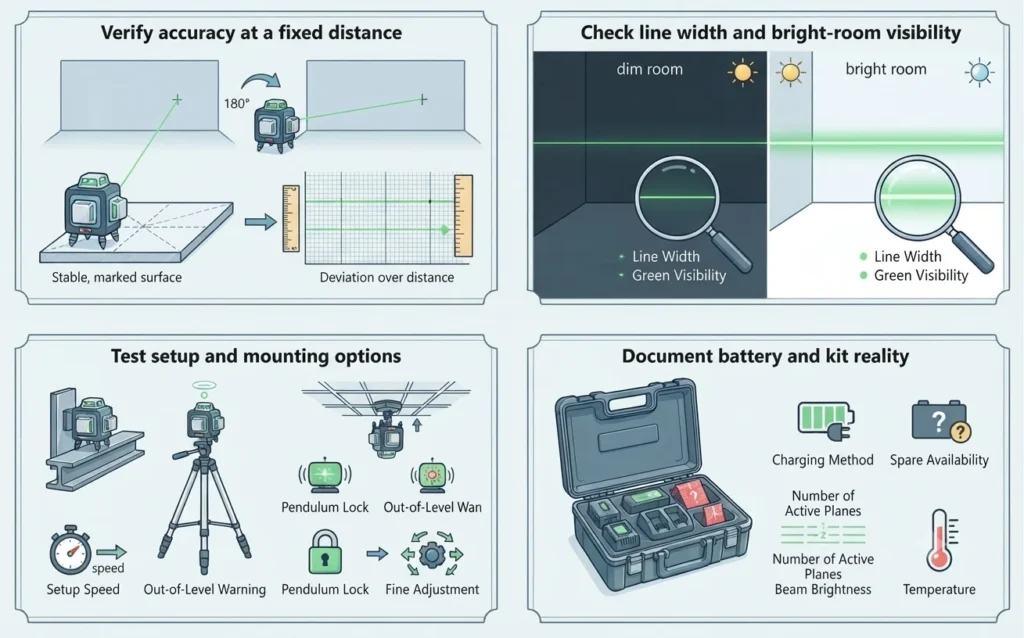
A credible laser-level review must distinguish between a hands-on observation, a manufacturer specification, and an unverified marketing claim. When a unit is physically assessed, the useful checks are repeatable: fixed-distance accuracy, line clarity, setup speed, mount stability, controls, case quality, battery handling, and detector operation. Results should always identify the exact model and kit tested.
Verify accuracy at a fixed distance
Mark a horizontal reference, rotate the laser, and compare the returned line at the same distance. Repeat on a stable surface. Accuracy should be discussed as deviation over distance—not as a vague claim that a line “looks straight.”
Check line width and bright-room visibility
Assess the beam in a dim room, a room with daylight near windows, and bright ambient conditions. Green often appears brighter to the eye, but visibility also changes with optics, surface color, distance, and ambient light.
Test setup and mounting options
Use the supplied bracket on steel, a tripod thread, and a practical wall or ceiling position. A strong laser with a weak bracket can slow down layout work. Note self-leveling speed, out-of-level warning, pendulum lock, and fine adjustment.
Document battery and kit reality
Record the battery type, charging method, spare-battery availability, and what is actually supplied in the tested kit. Runtime depends heavily on the number of active planes, beam brightness, temperature, and battery condition.
Choose the laser layout before choosing the brand
The right format removes work; the wrong one creates workarounds. Start with the lines or reference points your trade needs, then compare accuracy, mounting, protection, and support within that category.
Document battery and kit reality
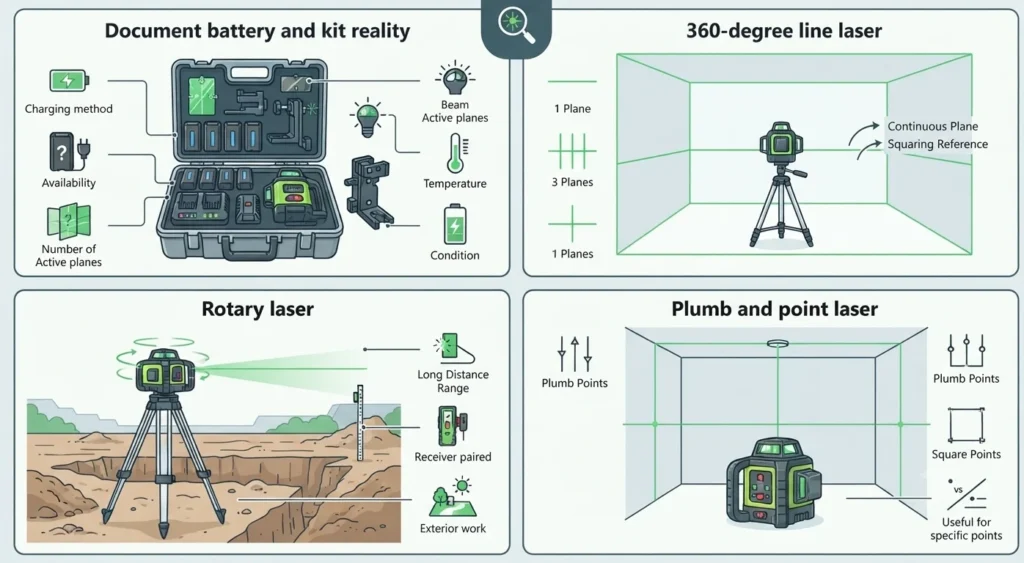
Record the battery type, charging method, spare-battery availability, and what is actually supplied in the tested kit. Runtime depends heavily on the number of active planes, beam brightness, temperature, and battery condition.
360-degree line laser
Projects a continuous plane around the room. One horizontal plane speeds up cabinet and ceiling layout; three-plane models add vertical references for squaring walls, partitions, and fixtures.
Rotary laser
A rotating head creates a level reference over longer distances and is usually paired with a receiver. It is the workhorse format for exterior work and site layout, rather than close-range interior detailing.
Plumb and point laser
Projects points rather than broad lines. It is useful for transferring a point from floor to ceiling or setting square references, but it is not a replacement for a line laser when installing a long run of cabinets or tile.
What matters when buying the best laser level
Compare the stated accuracy in a like-for-like format, then inspect the practical details that affect every working day: self-leveling range, line thickness, detector mode, IP rating, pendulum protection, mounting threads, bracket design, battery availability, case quality, and local repair support.
Accessories that are worth paying for
For interior fitting, prioritise a magnetic fine-adjust bracket, a stable base, a target plate, and a compatible tripod thread. For site work, add a receiver, staff clamp, sturdy tripod, and a protective case. A ceiling clamp can be valuable for suspended-ceiling work, but check compatibility before buying.
Green versus red: visibility is not the whole decision
Green beams are commonly easier to see indoors, especially in brighter rooms, but they can cost more and may use more power. Red lasers can still be the sensible option for controlled indoor work. Outdoors, a detector-compatible system is more important than expecting any visible beam to overcome direct sunlight.
How to check whether a laser level is calibrated
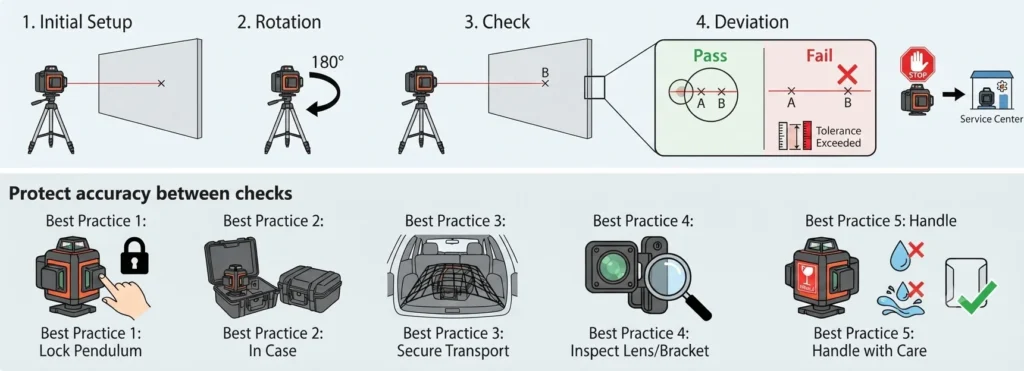
Use the manufacturer’s calibration-check procedure before relying on a laser after a heavy impact, long transport, or unexplained layout mismatch. A basic field check compares marks after rotating the instrument on the same stable setup. If the deviation exceeds the manual’s tolerance, stop using it for precision work and arrange authorised calibration or service.
Protect accuracy between checks
Lock the pendulum before transport, keep the unit in its case, avoid leaving it loose in a vehicle, and inspect the lens and bracket before setup. A good IP rating helps with dust and water, but it does not make any precision instrument immune to drops or poor handling.
Laser level questions, answered
What is the best laser level for professional use?
For many interior professionals, a detector-compatible three-plane 360-degree laser is the most flexible category. It can provide horizontal, vertical, floor, and ceiling references. The best individual choice depends on confirmed accuracy, bracket design, battery platform, durability, local service, and the specific kit contents.
Is a 360-degree laser level worth buying?
It is worth it when you regularly need a level line around a room, such as for cabinet runs, partitions, suspended ceilings, tile, or multi-wall layouts. For occasional shelving and picture hanging, a standard cross-line laser can be more economical and easier to carry.
Do I need a laser detector?
Use a detector when the beam is difficult to see at distance or in bright ambient light, especially outdoors. The detector reads the laser plane even when your eyes cannot clearly see the line. Confirm that the laser has a compatible pulse or receiver mode before purchasing one.
How accurate should a laser level be?
For professional layout, compare manufacturer accuracy stated as a deviation over a stated distance and check it against the tolerance your task allows. Fine finish work benefits from tighter accuracy and a narrow, clean line. Always verify the tool after impacts and follow the maker’s calibration procedure.