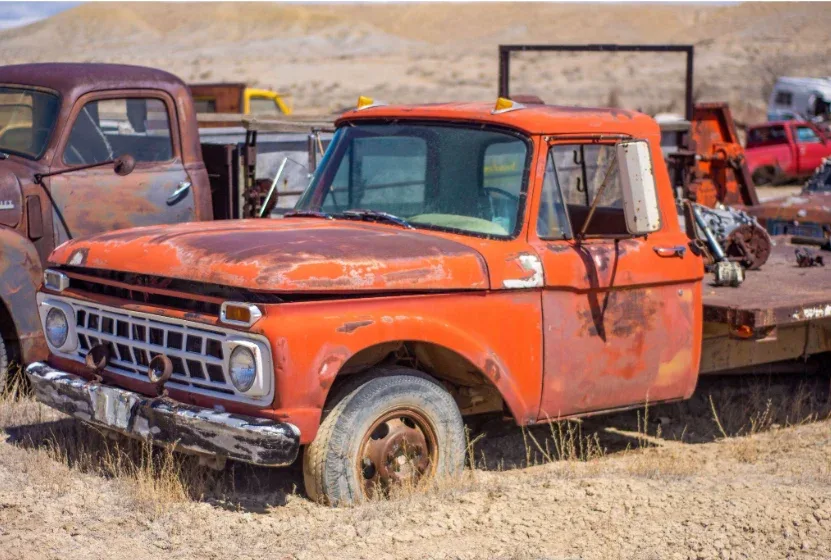

The rust you can see is almost never where the rust started. By the time a bubble appears on a rail or a stain runs down a crossmember, the thing you are looking at has been going on inside that steel for two or three winters.
This matters more on working equipment than on a car. A commuter sits in a driveway most of its life. A work truck, a utility trailer, a tandem axle deck or a piece of farm kit spends its winter in brine, its summer around fertiliser and chemicals, and most of its life outdoors. It also has ten times the number of joints, brackets, box sections and bolted plates for water to hide in.
So here is where corrosion actually begins on that kind of equipment, in the order it tends to show up, and an honest split between what is worth doing in your own shop and what is not.
The scale of what you are up against
Canada alone spreads about five million tonnes of road salt every year to keep roads open. That is the electrolyte your frame is driving through for four or five months, and it does not stop working when the road dries, because most modern de-icing brines stay damp far longer than rock salt does.
AAA put numbers on the damage side. Their research on de-icers and rust found that 15 per cent of drivers in winter climate regions had needed rust related repairs at least once over five years, at an average of $490 a repair, adding up to an estimated $15.4 billion over that period, or more than $3 billion a year. The systems they flagged as most vulnerable were brakes, fuel tanks and exhausts.
On a passenger car those three are an expensive nuisance. On a trailer with air lines, ABS wiring and a braked axle group, the same corrosion is an out of service defect and a failed inspection.
Where rust starts, precisely
1. Inside the box sections, working outward. Frame rails, crossmembers and stake pockets are hollow. They have drain holes, and those drain holes pack solid with mud, chaff and road grit within a season or two. Once a section cannot drain, it holds a small permanent puddle, and the rust works from the inside where no coating ever reached. This is why a rail can look perfect and still be thin.
2. The toe of the weld. Welding changes the metal either side of the bead and usually burns off whatever coating was there. On a trailer that has been repaired or had a bracket added, the line right beside the weld is often the first place bare steel appears.
3. Crevices where two surfaces meet. Where a deck board meets a crossmember, where a bolted plate sits against a rail, under a suspension hanger. Water gets in by capillary action and then cannot evaporate, so the joint stays wet for days after the surface is dry. Crevices beat open surfaces every time.
4. Wherever two different metals are bolted together. Aluminium bodies on steel frames, aluminium brackets on steel crossmembers, stainless fasteners through aluminium sheet. In simple terms, A small aluminium bracket bolted to a big steel frame is in far more trouble than the frame is.
5. Anywhere the coating got broken. Stone chips across the front of a trailer, chain rub on the rails, forklift scars in a deck, ramp hinges, tie down points, the spot where somebody dragged a pallet. Bare metal on working equipment does not weather gently. It starts within weeks.
6. Electrical grounds and light housings. A corroded ground is the single most common cause of the lighting faults that get a trailer pulled over. The connection does not have to fail completely to cause trouble, it only has to add resistance.
7. Brake and air lines where they clip to the frame. The clip holds the line against the rail, grit packs in behind it, and the line corrodes where you cannot see it. Anything that clamps a line tight to a frame is a place to look.
What actually works to stop rust in its tracks
Wash the underside, and know where the water goes. Rinsing brine off is the highest value thing you can do all winter. Just be aware that a pressure washer aimed into a box section drives water into exactly the cavities you want dry, and it strips away cavity wax while it is at it. Lower pressure, more volume, and let it drain.
Clear the drain holes, every season. It takes twenty minutes with a piece of welding wire and it does more for a frame than most of the products sold for the purpose.
Deal with damage while it is small. Bare steel on a frame is not cosmetic. Clean it, treat it, coat it, and do it before winter rather than after.
Isolate dissimilar metal joints. Isolation washers, proper bedding compound, dielectric grease on fasteners. It is boring work and it is the difference between a bracket lasting a decade and a bracket lasting three years.
For exposed metal and painted panels that have to keep looking presentable, a clear barrier coating is the option worth understanding, because it seals the surface without hiding it. That matters on equipment where a thick opaque undercoat would just trap moisture against the metal and disguise what is happening underneath.
What does not work, however often it gets done
- Painting over rust. You are sealing moisture in with the metal and buying yourself one good looking season.
- Spraying undercoat over a dirty underside. Same problem, larger scale, and now you cannot inspect what is going on under it.
- One heroic wash in April. Corrosion does not wait for spring. The damage is done during the months the salt is on the road, not after.
- Assuming galvanised means immune. Galvanising is sacrificial, which means it is being consumed on your behalf. Once it has been consumed at the point of a scratch or a drilled hole, the steel underneath is on its own.
DIY may sound like a good idea, but here’s why it isn’t
Cleaning, draining, treating surface rust, coating, isolating fasteners and replacing corroded light housings and grounds are all reasonable shop floor jobs for anyone comfortable with tools.
What is not: pitted or perforated frame rails, cracked welds, corroded suspension hangers, anything on a fifth wheel plate or a king pin area, and anything that makes you wonder whether the section is still the thickness it started at.
Those are structural, and a wire brush and a rattle can do nothing but disguise them. Frame and crossmember work is welding, measuring and alignment, and it needs equipment and a straight reference to work from.
The part that pays for itself
Corrosion work is easy to defer because nothing stops working on the day you skip it. The cost shows up two ways instead. It shows up at inspection, where a corroded air line or a soft crossmember takes a unit off the road at the worst possible time. And it shows up at disposal, where a clean frame and a presentable body are the difference between a trade in figure and a scrap figure on the same age of equipment.